Use comparison to examine likenesses and differences, choose a reference, or express an evaluation.
A shared basis makes a relationship visible
A shared basis makes a relationship visible
Consider two pencils together.
comparison
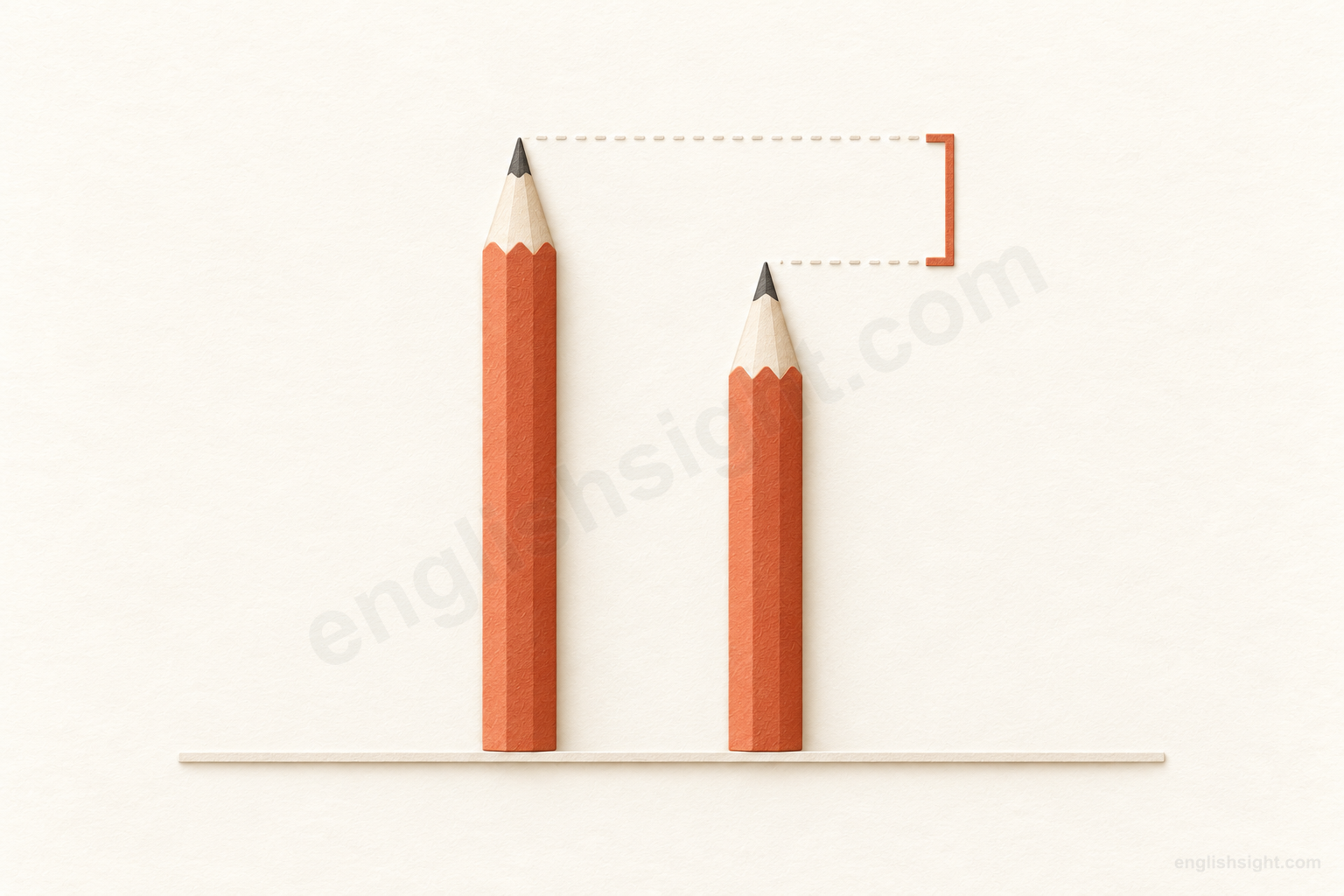
The pencils share a width but differ in length.
Use their aligned bottom ends to compare length.
The same baseline makes length easier to compare; the pencils themselves stay unchanged.
Consider two or more things together on a chosen basis to notice how they are alike or different.
The pencils illustrate a shared feature and a difference: both have the same width, but one is longer. A comparison need not involve physical objects, produce a winner, or change the things themselves.
Comparison brings two or more things into the same judgment. You choose a feature—such as length, cost, or quality—and consider how the things relate on that basis.
The noun can name the process, a particular assessment, or a stated likeness. Expressions such as by comparison and there’s no comparison add their own functions; they are not interchangeable translations of one idea.
01
Examine things together
Name the activity, the things involved, and the reason for looking at them together. A comparison can reveal either likeness or difference.
01
make a comparison; comparison + singular verb; a comparison / comparisons
make a comparison
examine things in relation to one another
Things / reference
Two phone plans offer different prices and data limits.
Relationship / judgment
You assess their features together.
Comparison names the activity or one particular act of comparing.
Use comparison without an article for the general activity: Comparison takes time. For one particular assessment, use a comparison; several assessments are comparisons. Make a comparison is a natural verb–noun combination.
The choice of feature matters. Two plans may cost the same but offer different amounts of data. The noun does not itself say that the things are equal or that one is better.
In a sentence
We made a comparison of the two phone plans before choosing one.
Watch the difference Comparison is a noun. Say We compared the plans or We made a comparison, not We comparison the plans.
02
a comparison between A and B; a comparison of A and B; a comparison of A with B; comparison with B
a comparison between A and B
identify the things being compared
Things / reference
A report contains this year’s costs and last year’s costs.
Relationship / judgment
The reader knows which figures are being related.
Between links the participants; of can name the material examined.
A comparison between this year and last year puts both periods in view. A comparison of the two years names the pair as the material examined. A comparison of this year’s costs with last year’s costs names each side separately.
Comparison with last year’s figures can name just the reference when the current figures are already clear. These patterns can report likenesses and differences. Keep the items parallel: compare costs with costs, rather than accidentally comparing costs with a whole company.
In a sentence
The report includes a comparison between this year’s travel costs and last year’s.
Watch the difference Use between A and B, not between A with B. The preposition belongs to the chosen pattern.
03
draw a comparison between A and B; a comparison of A to B; invite comparison with B
draw a comparison
point out a particular likeness
Things / reference
You want to explain how a team depends on coordination.
Relationship / judgment
You relate it to musicians playing together.
An analogy selects a resemblance without making the two things identical.
Draw a comparison can introduce a likeness that helps explain an idea. Here the team and the orchestra both need people to coordinate. It does not follow that everything about a team resembles music.
A comparison of a team to an orchestra also presents an analogy. With can introduce a likeness too; do not treat to and with as an absolute similarity-versus-difference rule. Something invites comparison when it makes people likely to notice a resemblance.
In a sentence
Maya drew a comparison between our project team and an orchestra.
Watch the difference Draw is figurative here: you can draw a comparison in speech without drawing a picture.
04
a fair / unfair / direct / detailed comparison; a favorable / unfavorable comparison
a fair comparison
use a suitable basis for judging things together
Things / reference
One repair quote includes parts; the other does not.
Relationship / judgment
You adjust the figures before judging the prices.
Fair describes the basis of the assessment, not its result.
A fair or valid comparison uses information that fits the question. A direct comparison examines the things against one another without an indirect substitute. A detailed comparison looks at several relevant features.
A favorable comparison makes something look good; an unfavorable one makes it look worse. Those words describe the outcome. A favorable result is not proof that the comparison was fair.
In a sentence
We need both quotes to include parts before we can make a fair comparison.
Watch the difference A fair comparison can still show a large difference. Fair does not mean equal.
05
include / show / keep something for comparison; a basis for comparison
for comparison
provide something so that a comparison can be made
Things / reference
A new design is ready.
Relationship / judgment
The old design is included as a reference.
For introduces the purpose of supplying the extra material.
For comparison explains why you show or keep another item. The reader can look at both versions. For comparison purposes is a longer version with the same basic function.
A basis for comparison is the information or shared feature that makes an assessment possible. Without dates or units, two numbers may be a poor basis for judging a change.
In a sentence
I have attached the old design for comparison.
Watch the difference For comparison gives a purpose. It does not itself claim that one design is better.
02
Judge against a reference
A room can feel large or small depending on the room you compare it with. These expressions make that reference explicit or retrieve it from context.
06
in comparison with / to + noun phrase; by comparison with + noun phrase
in comparison with / to
describe something relative to a named reference
Things / reference
The old office had very little floor space.
Relationship / judgment
The new office feels spacious against that reference.
The phrase supplies the standard behind a relative description.
In comparison with the old office tells us what makes spacious a useful judgment. In comparison to is also standard. By comparison with can serve the same purpose.
You can say The new office is small in comparison with the warehouse without contradicting the example. The reference changes; the office itself need not change size. The phrase can support a favorable or unfavorable judgment.
In a sentence
Our new office is spacious in comparison with the old one.
Watch the difference Say in comparison with or in comparison to, not in comparison than. Use than after a comparative such as larger than.
07
By comparison, + clause; adjective + by / in comparison
by comparison
use a reference already established in the conversation
Things / reference
You have just described a difficult climb.
Relationship / judgment
A second walk seems easy against it.
The reference can remain unstated when the reader already knows it.
By comparison can start a sentence or follow its description. It tells the reader to judge this item against the one already mentioned. In comparison can also leave the reference understood.
The second walk might still be demanding in ordinary terms. Easy by comparison is a relative judgment, not a promise of no effort. Add with the first climb if the reference would otherwise be unclear.
In a sentence
Yesterday’s climb took eight hours. Today’s walk felt easy by comparison.
Watch the difference Do not omit the reference unless the listener can recover it from context.
03
Express a strong judgment
These established expressions evaluate similarity, quality, or importance. Learn the full wording: the noun alone does not supply the whole judgment.
08
there is / there’s no comparison (between A and B)
there’s no comparison
emphasize a very large difference
Things / reference
You have heard a poor recording and a much clearer one.
Relationship / judgment
You strongly prefer the clearer recording.
The fixed expression often rejects any suggestion of equal quality.
When a listener asks which recording sounds better, There’s no comparison can be an emphatic answer: one is far better. Say which one you prefer if the context does not make that clear.
The phrase can also emphasize a difference in size, price, or kind rather than praise. Read the surrounding statement. It usually expresses a judgment, not a claim that no one has performed an assessment.
In a sentence
There’s no comparison: the new recording is much clearer.
Watch the difference Do not automatically interpret this as We have no comparison data. That would be a different, literal statement.
09
A stands / bears comparison with B; A can stand / bear comparison with B
stand / bear comparison with
be good enough to be judged alongside something else
Things / reference
A small restaurant is being measured against respected rivals.
Relationship / judgment
You judge its food to be of a similar standard.
In this evaluative use, the subject holds up against a strong reference.
The restaurant stands comparison with its rivals is fairly formal praise. Bears comparison with can express the same assessment: it is of a comparable standard, even if it is not identical or clearly superior.
With can introduce a person, a work, or a product as the reference. This is a fixed evaluative expression; stand does not describe someone’s posture, and bear does not mean physically carrying an object. In a discussion of similarities, stand or bear comparison can also mean that things are sufficiently alike in kind or scale to be compared, without praising either one.
In a sentence
This small restaurant can stand comparison with the best in town.
Watch the difference The phrase can praise a comparable standard without saying that A wins.
10
A bears no comparison with B; A does not bear comparison with B
bear no comparison with
be too different, or too far below a standard, for a close comparison
Things / reference
A temporary shelter is being set against a comfortable home.
Relationship / judgment
You reject the idea that the two offer similar conditions.
The negative expression denies a meaningful likeness or comparable standard.
Bear no comparison with can emphasize that two things are very unlike. In a review, it can also mean that one falls far short of the other. Context tells us whether the issue is difference of kind or inferior quality.
In The two buildings bear no comparison, the plural subject already names both things, so a with phrase is unnecessary. Do not force a quality ranking when the speaker is simply rejecting a likeness.
In a sentence
The temporary shelter bears no comparison with a proper home.
Watch the difference Positive bear comparison can praise comparable quality; the negative form can reject similarity as well as express inferiority.
11
A pales in / by comparison (with / to B)
pale in comparison
seem much less important or impressive beside a reference
Things / reference
You are worried about a delayed parcel.
Relationship / judgment
A friend’s serious loss puts that worry in perspective.
The assessment loses weight relative to something more significant.
Pale in comparison with or to introduces the situation that overshadows the subject. The subject may still matter; the expression says that it seems much less significant against this reference.
Pale by comparison is another form, and the reference can be understood from context. Pale contributes the idea of reduced impact. The idiom need not describe an actual change of color.
In a sentence
My worry about the parcel pales in comparison with what she is facing.
Watch the difference The subject is the less significant thing, not the one that overshadows it.
12
be beyond comparison; a quality beyond comparison
beyond comparison
praise something as having no equal
Things / reference
A reviewer wants to give unusually strong praise.
Relationship / judgment
The object is presented as unmatched.
Beyond comparison can express admiration rather than a lack of data.
Calling a performance beyond comparison presents it as exceptionally good, with no equal. This is emphatic, elevated wording; in an ordinary conversation, much better or exceptionally good may suit the tone more naturally.
Unlike in comparison with, beyond comparison does not introduce a normal reference for a relative judgment. The expression makes a strong claim about excellence rather than reporting the steps of a test.
In a sentence
For me, the beauty of that evening sky was beyond comparison.
Watch the difference This praise is a speaker’s evaluation, not objective proof that every possible rival was tested.
04
Shopping and language study
Comparison also appears in practical compounds and as a grammar term. Each keeps the idea of relating alternatives, but has its own use.
13
do some comparison shopping; a (price-)comparison site / website; a comparison chart
comparison shopping
check offers from different sellers before buying
Things / reference
You want the same camera at a good price.
Relationship / judgment
You check several sellers’ offers first.
Comparison modifies shopping by naming the way you shop.
Do some comparison shopping describes the activity of checking prices across shops or websites. You can compare the same camera at several sellers, rather than merely looking at unrelated things in one shop.
A price-comparison site or comparison website puts offers together so you can examine them. A comparison chart presents alternatives in a convenient form. Check what each offer includes: a low displayed price alone may not settle your choice.
In a sentence
I did some comparison shopping before ordering the camera.
Watch the difference Comparison shopping names an activity; say some comparison shopping, not a comparison shopping. A comparison site is a countable website.
14
degrees of comparison: positive / comparative / superlative
degrees of comparison
recognize a grammar term for levels expressed by adjectives and adverbs
Things / reference
You study how tall changes when comparing heights.
Relationship / judgment
You recognize tall, taller, and tallest as a related set.
Here comparison is a grammar term, not a shopping or review phrase.
A grammar book may call tall, taller, tallest the positive, comparative, and superlative degrees of comparison. These forms express a quality without an explicit comparison, relative to another, or at the highest or lowest degree within a set.
Other words use more and most, as in more carefully and most carefully; less carefully and least carefully express lower degrees. This entry explains the term only; it is not a full lesson on choosing adjective and adverb forms.
In a sentence
The chart shows the degrees of comparison: tall, taller, tallest.
Watch the difference Comparison is the noun; comparative names a particular form. The two words are related but not interchangeable.
Choose the basis and the whole expression
Similarity and difference both belong here
Comparison can show what matches and what differs. Contrast focuses on differences. A comparison is not automatically a claim that two things are the same, nor does it always decide which is better.
Noun forms and grammar
Comparison is a noun, pronounced /kəmˈpærɪsən/; the plural is comparisons. Use compare as the verb. Verb tense, passive voice, and causative patterns belong to the surrounding verb, not to comparison itself. In a comparison site, the noun modifies another noun.
References and limits
Ask which things, which feature, and which reference are intended. A useful comparison can be narrow: two services may match in price while differing in quality. A vivid analogy is an explanation, not evidence that every feature is shared.
Choose the intended relationship
Read the situation and decide what the complete expression contributes.
1. You completed one particular assessment of two offers. Which sentence is grammatical?
2. Your new bag is still heavy, but your old bag was much heavier. Which statement can express that relative judgment?
3. A review says a local café can stand comparison with famous cafés. What does it mean?
4. The cost of a taxi pales in comparison with the cost of the flight. Which cost is presented as less significant?
5. “Which recording is clearer?” “There’s no comparison—the new one.” What is the speaker doing?
Sources and teaching notes
The linked dictionary entries support the senses and constructions. Explanations and examples are original teaching material. The diagram is a teaching model of a comparison, not a dictionary definition.
The diagram illustrates one way to understand the relation; it does not claim that every native speaker sees the same picture.