Connect a whole with all its parts, a task with its endpoint, and a description with its full degree.
From a missing part to a complete whole
Nothing required is missing
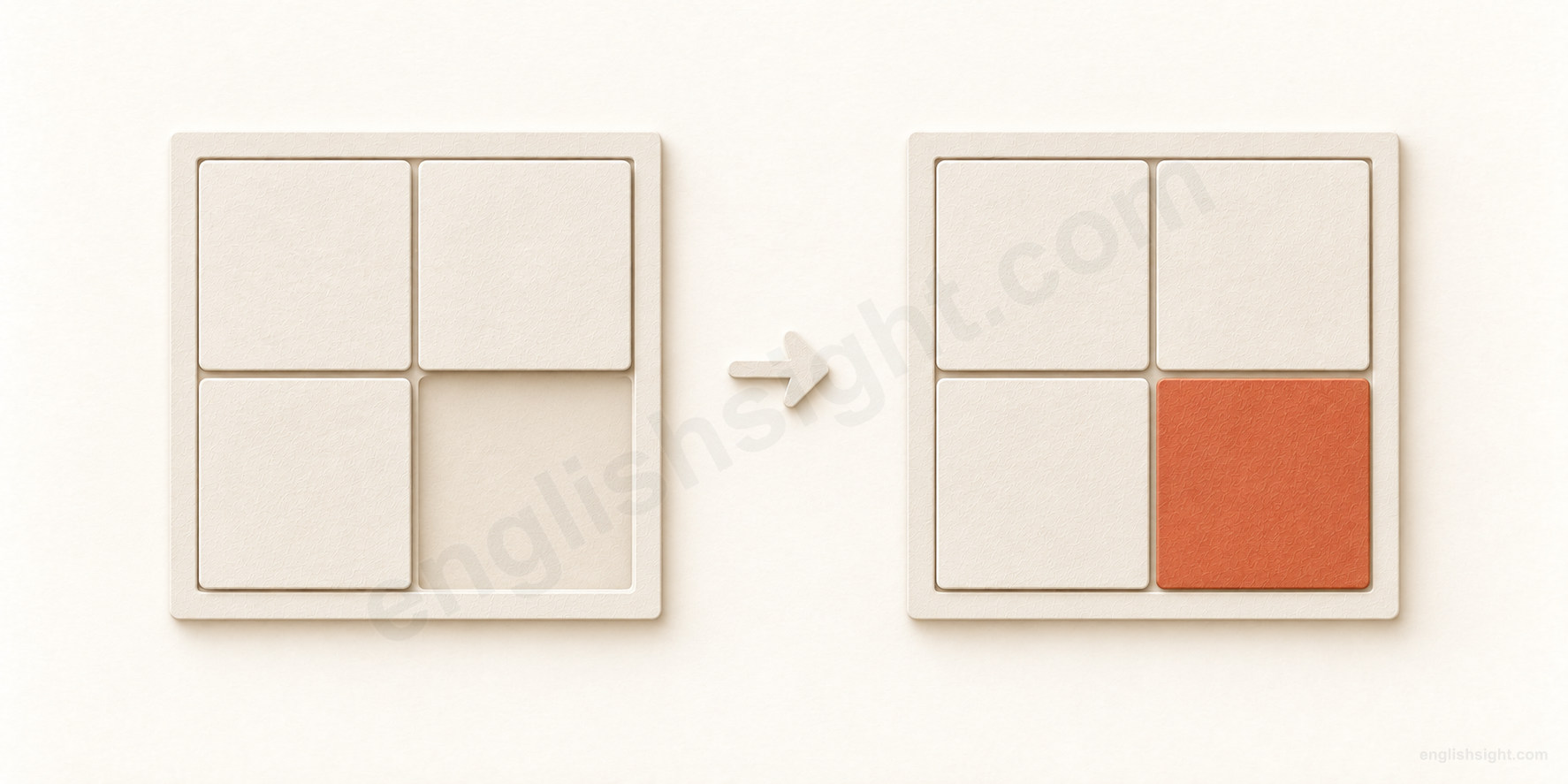
One of the panel's four required tiles is missing.
complete
All four required tiles are now present.
Add the last required tile.
The last required tile completes this whole. Being complete does not guarantee perfection.
A complete whole has everything required; to complete it is to supply what is missing or finish what remains to be done.
The picture models a defined whole. It does not prove that something is flawless, and emphatic noun combinations need their own explanations.
A collection can be complete, and you can complete a task. Start by asking what the whole requires. In emphatic expressions such as a complete surprise, the connection is to full degree rather than literal pieces.
The adjective and verb share the pronunciation /kəmˈpliːt/. The diagram is a teaching model for wholeness and completion, not a claim about a picture shared by every English speaker.
01
All the parts, or all the work
First decide what counts as the whole: a collection, an account, a period, or a finished task. The same object can be complete in one respect and incomplete in another.
01
a complete + set / collection; a set + be + complete
a complete set
a set with none of its required members missing
Situation / requirement
A box should contain twelve colored pencils.
Meaning / result
You check that every one of the twelve is there.
Complete compares what is present with what belongs in this set.
When you check a set, ask which members it is supposed to contain. A complete set of twelve pencils has all twelve; a larger collection with many duplicates might still be missing one required color.
The same adjective works after a linking verb: The set is complete. It describes the present state; it does not tell you who collected the pencils or when they arrived.
In a sentence
The box contains a complete set of twelve colored pencils.
Watch the difference Complete does not simply mean large. A small set can be complete, and a large collection can be incomplete.
02
a complete + list / account / guide; the complete works of + author
a complete list / account
information covering everything relevant to the stated scope
Situation / requirement
You need to know everyone who is coming to dinner.
Meaning / result
The list includes every expected guest.
The required parts can be facts, names, or topics rather than physical pieces.
In a complete list of guests, the scope is guests for this event. It is not a list of everyone in the world. A complete account or picture of a situation similarly promises that relevant information has not been left out.
A complete guide covers its stated subject; the complete works of an author is an established publishing expression for the author’s works collected together. Neither phrase promises that every claim in the book is correct.
Compare the whole list: that means every part of the particular list you already have. You can read the whole list and still discover that the list itself is not complete.
In a sentence
Please send me a complete list of the guests coming on Saturday.
Watch the difference Being complete concerns coverage; being accurate concerns correctness. Check both when information matters.
03
a / one complete + unit of time, text, or activity
a complete day / cycle
the whole of a unit from beginning to end
Situation / requirement
The machine begins one washing cycle.
Meaning / result
It runs through the entire cycle.
Here the whole is an amount or a stretch with a beginning and an end.
A complete day, book, cycle, or circuit is considered as one entire unit. In a payment rule, a complete day contrasts with part of a working day; its exact length depends on that rule.
In the example, one complete cycle includes all its stages. It does not mean that the machine has finished every cycle it will ever run. Complete can describe one bounded unit within a longer activity.
In language learning, complete sentences contrasts with isolated words or sentence fragments. Please answer in complete sentences asks for whole sentences, rather than a list of single words. This is an everyday application of having the necessary parts; it is not a new technical sense of complete.
In a sentence
Let the machine run through one complete cycle before you test it again.
Watch the difference A complete day does not automatically mean a 24-hour work shift. Identify the unit intended in the situation.
04
work / a process + be + (almost / nearly) complete
The work is complete.
the work has reached its finished state
Situation / requirement
One final repair is still needed.
Meaning / result
All the planned repair work has been done.
Complete after be can describe the result of finishing.
The repairs are complete reports their current status. Compare We completed the repairs, which names the people who did the work and presents their action.
Almost complete and nearly complete place the work close to the endpoint. A progress report can also say 80 percent complete. These expressions do not claim that the endpoint has already been reached.
Before a noun, a completed report clearly says the writing task has been finished. A complete report often stresses that all required information is included. The two descriptions can both be true, but they draw attention to different things.
In a sentence
The repairs are nearly complete; only the window latch still needs attention.
Watch the difference Do not treat nearly complete as already finished. The small amount left may still matter.
05
not / no … complete without + noun / -ing; make + object + complete
not complete without…
missing something treated as an essential part of the experience
Situation / requirement
A family picnic has food and a place to sit.
Meaning / result
The speaker adds the music that makes it feel right to them.
What counts as necessary can be a personal or cultural judgment.
No picnic is complete without music says that the speaker regards music as part of a satisfying picnic. It is an expressive judgment, not a literal rule defining every picnic.
Would not be complete without imagines the experience without that feature: Our visit would not be complete without seeing the harbor. Without is followed by a noun or an -ing form.
You make my life complete is a related emotional use: someone makes life feel fulfilled. Make + object + adjective describes causing that state; complete is still an adjective in this construction.
In a sentence
For my family, no picnic is complete without music.
Watch the difference Do not present a speaker’s idea of a satisfying experience as an objective checklist for everyone.
06
come complete with + noun; noun, complete with + noun
come complete with…
be supplied with a named feature or extra
Situation / requirement
You are choosing a bicycle.
Meaning / result
The description says a bell and lights are included.
The phrase names features that come with the main thing.
Comes complete with is useful in descriptions of products, accommodation, or elaborate scenes. In the example, the bicycle is the main item; the bell and lights are features included with it.
The description can omit come: We rented a cabin, complete with a tiny kitchen. The phrase adds detail about the cabin. It may highlight a pleasing or even amusing extra rather than something strictly required.
This is an adjective phrase with with, not a separable phrasal verb. Compare Complete the picture with a title: that is a command using the verb complete, with a phrase naming the addition.
In a sentence
The bicycle comes complete with a bell and front and rear lights.
Watch the difference Complete with does not mean that every possible accessory is included, and it does not by itself mean the extras are free.
02
Emphasizing the full degree
Before certain nouns, complete strengthens a description. These familiar combinations express totality, surprise, or a strong judgment rather than a literal collection of pieces.
07
complete + abstract noun; in complete + agreement / silence
complete agreement / control / silence
the full degree of a condition or state
Situation / requirement
Two people compare their plans.
Meaning / result
They discover that they disagree on no part of the proposal.
Complete strengthens the noun to express totality.
In complete agreement, the emphasis is on the absence of disagreement. Complete control and complete confidence likewise express the full degree of the named condition, not a completed task.
Complete silence stresses the absence of sound. A complete lack of evidence stresses that there is no evidence at all. The noun determines which condition is being intensified; complete does not make a negative noun positive.
A complete change affects the situation thoroughly. The complete opposite of an idea is directly contrary to it in the relevant respect. In The bus came to a complete stop, the bus has stopped moving altogether; it is not merely slowing down.
This use usually comes before the noun, even when the whole phrase follows a verb: We are in complete agreement. To modify an adjective directly, use completely: We are completely satisfied.
In a sentence
We are in complete agreement about the new opening hours.
Watch the difference Say completely sure, not complete sure. Complete is the adjective; completely is the adverb.
08
a complete + stranger / surprise / mess; complete and utter + noun
a complete stranger / surprise / mess
a strong description with no qualification
Situation / requirement
Someone you have never met calls your name.
Meaning / result
You stress that this person is entirely unfamiliar to you.
The established noun combination supplies the particular interpretation.
A complete stranger is someone entirely unknown to you. A complete surprise is wholly unexpected. A complete mess or failure is a strong negative assessment; these do not refer to a set of physical parts.
A complete beginner is at the very start of learning, with little or no experience in the activity: This class is for complete beginners. The emphasis is on the starting level, not an insult about intelligence.
Such combinations are useful for emphasis, but choose the noun carefully. Calling someone a complete idiot is insulting; saying I felt like a complete idiot is a harsh judgment of yourself, often after an embarrassing mistake.
Complete and utter adds still more force, especially before negative nouns: The instructions caused complete and utter confusion. Learn this as an emphatic pairing, not a requirement to add utter whenever you use complete.
In a sentence
I had never met him before; he was a complete stranger to me.
Watch the difference Complete does not mean good or perfect in these expressions. A complete disaster is emphatically bad.
03
Bringing something to completion
As a verb, complete usually takes an object. That object tells you what must be finished, filled in, carried through, or supplied with its last necessary part.
09
person / team + complete + task / project / report
complete a task / project
finish the work needed to produce the intended result
Situation / requirement
The team still has several tests to run.
Meaning / result
They finish the planned tests and can deliver the project.
The subject does the work; the object is what they bring to its endpoint.
Complete a report, task, project, or investigation presents the work as a defined undertaking with an endpoint. Complete often suits workplace or official wording; finish is also natural in everyday conversation.
Use complete followed by the task as a noun: We completed the report. If you want to name the activity with an -ing form, finish writing the report is a straightforward everyday choice. Do not use complete to write the report to mean finish writing it.
The endpoint does not guarantee perfection. A team can complete a project and later discover mistakes. The diagram’s final part represents whatever is still required to finish, not a promise that no improvement is possible.
In a sentence
Our team completed the safety report before lunch.
Watch the difference We completed the report has an object. In ordinary task talk, say We finished rather than We completed when no object is expressed.
10
complete + course / training / journey / lap; complete something in + duration
complete a course / journey / lap
do the whole of a defined course or activity
Situation / requirement
A walker starts a route around a lake.
Meaning / result
She follows the whole route and returns to its end point.
Completion concerns the full extent, not merely starting or participating.
Complete a course or training means reaching its required endpoint. Complete a journey, race, or lap means covering its full extent. The noun supplies the relevant requirements or boundary.
Someone may complete a race without winning it. Similarly, merely attending a course does not necessarily mean completing it. Whether completion includes passing an assessment depends on the course’s rules.
A duration can describe the time needed: She completed the route in two hours. Here in introduces elapsed time, not the deadline expressed by by Friday.
In a sentence
Maya completed the lake route in just under two hours.
Watch the difference Complete a race does not mean win it, and complete a course does not by itself specify the grade earned.
11
complete + form / questionnaire / sentence; complete something with + answer
complete a form / questionnaire
supply the information or answers requested
Situation / requirement
An application has empty fields.
Meaning / result
The applicant supplies the required information.
The missing parts are answers, not necessarily physical objects.
Complete a form is a standard instruction on applications and surveys. In everyday language, fill in a form and fill out a form are familiar alternatives.
In a language exercise, Complete each sentence with a word from the box means supply what is missing. With names the material to insert. Complete the questionnaire may involve choosing answers as well as writing them.
A completed form is a form after this task has been done. Check any instruction to sign, attach a document, or submit it: completing the fields is not automatically the same action as sending the application.
In a sentence
Please complete the application form and return it by Friday.
Watch the difference Complete the form and return the form are separate instructions. Do not assume that entering information also submits it.
12
complete + whole; final item + complete + whole; complete something with + addition
complete the set / picture
supply the last needed element that makes the whole
Situation / requirement
An album has a space for one missing stamp.
Meaning / result
A newly found stamp fills that final space.
The subject may be the person adding the piece or the piece itself.
I need one stamp to complete the album places the action with the collector. This stamp completes the album makes the stamp the subject: it supplies what was missing. The stamp is not performing a human action.
The idea extends beyond collections. A scarf can complete an outfit, or a final detail can complete the picture of what happened. Here the whole is a satisfying appearance or an understanding of events.
You can name the addition after with: Complete the picture with a title. This is an ordinary verb plus object and prepositional phrase. It differs grammatically from The picture comes complete with a frame.
When an item is the subject and you describe its contribution to a whole, the simple form is the usual choice: The scarf completes the outfit. Compare She is completing the report, which describes a person doing unfinished work. The form depends on whether you describe a relationship or an activity in progress.
In a sentence
This stamp completes the album; every space is now filled.
Watch the difference The direct object is the whole that becomes complete: the stamp completes the album, not the album completes the stamp.
13
be + completed (+ by + worker); get + object + completed; be completing + object
be completed / get something completed
describe a finished action or arrange for work to reach its endpoint
Situation / requirement
A roof needs repair before the rainy season.
Meaning / result
The responsible person makes sure the repair work is finished.
The passive can leave the worker unnamed; get can add responsibility for achieving the result.
The roof repairs were completed on Tuesday is passive: someone finished them. The person or team can be named with by. The repairs were complete on Tuesday instead describes their state at that time.
We need to get the repairs completed by Friday focuses on ensuring the result. Depending on context, we may organize other people’s work, do it ourselves, or combine both. The arrangement meaning comes from get + object + past participle, not a separate meaning of complete.
The project is being completed is possible when you describe work in progress toward completion. It does not say the project is already complete. Use completed as the past participle, and completing after be in an active progressive such as They are completing the final checks.
In a sentence
We need to get the roof repairs completed before the heavy rain arrives.
Watch the difference The repairs are completed and The workers are completing the repairs have different grammatical subjects. Do not use are complete the repairs.
14
complete (on + property) (+ time); complete + purchase
complete on a house
finalize a property purchase, in British property language
Situation / requirement
A buyer has agreed to buy a house, but the final transaction is pending.
Meaning / result
The purchase reaches its formal completion stage.
A restricted intransitive use appears in British property discussions.
In British property language, complete can occur without a direct object: We complete on Friday. Complete on the house names the property. This refers to the final transaction stage, not simply finishing a viewing or deciding to buy.
Complete the purchase is a transitive alternative that names the transaction as object. Treat the objectless property use as a specific convention; it does not license I complete at six for finishing an ordinary workday.
The exact transaction procedure is outside this language lesson. In general conversation, We finalize the purchase on Friday may make the intended meaning clearer for listeners unfamiliar with British property terminology.
In a sentence
We hope to complete on the house next Friday.
Watch the difference On the house names the property in this pattern. On Friday names the day; the two on-phrases do different jobs.
Check the whole, the grammar, and the context
Complete, full, whole, and perfect
A full box may have no space left while still lacking one item needed for a complete set. The whole box refers to the box considered in its entirety. Perfect adds a judgment of quality that complete does not always make.
Endpoint language can describe progress
Almost complete, 90 percent complete, and a more complete account are possible. They describe closeness to an endpoint or how much information is included. Do not turn the idea of completeness into a rule that the adjective can never have a modifier or comparison.
Forms and related words
The verb forms are complete, completes, completed, completing. The adjective has the same base form as the verb; completely is the adverb. Completion and completeness are related nouns, but they are not the target word in this lesson.
Boundaries of the model
This selection covers everyday adjective and verb uses, with one marked British property expression. The less everyday description a complete musician means accomplished in all relevant aspects. Specialized senses in American football, mathematics, logic, botany, and grammatical terminology need their own subject knowledge and are not developed here; the everyday instruction to use complete sentences is included. Complete with is an adjective phrase; complete does not have a productive everyday family of particle verbs.
Choose what complete contributes
Check the required parts, the endpoint, and the construction before answering.
1. A box holds many stamps, but one stamp needed for a particular series is missing. Which description fits that series?
2. Only the final check remains. Which sentence accurately describes the work?
3. A camera comes complete with a carrying case. What does this tell you?
4. Choose the natural wording to say that you are fully sure.
5. One new stamp fills the album’s only empty space. Which sentence makes the stamp the final needed element?
6. You want to report that someone finished the checks yesterday, without naming that person. Which form fits?
Sources and teaching notes
The linked dictionary entries support the uses and constructions. The explanations, examples, exercises, and visual model were created for this lesson; the diagram is a teaching interpretation.
This diagram explains a connection; English speakers do not all share one mental picture.