Connect being conscious, noticing something, and acting with it in mind.
Present in awareness
Present in awareness
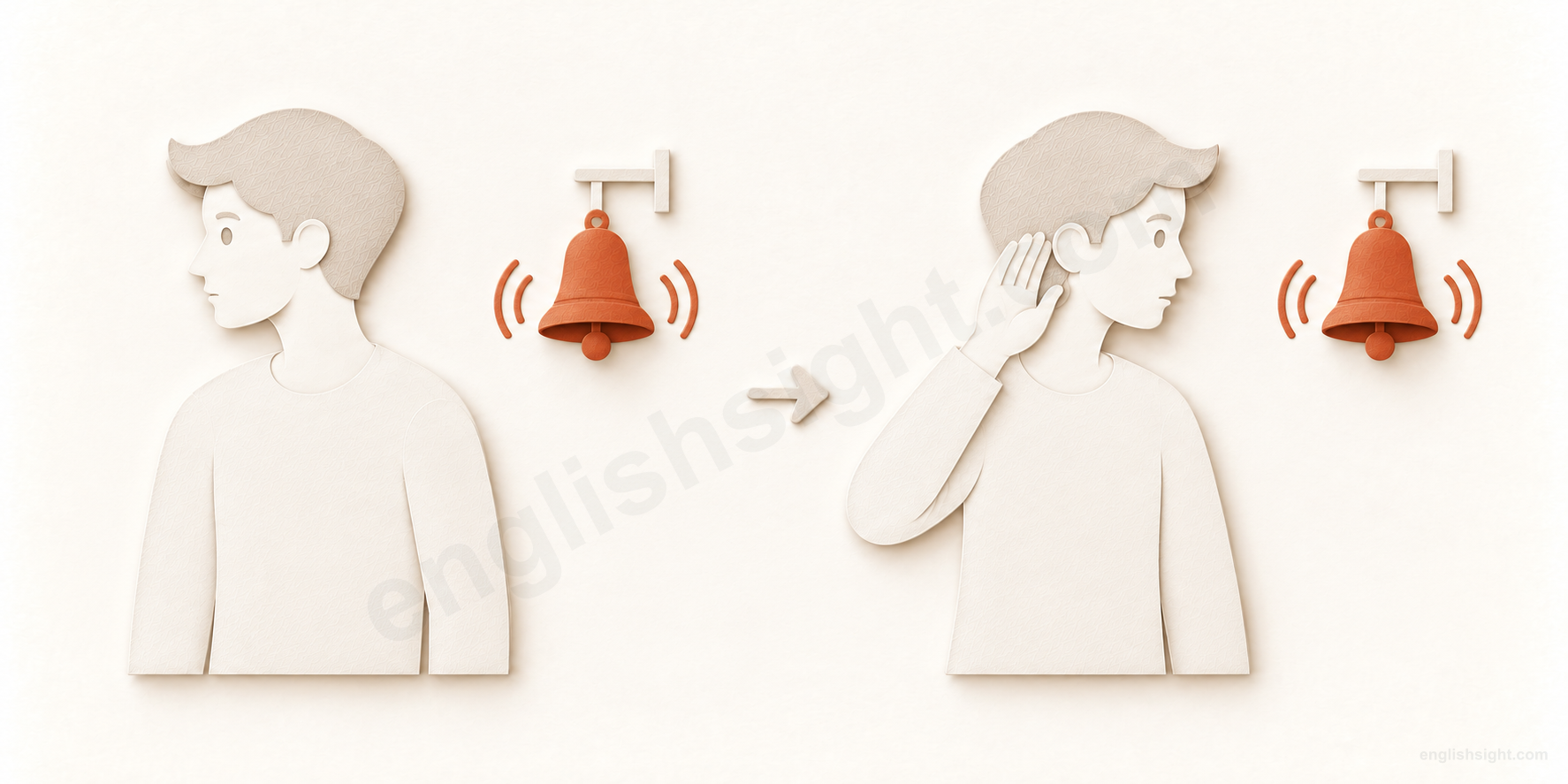
The bell is already ringing while the awake listener faces away.
conscious
The listener is now conscious of the sound.
The listener turns toward the ringing bell and raises a hand to listen.
The sound is present before it catches the listener’s attention.
Conscious describes awareness: being able to experience what is happening, noticing something, or acting with it in mind.
The listener and ringing bell illustrate conscious of a sound. Conscious without a complement can describe the broader state of awareness; a conscious choice adds intention. The drawing is a teaching model, not a shared mental picture claimed for all speakers.
Conscious is an adjective. Ask whether the sentence concerns a person’s state, something they notice, an intentional action, or an area that matters to them. The surrounding words make the distinction.
A useful teaching connection is awareness: a sound can be present without being noticed. This model links several uses, but it does not turn every compound into a predictable literal meaning.
01
Being aware and noticing
First distinguish the state of being conscious from awareness of a specified sound, action, or fact.
01
be / become / remain / stay + conscious; fully / barely conscious
be / remain / stay conscious
be able to experience what is happening
Situation
A person has had a fall.
What the words express
They can hear and answer a question.
Conscious here describes a state of awareness, without an of-complement.
“Was he conscious?” asks about his awareness after the fall. Remain or stay conscious says that this state continues; become conscious describes entering it.
Fully conscious and barely conscious describe different degrees. “She was conscious but confused” is possible: conscious does not promise complete understanding.
“Are you awake?” is the ordinary question when checking whether someone is sleeping. Conscious is especially useful in accounts of fainting, injury, or an operation. The diagram shows noticing, not a test for this bodily state.
In a sentence
After the fall, Mina remained conscious and answered my question.
Watch the difference Say “He regained consciousness,” using the noun, not “He regained conscious.”
02
be / become + conscious of + noun phrase
be conscious of something
notice or be aware of a particular thing
Situation
A low sound continues outside.
What the words express
You notice the sound.
Of introduces the thing within the person’s awareness.
The subject is the person who notices; the noun after of identifies what is noticed. You can be conscious of a sound, a feeling, your surroundings, or a problem.
Compare “I was conscious” with “I was conscious of the noise.” The second tells us what registered. “I wasn’t conscious of the noise” does not say that I had fainted.
Conscious of the cost can also mean keeping the cost in mind because it matters. Aware of is often a neutral alternative; conscious of can emphasize attention.
In a sentence
I became conscious of a low humming sound outside.
Watch the difference Use of: “conscious of the noise,” not “conscious the noise.”
03
conscious of + -ing; conscious of + person + -ing; conscious of having + past participle
conscious of doing / having done
be aware of an action or an earlier event
Situation
You are speaking in a quiet room.
What the words express
You notice how loudly you are speaking.
After the preposition of, an action can be expressed with an -ing form.
“Conscious of speaking too loudly” puts your own action in focus. In “conscious of someone watching,” the other person is doing the watching.
Having plus a past participle can mark an earlier event: “conscious of having interrupted” means aware that you interrupted before this moment. It is not an instruction to interrupt.
In a sentence
I was suddenly conscious of speaking much louder than everyone else.
Watch the difference Do not replace of speaking with to speak when you mean awareness of an action.
04
be conscious that + subject + verb; be conscious of the fact that + clause
be conscious that…
realize or keep in mind a whole fact
Situation
There is little time left.
What the words express
That limit is present in your thinking.
A that-clause states what the person realizes.
Compare “conscious of the deadline” with “conscious that the deadline is close.” Of takes a noun or -ing phrase; that introduces a clause with its own subject and verb.
Vaguely or dimly conscious suggests weak awareness; acutely or painfully conscious suggests strong or uncomfortable awareness. Painfully need not mean physical pain.
In a sentence
We were acutely conscious that the last bus would leave in ten minutes.
Watch the difference Use “conscious that we were late” or “conscious of the fact that we were late,” not “conscious of that we were late.”
02
Deliberate action and conscious thought
Before an action noun, conscious often emphasizes intention. Before mind or memory, it concerns awareness of mental activity.
05
make a conscious effort to + verb
make a conscious effort
deliberately try, rather than leave something to habit
Situation
You tend to interrupt people.
What the words express
You deliberately try to let them finish.
Conscious modifies effort; the effort has an intended aim.
An effort can be conscious even when it does not succeed. The phrase describes how you try, not a guaranteed result.
In “a conscious effort to listen,” to listen belongs to effort and names its aim. This differs from conscious of listening, which means aware that you are listening.
In a sentence
I made a conscious effort to let everyone finish speaking.
Watch the difference Do not use “I am conscious to listen” to mean that you deliberately try to listen.
06
a conscious choice / decision / act; make a conscious decision to + verb
a conscious choice / decision / act
a choice or action made deliberately
Situation
You could accept every invitation automatically.
What the words express
You choose how to use your time.
The person chooses knowingly rather than simply following an automatic response.
Conscious before choice, decision, or act emphasizes intention. It does not mean that the choice is wise or morally good.
Compare “a conscious decision to wait” with “conscious that we must wait.” The first describes a decision; the second describes awareness of a fact.
In a sentence
We made a conscious decision to keep one evening free each week.
Watch the difference Conscious is an adjective: use “a conscious decision.” Use an adverb in “We consciously chose to wait.”
07
the conscious mind; conscious thought / memory
the conscious mind / conscious thought
mental activity that a person is aware of
Situation
You are thinking through a difficult question.
What the words express
You can attend to the thoughts you are considering.
Conscious describes accessible mental experience, rather than every hidden mental process.
In “conscious thought,” conscious describes thought you are aware of. The conscious mind is contrasted with unconscious mental activity.
This is a way of talking about mental experience, not a claim that the mind has a literal visible compartment. It does not follow that every conscious thought was deliberately selected.
In a sentence
I have no conscious memory of the moment I fell asleep.
Watch the difference Awareness and intention overlap in some uses, but a conscious memory need not be a memory you chose to create.
03
What matters to someone
Compounds and adverb combinations describe areas of concern. Self-conscious has a familiar emotional meaning that needs separate attention.
08
a health-conscious person; be / become health-conscious
health-conscious
concerned about health in everyday choices
Situation
You compare foods before buying them.
What the words express
Health is one of the things guiding your choices.
Health-conscious describes a continuing concern, not just noticing one fact.
A health-conscious shopper gives health a place in decisions about food or daily habits. The adjective alone does not say that every decision improves health.
Compare “conscious of my health problems,” which identifies particular problems I know about. Health-conscious describes an orientation. It can come before a noun or after be.
In a sentence
The café offers smaller portions for health-conscious customers.
Watch the difference Keep the compound together: “health-conscious customers,” not “health conscious of customers.”
09
a cost-conscious buyer / approach; be cost-conscious
cost-conscious
careful about what things cost
Situation
A team compares possible travel plans.
What the words express
Spending matters in its final choice.
Cost-conscious connects awareness of prices with care in spending.
A cost-conscious buyer checks whether a purchase fits the budget. This does not mean buying the cheapest option regardless of quality.
Use conscious of the cost to discuss awareness of a particular expense. Use cost-conscious to describe a person, group, or approach that pays attention to spending.
In a sentence
Our cost-conscious team booked the train tickets early.
Watch the difference Cost-conscious does not mean unconscious because of a cost; the first element names the concern.
People consider the wider effects of their choices.
What the words express
Those concerns receive attention.
An -ly adverb can specify the area of awareness without forming a hyphenated compound.
Environmentally conscious customers consider environmental effects. Socially conscious writing draws attention to social concerns. Politically conscious similarly relates to political issues.
Compare health-conscious, with a noun as its first element. In environmentally conscious, environmentally is an adverb; the usual spelling has no hyphen after -ly.
In a sentence
Environmentally conscious customers often bring their own containers.
Watch the difference An adjective describing concern does not by itself prove that an action has a beneficial effect.
11
be / feel self-conscious (about + noun / -ing)
feel self-conscious about…
feel awkward about yourself or others’ opinions
Situation
You hear a recording of your own voice.
What the words express
You feel embarrassed about how you sound.
The established compound often adds discomfort, not just neutral self-awareness.
“Conscious of my accent” can simply mean aware of it. “Self-conscious about my accent” says I feel awkward or worry about other people’s reactions.
About can introduce a noun or -ing phrase: self-conscious about dancing. A self-conscious smile can show awkward awareness of being observed. In criticism, self-conscious can also suggest an effect that feels deliberately displayed or contrived.
In a sentence
I felt self-conscious about my accent during the recording.
Watch the difference Use about with this common emotional sense. Self-conscious is not a synonym for conscientious, meaning careful about doing things properly.
Awareness, intention, and similar-looking words
Conscious is an adjective
Use be conscious, conscious of something, or conscious that something is true. Awareness commonly follows a linking verb; intention commonly appears before a noun. These are adjective constructions, not phrasal verbs. There is no verb tense or separable particle to learn for conscious itself.
Conscious, consciousness, conscience
Consciousness is the noun for awareness: lose or regain consciousness. Conscience is your sense of right and wrong: “My conscience told me to return the money.” A person can be conscious of doing something wrong and still ignore their conscience.
Conscious and conscientious
A conscientious worker takes care to do the job properly. A conscious worker is awake and aware in an appropriate context. “She is very conscientious” praises her care; “She is very conscious of errors” says she notices or pays attention to them.
Unconscious depends on its surroundings
“He was unconscious” concerns lack of awareness. “He was unconscious of the problem” concerns a problem he did not notice. An unconscious habit contrasts with a deliberate action. Do not treat every negative expression as a statement that someone has fainted.
Choose the intended meaning
Read the complement and the noun being described.
1. You were awake but did not notice a quiet sound. Which sentence fits?
2. You deliberately tried to stop checking your phone. Which expression describes your intention?
3. Complete the sentence with a clause: “We were conscious ___ the room was getting cold.”
4. You feel awkward because you worry about how your dancing looks. Which wording expresses that feeling?
5. Which sentence correctly uses the noun for awareness?
Sources and teaching notes
Dictionary entries support the usage distinctions below. The explanations, examples, and visual teaching model were created for this lesson.
The diagram offers a teaching connection, not a mental picture shared by every English speaker.