Connect authority, adjustment, restraint, and the things we call controls.
A controller shapes what happens
A controller shapes what happens
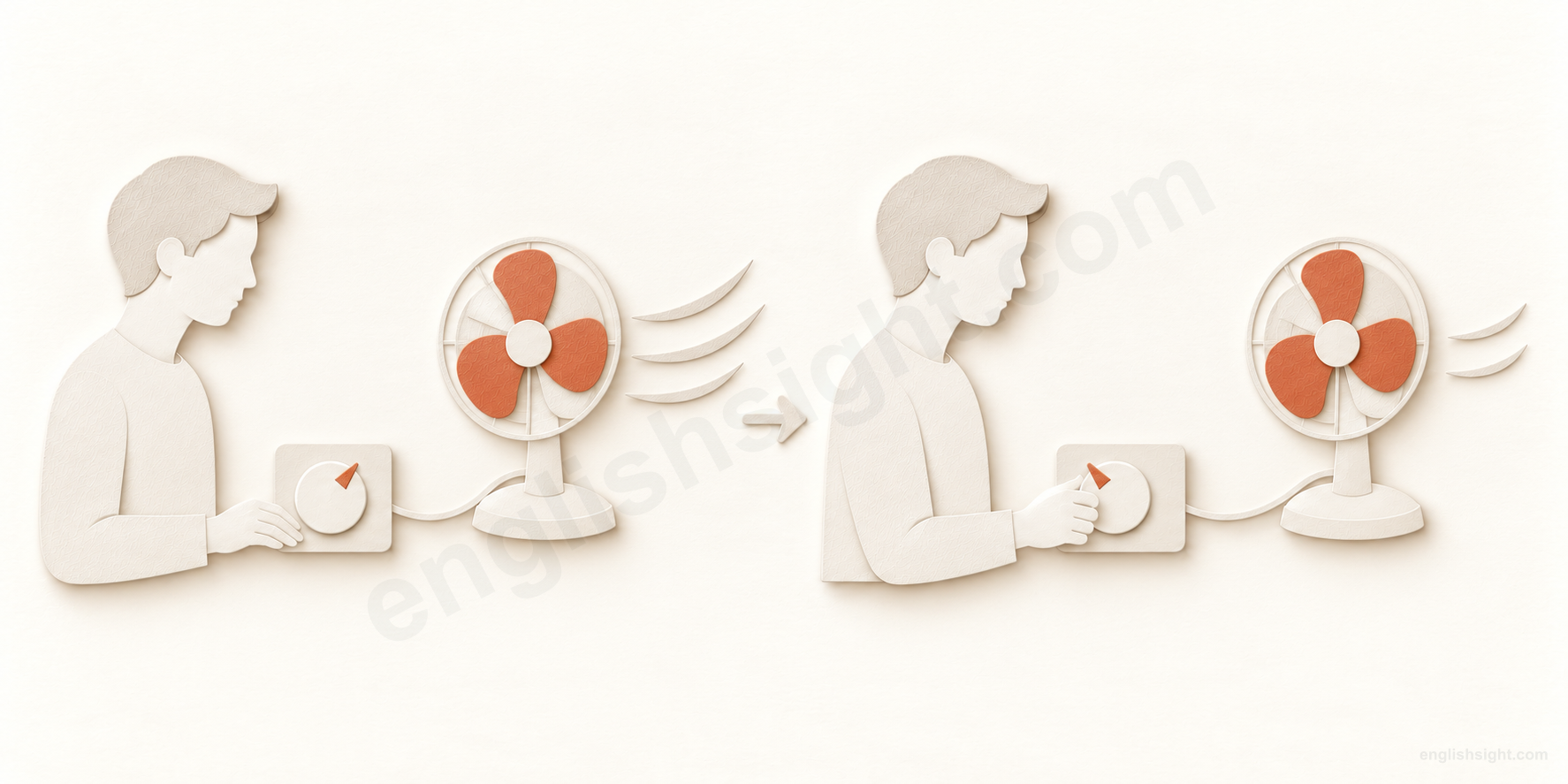
The fan runs with stronger airflow at the current dial setting.
control
The fan keeps running with gentler airflow at the new setting.
The person turns the dial to change the fan’s speed.
Control directs how something runs: adjusting the dial changes the fan’s speed without stopping it.
To control is to direct how something behaves or keep it within chosen limits.
The fan and dial make the regulating relationship visible. Authority, emotional restraint, institutional checks, and experimental comparisons require the distinctions explained below.
Who decides, what responds, and what is being kept manageable? These questions connect many everyday uses of control. A person can control a budget, a dial can control speed, and a team can bring a difficult situation under control.
Control does not always mean stop completely. It may mean direct an action, choose a setting, or contain a problem. Some established compounds and the scientific comparison sense need their own explanations.
01
Direct, adjust, or restrain
The object tells you what kind of control is involved: decisions, a machine’s behavior, an amount, a danger, or your own reactions.
01
control + person / organization; be controlled by + agent
control a company / a person
have the power to direct decisions or behavior
Starting situation
A company needs decisions about its future.
What follows
One organization has the deciding power.
Control concerns the power to direct, not merely ownership or helpful influence.
A parent company can control another company even when it does not perform every daily task. In The company is controlled by a family, the passive makes the company the topic and by names the controlling party.
With a person as object, control can sound restrictive: trying to control a partner means trying to direct that person’s choices. Manage a team can describe ordinary coordination without the same emphasis on domination. Control does not automatically mean ownership.
In a sentence
A local trust controls the museum and appoints its director.
Watch the difference Use control the company as a verb. Control over the company uses the noun; do not add over after the verb for this meaning.
02
control + what / how / when + clause
control what happens
determine or restrict the content or manner of an action
Starting situation
Other people may choose how to use information.
What follows
You can decide some aspects of access.
A what- or how-clause can name the thing being regulated.
Control what visitors can see treats the whole clause as the object: what visitors can see identifies the content subject to a restriction. Control how the money is spent focuses on the manner of spending.
For a direct instruction, say They told us to wait. They controlled our movements describes restriction or direction more generally. Control does not normally take the pattern control someone to do something.
In a sentence
The settings let you control who can see your photos.
Watch the difference Use statement order inside the clause: control how the money is spent, not control how is the money spent.
03
control + machine / setting; control something with / via something
control the speed / temperature
regulate how a machine or process works
Starting situation
A fan can run at different speeds.
What follows
Its speed follows the selected setting.
The subject may be a person, a device, or an automatic system.
A dial controls the fan’s speed; a person controls the fan with the dial. The first sentence names the regulating part, while the second names the operator and uses with to identify the tool. Neither requires the fan to stop.
The fan is controlled by a timer names the regulating device in a passive. You can also control it via an app or from another room. Control is broader than switch on: it may cover speed, timing, direction, or other behavior. In a computer-controlled fan, -controlled combines with computer to describe what regulates the fan; it does not mean that the fan controls the computer.
In a sentence
This dial controls how fast the fan turns.
Watch the difference Control the temperature means regulate it; check the temperature means find out what it is.
04
control + costs / spending / prices / activity
control costs / spending
keep an amount or activity within intended limits
Starting situation
Travel spending is rising.
What follows
The team uses limits and planning to contain it.
Control often involves restraint rather than a precise setting.
Controlling spending means managing how much is spent. Costs might still rise, but less than they otherwise would. Control does not always mean reduce to zero, freeze permanently, or stop altogether.
In a discussion of public policy, control prices can mean regulate permitted prices. In a household, control spending more often describes personal budgeting. The object and setting determine the practical method.
In a sentence
We share equipment to control costs.
Watch the difference Reduce costs explicitly says they become lower. Control costs emphasizes managing or restraining them.
05
control + danger / symptoms / spread; control something with something
control a fire / the spread of disease
prevent a harmful process from spreading or worsening
Starting situation
A fire threatens more of the building.
What follows
Firefighters restrict its spread.
A problem can be controlled while still present.
To control a fire is to contain it or stop it getting worse; to put it out is to extinguish it. The two outcomes may occur at different times. The same distinction helps with control pollution and control the spread of disease.
In control symptoms, the focus is keeping their effects manageable, not necessarily removing their cause. With can introduce the means of control, as in control the temperature with a cooling system. This is grammar, not a recommendation about treatment.
In a sentence
The crew controlled the fire before it reached the stairs.
Watch the difference Do not assume control means cure, remove, or completely eliminate.
06
control + reflexive pronoun / emotion / reaction
control yourself / your temper
manage your reactions instead of acting on a strong feeling
Starting situation
You are angry and want to shout.
What follows
You keep your words and behavior measured.
The controller and the person being restrained can be the same person.
Control yourself uses a reflexive pronoun because you direct your own behavior. Control your temper, your voice, or your laughter names a particular reaction. You may still feel angry or amused; the expression need not mean the feeling disappears. Control your breathing can instead describe regulating the physical rhythm of your breaths; it need not concern anger.
Self-control is the related uncountable noun: She showed great self-control. Control yourself! is a direct command and may sound sharp or unsympathetic. Stay calm is often gentler when offering reassurance. Controlled can also be an adjective: a controlled voice is measured and restrained, even if the speaker feels strongly.
In a sentence
I was furious, but I controlled my temper and answered quietly.
Watch the difference Match the reflexive to the subject: he controlled himself; we controlled ourselves.
07
control + the ball; ball control
control the ball
handle a moving ball accurately
Starting situation
A fast pass comes toward a player.
What follows
The player brings the ball into a usable position.
In sport, control can be skillful handling rather than authority over a person.
A player who controls the ball makes its movement manageable, for example by receiving a pass cleanly before the next action. Ball control names the skill; it is not a rule imposed on the ball.
This fits the general idea of directing behavior, but the sporting object supplies the specific action. Control the ball does not by itself mean score, win, or keep possession for the rest of the game.
In a sentence
Nia controlled the ball with her first touch and then passed it.
Watch the difference Distinguish control of the ball from control of the match: the latter is broader influence over play.
02
Having, gaining, and giving up control
Here control is usually an uncountable noun. The surrounding verb tells you who has the power and whether that changes.
08
have / retain / exercise + control + of / over + noun
have control of / over something
possess the ability or authority to direct something
Starting situation
Someone else could decide how your time is used.
What follows
You have some freedom to make those decisions.
Here control is an uncountable noun followed by of or over.
Have control over your schedule emphasizes decision-making power. Control of the vehicle emphasizes handling it. Of and over overlap in many authority contexts; they do not form a rigid physical-versus-abstract rule.
Full control, some control, and little control describe degree. Exercise control over something means actually use that power and is more formal. The noun is normally uncountable in this sense: We need more control, not more controls, unless we mean rules or devices.
In a sentence
The team has full control over its weekly schedule.
Watch the difference A control is usually a device, rule, or experimental comparison, not one unit of decision-making power.
09
take / gain / seize + control of + noun
take / gain control of
come to have the power to direct something
Starting situation
The project lacks a clear decision-maker.
What follows
A new leader starts directing it.
Take highlights assuming direction; gain highlights acquiring the power.
Take control of the project says someone begins directing it, perhaps by stepping forward. Gain control of the company focuses on obtaining the authority, for example through an agreement or a purchase. Seize control suggests a forceful or sudden takeover.
These are verb-plus-noun combinations, not separable particle verbs. In take control of it, it follows of. Taking control need not involve grabbing a physical object or buying something.
In a sentence
When the organizer fell ill, Jo took control of the preparations.
Watch the difference Say took control of it, not took it control. Keep the whole noun phrase together.
10
lose / regain / keep + control (of + noun)
lose / regain control
cease to direct something, then possibly recover that ability
Starting situation
A driver can normally steer the car.
What follows
On ice, the car stops responding as intended.
The same expression can concern handling, authority, or emotional restraint.
Lose control of a car means lose the ability to direct its movement. Lose control of a company means lose decision-making power. Lose control without a following noun can describe an emotional outburst; context identifies the missing domain.
Regain control means get that ability or authority back. Keep or retain control means avoid losing it in the first place. These contrasting verbs describe changes in control, not separate meanings invented by control itself.
In a sentence
The driver lost control on the bend but regained it before reaching the ditch.
Watch the difference Lose control of the car does not mean lose the car’s location or ownership.
11
give someone control of something; hand over control to someone; give up control
give / hand over control to someone
allow another party to direct something
Starting situation
You make the decisions about a project.
What follows
Another person receives that authority.
Control can be transferred without transferring a physical object.
Give someone control of the budget presents the new controller as recipient. Hand over control of the budget to someone emphasizes the transfer. Give up control emphasizes your loss or surrender of power and need not identify who gets it.
The particle belongs to hand over or give up, not to control. In hand it over, it can replace something already mentioned; in hand over control to her, control is the noun object and to introduces the recipient.
In a sentence
The founder handed over control of the business to her daughter.
Watch the difference Give up control is not the same as lose control accidentally; it can describe a deliberate decision.
03
In control, under control, or out of control?
These expressions describe different sides of the relationship: the person managing things, the thing being managed, or a loss of manageability.
12
be / stay + in control (of + noun)
be in control (of)
be the one managing things; feel able to manage yourself
Starting situation
Several people can contribute ideas.
What follows
One person remains in charge of the event.
In control normally describes the directing side of the relationship.
Who is in control of the event? asks who is directing it. She is in control can also mean she feels composed and able to manage her life, even if the situation is demanding.
Compare The event is under control, which describes how successfully the situation is being managed. The event is in her control or in the control of her team uses a possessive or named controller and means it lies within their power.
In a sentence
Even during the delay, the coordinator stayed in control.
Watch the difference She is in control and She is under control do not mean the same thing: the second puts her on the controlled side.
13
be under control; bring / get / keep + object + under control
bring / keep something under control
make or keep a situation manageable
Starting situation
The queue is becoming disorderly.
What follows
Staff manage it so it no longer causes trouble.
Under control describes the managed thing, not the manager.
The queue is under control describes a satisfactory state. Bring or get it under control describes reaching that state. Keep it under control describes maintaining it. The preposition under marks a managed condition here, not a physical position.
The company is under her control names the person with authority; The problem is under control leaves that person unspecified and often reassures someone. Successfully managing a problem need not mean it has disappeared.
In a sentence
Extra staff soon brought the queue under control.
Watch the difference Put the object before under control: keep it under control, not keep under it control.
14
be / get / go / run + out of control
get / go / run out of control
become impossible or very difficult to manage
Starting situation
Costs were following a budget.
What follows
They rise far beyond what the team can manage.
Out of control presents a failure of restraint or direction.
The costs are out of control describes their current state; they are getting out of control describes deterioration. A vehicle can go or run out of control when the driver cannot direct it. An argument can spiral out of control as it becomes more severe.
This expression can be emphatic: a speaker may mean very hard to manage rather than literally impossible. It does not mean there are no switches or no regulations; those are other senses of controls.
In a sentence
The argument got out of control when everyone began shouting.
Watch the difference Contrast out of control with out of order, which commonly describes a machine that is not working.
15
be beyond / outside + possessive + control
beyond / outside someone’s control
not something a person has the power to determine
Starting situation
You have planned an outdoor event.
What follows
Unexpected weather prevents it from going ahead.
This concerns the limits of someone’s power, not necessarily chaos.
The weather is beyond our control says we cannot decide what it will do. The event can still be well organized. Out of our control can similarly express lack of power; plain out of control more strongly suggests something unmanageable.
Due to circumstances beyond our control is a conventional formal explanation for a change or cancellation. It does not tell the listener exactly what happened, and it is not proof that no one was responsible.
In a sentence
The ferry delay was caused by weather beyond our control.
Watch the difference Beyond my control means I cannot determine it; under my control means I can direct it.
04
Rules, switches, and remote operation
Countable controls can be regulations or physical devices. Context and prepositions help separate them from uncountable control.
16
controls on + activity; impose / tighten / relax / lift controls; noun + control
controls on spending / imports
rules or measures that restrict an activity
Starting situation
An activity is not closely restricted.
What follows
An authority introduces limits or checks.
Plural controls can be individual restrictions, not pieces of machinery.
Controls on imports refers to measures restricting or regulating imports. Price controls regulate prices; gun control and arms control name policy areas concerned with weapons. The noun before control identifies the domain, not the person exercising power.
Authorities can impose, tighten, relax, or lift controls. Tighten makes restrictions stronger; lift removes them. Compare control over spending, which emphasizes decision-making power, with controls on spending, which emphasizes restrictive measures.
In a sentence
The council introduced tighter controls on late-night noise.
Watch the difference Use controls on imports for restrictions; the controls of a machine refers to operating devices.
17
a control; the controls of / on a machine; at / take the controls
the controls / at the controls
the devices used to operate a machine; in the operator’s position
Starting situation
You are learning to operate a new machine.
What follows
You identify and use its switches and levers.
A countable control is a physical means of directing operation.
The volume control is one dial, slider, or button arrangement used to change volume. The controls can mean the collection of operating devices. A control panel is the surface or unit where these devices are grouped.
At the controls of an aircraft means in the position of operating it, not merely standing beside its switches. Take the controls means start operating it. Contrast take control of a company, which concerns authority and has no plural s.
In a sentence
The instructor explained the controls before I started the machine.
Watch the difference The controls are plural; control meaning authority is normally uncountable.
18
by remote control; a / the remote control; remote-controlled + noun
remote control
operation from a distance, or the device used for it
Starting situation
A television is across the room.
What follows
A handheld device changes its settings.
The same compound can name a method or a countable object.
The gate works by remote control describes the method: signals allow operation at a distance. Where is the remote control? asks for a device, often simply called the remote in conversation.
Remote-controlled in a remote-controlled toy describes how it is operated. You can say two remote controls when counting devices, but by remote control normally has no article because it names the method.
In a sentence
I found the remote control under the sofa and turned the volume down.
Watch the difference Distinguish the remote control, the device, from by remote control, the way something operates.
05
Established expressions in daily life
Learn what each compound names. Control helps connect the ideas, but the full expression supplies its specific purpose or institution.
19
quality control; work in / improve + quality control
quality control
checking production to maintain the required standard
Starting situation
Goods are being made.
What follows
Checks identify defects before goods are accepted.
This compound names a process for maintaining product standards.
Quality control concerns whether products meet the required standard. It may be the name of a procedure or the function of a team: She works in quality control. It is not simply someone choosing which products they like.
Control here connects checking with maintaining standards. Compare control the quality of production, a verb phrase, with improve quality control, a noun phrase naming the checking process.
In a sentence
The factory improved quality control after finding faulty switches.
Watch the difference Quality control is normally uncountable: better quality control, not a quality control for the whole process.
20
do + damage control; an exercise in damage control
damage control
action to limit harm after something has gone wrong
Starting situation
A mistake has already caused trouble.
What follows
A response aims to prevent further harm.
The aim is to contain consequences, not undo the past.
In a business or public discussion, damage control is the effort to reduce the harmful effects of a mistake or event. An apology, correction, or practical response may be part of it; the phrase does not specify which action is taken.
The damage already exists or is threatened. Doing damage control therefore differs from solving the original problem completely. The expression can sound critical if someone seems more concerned about consequences or reputation than the underlying fault.
In a sentence
After sending the wrong prices, the sales team spent the morning doing damage control.
Watch the difference Do not confuse damage control with damage assessment, which focuses on finding out how much harm there is.
21
birth control; a method of birth control; birth-control + noun
birth control
methods used to prevent pregnancy
Starting situation
Someone wants information about preventing pregnancy.
What follows
The discussion concerns contraceptive methods.
This is an established name for contraception, not control of a birth in progress.
Birth control names the use of contraception to prevent pregnancy and manage whether or when to have children. The compound is normally uncountable; a method of birth control counts one method.
The phrase birth-control pills names a particular kind of product, whereas birth control is broader. The expression does not mean controlling a child’s behavior, and its vocabulary meaning alone does not tell you which method suits someone.
In a sentence
The leaflet explains several methods of birth control.
Watch the difference Read the compound as a whole; it does not mean instructions for managing labor.
22
go through / wait at + passport control; border controls
passport control / border controls
official checking of travelers or crossings
Starting situation
Travelers arrive at a national border.
What follows
Officials check their travel documents.
Control can name a checking process or the place where checks occur.
At an airport, passport control commonly names the official document-checking area or procedure. Go through passport control describes passing through those checks, not losing power over your passport.
Border controls is broader: it names checks or restrictions at a border. Compare passport control with baggage collection, which concerns collecting luggage. The travel setting supplies this institutional meaning; the fan diagram does not predict it word for word.
In a sentence
We waited at passport control before collecting our bags.
Watch the difference In go through passport control, the expression usually has no article. It does not mean a handheld passport device.
23
work in / contact + air traffic control
air traffic control
the service directing aircraft movements, or the organization providing it
Starting situation
An aircraft is approaching an airport.
What follows
Controllers give instructions for its approach or landing.
The compound can refer to an activity or to the people providing the service.
Air traffic control coordinates aircraft movements through instructions to pilots. In She works in air traffic control, it names the field of work. In Contact air traffic control, it refers to the service or its personnel.
This is organized direction, not a physical switch in the cockpit. The pilot at the controls is operating the aircraft; air traffic control gives instructions from elsewhere. These two uses of control describe different roles.
In a sentence
The pilot contacted air traffic control before landing.
Watch the difference Do not confuse the controllers with the pilots operating the aircraft’s controls.
24
a control freak; be a bit of a control freak
a control freak
someone who insists on directing everything
Starting situation
A group is sharing responsibility.
What follows
One person wants to decide every detail.
This informal label usually criticizes excessive insistence on control.
A control freak wants things done their own way and finds it difficult to leave decisions to others. It is not a neutral job title for someone who operates equipment or supervises a project.
The phrase is informal and disapproving, though people sometimes use it jokingly about themselves. Calling a colleague a control freak can sound insulting. A manager or coordinator is a more neutral description of a role.
In a sentence
I can be a control freak when we plan trips, so I let Sam choose the hotel this time.
Watch the difference Use the label with care: being competent or organized does not by itself make someone a control freak.
25
the Control key; press / hold + Control / Ctrl
the Control key / Ctrl
a keyboard key used together with other keys
Starting situation
A computer command has a keyboard shortcut.
What follows
You hold a modifier key while pressing another key.
Control here is the name of a key, not a statement about authority.
The Control key is often labeled Ctrl. In an instruction such as Press Control and C, the name identifies a particular keyboard key. It is commonly held with another key to issue a command.
This specialized label is an established computer use. The exact shortcut depends on the application and system, so recognizing the key does not guarantee that every Control combination does the same thing everywhere.
In a sentence
Hold the Control key while pressing the key shown in the shortcut.
Watch the difference Control, Alt, and Shift name different keys. Read the actual shortcut rather than substituting one for another.
06
A comparison in an experiment
Scientific control is a separate technical use worth recognizing in reports. A control is a reference for comparison, not a person in charge.
26
a control; serve as a control; a control group; a controlled experiment
a control / control group
a comparison used to interpret an experimental result
Starting situation
Researchers want to test one treatment’s effect.
What follows
They compare a treatment group with a reference group.
The control is the reference for comparison, not the group giving orders.
In an experiment, a control provides a reference against which a result can be assessed. A control group may receive a placebo, usual care, or another comparison condition, depending on the study. Control does not invariably mean nobody receives anything.
In The untreated plants served as controls, controls counts comparison specimens. A controlled experiment uses comparison conditions to help identify the effect being tested while managing relevant differences between conditions. This scientific branch must be learned separately from the everyday image of directing a fan.
In a sentence
The plants given plain water served as controls for the plants given the new fertilizer.
Watch the difference A control group is a comparison group, not a group of supervisors. Details depend on the experiment.
Read the grammar and the whole expression
Verb forms and objects
Forms are control, controls, controlled, controlling; double the l before -ed and -ing in both British and American English. The everyday verb is transitive: control it, control yourself, control what happens. Ongoing action can be progressive, as in They are controlling access, and passives are common.
Noun, verb, and preposition
Use control the process with the verb, have control of or over the process with the noun, and controls on a process for restrictions. Control of and control over overlap; choose the whole natural expression rather than assigning each preposition one universal meaning.
Control, check, and manage
Check the machine asks whether it is working or what state it is in; control the machine directs its operation. Manage often emphasizes handling a task or organization; control foregrounds direction, regulation, or restraint. The words overlap, but they are not interchangeable in every context.
No automatic particle-verb rule
In control, under control, and out of control are expressions with the noun. In take control of, take is the verb. In hand over control, the particle belongs to hand over. These are not a single family of control plus movable particles.
A useful model with limits
The diagram illustrates regulation, not a universal mental picture shared by English speakers. Scientific controls and compounds such as passport control are established uses; a dial alone cannot predict them. This course selects common modern uses, with a short science-recognition branch, rather than every technical or historical meaning.
Choose the expression that fits
Look for the controller, the controlled thing, and the intended result.
1. Maya is directing the event confidently. Which sentence puts Maya in the managing role?
2. The fire is still burning, but it is no longer spreading. Which statement fits without claiming it is extinguished?
3. A council adds stricter rules limiting construction. Which phrase names the regulations?
4. The weather delays your event, but your team remains well organized. Which sentence identifies a limit on your power?
5. Plain-water plants are compared with plants receiving fertilizer. What are the plain-water plants called?
Sources and teaching notes
Usage was checked against the dictionary entries below. Explanations, examples, and the diagram are original teaching material; the visual model illustrates a connection rather than proving a word’s history.
This diagram is a teaching aid, not a picture shared by every native speaker.