Learn who cooks, what cooks, and when cooking words leave the kitchen.
Food changes through heating
Food changes through heating
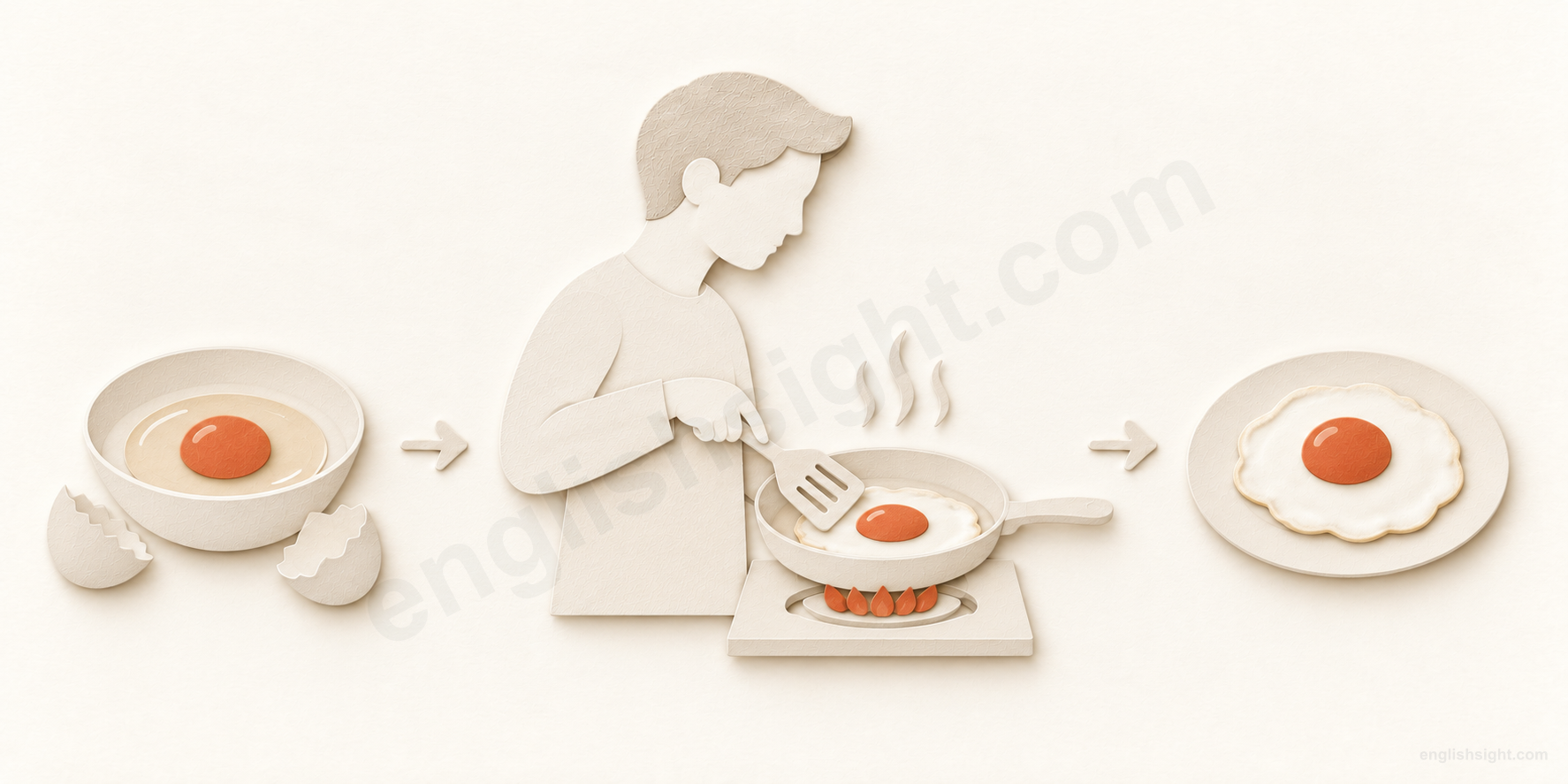
A raw egg rests in a bowl beside two empty shell halves.
cook
The cooked egg has a set white and rests on a plate.
A person heats the egg in a frying pan over a flame.
Heat changes food for eating; frying is one way to cook.
A person uses heat to change food for eating; the food undergoes the cooking process.
The central model concerns food and heat. It helps connect the ordinary verb and the person noun, but it does not independently predict fixed idioms or current slang.
Cooking uses heat to change food for eating. English can follow the person doing the cooking or the food undergoing it. That distinction helps you read I cook rice and The rice cooks without translating word by word.
Cook also names a person. Established phrases take cooking language into planning, dishonesty, success, and failure. The diagram is a teaching model for the food process, not a claim that every speaker pictures cook in the same way.
01
Cooking food: the person and the process
Start with heat changing food. Choose a subject, an object, a recipient, and the details the listener needs.
01
cook + food / meal; cook without an object
cook dinner / learn to cook
prepare food using heat
Starting situation
Dinner still needs preparing.
Meaning or result
Someone works on the meal.
The person is the subject; the food may be named or left understood.
In I cook dinner, I names the person doing the work and dinner names the meal. In I cook most evenings, the object is understood. Neither construction tells us which heating method is used.
Cook is the broad verb; boil, bake, fry, roast, and steam specify methods. Make or prepare a meal is broader: making a salad does not require cooking it.
In a sentence
I cook dinner while my brother sets the table.
Watch the difference Say make a salad when you only assemble raw ingredients. Cook does not simply mean every kind of food preparation.
02
food + cook; food + be cooking
The rice is cooking.
food undergoes heating and changes
Starting situation
Rice is in the heated pot.
Meaning or result
The process is still continuing.
The food can be the subject without becoming the person doing the work.
Compare I am cooking the rice with The rice is cooking. The first names the person causing the process; the second follows the food through it. Rice does not need to act like a person.
The rice is cooking describes a process in progress. The rice is cooked can describe the resulting state. The rice cooks quickly describes its usual behavior, not necessarily what is happening now. Let the rice cook for a little longer asks someone to allow the process to continue; let supplies that meaning of allowing.
In a sentence
The rice is cooking, so we have time to slice the tomatoes.
Watch the difference The rice is cooking is active in form, though the food undergoes the process. Do not add an object after it.
03
cook + person + food; cook + food + for + person; cook for + person / number
cook someone a meal / cook for someone
prepare food for a recipient
Starting situation
A guest is coming for lunch.
Meaning or result
You take responsibility for the guest’s meal.
The person after cook can be a recipient, followed by the food.
Cook Maya lunch and cook lunch for Maya express the same basic arrangement. In the two-object pattern, Maya receives the benefit and lunch is the food. Cook for Maya can leave the meal unnamed.
Cook for six gives the number of eaters. Cook for an hour gives duration. The noun phrase after for tells you which relation is intended; for is a preposition here, not a particle making a new verb.
In a sentence
I’ll cook you lunch after your appointment.
Watch the difference Keep the food in cook you lunch. Cook you alone would make you sound like the food, rather than the recipient.
04
cook + in / on / over / with + noun phrase; cook for + time; cook until + condition
cook in / on / over / with; cook for / until
give equipment, heat, ingredients, or timing
Starting situation
A recipe needs practical details.
Meaning or result
The instructions tell you how to manage the process.
Prepositions add details; they do not all create phrasal verbs.
Cook in the oven names a cooking space or appliance; cook on the stove names where the pan is heated; cook over low heat describes heat intensity. Cook with olive oil names an ingredient or cooking medium.
Cook for ten minutes measures time; cook until tender gives an endpoint. Compare boil the potatoes, which specifies a method, with cook the potatoes, which leaves the method open. Exact times depend on the food and recipe.
In a sentence
Cook the lentils over low heat until tender.
Watch the difference Cook at 180°C gives a temperature; cook for 20 minutes gives duration. These details are not interchangeable.
05
be + cooked; cook + food + through; cook until + adjective
be cooked / cook through
focus on cooked food or completion inside it
Starting situation
The outside may look finished.
Meaning or result
Attention shifts to the food’s state or the whole interior.
Through adds the idea of reaching all the way inside.
The beans were cooked by my father is a passive sentence: it still allows us to name the person doing the work. The beans are cooked can instead describe their present state. Context helps decide whether cooked describes an event or a result.
Cook the potatoes through and the potatoes are cooked through concern their interior, not just the surface. Cook until soft states a result. Have the food cooked by noon can mean arrange for it to be ready; that arrangement comes from have, not a special meaning of cook.
In a sentence
The potatoes are browned outside but not cooked through yet.
Watch the difference Appearance alone does not establish safe cooking. This is a language example, not a test of food safety.
02
The person, the skill, and the food
A cook is a person. Cooking can name the activity or its results. Related words need their own grammar.
06
a / the + cook; a + adjective + cook; work as a cook
a cook / a good cook
a person who cooks, professionally or at home
Starting situation
Someone prepares food.
Meaning or result
You name their role or assess their skill.
Cook is a countable noun as well as a verb.
A cook may be paid to cook or simply be the person making a meal. Calling a friend a good cook praises a skill; it does not give them a job. Compare She cooks well, where cooks is a verb.
Chef usually names a professional cooking role, often a senior one. Cooker normally names equipment, such as a rice cooker; in British English a cooker can be a stove with an oven. Use cook for the person, not cooker.
In a sentence
My uncle is a great cook, although he works as a bus driver.
Watch the difference Use an article in She is a cook. In She cooks, cooks is the third-person verb, not a plural noun.
07
do the cooking; enjoy + cooking; possessive + cooking; home cooking
do the cooking / home cooking
the activity of cooking, or food prepared in a certain style
Starting situation
A household shares meal preparation.
Meaning or result
Cooking names the work, or the food someone produces.
The -ing noun can refer to an activity or its results.
Who does the cooking? asks who takes on meal preparation. I enjoy cooking uses the -ing form after enjoy. I am cooking uses it as part of a progressive verb instead.
Her cooking is wonderful evaluates the food she prepares. Home cooking names a familiar style of food associated with home. In these ordinary senses cooking is uncountable: some cooking, not two cookings. For separate occasions, say two cooking sessions.
In a sentence
We take turns doing the cooking during the week.
Watch the difference A cook is a person; cooking is the activity or its result. They cannot replace each other in a sentence.
03
Preparing, inventing, and hiding the truth
Some combinations extend the idea of preparing something. Others have established meanings that need to be learned as expressions.
08
cook up + food; cook + food / it + up
cook up a meal
prepare a dish or meal, often with a casual tone
Starting situation
A few ingredients are available.
Meaning or result
Someone produces a meal from them.
Here cook up still refers to real food.
Cook up can describe producing food, sometimes quickly or with what is available. It need not mean inventing a recipe. Plain cook dinner is enough when no extra conversational emphasis is needed.
This phrasal verb allows cook up a meal and cook a meal up. With a personal pronoun, put it between the verb and particle: cook it up. Up is not a direction above the kitchen.
In a sentence
We can cook up a simple supper with the vegetables we have.
Watch the difference The object decides the reading: cook up supper concerns food; cook up an excuse concerns invention.
09
cook up + plan / story / excuse; cook + it + up
cook up a plan / an excuse
invent or devise something
Starting situation
Someone needs a story or a scheme.
Meaning or result
They put together something that did not exist before.
The preparation model extends to an idea, often with suspicion.
Cook up an excuse means invent an excuse. Cook up a scheme means devise it. The combination is informal and often suggests deception; the particular object and context tell us whether it is dishonest or merely inventive.
Both cook up a story and cook a story up are possible; use cook it up with a pronoun. A story is assembled in this teaching comparison, not literally heated. Learn the established combination instead of assuming that up always means invention.
In a sentence
He cooked up an excuse for missing the rehearsal.
Watch the difference For a neutral professional description, devise a plan or develop an idea usually carries less suspicion.
10
what + be + cooking?; something + be + cooking
What’s cooking? / something is cooking
ask what is happening or suggest that plans are developing
Starting situation
People are being secretive about an event.
Meaning or result
You suspect that something is being arranged.
An activity in preparation is compared with food still cooking.
Outside a kitchen, What’s cooking? can be an informal question about what is happening. There’s something cooking can hint that a plan is developing. These uses are especially natural in progressive forms.
The same question can be literal if you smell food. Context determines the reading. Cooking here does not automatically imply fraud: a surprise party may be cooking without anything dishonest.
In a sentence
Everyone has cleared Friday evening; there’s something cooking.
Watch the difference What do you cook? usually asks about dishes you make, not current news or plans.
11
cook the books; cook + figures / data
cook the books
dishonestly change financial records
Starting situation
The actual accounts show a loss.
Meaning or result
Someone changes the records to give a false impression.
The idiom concerns falsification, not preparing books as food.
The books means financial accounts in this expression. Cooking them makes the records misleading. The idiom can appear in a passive: the books were cooked. This is an accusation of dishonesty, not ordinary accounting.
The broader verb also occurs with data or figures when someone deliberately alters them to mislead. Checking a spreadsheet or correcting an honest error is not cooking the books.
In a sentence
The auditor discovered that the manager had cooked the books to hide a loss.
Watch the difference Keep the established plural the books. Cook a book is not the usual form of this financial idiom.
04
Success, failure, and too much interference
These expressions use cooking language for other situations. Read the complete expression rather than replacing each word with a literal meaning.
12
be + cooking with gas
be cooking with gas
be working effectively and making good progress
Starting situation
A task was awkward or slow.
Meaning or result
The method now works well.
The whole idiom praises effective performance.
Now we’re cooking with gas! can celebrate finally finding a successful way to do something. It does not require a kitchen or a gas supply. The expression is informal and often sounds enthusiastic or playful.
The cooking image provides a memory link to working conditions that help a process succeed. It does not establish a general English rule that with gas means successfully.
In a sentence
The new layout makes everything easier to find—now we’re cooking with gas!
Watch the difference In an actual kitchen, cooking with gas may simply identify the fuel. Read the setting before choosing the idiomatic meaning.
13
cook + possessive + goose; someone’s goose + be cooked
cook someone’s goose
ruin someone’s chances
Starting situation
A player still has a chance to be selected.
Meaning or result
A serious mistake destroys that chance.
The possessive names the person whose prospects are damaged.
An event, mistake, or person can cook someone’s goose. The expression is informal and means that their hopes or prospects have been badly damaged. It does not mean helping them by preparing a meal.
Someone’s goose is cooked presents the damaged prospects as a result. Learn this as an idiom; the literal food diagram cannot predict why goose has this meaning here.
In a sentence
Missing the final trial cooked his goose with the selection committee.
Watch the difference Cook him a goose could describe making him a meal; cook his goose is the idiom about ruining his chances.
14
too many cooks spoil the broth
Too many cooks spoil the broth.
too many people managing one task can make it go badly
Starting situation
Several people give conflicting instructions.
Meaning or result
The work becomes confused instead of improving.
The proverb maps competing cooks onto competing decision makers.
Broth is a kind of soup. The saying is used when too many people interfere with the same job, especially when their directions conflict. It can apply to a website, a meeting, or a building project.
This is a warning about how work is organized, not proof that teamwork is bad. Clear roles can make collaboration effective. Cooks is a plural noun here; spoil is the verb.
In a sentence
Five people keep rewriting the same invitation—too many cooks spoil the broth.
Watch the difference Use the full saying as a comment on a situation. It is not a literal instruction to avoid hiring more than one cook.
15
cook up a storm
cook up a storm
cook with great energy and enthusiasm
Starting situation
Someone starts preparing food for a gathering.
Meaning or result
They work energetically on the dishes.
Up a storm intensifies the activity; it is not an actual storm.
Cooking up a storm portrays lively, enthusiastic cooking. A large amount of food may result, but the core emphasis is the energy of the activity. The expression is informal.
The pattern also occurs with other activities, such as dancing up a storm. In cook up a meal, the meal is the thing prepared. In cook up a storm, a storm is part of an intensifying idiom, not a dish.
In a sentence
Nora was cooking up a storm before the family arrived.
Watch the difference Do not treat storm as an ordinary food object or infer that the cook is angry or making a mess.
05
Heat, performance, and current slang
These uses depend strongly on context and register. They are useful to recognize, but plain alternatives fit more situations.
16
person / place + cook + in the sun; be cooking in here
cook in the sun
feel or become extremely hot
Starting situation
People are waiting without shade.
Meaning or result
They experience uncomfortable heat.
Real heat motivates a figurative comparison with food.
We’re cooking in here! can complain that a room is extremely hot. People are compared with food under heat; the speaker does not mean that a meal is being prepared.
This informal exaggeration differs from I’m cooking dinner, where dinner is the object and the speaker prepares it. The surrounding words and situation resolve the difference.
In a sentence
We were cooking in the afternoon sun, so we moved into the shade.
Watch the difference This expression reports heat, not a precise temperature or a medical diagnosis.
17
be + really cooking; let + person + cook
really cooking / let them cook
perform well, or allow someone to keep doing their thing
Starting situation
A musician or teammate is developing an idea.
Meaning or result
They perform strongly, and others let them continue.
Figurative cooking can praise performance rather than food preparation.
The band is really cooking can praise a lively, effective performance. In current informal speech, let her cook or let them cook asks others to give someone room to continue, often because the speaker trusts the result.
Let takes an object followed by the bare verb: let her cook, not let her to cook. Online, the expression can be sincere or joking, including when the outcome looks doubtful. Tone matters; this is slang, not a neutral workplace instruction.
In a sentence
Maya’s idea is taking shape—let her cook before we interrupt.
Watch the difference Let her cook can also be literal permission to prepare food. Do not assume a slang meaning in a kitchen.
18
person / thing + be + cooked
I’m cooked. / We’re cooked.
be in serious trouble, facing failure, or exhausted
Starting situation
A group discovers a problem that seems impossible to fix.
Meaning or result
They express a bleak prediction about their chances.
Context distinguishes bleak prospects from physical exhaustion; neither is literal cooking.
We’re cooked can mean that our prospects look hopeless. In casual conversation it is often dramatic or humorous. It need not mean that failure has already happened or that nothing can actually be done.
Compare We’re cooking, which can praise current performance, with We’re cooked, which can predict defeat or trouble. The small grammatical change matters. For formal writing, state the actual problem instead.
Cooked can also describe exhaustion, especially in sporting contexts: After three hours of training, I’m cooked means that I am worn out. It does not necessarily mean that I face defeat or a disaster. The surrounding situation distinguishes being out of energy from being in serious trouble.
In a sentence
The only copy of our presentation has vanished; we’re cooked.
Watch the difference Do not assume that I’m cooked always predicts failure: after strenuous activity it can mean exhausted. With food, cooked has its ordinary food meaning.
19
cook + opponent; get / be + cooked + by + opponent; get cooked online for + noun / -ing
get cooked by an opponent / online
be badly beaten, or be publicly criticized
Starting situation
Someone faces a strong rival or a public reaction.
Meaning or result
They suffer a defeat or harsh criticism.
Different contexts distinguish losing a contest from receiving criticism.
In sports or gaming, Their defender got cooked can mean an opponent outplayed that defender badly. Here cook takes the opponent as its object: their striker cooked our defender.
In social-media discussion, She got cooked online can instead mean people publicly criticized her. For example, The brand got cooked online for its confusing advert describes criticism, not a match. These informal verb uses differ from I’m cooked, the adjective describing bleak prospects.
In a sentence
Our defender got cooked by their fastest winger.
Watch the difference Name the context: cooked by a winger suggests defeat; cooked online for an advert suggests criticism. Neither means literal heating.
Keep the grammar and register in view
Forms and pronunciation
Cook and the person noun cook are pronounced /kʊk/, with the vowel in book, not the vowel in food. The verb forms are cook, cooks, cooked, cooked, cooking. Cooked is one syllable, /kʊkt/. The noun plural is cooks.
Cooking, heating, and preparing
Cook is broader than any one method such as frying or boiling. Prepare and make can include food that is not heated. Heat or reheat can mean making already cooked food hot again; the words do not always describe a new cooking process.
Read the whole construction
Cook for a friend uses a preposition; cook up an excuse is a phrasal verb; cook the books is an idiom. Passive forms work with transitive uses. Let someone cook and have food cooked add permission or arrangement through let and have, not through cook alone.
Scope and learning order
Start with food, recipients, and the person noun. The informal expressions are for recognition and appropriate use, not a frequency ranking. Specialized industrial and drug-related meanings, proper names, and rare regional senses are outside this lesson.
Follow the subject and the context
Choose the expression that matches the situation, not just a familiar word.
1. The food is still heating in the pot. Which sentence describes the process in progress?
2. You will make lunch for a friend. Which sentence puts the recipient before the food?
3. Your friend prepares excellent meals at home. How can you naturally praise that skill?
4. Someone invents an excuse. Which pronoun position is standard?
5. A company deliberately changes its accounts to hide losses. What has it done?
6. A musician is playing brilliantly. Which informal comment praises the performance?
Sources and teaching notes
Usage was checked against the publisher pages below. The explanations, examples, and visual model were written for this lesson. The visual connection is a teaching interpretation, not a dictionary claim.
The diagram explains the food process; it is not a picture shared by every native speaker.