Recognize the metal, its colour, and the separate meanings of coppers and a copper.
Different shape, same material
Different shape, same material
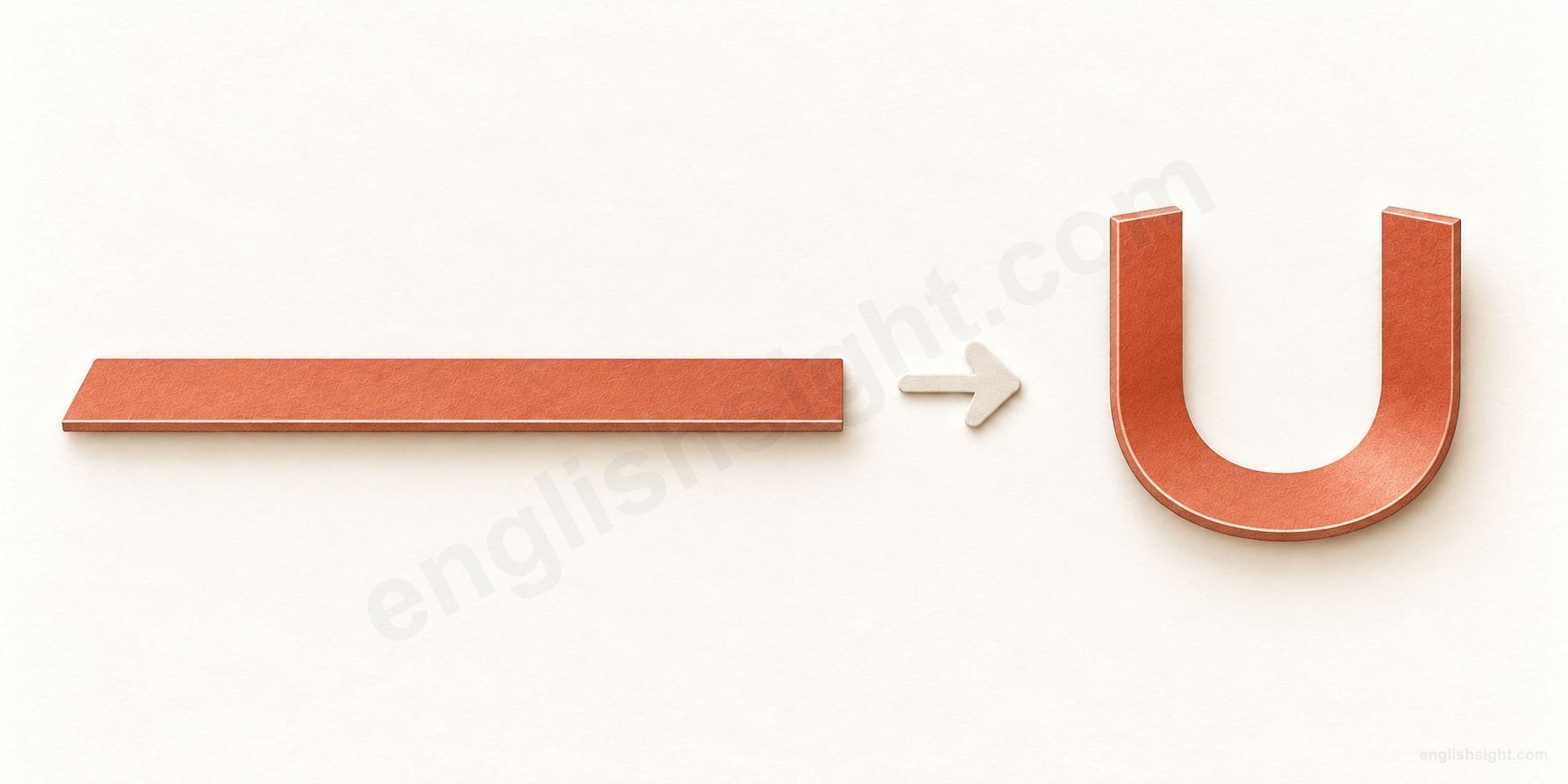
A straight strip made of copper.
copper
The strip is U-shaped and still copper.
Bending changes the strip’s shape, not its material.
Different shape, same copper: the material keeps its name.
Copper names the material, rather than a particular shape or object. Bending a copper strip changes its shape while it remains copper.
This physical demonstration explains the material use. Colour descriptions borrow the metal’s appearance; coin names refer to associated objects. The police meaning and the fixed expression copper-bottomed need to be learned separately.
Copper usually names a reddish-brown metal. A strip, a pipe, and a wire can have different shapes but be made of the same material. This material idea is a useful starting point for understanding copper in everyday descriptions.
Some uses need their own explanation: copper can describe a colour, coppers can mean small coins in British English, and a copper can informally mean a police officer. The police meaning is a separate word history, not a story about someone made of metal.
01
Name the material and its uses
Start with the substance, then use the surrounding words to identify an object, its source, or its price. These are connected applications of the material meaning.
01
be made of copper; some / a piece of / an amount of copper
made of copper
made from the reddish-brown metal
Starting situation
You want to identify what a strip is made of.
What the expression tells us
You name its material rather than its shape.
Copper is normally an uncountable material noun.
In This strip is made of copper, strip names the object and copper names the substance. The bent strip in the sketch remains copper: changing an object’s shape does not automatically change its material.
Use some copper, a piece of copper, or two kilos of copper when an amount matters. For the material, do not normally say a copper or two coppers. Copper is valuable uses singular agreement because the subject names a substance.
Copper can carry heat and electricity, which helps explain its use in cookware and wiring. The chemical symbol is Cu. Brass and bronze are copper alloys—mixtures containing copper—not simply alternative names for pure copper.
In a sentence
The artist bent a thin strip made of copper into a small ring.
Watch the difference A copper object is countable; copper as its material is not. Say two copper rings, not two coppers, for two rings.
02
copper + object noun; copper-plated + object noun
copper wire / copper pipes
objects or components identified by their material
Starting situation
You compare wire or pipe materials for a job.
What the expression tells us
Copper tells the listener which material you mean.
The following noun names the object and carries any plural ending.
Copper before a noun often specifies material: copper wire, a copper pipe, copper pans. The last noun determines what kind of thing is being discussed. A copper pipe is a pipe; it is not a special grammatical form of the material noun.
Keep copper unchanged when the object is plural: one copper pipe, several copper pipes. Wire can itself be uncountable in some copper wire or countable when separate wires are meant in three copper wires.
Not every phrase beginning with copper says that the whole object is solid copper. Copper wiring identifies the conducting material; copper-plated describes a surface layer. The words after or attached to copper refine the relationship.
In a sentence
We replaced the old pipes with new copper pipes.
Watch the difference For a coating, say copper-plated. A copper-coloured object may only have the colour, with no copper in it.
03
a copper mine; produce / contain copper; the price of copper; copper prices
a copper mine / the price of copper
the metal as a resource or commodity
Starting situation
You read a report about mining or metal prices.
What the expression tells us
Copper identifies the resource being extracted or sold.
The noun following copper need not be made of copper.
A copper mine is a place where copper is extracted, not a mine built from copper. Copper ore is rock from which copper can be obtained. Copper mining names the activity. The main noun tells you how it is connected to the metal.
Produce copper and contain copper use the same uncountable material noun as made of copper. In the price of copper, the discussion concerns the metal as a traded material, rather than a single coin.
You can also see copper prices, with the material noun before the plural prices. The plural belongs to prices; it does not turn the metal into coppers.
In a sentence
The report says the price of copper has risen this month.
Watch the difference Interpret the relationship from the whole phrase: copper pipes are made of the metal; a copper mine produces it.
02
Describe a colour
A thing can resemble copper in colour without containing any copper. Keep appearance separate from composition.
The comparison identifies a colour, not a substance.
A colour word can borrow the appearance of a material.
Copper-coloured hair describes colour; the hair is not made of metal. American spelling is copper-colored. A copper shade similarly uses copper as a colour description before a noun. Collins labels its bare colour adjective literary; the explicit -coloured form makes the comparison especially clear.
Copper can also name the colour itself: The fabric comes in copper and black. Here in introduces an available colour. By contrast, an artist who works in copper uses the metal as a medium. The surrounding activity resolves the difference.
Coppery is a related adjective meaning resembling copper, especially in colour: coppery hair. These appearance uses connect to the metal’s characteristic look, but colour alone does not establish what something is made of.
In a sentence
In the afternoon light, her hair looked copper-coloured.
Watch the difference Copper-coloured describes appearance; made of copper describes composition. A painted plastic object can be copper-coloured.
03
Recognize British uses and a fixed expression
Countable forms and an established compound introduce other meanings. Context and register matter more than the metal picture here.
05
a few / some coppers; a copper (one low-value coin)
a few coppers
a few small brown coins of low value
Starting situation
You look for small change in your pocket.
What the expression tells us
Coppers refers to individual low-value coins.
This British use counts coins rather than an amount of metal.
In British English, especially informal conversation, coppers can mean small brown coins. A few coppers means a few such coins; the phrase does not specify their exact total value.
This use is connected with copper or bronze coins, but it is a familiar coin name, not a precise statement of a modern coin’s composition. Collins also records the singular a copper for one such coin; Oxford presents the usual plural coppers.
Compare some copper, an amount of metal, with some coppers, several coins. Small change is a broader expression for low-value money and need not mean only brown coins.
In a sentence
I found a few coppers at the bottom of my bag.
Watch the difference Do not use coppers as the normal plural of the metal. The coin meaning is mainly British and depends on context.
06
a copper; plural coppers (British, informal)
a copper
a police officer, in informal British English
Starting situation
Someone is talking informally about the police.
What the expression tells us
A copper names one officer, and coppers can name several.
This is a separate informal person noun.
A copper can mean a police officer in informal British English. It is countable: one copper, two coppers. Police officer is the neutral expression to choose in a formal report or when you want to avoid slang.
The setting distinguishes officers from coins: coppers directing traffic are people, while coppers in a purse are probably coins. Neither interpretation is the uncountable material use.
Oxford and Collins give this word a separate history connected with cop. Do not invent a link through the metal, uniforms, or badges to explain it. The strip diagram does not represent this meaning.
In a sentence
“Ask that copper by the crossing,” said Ben.
Watch the difference Copper is not the neutral term for an officer in every variety of English. In international or formal communication, use police officer.
07
a copper-bottomed + guarantee / assurance (British)
a copper-bottomed guarantee
a guarantee presented as completely dependable
Starting situation
A speaker wants to stress that a promise can be relied on.
What the expression tells us
The compound adjective strongly emphasizes reliability.
Learn the established figurative compound as a whole.
In British English, copper-bottomed can figuratively describe something presented as completely reliable, as in a copper-bottomed guarantee. This is a useful expression to recognize, rather than the main everyday meaning of copper.
The figurative meaning belongs to the whole compound. A plain copper guarantee does not have the same established meaning. The speaker’s description also does not prove that a promise will actually be kept.
Keep the hyphen in copper-bottomed before a noun. The literal reading of a copper-bottomed pan concerns its copper bottom; with a guarantee, the reliability reading is intended.
In a sentence
The company promised a copper-bottomed guarantee of a full refund.
Watch the difference Do not extend this figurative meaning to copper on its own. A claim of reliability is still a claim that may need checking.
Material, appearance, or a countable thing?
Listen for the noun and the setting
Copper as metal is uncountable; copper before pipes identifies their material. A copper and coppers can instead name coins or, informally in Britain, police officers. Articles, plural endings, and context help select the reading.
Do not turn a colour into a chemical claim
Copper-coloured and coppery describe resemblance. Brass and bronze contain copper but are alloys, not pure copper. A copper-plated object has a copper surface layer; the whole object need not be made of copper.
Boundaries of this lesson
The specialist verb copper means coat with copper; its forms are coppers, coppered, coppering. It is not a common particle-verb family. Historical washing boilers called coppers, copper butterflies, technical chemical compounds, and specialized gambling uses are not developed here. This selection supports practical reading without claiming every dictionary use.
Pronunciation and spelling
The stress is on the first syllable: British /ˈkɒpə(r)/, American /ˈkɑːpər/. The chemical symbol is Cu, with a capital C and a small u; write copper in lowercase in an ordinary sentence.
Choose the intended meaning
Use the construction and the situation, rather than translating copper the same way every time.
1. You need to describe an amount of the metal. Which expression fits?
2. A plastic bowl has a reddish-brown finish but contains no metal. Which description fits?
3. In a British conversation, someone says, “There are a few coppers in my purse.” What is the likely meaning?
4. A report mentions a copper mine. What does copper tell you?
5. A British advertisement offers a copper-bottomed guarantee. What is being emphasized?
Sources and teaching notes
The dictionary entries below support the meanings and usage distinctions. The explanations, examples, and diagram are original teaching material. The sketch illustrates material identity through a change of shape; it does not explain the unrelated police meaning.
The diagram is a teaching aid, not an image shared by every native speaker.