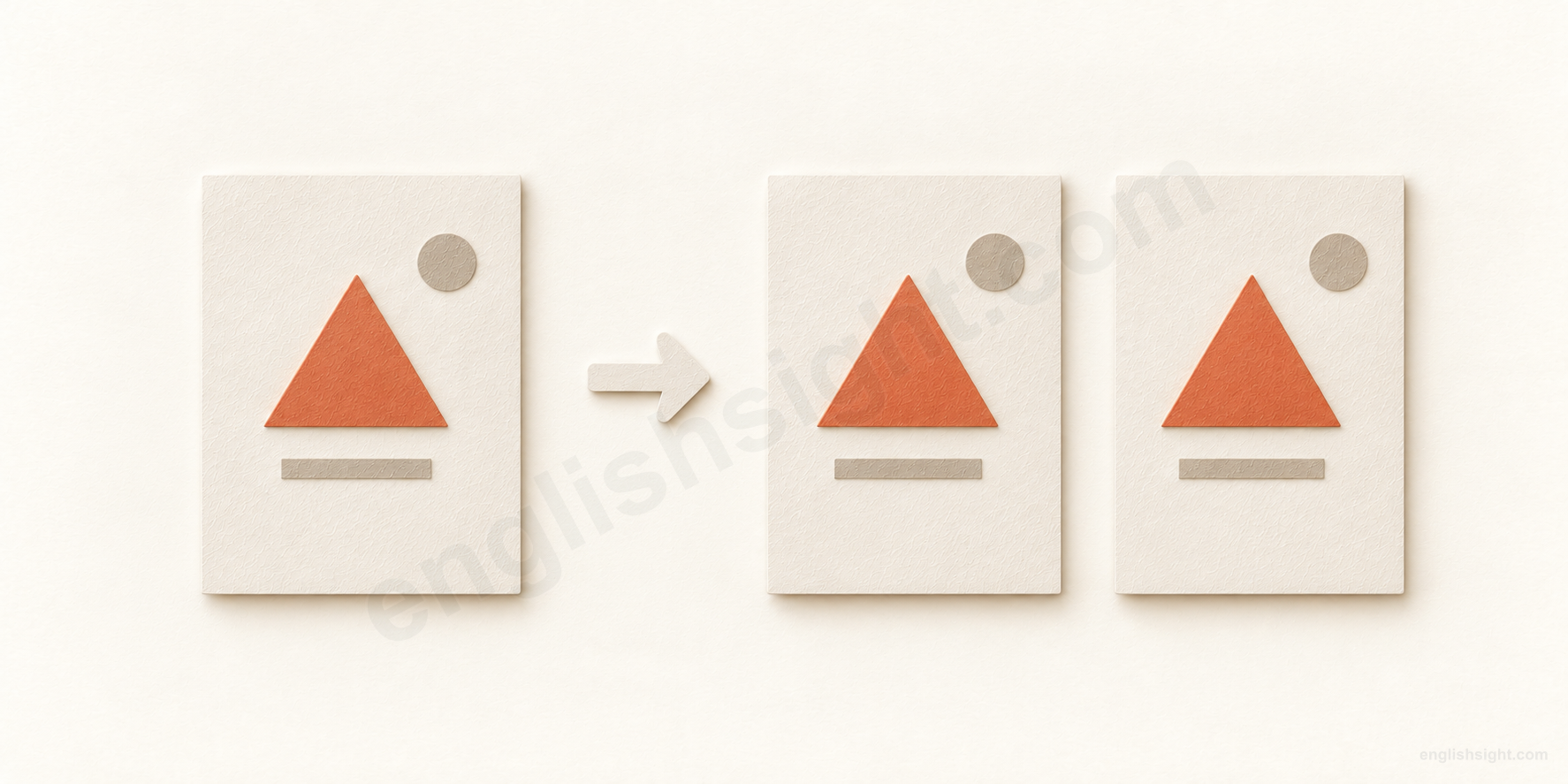
Connect copies, copying, and familiar expressions without treating them all as photocopying.
Reproduce a pattern while the source remains
Reproduce a pattern while the source remains
One source sheet
copy
The source remains beside a new copy
Reproduce its pattern on another sheet.
The source remains while another sheet repeats its pattern.
Use an existing thing as a model to produce another version that preserves its content or form.
This model connects reproduction, transcription, digital duplication, and imitation. It does not define every use: publication text and radio acknowledgment need separate explanations. A copy may be imperfect, and copying need not be dishonest.
A useful starting point is a relationship: something already exists, and another version reproduces its content, form, or behavior. Copy can name the new item or the act of making it.
A bookshop’s copy, a writer’s advertising copy, and a radio operator’s I copy belong to different established uses. The construction and situation help you choose the right interpretation.
01
Copies you can count
A copy can be a reproduced object or one item in a published set. Modifiers tell you about its form, resemblance, finish, or date.
01
a copy of + noun; make / keep / send + a copy
a copy of the document
another version made from an existing thing
Source / situation
You have a signed document.
Result / relationship
You keep the signed original and send a reproduced version.
The copy is a separate item related to an original.
Use a copy of something to identify what was reproduced. You can make, keep, send, or attach a copy. A copy may preserve the content without sharing the original’s material or status.
Compare the original with a copy. An exact copy stresses matching details; a poor copy may differ noticeably. Copy alone does not guarantee perfection or mean a fake sold dishonestly.
In a sentence
Please send a copy of the receipt and keep the original.
Watch the difference Use of to name the original: a copy of the receipt, not a copy from the receipt in this noun pattern.
02
a copy of + title / publication; number + copies
a copy of a book
one individual item of a published work
Source / situation
A publisher has printed many books with the same content.
Result / relationship
You buy one individual book.
Copies counts items, rather than different titles or editions.
My copy of the novel means the particular item I own. Ten copies of the same book can all contain the same work; ten books can instead mean ten different titles.
This copy need not be a photocopy or an imitation. A shop sells authorized copies too. An edition concerns a published version; many copies may belong to one edition.
In a sentence
The library ordered four copies of the same novel.
Watch the difference The plural is copies. Four copies does not mean four different novels.
03
a hard copy of + noun; in hard copy
a hard copy
information printed on paper
Source / situation
The information is on a computer.
Result / relationship
You have the information on paper.
Hard describes the medium, not how difficult the text is.
A hard copy is a paper printout. It contrasts with an electronic or digital copy. The paper may show a document that also remains on a computer.
Use a hard copy for one item, two hard copies for two items, or in hard copy for the format. A printed copy can be a draft; hard does not mean final, official, or legally certified.
In a sentence
Bring a hard copy of the timetable in case your phone stops working.
Watch the difference A hard copy is not a difficult copy. A digital copy is not automatically a backup unless it is kept for recovery.
04
be + a carbon copy of + person / thing
a carbon copy of…
a literal duplicate made with carbon paper, or a very close likeness
Source / situation
You compare a new design with an older one.
Result / relationship
You notice almost no difference.
The figurative expression stresses close resemblance.
Originally, carbon paper transferred writing onto another sheet underneath. A carbon copy could be the resulting document.
In figurative use, a person, event, or thing can be a carbon copy of another. This expresses striking similarity, without claiming that a person was literally manufactured or copied. It can sound critical when originality was expected.
In a sentence
Their new logo is a carbon copy of the old one.
Watch the difference Carbon copy is an established expression. It does not describe the carbon content or color of a similar object.
05
make / write + a fair copy of + writing
a fair copy
a neat version made after corrections
Source / situation
Your draft contains crossings-out and changes.
Result / relationship
You produce a clean version with the changes incorporated.
Fair refers to a finished, neat presentation in this expression.
Especially in British English, a fair copy is a neat written or printed version prepared after the final changes. It contrasts with a rough draft.
This is a useful recognition phrase in writing and education, though clean copy or final version may be clearer in general conversation. A fair copy is not simply any photocopy, and fair does not mean impartial here.
In a sentence
After correcting the draft, I wrote a fair copy of the letter.
Watch the difference A fair copy is about neatness after revision, not a fair opinion or a free copy.
06
a back copy of + newspaper / magazine; back copies
a back copy of a magazine
a copy from an earlier issue
Source / situation
You need an article from last year.
Result / relationship
You find the magazine issue that contained it.
Back refers to an earlier publication date.
Back copy, especially British English, means a past issue of a newspaper or magazine. Back issue is also used in British and North American English.
It is still a countable copy, but back specifies its date relative to the current issue. It does not mean the back cover, a reversed image, or an extra copy kept as a backup.
In a sentence
I found the interview in a back copy of the magazine.
Watch the difference A back copy is an old issue; a backup copy is saved for recovery. They are different expressions.
02
Reproducing words, pictures, and files
The object names what is reproduced. Other words identify the source, the destination, or the particular copying task.
07
copy + object; be copied; have + object + copied
copy a drawing
make another version using an existing one as the model
Source / situation
One drawing supplies the pattern.
Result / relationship
Another drawing reproduces its features.
The object after copy is what is reproduced.
Copy a drawing can mean draw it again from the model. Copy a document can mean use a copier; photocopy makes that method explicit.
Copy is also used in the passive: The design was copied. In ordinary context, copying leaves the model available; it does not itself mean giving it away. Have the page copied uses have to arrange the work, not a special meaning of copy.
In a sentence
Maya copied the pattern onto a fresh sheet of paper.
Watch the difference Say copy the pattern to name the model. Copy is not normally followed by someone to do something as a causative construction.
08
copy + content + from + source + into / onto + destination
copy words from… into…
write existing information again at another location
Source / situation
An address is written on an envelope.
Result / relationship
You enter the same address in your notebook.
From names the source; into or onto names the destination.
In copy the address from the envelope into my notebook, the address is the content, the envelope is its source, and the notebook is its new location. Onto a card highlights a writing surface.
Copying preserves the wording or information; summarizing selects and rephrases it. The source can remain in place. In copy the address from my notebook, from identifies the source; in copy the address into my notebook, into identifies the destination. Neither construction says that the original information is removed.
In a sentence
I copied the address from the envelope into my notebook.
Watch the difference Do not confuse source and destination. Copy into my notebook does not mean learn the notebook by heart.
09
copy down + noun; copy + noun / pronoun + down
copy it down
record words or information accurately in writing
Source / situation
You see or hear information you need to retain.
Result / relationship
You have an accurate written record.
Down marks recording, not a lower physical destination.
Copy down can refer to spoken words as well as visible writing. When a teacher says an address aloud, you can copy it down.
With a noun, copy down the number and copy the number down are both possible. With a pronoun, say copy it down. Compare take notes, which can involve choosing and shortening ideas rather than recording them exactly.
In a sentence
She read the code aloud, and I copied it down.
Watch the difference Use copy it down, not copy down it. Down does not tell you where to move the source.
10
copy out + noun; copy + noun / pronoun + out
copy a passage out
write existing text again
Source / situation
A passage is printed in a book.
Result / relationship
You have written that passage separately.
Out presents the act of writing a separate version of supplied text.
Copy out overlaps with the writing sense of copy. It commonly describes writing an existing passage again rather than composing new wording. It need not involve a printer.
Both copy out the passage and copy the passage out are possible; use copy it out with a pronoun. Copy out a poem reproduces it, while write a poem can mean compose it. Out does not mean erase the original.
In a sentence
I copied the short poem out by hand for my grandmother.
Watch the difference Use copy it out, not copy out it. Out alone does not guarantee that the version is neat or error-free.
11
copy + data + to / into / onto + destination; copy and paste + content
copy and paste
duplicate digital content and insert it somewhere
Source / situation
A link or file is available at a source.
Result / relationship
The same content is available at a chosen destination.
Copy duplicates content; paste inserts copied content at a location.
Copy a file to another folder creates another instance there. Copy text to the clipboard prepares it for pasting; copying alone may not visibly insert it into the document.
Compare cut and paste or move a file, which normally relocates the selected content rather than leaving a second instance at the source. Copy and paste is a coordinated pair of commands, not one particle verb.
In a sentence
Copy the link and paste it into the message.
Watch the difference After copy, to identifies a destination. Copying is not the same command as cutting, moving, or saving every later change.
03
Following people and including recipients
People can provide a model, supply answers dishonestly, or receive a message. The construction distinguishes these relationships.
12
copy + person / behavior / style; copy + what-clause
copy someone’s behavior
use someone or something as a model for your own behavior
Source / situation
A child observes an older child’s actions.
Result / relationship
The child performs similar actions.
Behavior can be reproduced without making another physical object.
Copy someone, copy their style, and copy what they do describe following a model. Here the matching features are actions or choices, rather than marks on paper.
Copying may be part of learning, or it may be criticized as unoriginal. The verb alone does not say that admiration is always the reason. Mimic often highlights close imitation of voice or manner, while copy can cover a wider model such as a method or design.
In a sentence
The younger children copied the steps their coach showed them.
Watch the difference Copy me can mean do as I do. It does not normally mean make a physical duplicate of me.
13
copy; copy + answers / work; copy from / off + person
copy from / off another student
dishonestly use someone else’s answers as your own
Source / situation
A student is expected to provide independent answers.
Result / relationship
The student submits answers taken from another student.
The assessment context supplies the dishonest use.
Copy can stand alone in this sense: He was caught copying. Copy someone’s answers names the material; copy from someone or copy off someone names its source.
Off is a preposition here: copying off her, not copying her off. Copying a useful demonstration is not automatically cheating. In assessed work, presenting borrowed answers as your own is what makes this use dishonest.
In a sentence
Nina was caught copying from the student beside her during the test.
Watch the difference Copy off someone is not separable like copy something out. Say copy off him, not copy him off.
14
copy + person + in (on + message); copy + person + on + message; be copied in on / on + message
copy me in on the email
include someone among the people receiving a message
Source / situation
An email is going to a main recipient.
Result / relationship
An additional person receives the message too.
The person after copy is a recipient, not a model to imitate.
Copy someone in on an email means send them a copy of the message being sent to someone else. On introduces the message or correspondence; in marks inclusion among recipients.
Please copy me in and I was copied in on the email are natural active and passive forms. With me, place the pronoun before in. This use distributes information; it does not mean mimic the recipient or record that person’s words.
Copy someone on an email is another standard way to express this recipient meaning: I have copied Leila on this message. In email, cc stands for carbon copy; to cc someone is to include them as an additional recipient. Neither wording means that they are the author of the message.
In a sentence
Please copy Leila in on the email about Friday’s meeting.
Watch the difference Say copy me in on it, not copy in me on it. Distinguish copy the email, which names the content, from copy me in, which names a recipient.
04
Text for publication and messages received
Some established uses need their own explanation: publishing copy is material to use, while radio copy acknowledges a message.
15
write / edit + copy; advertising / news + copy
write advertising copy
prepare words for publication or promotion
Source / situation
An advertisement needs wording as well as images.
Result / relationship
A writer supplies the text.
Uncountable copy names text as material, not individual duplicates.
Advertising copy is the wording of an advertisement. News copy is written material prepared for publication or broadcast. A copy editor checks such text, and a copywriter writes promotional wording.
This copy can be newly written. It does not imply that the writer copied somebody else. Compare two copies of the advertisement, which counts reproduced items, with some advertising copy, which refers to its wording.
In a sentence
Rosa writes the copy for our online advertisements.
Watch the difference Use some copy or the copy for text material. Two copies normally counts items, not two pieces of advertising text.
16
person / event / story + make + good copy
make good copy
provide interesting material for news or an article
Source / situation
A journalist hears an unusual story.
Result / relationship
The journalist sees material that could interest readers.
Good evaluates the usefulness of a story as publishable material.
In journalism, a person’s remarks or an event can make good copy: they provide something worth writing about. The event itself need not be good or pleasant.
This is a publishing expression, not the everyday countable meaning of an accurate duplicate. Compare The story makes good copy with This is a good copy of the letter, which evaluates a reproduced item.
In a sentence
The unexpected reunion made good copy for the local paper.
Watch the difference There is no a in make good copy. Make a good copy means produce a good reproduction.
17
do you copy?; I copy; copy that
Do you copy?
check whether a radio message has been received and understood
Source / situation
An operator sends instructions over the radio.
Result / relationship
The other operator confirms reception.
Here copy concerns communication, not making a printed duplicate.
In radio or military communication, Do you copy? asks whether the message is being received and understood. I copy or Copy that can acknowledge it.
The radio meaning is an established use and cannot be predicted simply from a picture of two sheets. In ordinary conversation, Did you get that? or Do you understand? is usually more neutral. Copy that is also used informally in imitation of radio language.
In a sentence
“Wait at the gate. Do you copy?” “I copy.”
Watch the difference An acknowledgment of reception does not prove the instruction has already been carried out.
Read the object, the grammar, and the situation
Forms and pronunciation
The noun plural and third-person verb form are copies; the past and past participle are copied; the -ing form is copying. The usual pronunciations are /ˈkɒpi/ in British English and /ˈkɑːpi/ in American English. Both noun and verb have first-syllable stress.
Countable items and uncountable material
Use a copy or several copies for individual reproductions and published items. Use copy without a or a plural when you mean text material for publication. The two uses can appear together: we edited the copy, then printed fifty copies of the leaflet.
Actions, passives, and quality
Copying is an action: I am copying the file is ordinary English. The page was copied is a passive. This page does not copy well describes a poor reproduction result, with the page as subject. A “No copying” sign usually forbids duplication or cheating according to context.
Resemblance is not permission
Copy does not by itself establish whether copying is allowed, whether the result is accurate, or whether somebody claims it as original. A copy of a painting can be an openly described reproduction; calling it the original would make a different claim.
Scope of this lesson
The lesson covers modern general noun and verb uses, practical particle combinations, and selected publishing and radio expressions for recognition. Historical senses meaning a model to imitate, the regional notebook sense, and specialized biological or printing terminology are not developed here.
Choose what copy is doing
Use the whole expression and its context, not one fixed translation.
1. A library orders six copies of one novel. What is being counted?
2. Your colleague reads a code aloud. Choose the natural request to record it accurately.
3. “Please copy me in on the email.” What does the speaker want?
4. Rosa has a job writing advertising copy. What does she produce?
5. You copy a file to another folder. What normally distinguishes copying from moving?
6. An operator replies “I copy” after an instruction. What does that establish?
Sources and teaching notes
The sources below were consulted for meanings, grammar, and established expressions. Explanations and examples are original. The visual connection is a teaching model, not a dictionary claim about a universal mental image.
The diagram is a teaching aid; different speakers need not imagine the same picture.