Recognize cord as string, an electrical lead, a body structure, and part of established expressions.
A flexible length used to bind or connect
A flexible length used to bind or connect
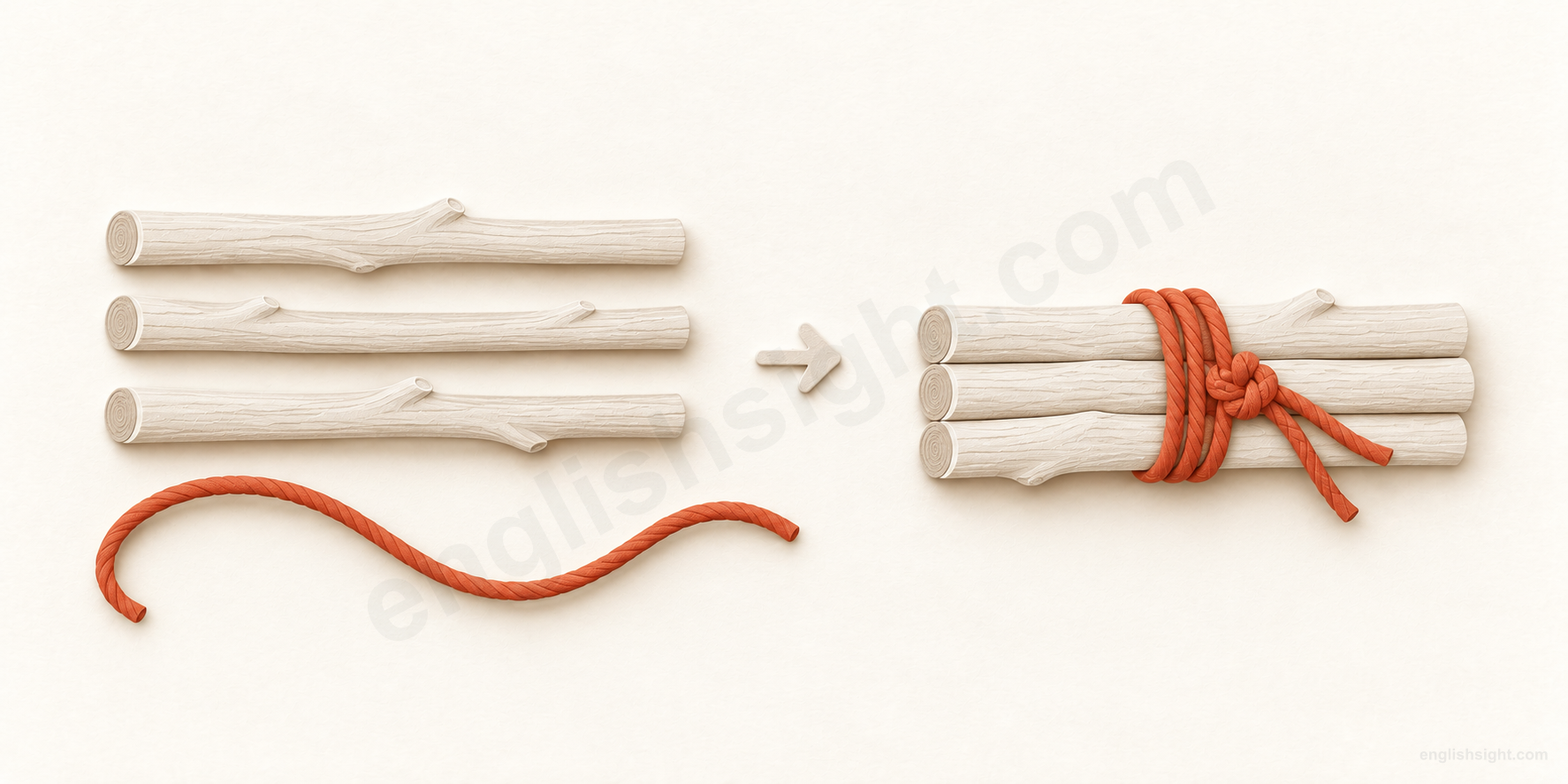
Three sticks lie loose beside a length of cord.
cord
The cord holds the three sticks together in a bundle.
The flexible cord wraps around the sticks and is tied.
Flexible cord bends around the sticks and holds them together.
A cord is a long, slender, flexible length, often made of strands, that can be used to tie or connect things.
Binding a bundle illustrates one use. Electrical cords and body compounds have their own functions; the clothing and wood-measure senses must be learned separately.
Picture a length that bends around something or runs between things. This helps with ordinary cord and some extended uses, but it cannot predict every compound or idiom.
Start with the object, then read the surrounding words: a power cord, the spinal cord, and a pair of cords belong to different situations.
01
Tying, pulling, and connecting
Start with the flexible physical object. The surrounding words tell you its material and purpose.
01
some cord; a length / piece of cord; tie something with cord; tie a cord around something
a cord / a length of cord
strong flexible string used to fasten or hold things
Situation
Several small sticks lie loose.
What is described
A length of cord holds them in a bundle.
Cord names the material or a particular length; tie names the action.
Cord is typically thicker than ordinary string and lighter than a heavy rope, though these names overlap. Nylon cord and cotton cord specify the material. A cord can bend around an object; it is not a rigid rod.
Use some cord for an unspecified amount, a length or piece of cord for a portion, and two cords for separate lengths. In tie the sticks together with cord, with introduces the material used. Tie a cord around the bundle puts the cord itself after tie.
In a sentence
We tied the sticks together with a length of cord.
Watch the difference There is no exact thickness that always separates string, cord, and rope. Do not call every thin line a cord.
02
a pull cord; pull + the cord; the cord on / for something
pull the cord
operate something by pulling an attached cord
Situation
A light has a cord hanging from its switch.
What is described
Someone pulls the cord and changes the light setting.
The cord transmits a pull to a mechanism.
A pull cord operates a device when someone pulls it. A blind cord, a light-switch cord, and a starter cord have different jobs; the object and context identify the mechanism.
Pull the cord is an ordinary verb plus its noun object. Pull does not become part of a phrasal verb with cord. An emergency cord is provided for a particular emergency function; the words alone do not tell you exactly what it activates.
In a sentence
Pull the cord to switch on the bathroom light.
Watch the difference A pull cord need not carry electricity. A power cord and a pull cord name different functions.
03
a power / electrical cord; plug in / unplug / coil a cord
a power cord
a flexible covered electrical cable for equipment
Situation
A lamp needs an electrical connection.
What is described
Its cord links it to a power supply.
Here cord names an insulated electrical connection, not tying string.
A power cord or electrical cord connects equipment to a power supply. The cable has a protective covering. Cord can refer to the whole flexible lead, rather than just a metal wire inside it.
You can plug in a cord, unplug it, or coil it for storage. These verbs describe what happens to the cord; they do not change the noun’s meaning. British speakers also use lead or flex for this kind of connection.
In a sentence
The lamp’s power cord is too short to reach the socket.
Watch the difference Cord does not mean every cable. Choose a specific name when the connection type matters.
04
an extension cord; an extension cord for + equipment
an extension cord
an extra electrical lead that provides greater reach
Situation
An appliance’s lead cannot reach the outlet.
What is described
An additional lead bridges the distance.
Extension specifies extra reach, not a thicker kind of cord.
An extension cord has a plug at one end and a socket at the other so that equipment can connect from farther away. The term is especially associated with American English; extension lead is a familiar British term.
The compound is a countable noun: an extension cord, two extension cords. In an extension cord for the lamp, for names its intended use; it does not make a new idiom.
In a sentence
We need an extension cord for the projector.
Watch the difference An extension cord is an electrical item, not an extra piece of string.
02
Three names for body structures
Learn these compounds as names. Resemblance to a cord helps explain their shape, but they are living tissue.
05
the spinal cord; a spinal cord injury
the spinal cord
the long structure of nervous tissue inside the backbone
Situation
A biology class studies communication within the body.
What is described
The teacher identifies the spinal cord in a diagram.
Spinal identifies a particular cord-shaped body structure.
The spinal cord extends from the brain down inside the spinal canal. It carries nerve signals and is also involved in reflexes. It is nervous tissue, not a length of ordinary cord.
Use the full compound in general conversation. The spine or backbone is the supporting bony structure; the spinal cord is the nervous tissue within it. In spinal cord injury, the compound modifies injury.
In a sentence
The teacher showed us where the spinal cord runs inside the backbone.
Watch the difference Spinal cord and spine are related terms, but they do not name the same structure.
06
the umbilical cord; cut the umbilical cord
the umbilical cord
the connection between a developing baby and the placenta
Situation
A diagram shows a baby developing before birth.
What is described
A cord connects the baby to the placenta.
This cord carries substances between the developing baby and the placenta.
The umbilical cord connects the developing baby at the navel to the placenta. It contains blood vessels. Learn umbilical cord as a whole name, rather than trying to infer its precise anatomy from cord alone.
After the full term has been introduced, the cord can refer back to it in a birth-related context. Cut the umbilical cord can describe a literal action at birth; the independence idiom in the next group is a figurative use.
In a sentence
The illustration shows the baby’s umbilical cord attached to the placenta.
Watch the difference The cord attaches to the placenta, not directly to the mother’s stomach.
07
the / someone’s vocal cords; vocal cord + noun
the vocal cords
folds of tissue that vibrate to produce the voice
Situation
Someone is learning how speech sounds are made.
What is described
They identify the vibrating folds in the voice box.
Vocal cords are body tissue, not strings placed in the throat.
In everyday use, the term vocal cords refers to the folds in the larynx, or voice box, that vibrate in voice production. Vocal folds is another term. The familiar expression normally uses the plural: my vocal cords, her vocal cords.
Cord and chord sound alike. Use vocal cords as the standard spelling in this lesson. Musical chord is a different word, used for notes sounded together; a guitar string is called a string, not a guitar chord.
In a sentence
The singer explained how her vocal cords vibrate when she sings.
Watch the difference Do not replace cords with chords when writing about ordinary rope or electrical cord. Vocal chords is a recorded variant, but vocal cords is the spelling taught here.
03
Ending a connection
Cut the cord can describe independence or a change in television service. Context selects the meaning.
08
cut the cord; cut the umbilical cord
cut the (umbilical) cord
stop depending on another person or organization
Situation
An adult relies on a parent to make every decision.
What is described
The adult begins making decisions independently.
The cord is a metaphor for a dependence that is being ended.
Cut the cord and cut the umbilical cord can mean becoming independent. The birth connection supplies the metaphor, but the speaker is talking about a relationship or support arrangement, not performing a physical cut.
The expression can sound forceful: it suggests an existing dependence needs to end. Cutting the cord does not necessarily mean ending all affection or contact. The context tells you what kind of independence is intended.
In a sentence
He asks his parents to make every decision; it is time for him to cut the cord.
Watch the difference This is an established idiom. Cord by itself does not ordinarily mean an independent decision.
09
cut the cord (on cable TV); cord-cutting; a cord-cutter
cut the cord on cable TV
cancel a cable television subscription
Situation
A household pays for cable television.
What is described
It cancels the subscription and chooses other ways to watch.
The same expression has a specific media-service meaning.
In discussions of television, cutting the cord means giving up a cable TV subscription, often in favor of internet-based viewing. It does not mean taking scissors to a cable. A cord-cutter is a person who does this; cord-cutting names the practice.
Context matters: We cut the cord last month could refer to television or to ending dependence. Mention cable TV or streaming if the intended meaning is not already clear. The expression does not mean that every physical cable in the home disappears.
In a sentence
We cut the cord on cable TV and now watch films online.
Watch the difference The media meaning is a conventional use of the full phrase, not a new meaning of the verb cord.
04
Clothes and a regional measure
These established meanings need their own context; you cannot infer them simply from tying something.
10
a pair of cords; cords + plural verb; a cord jacket
a pair of cords
trousers made of corduroy, a fabric with raised parallel ribs
Situation
Someone chooses clothes for a cool day.
What is described
They choose trousers made from ribbed fabric.
In clothing, cords can name trousers rather than several ropes.
Cords is a shortened name for corduroy trousers. Say a pair of cords, two pairs of cords, or These cords are comfortable. The plural noun works like trousers; it does not mean two separate cords used for tying.
Cord can also name the fabric or describe a garment: a cord jacket, cord trousers. The raised ribs provide a connection with the shape of a cord, but you need the clothing context to recognize this meaning.
In a sentence
These brown cords go well with your blue shirt.
Watch the difference For one garment, say a pair of cords, not a cord. A cord jacket is made of corduroy; it is not simply a jacket with a cord attached.
11
a cord of wood; two cords of firewood
a cord of wood
a North American volume measure used for firewood
Situation
A seller offers firewood by volume.
What is described
The buyer orders a measured quantity called a cord.
This use measures a stack, not a length of rope.
A full cord of wood is a stacked volume of 128 cubic feet, conventionally 4 feet high, 4 feet wide, and 8 feet long. The measure includes the spaces between the stacked pieces; it is not a weight.
Use a cord of wood or two cords of firewood. This regional trade use is useful to recognize when reading North American firewood advertisements, but it is separate from the ordinary flexible-material sense.
In a sentence
They ordered two cords of firewood for the winter.
Watch the difference A cord is a volume measure, not a kilogram or a fixed number of logs. Do not assume other named wood measures are identical.
Shape helps, but context decides
Cord and chord
They sound alike. A cord can be string or an electrical lead; a musical chord is a combination of notes. Write strike a chord for an emotional response, not strike a cord. The spelling vocal cords is used throughout this lesson.
Noun, material, and plural
Some cord names material; a cord names one length or item. Cords can be separate lengths or, in a clothing context, corduroy trousers. A pair of cords is one garment.
A less usual verb
Dictionaries also list cord, corded, cording as a transitive verb meaning to bind, connect, or supply with cord, and to stack wood in cords. In ordinary instructions, tie with cord is usually clearer. These verbs are recognized here rather than expanded into a phrasal-verb family.
Limits of the connection model
The picture is a teaching aid, not a shared mental image claimed for every speaker. Anatomical names, the clothing use, and the firewood measure need their established meanings; a single drawing cannot derive them all.
Choose from the context
Look at the object, the situation, and the whole expression.
1. You need an unspecified amount of strong string to tie a parcel. Which request fits?
2. The projector’s lead cannot reach the outlet. Which item provides extra electrical reach?
3. Which term names nervous tissue inside the backbone?
4. A family says, “We cut the cord on cable TV.” What happened?
5. An adult begins making decisions without relying on a parent. Which expression fits?
Sources and teaching notes
The sources below support the uses and distinctions taught here. Explanations and examples are original; the bundle diagram is a teaching illustration, not a dictionary claim about how everyone thinks.
The diagram illustrates how flexible cord can bind a bundle. It does not represent every use of the word.