Distinguish cork as a material from a cork as an object, then follow the bottle-related expressions.
From material to a fitted stopper
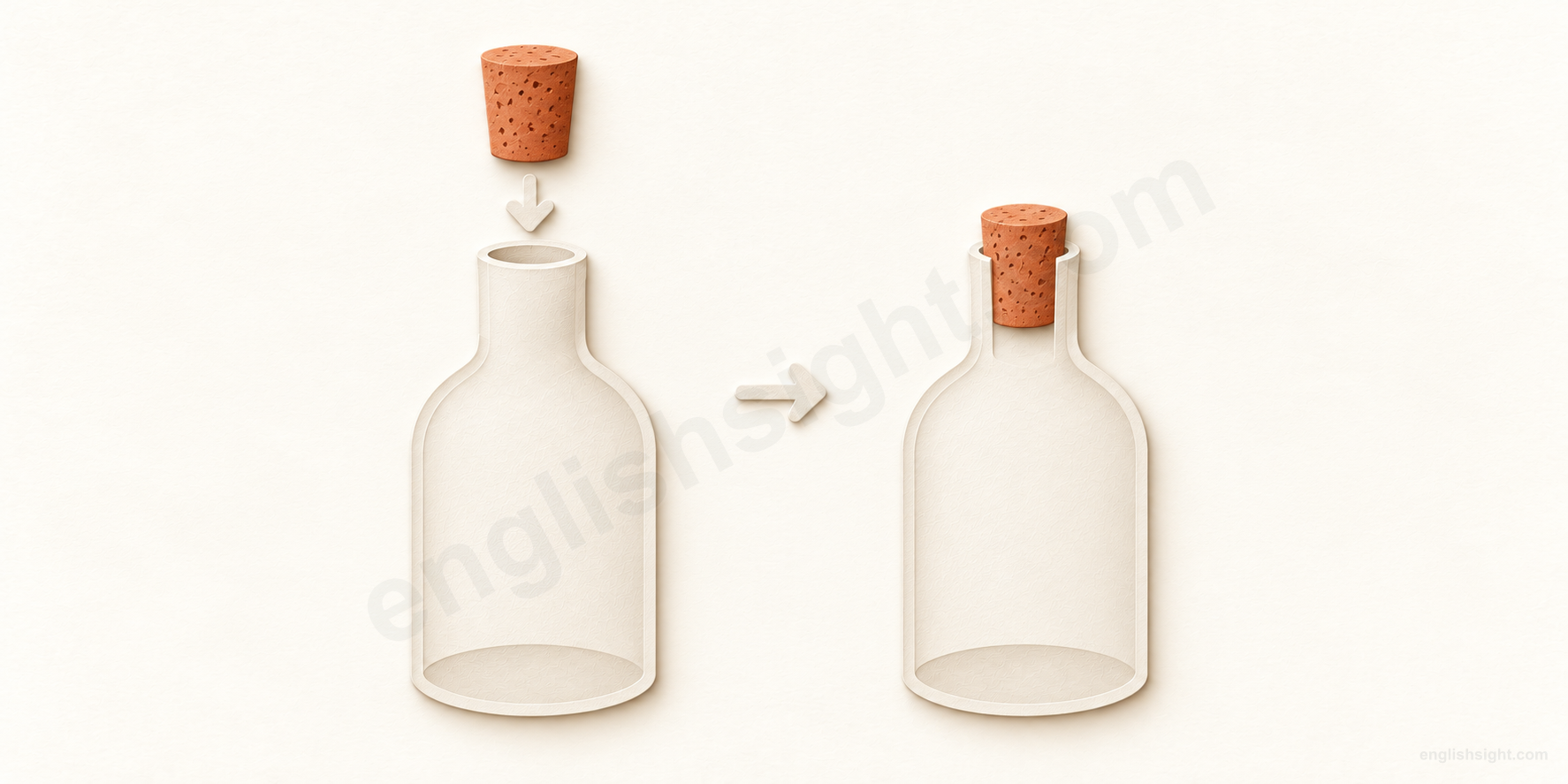
From an open neck to a fitted stopper
A cork stopper is separate above the open bottle neck.
cork
The fitted stopper closes the same bottle.
The stopper moves down into the opening.
A cork fits inside the neck; to cork a bottle is to close it this way.
Cork names a light, springy bark material; a shaped piece can fit into a bottle opening as a stopper.
The sketch focuses on the stopper-and-closure branch. Cork floors and corkboards use the same material without blocking a bottle; emotional expressions must be learned as expressions.
Cork names a light, springy material from tree bark. A piece shaped to fit a bottle neck is a cork, and to cork a bottle is to close it with one. Material, object, and action are related, but their grammar is different.
The bottle gives us a useful model for stopping and releasing, including some fixed emotional expressions. It does not explain every use of the material or let us invent new idioms freely.
01
The material and things made from it
Start with what cork is, then recognize material descriptions and a useful compound.
01
made of + cork; a piece / sheet of cork
made of cork
made from a light, springy bark material
Situation
You ask what a mat is made from.
Meaning in context
Cork identifies the material, not a bottle stopper.
Material cork is uncountable.
Cork is obtained from the thick outer bark of the cork oak. It is light and can be compressed and spring back. This material sense comes before any particular shape or use: cork need not be a plug.
Say made of cork or a piece of cork. Some cork means a quantity of the material; some corks means several individual stoppers. The article changes what you are counting.
Float like a cork is a transparent comparison with the light material or a floating stopper: The toy boat floated like a cork. Like supplies the comparison; cork does not mean float as a general-purpose verb.
Example
The mat is made of cork, so it feels light in my hand.
Watch the difference For the material, say This is cork, not This is a cork. A cork normally means one stopper.
02
cork + product noun; a corkboard
cork tiles / a corkboard
name products by their material
Situation
You choose a surface for a floor or a notice board.
Meaning in context
Cork tells you what the surface is made from.
In a material description, the following noun names the product.
A cork mat, cork tiles, and cork flooring are products made with this material. In cork tiles, tiles is plural; the material word cork stays unchanged. Dictionaries may label this use an adjective or treat it as a noun used before another noun.
A corkboard is a board with a cork surface, often used for pinning up notes. The solid spelling corkboard has its own dictionary entry; cork board is also used. This is a compound related to the material, not a new verb meaning to display information.
Example
We pinned the shopping list to the corkboard by the door.
Watch the difference Cork flooring is a surface material; corks on the floor would normally be loose bottle stoppers.
02
Stoppers, opening, closing, and wine
Follow the object into common bottle actions, and distinguish a closed bottle from corked wine.
03
a / the + cork; number + corks
a cork / two corks
an individual stopper fitted into a bottle opening
Situation
A bottle needs a small object to close its neck.
Meaning in context
A cork fits inside the opening.
The countable noun names the object by its established function.
A cork is normally a bottle stopper, especially one used for wine. A stopper of this kind may be made from natural cork or from a substitute such as plastic. The object name does not guarantee the material.
Use ordinary countable grammar: a cork, the cork, two corks. A plastic cork is therefore possible, although plastic is not the natural material cork.
A cap generally covers or screws onto a bottle opening; a cork fits into it. Stopper is the broader word for an object that closes an opening. A cork stopper makes the material or stopper type explicit.
Example
This bottle has a plastic cork rather than a screw cap.
Watch the difference Do not assume every bottle closure is a cork, or that every object called a cork is made of natural cork.
04
pull / take + the cork + out (of the bottle); draw the cork
pull / take / draw the cork out
remove the stopper to open a bottle
Situation
The cork blocks the neck of the bottle.
Meaning in context
The cork is out and the bottle is open.
The removal verb and out express the action; cork is its object.
Pull the cork out of the bottle describes removal. Take the cork out is a general alternative; draw the cork is an established expression for extracting it. These are ordinary verb-and-object patterns, not phrasal verbs headed by cork.
With a pronoun, say pull it out or take it out. With the noun, pull out the cork and pull the cork out are both possible. Out of the bottle identifies the container it leaves.
A corkscrew is a tool used to pull corks from bottles. Uncork the bottle also means remove its cork. The bottle is the object of uncork, whereas the stopper is the object of pull in pull the cork out.
Example
Maya used a corkscrew to pull the cork out of the bottle.
Watch the difference Cork the bottle closes it; uncork the bottle opens it. Removing the cork is not corking it.
05
pop + the cork; the cork + pop(s)
pop the cork / the cork pops
open with a popping sound, often in celebration
Situation
A bottle of sparkling wine is still closed.
Meaning in context
The cork comes out with a pop.
Pop can name the action or what the cork does.
Pop the cork describes opening the bottle with the characteristic sound. In The cork popped, the cork is the subject and comes out with that sound. This transitive/intransitive difference belongs to pop, not to a new sense of the verb cork.
Champagne corks were popping can suggest a celebration as well as describe bottle opening. The context supplies the festive occasion; an ordinary cork does not always pop when it is removed.
Keep the literal the cork separate from the possessive in blow his cork or pop his cork, which can refer to losing emotional control. Read the whole expression.
Example
When the team won, they popped the cork on a bottle of sparkling wine.
Watch the difference Pop the cork can describe celebration; blow your cork is an informal anger expression, not an instruction to open wine.
06
cork + container; cork + container + up; cork it up; be corked
cork the bottle / cork it up
close a container by fitting a cork into its opening
Situation
The bottle neck is open.
Meaning in context
A fitted cork closes it.
The verb takes the container as its object.
To cork a bottle is to close it with a cork. The noun names the stopper; the related verb names the act of fitting it. Forms are cork, corks, corked, corking. The bottle is the object: She corked the bottle, not She corked the cork.
Cork up the bottle and cork the bottle up add up to emphasize closing the opening. Put a pronoun between the verb and up: cork it up. Up here does not mean moving the bottle upward.
The passive is natural when the closure matters more than the person: The bottles were corked by hand. She is corking the bottles describes an action in progress. Neither construction means the wine has gone bad.
Example
After filling the small bottle, she corked it and put it on the shelf.
Watch the difference Cork is a specific way to close something. Close the door or put the lid on the box does not normally become cork the door or cork the box.
07
wine + be / taste + corked
the wine is corked
the wine has an unpleasant taste associated with its cork
Situation
A customer tastes the wine after opening it.
Meaning in context
The customer reports a fault in its taste.
The established wine adjective differs from the ordinary participle.
In a tasting context, This wine is corked means the wine has an unpleasant taste associated with the cork. This is a quality judgment, not simply a statement that the bottle has a stopper.
Compare The bottle was corked by hand, which describes closing it, with The wine tastes corked, which describes a fault. The noun and the surrounding situation tell you which reading of corked is intended.
Example
Could we try another bottle? This wine tastes corked.
Watch the difference Wine does not become corked in this sense merely because its bottle is closed with a cork.
03
Holding in, demanding silence, and losing control
These established expressions borrow the stopper image. Pay attention to register and the whole wording.
08
cork up + feelings / emotions; cork them up
cork up your feelings
hold feelings in instead of expressing them
Situation
A person feels upset but avoids showing it.
Meaning in context
The emotion remains unexpressed.
The bottle-closure relation provides a metaphor for restraint.
Cork up anger or feelings extends physical stopping to emotional restraint. The feelings are treated as something kept inside. This is an attested figurative expression, not a literal operation on a person.
It is less neutral than simply keep your feelings to yourself. Bottle up your feelings is another familiar way to express the idea. Learn the emotional meaning with its object and context; not every noun after cork up becomes an emotion.
Example
She tried to cork up her anger until the meeting was over.
Watch the difference Holding an emotion in is different from no longer feeling it. Cork up does not mean cure the anger.
09
put a cork in it
Put a cork in it!
a rude demand to stop talking or complaining
Situation
Someone is irritated by another person’s complaints.
Meaning in context
They demand silence in an insulting way.
The whole fixed expression carries the social meaning.
Put a cork in it! is an informal, chiefly American expression telling someone to stop talking, especially to stop complaining. It is rude. The imagined closure helps you remember it, but does not make it an appropriate polite request.
It is fixed in this use: it does not require an actual bottle. Compare Could you be quiet for a moment?, which makes a more considerate request. In a bottling scene, put a cork in it can instead be a literal instruction; context matters.
Example
“Put a cork in it!” he snapped when the complaints started again.
Watch the difference Avoid this expression when asking politely for quiet; its force is closer to Shut up than Please be quiet.
10
person + blow + possessive + cork
blow your cork
lose your temper
Situation
A person is already frustrated.
Meaning in context
Their anger suddenly becomes uncontrolled.
The possessive identifies whose emotional control breaks.
Blow your cork is an American slang expression for losing your temper. Match the possessive to the person: I blew my cork; she blew her cork. The past tense of blow is blew, while cork remains a noun.
The memory image is pressure forcing a stopper out, but the emotional meaning is conventional. Collins also records pop one’s cork with emotional-release meanings. This lesson teaches blow one’s cork for anger; lose your temper is the plainer alternative.
Example
He nearly blew his cork when he saw the broken window.
Watch the difference Blow his cork describes his anger. Pop the cork on a bottle describes opening it, often for a celebration.
Keep the material, object, and expression distinct
Countability and forms
Cork as material is normally uncountable. Count pieces or sheets of cork; count individual stoppers as corks. The verb has regular forms corks, corked, corking. There is no general everyday meaning of cork as float or become angry.
A specific closure, not every kind of stopping
Use cork when a cork or a cork-like stopper is relevant. Cork up can be literal or figurative; the object and context decide. Causative patterns such as get someone to cork a bottle use general English grammar, not a separate meaning of cork.
Scope and recognition
The lesson covers ordinary material and bottle uses, plus selected established expressions. Fishing cork meaning a float, botanical cork as a tissue term, corking a baseball bat, and historical burnt-cork uses are not expanded here. Capitalized Cork is an Irish place name, separate from the lowercase word.
Choose what cork means here
Check countability, the object, and the whole expression.
1. You mean the material in a floor, rather than several bottle stoppers. Which fits?
2. You need to open a bottle that has a cork. Which describes the required action?
3. A customer tastes the wine and says, “This wine is corked.” What is the complaint?
4. You want to ask politely for a little quiet. Which is suitable?
5. “He nearly blew his cork over the mistake.” What almost happened?
Sources and teaching notes
Dictionary meanings and usage were checked against the sources below. Explanations and examples are original; the diagram illustrates a teaching connection rather than evidence about every speaker’s mental imagery.
The stopper image is a teaching aid; English speakers need not share one mental picture.