Recognize cotton as a crop, a fibre, fabric, and a material name—then learn its fixed expressions separately.
Follow the material connection
One material, several stages and forms
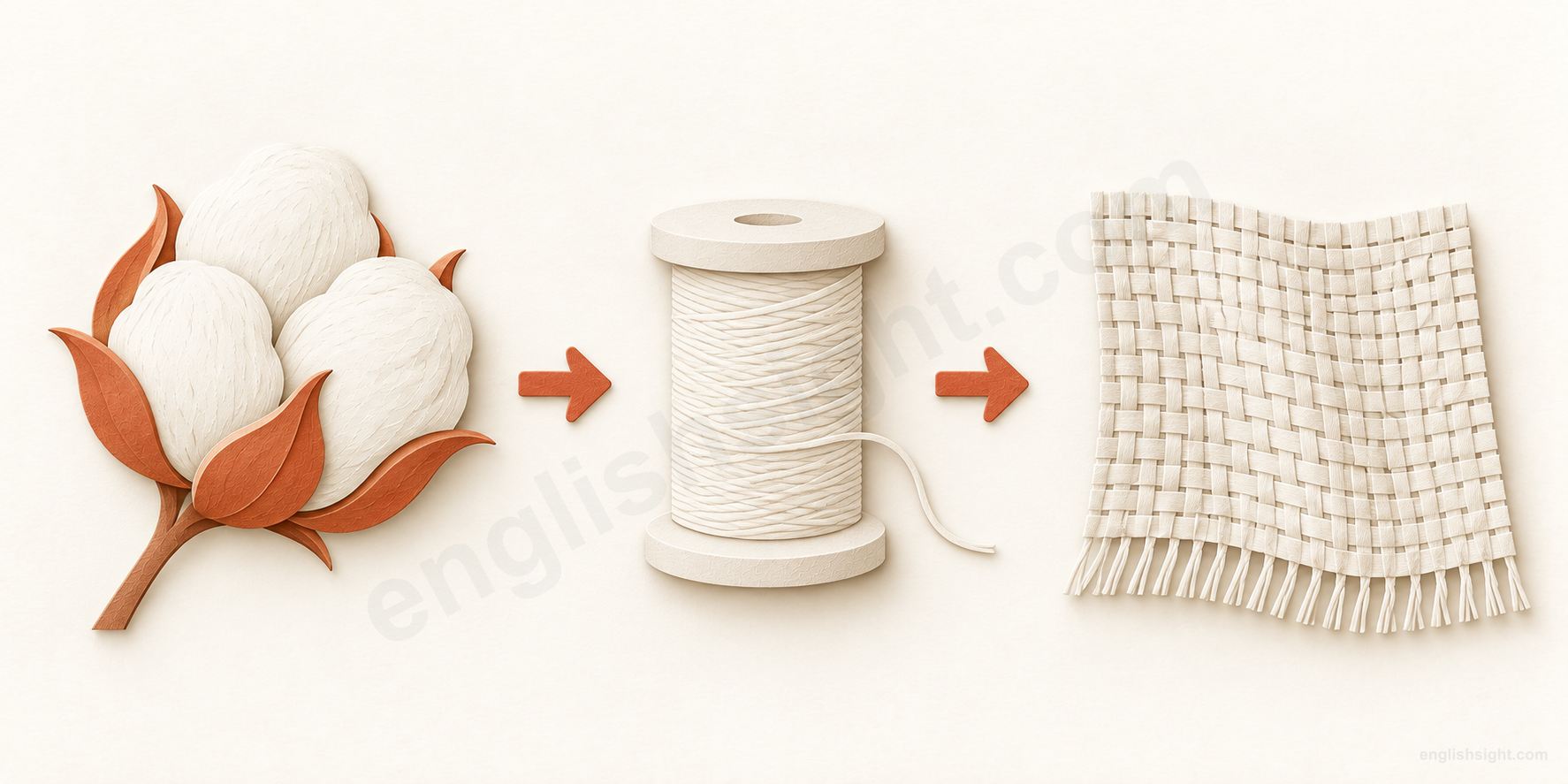
Soft cotton fibres emerge from an open boll.
cotton
A spool of thread and a woven cotton swatch.
The fibres can be spun into thread and woven into cloth.
Cotton fibres can become thread and cloth; these are selected material stages.
Cotton names a plant’s soft seed fibres and, by connection, the crop and materials made from those fibres.
The diagram shows one route from an open cotton boll through spun thread to cloth. Loose absorbent cotton takes another route. The verbs cotton on and cotton to are separate established expressions.
A cotton field, a cotton shirt, and a reel of cotton point to different stages or uses of one material. Context tells you whether people are growing it, processing it, wearing it, or sewing with it.
This lesson uses the plant-to-material connection as a teaching aid. It is not a claim that every English speaker imagines the same picture, and it does not derive the informal verbs from the fibre.
01
A crop, a fibre, and things made from it
Cotton can name the plant, its soft fibres, or material made from those fibres. Read the activity and the following noun to identify which stage is meant.
01
grow / plant / pick + cotton; a cotton + plant / field
grow / pick cotton
the plant or crop grown for its fibres
Situation
A farmer plans what to grow.
What is meant
Cotton grows in the field and is harvested.
The farming context points to a crop, not finished cloth.
In They grow cotton, cotton names a crop. A cotton plant means one plant; a cotton field is land planted with that crop. Pick cotton concerns harvesting it.
Use a cotton plant when counting individual plants. In Cotton needs a suitable climate, the material or crop name takes singular agreement; it is not a plural just because many plants are involved.
In a sentence
Her family grows cotton on a small farm.
Avoid this confusion Say three cotton plants when you mean individual plants, rather than three cottons.
02
cotton + fibre / fiber; a bale of cotton; some cotton
cotton fibres / a bale of cotton
the soft fibres obtained from the plant
Situation
Soft fibres surround the seeds in an open cotton boll.
What is meant
The harvested fibre can be prepared for use.
The same word follows the useful material from its plant source.
Cotton also names the fibre itself. A bale of cotton is a compressed bundle of that material, not a bundle of finished shirts. Fibre is the British spelling; fiber is the American spelling.
Cotton, wool, and synthetic fibres name different material sources. White or fluffy describes appearance; it does not by itself prove that a material is cotton.
In a sentence
The truck carried bales of cotton to the mill.
Avoid this confusion A bale counts the bundle. Cotton normally stays uncountable in this material use.
03
cotton + garment / fabric; be made of cotton; pure / 100% cotton; cotton blend
a cotton shirt / made of cotton
cloth or a product whose material is cotton
Situation
You compare two shirts in a shop.
What is meant
You identify what one shirt is made of.
Cotton can describe the material while shirt names the countable item.
A cotton shirt is a shirt made from cotton cloth. The shirt is the thing you count: two cotton shirts. Cotton can stand alone as a material name too: This shirt is made of cotton.
Pure cotton or 100% cotton specifies composition. A cotton blend contains cotton mixed with another fibre. Read the percentage when that distinction matters.
Some cotton refers to an amount of fabric. In a fabric shop, light cottons can mean different kinds of cotton fabric; this restricted plural does not mean individual fibres. The ordinary material question is Is it cotton? rather than Is it a cotton?
In a sentence
I bought two cotton shirts, but this jacket is made of a cotton blend.
Avoid this confusion Cotton identifies material, not a guarantee that every garment has the same thickness, care instructions, or quality.
04
needle and cotton; a reel of cotton; cotton thread
needle and cotton / cotton thread
thread used for sewing, especially in British English
Situation
A shirt pocket needs mending.
What is meant
You find a needle and matching thread.
In a sewing context, British cotton can mean thread rather than a piece of cloth.
Pass me the cotton can refer to sewing thread in British English. A reel of cotton is thread wound around a small holder. Thread is the more general word and the usual American choice for this meaning.
Cotton thread explicitly identifies the fibre. Not all sewing thread is made of cotton, so use thread when you want a neutral name without specifying its material.
In a sentence
Have you got a needle and some blue cotton to mend this pocket?
Avoid this confusion Some cotton in a sewing box may mean thread; in a fabric shop it may mean fabric. Let context decide.
02
Everyday products and a resemblance
Learn the names used for loose absorbent cotton and shaped products. Cotton candy is a separate food name: it resembles cotton but is made of sugar.
05
some cotton wool (BrE); some (absorbent) cotton (AmE)
cotton wool / absorbent cotton
a soft mass of cotton used to apply or remove liquids
Situation
You have lotion to apply.
What is meant
You put a little lotion on soft absorbent cotton.
This use keeps the fibres loose rather than turning them into woven cloth.
British English calls this material cotton wool; American English commonly uses cotton or absorbent cotton. Here wool is part of the product name, not a claim that it contains sheep’s wool.
Use some cotton wool for an amount. To count pieces, name their shape: a ball of cotton wool or two cotton wool balls. A cotton towel is fabric, whereas cotton wool names the soft mass.
In a sentence
She put a little lotion on some cotton wool.
Avoid this confusion Cotton wool is uncountable: use some cotton wool, not two cotton wools for two pieces.
06
a cotton ball / pad / bud / swab; plural cotton balls / pads / buds / swabs
cotton balls / pads / buds / swabs
shaped products with absorbent cotton
Situation
Several cotton products are on the shelf.
What is meant
You ask for the shape you need.
The final noun identifies the product: a ball, a flat pad, or a small tipped stick.
A cotton ball is a small rounded piece of soft cotton. A cotton pad is flatter. Cotton wool balls and cotton wool pads are also used, especially in British English.
A cotton bud is a small stick with cotton at its ends; cotton swab is the usual North American name for this everyday product. Bud here names the product, not a flower bud on the cotton plant.
The product noun carries the plural: one cotton pad, three cotton pads. Cotton stays in the same form before it.
In a sentence
I use cotton pads for my face and a cotton swab to remove this tiny paint mark.
Avoid this confusion A cotton bud or swab is not a ball of loose cotton. Choose the product name, not just cotton, when its shape matters.
07
some cotton candy (AmE); a stick of cotton candy; candyfloss (BrE)
cotton candy
a fluffy sweet made from sugar, not cotton fibre
Situation
You see a cloudlike sweet at a fair.
What is meant
You buy the sugar sweet called cotton candy.
Cotton refers to the sweet’s cottonlike appearance, not its ingredients.
Cotton candy is the North American name; British English usually calls it candyfloss. The sweet consists of fine sugar threads. Learn the whole name rather than interpreting cotton as a textile ingredient.
Cotton candy is normally uncountable: some cotton candy. To name one serving clearly, say a stick of cotton candy.
In a sentence
We shared a stick of pink cotton candy at the fair.
Avoid this confusion Cotton candy is a food name based on resemblance. It is not an example of made of cotton.
03
Protection, understanding, and liking
The protection image helps explain one idiom. The informal verbs are established expressions to learn separately; spinning fibres does not explain their modern grammar.
08
wrap + someone + (up) + in cotton wool; be wrapped in cotton wool
wrap someone (up) in cotton wool
protect someone so much that they have little chance to face difficulties
Situation
A parent wants to remove every small difficulty for a teenager.
What is meant
Another adult argues that the teenager needs independence.
Soft protective padding supplies a metaphor for excessive protection.
Cotton wool can suggest a comfortable, protected existence in British informal usage. Wrapping someone in cotton wool extends the padding image to how a person is treated, rather than literally covering them.
You can’t wrap her in cotton wool forever means she needs some opportunity to deal with life herself. The phrase often criticizes overprotection; ordinary sensible care is not automatically what the speaker objects to. Up is optional in this expression.
In a sentence
Let him try the new club; we can’t wrap him in cotton wool forever.
Avoid this confusion This is an idiomatic judgment about protection. It does not usually refer to the person’s clothes or bedding.
09
cotton on; cotton on to + noun / pronoun; cotton on to the fact that + clause
cotton on (to something)
begin to understand or realize something
Situation
The reason for a strange message is unclear.
What is meant
A clue helps you realize what happened.
The person changes from not understanding to understanding.
Cotton on is informal, especially British. It often concerns a realization from clues: Once I saw the date, I cottoned on. If you name what was understood, add to: cotton on to the joke or cotton on to the fact that it was a test.
Keep a pronoun after to: cotton on to it, not cotton it on. On can stand alone when the understood matter is already clear. This is an established verb expression, not a literal action involving cotton.
Merriam-Webster also records cotton to in the understanding sense. Because cotton to also means like, context matters; cotton on to makes the realization reading clearer in this lesson.
In a sentence
I finally cottoned on to the joke when everyone started laughing.
Avoid this confusion Cottoned on means understood, not necessarily agreed or approved. Write on to as two words in this pattern.
10
cotton to + someone / something; not cotton to + noun / pronoun
cotton to someone / something
start to like someone or accept something
Situation
Someone suggests a new plan.
What is meant
You find that you like it, or say that you do not.
This informal American expression concerns liking, not textile material.
Cotton to is an informal American way to express taking a liking to someone or something. I don’t cotton to that idea says it does not appeal to me; it does not simply say that I fail to understand it.
The person or thing follows to: cotton to him or cotton to the plan. Like is a more neutral choice across varieties. This liking use is learned as a whole expression; the fibre diagram does not predict it.
In a sentence
I don’t cotton to the idea of working every weekend.
Avoid this confusion Compare cotton on to the plan, meaning realize or understand it. Liking and understanding are different, though dictionaries record some overlap for cotton to.
11
cotton up to + person
cotton up to someone
try to be friendly to someone
Situation
A newcomer wants to get close to a colleague.
What is meant
The newcomer makes friendly approaches.
An attempt to form a friendly relationship differs from simply feeling a liking.
Oxford records cotton (up) to someone as an informal North American expression for trying to be friendly. Cotton up to her describes the approach to her; cotton to her in the liking sense describes how she appeals to someone.
This is useful for recognition, but try to be friendly to is a clearer neutral alternative. Keep the informal North American register in mind when choosing wording for a general audience.
In a sentence
He kept cottoning up to the new manager at lunch.
Avoid this confusion The person stays after to: cotton up to her, not cotton her up. Do not assume every use implies genuine affection or successful friendship.
Read the material, the product, and the whole expression
Usually a material noun
Use some cotton and Cotton is soft. Count a plant, a shirt, a reel, a bale, or a pad when that is what you mean. Cottons can refer to kinds of cotton fabric in a suitable context.
Material description and word class
In a cotton shirt, cotton describes the material before another noun. Some dictionaries label this attributive noun use, while others list an adjective. Cotton is a good material is natural; the ordinary material question is Is it cotton? rather than Is it very cotton?
Verb forms and grammar
Forms are cotton, cottons, cottoned, and cottoning. The informal expressions have no ordinary direct object: cotton on to it and cotton to her. They do not have a productive passive or causative counterpart for learners to build by analogy.
Scope of the picture
The fibre connection helps with the concrete noun family. Cotton candy uses resemblance; protection uses a padding metaphor; the verb expressions need their own learning. Technical plant varieties, industrial machinery, names, and obsolete verb senses are not expanded here.
Choose the meaning in context
Use the situation and the words around cotton. The same spelling does not guarantee the same meaning.
1. A shop assistant says, “These shirts are 100% cotton.” What is being identified?
2. You need two flat cotton pieces for applying lotion. Which request names the pieces clearly?
3. You finally work out why your friends were laughing. Which sentence describes that realization?
4. An American colleague says, “I don’t cotton to that plan.” In the liking use taught here, what do they mean?
5. You see pink cotton candy at a fair. What is cotton doing in this name?
Sources and teaching notes
The sources below support the meanings, regional labels, and expressions. Explanations, examples, and the material-connection diagram are original teaching material; the picture is a selected model, not a dictionary definition.
This diagram is a teaching aid; English speakers do not all share one mental picture.