Connect the bodily action with countable coughs, a continuing cough, and informal cough up.
A sudden burst, then read the context
Air comes out in a sudden noisy burst
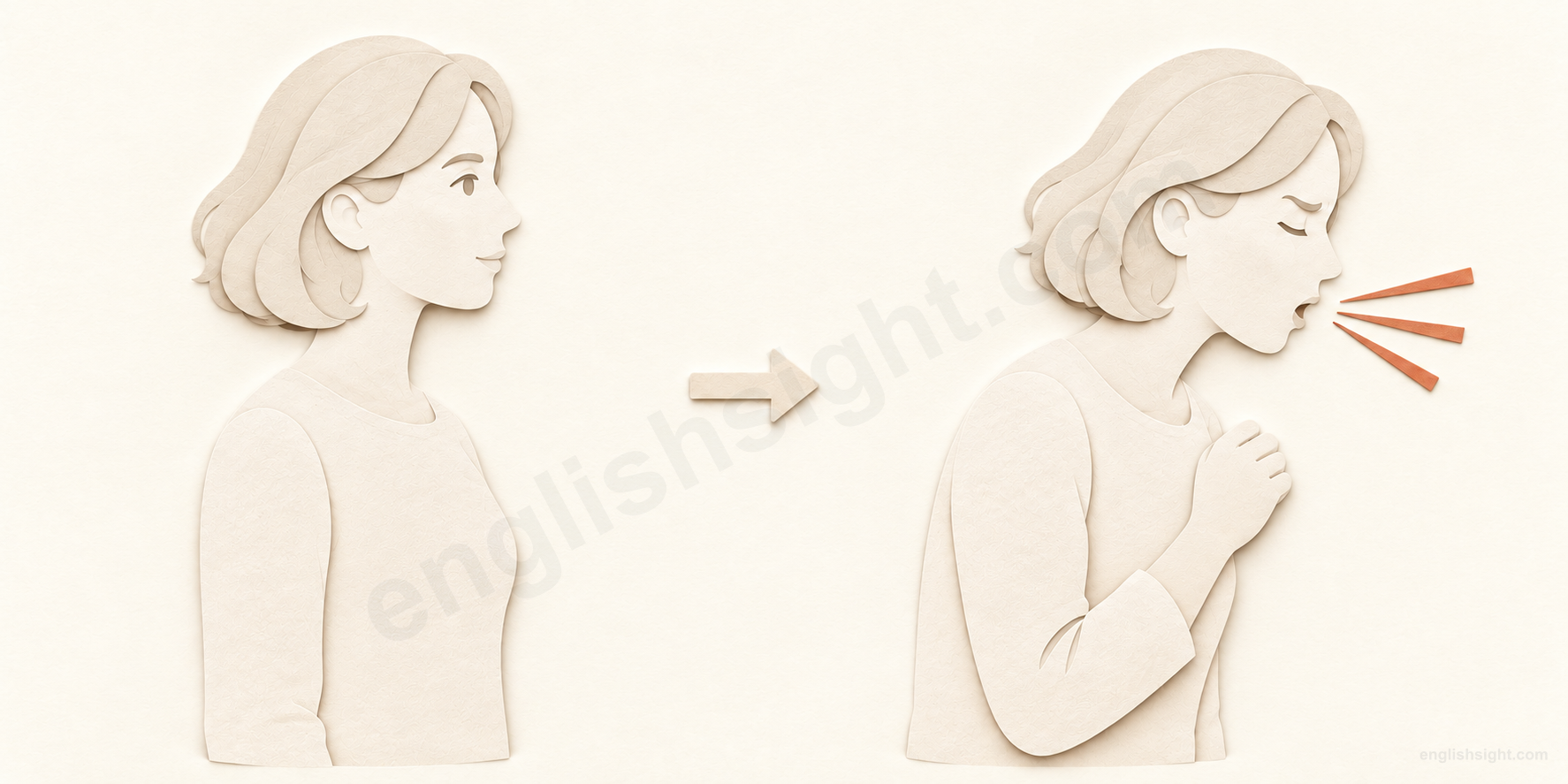
A woman stands upright with her lips closed.
cough
She leans forward slightly, coughing with one hand near her chest.
She forces air out through her throat in a sudden rough-sounding burst.
A cough is a sudden noisy burst of air, rather than steady breathing.
A person coughs by forcing air out through the throat with a sudden rough sound.
This model shows the bodily action, not a diagnosis. Coughing need not bring up visible material. Machine noises and figurative cough up require their own context.
Cough names a short, forceful release of air with a rough sound. You can describe the action, hear one cough, or have a cough that continues over time.
The sound also describes engines, while cough up has established informal uses for reluctantly giving money or information. The bodily image helps connect some uses; it does not predict every expression.
01
The action and what comes out
Start with the person coughing. Grammar then adds a cause, a purpose, duration, or material brought up.
01
person + cough; be + coughing; cough into + noun
cough / be coughing
force air out with a sudden rough sound
Situation before
A dusty curtain is being moved.
What happens / what is meant
Maya makes several sharp throat sounds.
The person is the subject; an object is not normally needed.
Cough describes the action itself. Cough once counts one occurrence; cough repeatedly describes several. Maya is coughing describes activity happening now, while Maya coughed reports a past event.
The word does not by itself specify illness, a cause, or a thing expelled. Cough into your sleeve adds where the action is directed; into is an ordinary preposition here, not part of a new phrasal verb.
In a sentence
Maya was coughing while we moved the dusty curtain.
Watch the difference Say She coughed or She had a cough, not She was cough.
02
make + person + cough; keep / stop + coughing
make someone cough / stop coughing
describe what causes or continues the action
Situation before
Dust reaches the room.
What happens / what is meant
Jon coughs and finds it hard to stop.
The surrounding verb determines the grammar and the cause or duration.
Dust made Jon cough uses make + person + base verb: the dust caused the action. Keep coughing means continue or repeatedly cough; stop coughing means end that activity.
I stopped to cough instead means I paused another activity in order to cough. These meanings come from the stop constructions, not from a new sense of cough. A person can be made to cough, but ordinary intransitive cough has no direct passive such as He was coughed.
In a sentence
The dust made Jon cough, and he could not stop coughing.
Watch the difference After made Jon use cough, not to cough; after stop use coughing when the coughing ends.
03
cough + adverb; cough + to-infinitive of purpose
cough politely / nervously
use or produce a cough in a social situation
Situation before
A receptionist is looking at a screen.
What happens / what is meant
A waiting visitor coughs gently to be noticed.
A small cough can function as a signal; context supplies its intention.
A person may cough deliberately to draw attention, or cough because they feel nervous. Politely, discreetly, and nervously describe manner or situation rather than separate physical actions.
I coughed to attract her attention states a purpose. A cough alone is not a fixed code for excuse me or disagreement; the listener interprets it in context.
In a sentence
I coughed politely, and the receptionist looked up.
Watch the difference Do not assume every cough is deliberate or that every deliberate cough means the same thing.
04
cough + material; cough up + material / cough + material + up
cough (up) mucus
bring material out by coughing
Situation before
There is mucus in the airways.
What happens / what is meant
Coughing brings some of it up.
With an object, cough names expulsion rather than just the sound.
Mucus is the material brought up, not a person receiving the action. Cough up mucus and cough mucus up are possible; use cough it up with a pronoun. Cough blood is also established without up.
Up helps express material coming up from inside. Cough something out, as in cough the dust out of his lungs, highlights removal and can name the starting place. These are bodily uses; the money expression below is figurative.
In a sentence
He coughed up some mucus into a tissue.
Watch the difference Use cough it up, not cough up it. Cough up does not always mean pay.
02
A sound, a continuing problem, and familiar names
A cough can be one occurrence or a condition. Other words specify episodes, features, and products.
05
give / hear / stifle + a cough; number + coughs
give / hear a cough
name one act or sound
Situation before
The room is quiet.
What happens / what is meant
One short cough breaks the silence.
Countable cough can identify an occurrence rather than an ongoing condition.
Give a cough means perform the action once or produce a short cough; give does not mean transfer an object here. Hear a cough focuses on the sound. Two coughs counts two occurrences.
Stifle or suppress a cough means hold back the action or sound. A polite cough can serve the social purpose described earlier, but a cough need not have an intended audience.
In a sentence
I heard a cough from the back of the room.
Watch the difference A cough can be a single sound; it does not necessarily describe a continuing illness.
06
have / develop / get / shake off + a cough
have / develop / shake off a cough
describe a continuing problem involving coughing
Situation before
Nina began coughing earlier this week.
What happens / what is meant
She says the problem is still present.
One countable noun can name a condition lasting across many coughs.
Have a cough describes the continuing problem, while develop a cough marks its beginning. Get a cough is a less formal way to talk about developing one. A bad cough describes severity, not one unusually loud sound.
Shake off a cough means get rid of the continuing problem: I cannot shake off this cough. Compare I gave a cough, which reports an act. The noun alone does not identify the cause.
In a sentence
Nina has had a cough since Monday.
Watch the difference In an ordinary sentence use have a cough, not have cough. Coughing can instead be uncountable: The coughing kept me awake.
07
have + a coughing fit; a fit of + coughing
a coughing fit / a fit of coughing
name a short episode of repeated coughing
Situation before
A speaker begins coughing during a talk.
What happens / what is meant
Several coughs interrupt the next sentence.
A fit is a burst of repeated activity, not one isolated cough.
A coughing fit and a fit of coughing describe an episode with repeated coughs. In the first phrase, coughing modifies fit; in the second, coughing is an uncountable activity after of.
The episode can interrupt speech: She had a coughing fit halfway through her talk. Do not confuse this noun fit with be fit, meaning healthy or suitable.
In a sentence
A coughing fit interrupted her talk.
Watch the difference Say a fit of coughing, not a fit of cough.
08
a + adjective + cough
a dry / persistent / hacking cough
describe a cough’s character or duration
Situation before
Someone asks what the cough is like.
What happens / what is meant
The answer specifies sound, duration, or material brought up.
The adjective adds a particular feature; it does not establish a diagnosis.
Persistent says the cough continues or keeps returning. Hacking describes repeated dry, painful coughing. These adjectives answer different questions, so a cough can be both persistent and hacking.
A productive cough brings up mucus or sputum; productive is a technical descriptive term here, not praise for useful work. A dry cough does not bring up mucus. These descriptions identify features rather than a particular cause.
In a sentence
She described it as a persistent, dry cough.
Watch the difference Persistent concerns duration; dry concerns the character of the cough. Neither word means loud.
09
cough + medicine / syrup / mixture / drop
cough medicine / cough drops
recognize names for products associated with a cough
Situation before
A customer is reading labels in a pharmacy.
What happens / what is meant
The labels name a liquid and some lozenges.
Cough modifies the product noun by naming its intended purpose.
Cough medicine and cough syrup name medicine for a cough; cough mixture is a British term for the liquid. Here cough is a noun modifier, not a command to cough.
A cough drop is a small lozenge, not a drop of liquid. Compare some cough syrup with two cough drops: syrup is normally a mass noun, while individual drops in this compound are countable.
In a sentence
The shelf had cough syrup and a box of cough drops.
Watch the difference Do not infer the form of a product from drop alone: a cough drop is a lozenge.
03
Similar sounds and reluctant giving
A machine borrows the sound; informal cough up has established meanings involving money and information.
10
engine / machine + cough; cough and splutter / sputter
the engine coughed
describe a machine making a short rough noise
Situation before
An old engine is being started.
What happens / what is meant
It produces an uneven burst of noise.
The sound resembles a bodily cough; the machine is not literally ill.
An engine can cough and splutter or sputter when it runs unevenly. This extends the sound of the bodily action to a machine.
Cough does not decide what happens next. The engine coughed into life describes starting; the engine coughed and stopped describes stopping. The following words supply the different outcomes.
In a sentence
The engine coughed twice, then began running smoothly.
Watch the difference An engine coughing does not necessarily mean it has stopped; read the rest of the sentence.
11
cough up + money / amount; cough + it + up; cough up for + expense
cough up the money
pay or hand over money reluctantly
Situation before
An unexpected charge must be paid.
What happens / what is meant
The speaker pays despite disliking the expense.
The whole informal expression conveys giving up money unwillingly.
Cough up an amount or the money often suggests pressure, reluctance, or an unwelcome expense. No bodily cough is involved. Cough up for repairs adds what the payment is for; the amount can remain unstated.
With a noun, both cough up the money and cough the money up are possible; a pronoun goes between: cough it up. Pay is a neutral alternative when you do not want the complaint or pressure conveyed by this informal expression.
In a sentence
We had to cough up another fifty pounds for the repair.
Watch the difference Cough up can sound complaining or demanding. It is unsuitable as neutral wording for a formal payment request.
12
cough up + information / details; cough + them + up
cough up information
provide information, often unwillingly or after pressure
Situation before
A person has kept some details private.
What happens / what is meant
After questioning, the person finally supplies them.
The object changes what is surrendered: information rather than money.
Informal cough up can take information as its object. The speaker presents the details as something extracted reluctantly; provide the details is more neutral.
He coughed up the names and He finally coughed them up describe disclosure, not necessarily a confession to a crime. The names need not be spoken between actual coughs. Learn this as an established figurative use, not a rule for every object after cough.
In a sentence
After several questions, he finally coughed up the names.
Watch the difference Do not use bare cough the names as the ordinary neutral equivalent of provide the names.
Keep the sound, grammar, and context separate
Pronunciation and forms
British English commonly has /kɒf/ and American English /kɔːf/ or /kɑf/. The gh is /f/. Forms are cough, coughs, coughed, coughing; the past ending is /t/, so coughed ends in /ft/.
Cough, sneeze, and clear your throat
A cough is a noisy outward burst through the throat. A sneeze is a different action involving a sudden expulsion through the nose and mouth. Clear your throat often names a small deliberate cough to prepare to speak clearly; it can serve a similar attention signal without being interchangeable in every context.
What the model cannot tell you
A cough can be deliberate or involuntary and can occur without illness. The diagram does not explain a medical cause, and an adjective such as persistent describes a feature. Informal cough up is an established expression, not a literal account of money or information leaving a throat.
Coverage boundary
This lesson covers modern everyday noun and verb uses, relevant constructions, and familiar compounds. Bare cough meaning confess, unusual ways of uttering words with coughs, specialist disease names such as whooping cough, and sports reporting about surrendering a lead or possession are not expanded here.
Read the whole expression
Choose the sentence that fits the situation and check the reason.
1. One small sound breaks the silence. Which sentence focuses on that single occurrence?
2. Jon was coughing, but now the coughing has ended. Which sentence says that?
3. An extra fee was unwelcome, but you paid it. Which informal sentence fits?
4. The money was handed over reluctantly. Replace the money with it.
5. The engine coughed twice and then ran smoothly. What happened?
Sources and teaching notes
The sources below were consulted for meanings, forms, and expressions. The explanations and example sentences are original; the diagram is a teaching model.
The diagram is a teaching aid; English speakers do not all share one mental picture.