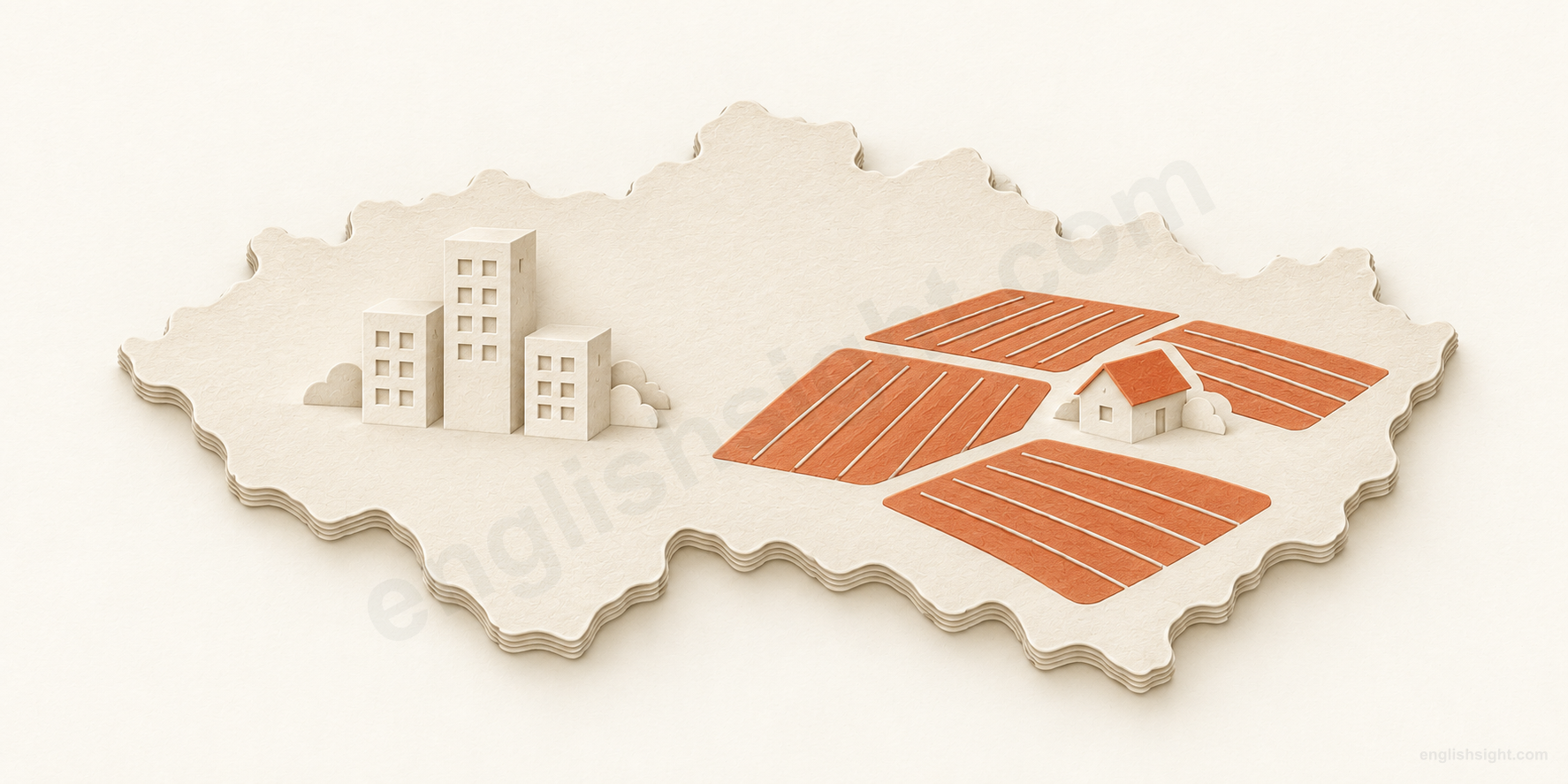
Distinguish a nation, its people, rural surroundings, and established expressions.
A whole area and the character of its land
Land viewed as a whole or by its character
The whole national area
country
Rural land within the same area
Context selects the whole area or its rural character.
A country can include cities and countryside. The country can also mean rural surroundings.
Country names land considered as an area: a political whole with its people, or a region described by its rural or physical character.
The whole outline represents a political country, including its city and fields. The fields highlight the rural sense. People-as-a-nation and fixed expressions need the explanations below; a map alone does not predict them.
Country can name a political area, the people who live there, or land viewed through its rural character. Read the article, the neighboring words, and the situation before choosing a meaning.
A country in the national sense can include both cities and countryside. The sketch keeps these two scales together as a teaching aid; it does not claim that every English speaker has the same mental picture.
01
Countries, belonging, and national life
Count political areas, say where someone belongs, and distinguish the territory from the people who live there.
01
a / the / this + country; adjective + countries
a country / several countries
a geographical and political unit
Situation / viewpoint
You are describing places on a world map.
What the phrase conveys
You count separate countries, not cities or continents.
A country is a whole political area, including its urban and rural parts.
Country is the ordinary neutral noun when talking about where people live, travel, or have a government. In this sense it is countable: one country, another country, three countries. The plural changes -y to -ies.
The country’s capital refers to one country; the countries’ borders refers to more than one. In a foreign country means outside the country treated as home in the conversation.
Country and state can overlap, but state often emphasizes political organization and can also mean a subdivision, as in a US state. Nation can emphasize a people and their shared identity. These words do not guarantee identical borders or settle disputed status.
In a sentence
We visited three countries during our train trip.
Watch the difference Say three countries, not three countrys. Country is not a synonym for continent or county.
02
my / your / our + country; home country; represent / serve + one’s country; the old country
my country / my home country
the country someone identifies with or comes from
Situation / viewpoint
You live abroad and discuss returning home.
What the phrase conveys
You refer to your national home, not a place you own.
A possessive links a person to a country; it does not imply ownership.
My country can express citizenship, origin, or belonging, depending on the speaker. Home country makes the home connection explicit. A person’s place of birth, citizenship, and present home need not all be the same.
Represent your country means act on its behalf, for example at an international competition. Serve your country emphasizes doing work for it; neither expression means owning the land.
The old country is an established expression for the country where someone was born, especially after moving abroad: My grandfather still has cousins in the old country. Old describes the earlier home connection, not the geological age of the place.
In a sentence
She will represent her country at the swimming championships.
Watch the difference Use my country, not the my country. Do not assume that home country always means current citizenship.
03
country of origin; host country; from / to / in + country noun phrase
country of origin / host country
identify an origin or a receiving country
Situation / viewpoint
A form asks where a product comes from; an exchange program describes its destination.
What the phrase conveys
You distinguish the starting connection from the receiving place.
The added words specify the country’s role.
Country of origin identifies where a person or product comes from. A label might say: Check the country of origin on the box. The exact rule for an official form or product label depends on its purpose; the phrase alone does not supply a legal test.
A host country receives visitors, students, refugees, or an international event. In our example it is where the student is staying. Host does not mean that the country becomes the student’s birthplace or home country.
These are noun phrases, not new meanings of a verb. Use in for location, from for origin, and to after a movement verb: students from one country travel to another.
In a sentence
During the exchange, I stayed with a family in the host country.
Watch the difference Country of origin and host country describe different roles; neither automatically names someone’s nationality.
04
across / around / throughout / all over + the country
across / around / all over the country
through different parts of a national territory
Situation / viewpoint
Shops in many cities introduce the same service.
What the phrase conveys
You describe its spread within one country.
The country can be the known national area, even without its name.
Across the country can describe movement from one part to another or distribution over many parts: The new service is available across the country. Around the country and all over the country also describe many locations; throughout the country emphasizes a broad spread.
In the country can mean within the national territory when the context supports it: This is the oldest bridge in the country. The same wording can mean in a rural area in a different sentence. The article the alone cannot decide between the senses.
Compare across country without the: that established expression usually describes travel over fields or open land. Do not drop the article from across the country when you mean nationwide coverage.
In a sentence
Libraries around the country are joining the reading project.
Watch the difference Nationwide spread does not necessarily mean every single town participates. Across the country is different from across country.
05
the (whole) country + verb; the country as a whole
the whole country / the country as a whole
the country’s people or national community
Situation / viewpoint
Supporters celebrate in many towns.
What the phrase conveys
You speak of the national community as one whole.
A place name can stand for its people and institutions.
In The whole country celebrated, people celebrate, not the soil. Country lets you refer collectively to a national community. This is a familiar shift from the area to those who live there.
The country as a whole considers the national community overall rather than one group or region. A sentence such as The country is facing a difficult winter can concern people, public services, and national conditions together.
The whole country can be rhetorical rather than a literal claim about every individual. In a neutral learner sentence, singular agreement is a safe choice: The country is waiting for the result. Countries takes a plural verb.
In a sentence
The whole country celebrated the team’s unexpected victory.
Watch the difference Do not interpret whole country as proof that every resident held exactly the same opinion.
02
The country, the landscape, and journeys
Shift from a political area to rural surroundings or a region with a particular character. Articles and neighboring words help select the meaning.
06
in / to / out in + the country; town and country
in the country / go to the country
in or to rural surroundings rather than a town or city
Situation / viewpoint
You compare city living with a quieter rural location.
What the phrase conveys
You describe being away from a town or city, without necessarily crossing a border.
The country can mean rural land inside the same political country.
In a town-versus-rural contrast, the country means areas with fields, farms, woods, or villages. We live in the country describes a rural location; We live in a country with cold winters describes a national unit.
Go to the country normally means travel to a rural place when the context is a weekend or a holiday. The destination may be only a short distance from the city. It does not by itself mean travel abroad.
Countryside is a close alternative for rural surroundings: We spent the afternoon in the countryside. It is not the word to use for a political unit: three countries, not three countrysides.
In a sentence
We moved out of the city and rented a cottage in the country.
Watch the difference For the general rural sense, say in the country, not in country. The context can give in the country a national meaning instead.
07
country + road / lane / cottage / house / life
a country road / country life
connected with rural surroundings
Situation / viewpoint
You describe a road, house, or way of life outside the city.
What the phrase conveys
Country tells the listener what kind of surroundings are involved.
Country before another noun often means rural, rather than national.
A country road or country lane runs through a rural area. Country life means life in rural surroundings. A country cottage is a small rural house; a country house is a house in the countryside, often a large one in British usage.
Dictionaries differ in labeling this grammar: country may be treated as an adjective or as a noun used before another noun. The practical pattern is country + noun, normally with country unchanged.
Compare a country road with the country’s roads. The first describes a rural kind of road; the second means the roads belonging to or within the national area under discussion. Not every country + noun phrase has the rural meaning: country music is a conventional genre name.
In a sentence
We followed a narrow country lane to the farm.
Watch the difference Use a country road for a rural road. A country’s road uses a possessive and expresses a different relationship.
08
adjective + country; a stretch / tract of + country
open / mountainous / wooded country
land described by its physical character
Situation / viewpoint
You describe the land beyond a village.
What the phrase conveys
You focus on the terrain, not national borders.
Here country is uncountable: the description identifies the kind of land.
Open country, wooded country, and mountainous country describe surroundings or terrain. The modifier tells us the character of the land. A single stretch of mountainous country may lie within one state or cross political borders.
Do not add a just because there is one area: They crossed rough country is natural for difficult terrain. A rough country can instead be heard as one nation described as rough, which changes the meaning.
To measure or isolate an area, use a stretch of country or a tract of country: We drove through a long stretch of wooded country. Countryside can often replace country here; terrain focuses especially on the physical surface and features.
In a sentence
Beyond the village, the road climbs through mountainous country.
Watch the difference Do not count terrain as three countries unless you actually mean three national units.
09
activity / product / person’s name + country
walking country / wine country / Hardy country
a region known for a use, product, or association
Situation / viewpoint
You choose a region for a walking holiday.
What the phrase conveys
You describe what the area offers or is associated with.
The word before country supplies the region’s defining connection.
Good walking country is an area suitable for walking. Wine country is a region known for producing wine. These descriptions do not claim that the region is an independent nation.
Country can also follow a person’s name to identify a landscape linked with that person: Hardy country refers to the region associated with the writer Thomas Hardy and his work. You need that cultural knowledge to identify the place; country alone cannot supply it.
These land descriptions generally use uncountable country. The patterns differ: We explored wine country; We visited the wine country of the region. An article can identify a particular area without turning it into a national unit.
In a sentence
The hills west of the lake are excellent walking country.
Watch the difference Do not read wine country or Hardy country as the official name of a sovereign state.
10
walk / ride / travel + across country
walk / ride across country
travel directly over fields or open land
Situation / viewpoint
The road goes the long way round.
What the phrase conveys
You travel over open ground instead.
Across gives the route; country without the describes the land being crossed.
Across country is an established expression for going over open land rather than following a main road. In our example, walkers leave the road and cross fields; they are not necessarily crossing a national border.
Across the country normally refers to movement or spread through a national territory. A one-hour walk across country and a month-long trip across the country can therefore have very different scales.
The verb can change: walk, ride, or travel across country. These are ordinary verbs followed by a route expression, not a family of phrasal verbs formed from country.
In a sentence
We left the road and walked across country to the village.
Watch the difference The missing the is meaningful in this expression; it does not make article omission generally acceptable.
across open land, across a country, or between countries
Situation / viewpoint
You see cross-country in a sports or travel description.
What the phrase conveys
The following noun and context tell you which kind of crossing is meant.
A fixed compound has several established uses; the hyphen does not select just one.
Cross-country running and cross-country skiing are sports over natural terrain rather than ordinary track running or downhill skiing. Cross-country can name the sport as an uncountable noun: Our school offers cross-country. The cross-country can also name a particular running or skiing race: She finished second in the cross-country.
A cross-country journey goes from one part of a country to another, often away from the main routes. It need not be a sporting event: We planned a cross-country train journey. Cross-country can also work as an adverb: We rode cross-country.
In research, a cross-country comparison compares different countries: The study makes a cross-country comparison of school costs. This between-countries sense is distinct from running across fields or traveling within one nation.
In a sentence
The children practise cross-country running on the hills behind the school.
Watch the difference Do not assume that cross-country always means international, or that every cross-country journey takes place off roads.
03
Established names for music and recreation
Some combinations name a recognized style or institution. Learn their conventional meaning rather than treating country as a nationality label.
12
listen to / play + country (music); country + singer / song; country and western
country / country music / a country singer
a musical genre with roots in the southern United States
Situation / viewpoint
Someone asks what sort of music you enjoy.
What the phrase conveys
You name a musical style, not the place where any music is played.
Country has an established cultural meaning that a land diagram cannot fully explain.
Country music names a recognized genre with roots in the traditional music of the southern United States. Country on its own can name the genre too: I listen to jazz and country. It is uncountable in this use.
A country singer performs that style; country songs are songs in that genre. This does not mean simply a singer or a song from any rural place. The style can be performed in a city and by musicians from different countries.
Country and western is another established name. Learn the genre label as a whole, rather than trying to deduce all of its musical features from the geographic word country.
In a sentence
The café plays country music on Friday evenings.
Watch the difference Country music is not a general translation of a country’s traditional or national music.
13
a / the + country club; country clubs
a country club
a place for sports and social activities outside or near a town
Situation / viewpoint
Friends arrange a game and lunch at their club.
What the phrase conveys
You identify the recreational institution they use.
The compound names a type of club; country does not mean the nation it represents.
A country club offers sports and social activities in a rural setting or near the edge of a town. The compound names an institution rather than any informal group that happens to meet outdoors.
Use it as a countable compound noun: a country club, two country clubs. The plural ending belongs to club. Activities differ from club to club, so the name alone does not guarantee one particular sport.
Compare a country club with a country music club. The second phrase can describe a club devoted to the musical genre; it need not be a recreational country club.
In a sentence
We met for lunch at the country club after our tennis lesson.
Watch the difference A country club is not a national sports team or automatically a club for country music.
04
Freedom, elections, and a large margin
These expressions belong to particular conversational or public contexts. Their meanings cannot be read straight off a map.
14
It’s a free country.
It’s a free country.
assert or acknowledge someone’s freedom to choose
Situation / viewpoint
Someone criticizes your harmless choice of clothes.
What the phrase conveys
You say you are free to make your own choice.
The sentence has a conversational function as well as a literal political reading.
As a familiar informal reply, It’s a free country can defend a choice or tell someone they may choose for themselves. In the example, the speaker rejects a friend’s attempt to control their clothing.
The tone depends on the situation. It can sound easygoing when granting a choice, or defensive and argumentative when resisting criticism. It is not necessarily a friendly way to ask for permission.
This reply does not establish that every action is legal or that rules have disappeared. Its conversational message is about freedom of choice in the situation, not a complete legal description of the country.
In a sentence
“You can’t wear those bright shoes!” “It’s a free country.”
Watch the difference Do not treat this informal response as a literal promise of unlimited permission.
15
a government / prime minister + go to the country
go to the country
call an election to choose a new parliament
Situation / viewpoint
A news report discusses what a government will do next.
What the phrase conveys
The government seeks a new parliamentary mandate through an election.
In British political language, the country stands for the electorate.
A government that goes to the country holds an election for a new parliament. This is a British political expression; the surrounding news context distinguishes it from a holiday in the countryside.
The government is not physically traveling to rural land. The expression presents an appeal to the country’s voters. In general conversation, call an election is a clearer alternative.
Compare The country goes to the polls, where the population is described as voting, with The government goes to the country, where the government initiates the election. Do not automatically assign either action to every use of country.
In a sentence
The government may go to the country before the end of the year.
Watch the difference Use the election meaning only in the relevant political context; We went to the country for the weekend normally has the rural meaning.
16
win / miss + by a country mile; be + a country mile apart
by a country mile
by a very large distance or margin
Situation / viewpoint
One candidate wins far more votes than the others.
What the phrase conveys
You emphasize how large the winning margin was.
The expression is an exaggeration, not a different unit of measurement.
A country mile means a very long distance and often appears in by a country mile. A runner may win by a country mile, and a candidate may win by a country mile even though the result is measured in votes, not miles.
The expression also describes a large difference: Their estimates were a country mile apart. Oxford labels the expression especially British English. It belongs to expressive speech or writing rather than a precise measurement.
The large-margin meaning belongs to the whole expression. It does not mean that a mile in rural land has a different official length.
In a sentence
Our proposal won the vote by a country mile.
Watch the difference Do not use a country mile as an exact distance in a route instruction or scientific measurement.
Let the context choose the scale
Countable countries and uncountable land
Country is pronounced /ˈkʌntri/. The national noun has plural countries. Land-character and music uses are uncountable; the country for rural surroundings or the national community is commonly treated as singular. Do not force all of these uses into one article rule.
Country is not county
A county is a regional administrative division in places that use that system. Country has an r and can name a national territory. The spellings and meanings are different.
Word class and scope
This lesson teaches the modern noun and common uses before another noun, with selected established compounds and idioms. Country is not an ordinary modern verb here, so verb tense, passive, causative, and separable-particle patterns do not apply. Literary, historical, specialist legal, and insulting rustic uses are outside the lesson.
A map is a useful limit, too
The diagram links national and rural land without claiming a single origin for every expression. The music genre, club name, freedom reply, election idiom, and exaggerated mile require their own conventional meanings.
Choose the intended country
Use the whole phrase and its setting to select the meaning.
1. Mia moves from a city flat to a cottage beside fields in the same nation. Which sentence describes the rural change?
2. A walker leaves the main road and takes a shortcut over fields. Which wording highlights that route?
3. In “The whole country cheered the result,” what is cheering?
4. A British news report says, “The government plans to go to the country.” What does this mean in the political context?
5. A café advertises a country singer. What does this normally tell you?
Sources and teaching notes
Definitions and usage were checked against the sources below. Explanations, example sentences, and the diagram were written for this lesson; the visual connection is a teaching interpretation.
The sketch connects national and rural land as a teaching aid; it does not represent a shared mental image for every speaker.