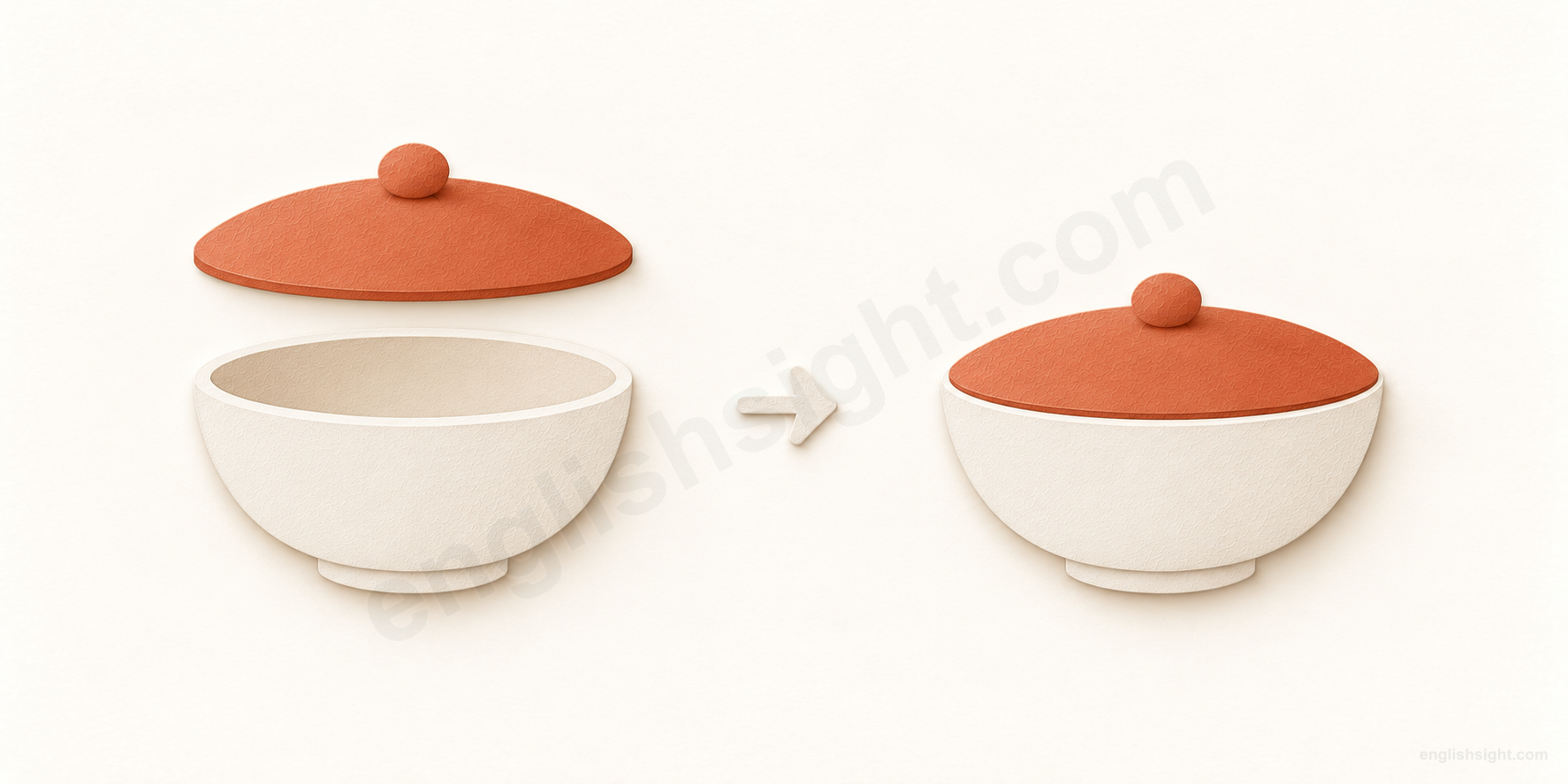
Connect physical covering with shelter, inclusion, responsibility, and familiar fixed expressions.
Something over what would otherwise be exposed
Something over what would otherwise be exposed
The bowl's opening is exposed.
cover
The lid covers the opening; the bowl's sides remain visible.
The lid is placed over the opening.
A cover lies over an exposed target; here the lid closes the bowl's opening.
In the physical use, something lies or is put over or in front of a target, changing what is exposed. Related uses concern protection, concealment, or how far an activity or provision extends.
The picture illustrates the physical relationship. It does not turn every abstract use into a literal lid; the music meaning and fixed expressions must also be learned in context.
A lid covers a bowl; mud covers boots. Start with one thing over or in front of another, then distinguish what the context contributes: concealment, protection, or the extent of something’s reach.
A course can cover a subject, money can cover a bill, and a colleague can cover for you. These are established uses with their own grammar. The diagram is a teaching connection, not a claim that all speakers share a single mental picture or that every meaning follows mechanically from it.
01
Layers, objects, and surfaces
Start with what lies over something else. The subject can be the person adding a layer or the material already there; a cover can also be a countable object.
01
cover + person / thing + with + covering
cover the bowl with a lid
put something over or in front of something else
Situation / exposed need
The bowl is open.
Result / scope
A lid closes its opening.
The object after cover is what receives the covering.
In Cover the bowl with a lid, you act on the bowl; with introduces the material or object you use. The layer may protect, hide, close, or decorate: its purpose comes from the context.
You can also cover your mouth with your hand or cover a table with a cloth. This is not a special verb-plus-with idiom: with adds the means or covering. Cover does not always mean wrap something on every side.
In a sentence
Please cover the bowl with a lid before you put it away.
Watch the difference Cover the bowl with a lid reverses the roles in The lid covers the bowl.
02
material + cover + surface; be covered in / with + material
be covered in / with mud
have a layer or many things on a surface
Situation / exposed need
Someone walks across a muddy field.
Result / scope
Mud lies over their boots.
The material may be the subject, or follow in / with in a result description.
Mud covered his boots makes mud the subject. His boots were covered in mud describes the resulting state. Covered with mud is also natural; in and with overlap here rather than expressing a universal difference in completeness.
In a passive, by can introduce the thing doing the covering: The road was covered by drifting sand corresponds to Drifting sand covered the road. The construction can describe a surface with many separate items too: a desk covered with receipts. Add completely, partly, or loosely when the degree matters.
In a sentence
After the walk, my boots were covered in mud.
Watch the difference A covered surface need not be completely hidden; cover alone does not guarantee total coverage.
03
cover something up / over; cover it up; cover an open space in
cover it up / cover over a hole
hide something beneath a covering
Situation / exposed need
An ugly patch is visible.
Result / scope
A rug keeps it out of sight.
Up and over can emphasize concealment of the whole visible target.
Cover up a patch and cover a patch up both work. A personal pronoun goes between the verb and particle: cover it up. Cover over similarly means to put something over a target so it is no longer visible.
A separate construction, cover an open courtyard in, means add a cover or roof. Do not confuse that particle in with covered in dust, where in introduces the material. These are related physical patterns, not evidence that any small word can follow cover freely.
In a sentence
We covered the damaged patch up with a small rug.
Watch the difference Say cover it up, not cover up it.
04
cover up; cover yourself / somebody up
cover up / cover yourself up
put on more clothing or cover the body
Situation / exposed need
Your arms are exposed to strong sunlight.
Result / scope
Clothing shields more of your skin.
Without an object, cover up can mean put on suitable clothing.
Cover up can stand alone when the body and the need for clothing are understood. Cover yourself up makes the person receiving the covering explicit; cover a child up can mean put a blanket over the child.
This physical use does not imply dishonesty. In They covered up the error, the object error instead selects concealment of information. Context distinguishes these uses of the same phrasal verb.
In a sentence
Cover up before you go out into the midday sun.
Watch the difference Cover up does not always mean hide a crime or mistake.
05
a cover for + thing; noun + cover; put on / remove a cover
a cover for the chair
a separate protective or decorative outer item
Situation / exposed need
The chair needs protection from dust.
Result / scope
A removable outer piece lies over it.
As a countable noun, a cover is a thing you can put on or remove.
A cover for a chair names the object and what it fits. Chair cover, cushion cover, duvet cover, and a protective cover for a phone use the same countable noun pattern.
A lid is specifically a top that closes a container; cover is broader. A duvet cover is the fabric case around a duvet, not the duvet itself. Choose the particular object name when its shape or function matters.
In a sentence
I bought a washable cover for the armchair.
Watch the difference Use a cover for a singular object; uncountable cover has other uses such as shelter.
06
the cover of + book / magazine; on the cover; from cover to cover
on the cover / from cover to cover
a book’s outside, or the whole work from beginning to end
Situation / exposed need
You see a book’s outside before opening it.
Result / scope
You can identify the outside or describe reading all its contents.
The physical outside supplies established reading expressions.
A book has a front cover and a back cover; a photograph appears on the cover of a magazine, not normally in the cover. The cover price is the printed selling price.
Read a book from cover to cover means read all of it. Don’t judge a book by its cover is a saying about people and things too: appearance alone is not a sound basis for judgment. The saying is advice about evaluation, not about book design.
In a sentence
I liked the picture on the cover and then read the book from cover to cover.
Watch the difference The saying don’t judge a book by its cover extends beyond literal books.
07
the covers; get under / pull up / throw back the covers
under the covers
beneath the bedclothes
Situation / exposed need
You get into bed.
Result / scope
Sheets or blankets lie over you.
The covers is an ordinary plural expression for bedclothes.
Pull up the covers, throw back the covers, and get under the covers refer to bedding on top of a person. The plural commonly groups the sheets, blankets, or duvet together.
Compare a duvet cover, which is one removable fabric case. Under cover without the normally means shelter or a secret identity, not necessarily being in bed.
In a sentence
She pulled up the covers and switched off the lamp.
Watch the difference Keep the in the familiar bedding expression under the covers.
08
cloud / snow / forest / ground cover
cloud cover / forest cover
a layer of clouds, snow, or vegetation over an area
Situation / exposed need
You assess the sky or a landscape.
Result / scope
You describe how much of it has a layer over it.
Uncountable cover can describe a natural layer across an area.
Cloud cover concerns clouds across the sky; snow cover concerns snow on the ground; forest cover concerns land occupied by forest. These are noun combinations with uncountable cover.
The layer need not have been deliberately added. Vegetation can also provide hiding places for animals, connecting natural cover with shelter. A reduction in forest cover is a change in the area forest occupies, not a reduction in removable covers.
In a sentence
Cloud cover increased during the afternoon.
Watch the difference Do not usually add a plural -s to cover when describing the extent of cloud or forest.
02
How far something reaches
A journey, a service, a course, or a report can reach across a distance or a range. These uses concern extent rather than putting a lid on something.
09
cover + area / region; cover an area of + measurement
cover an area / a region
extend across a space, or serve a territory
Situation / exposed need
You define the reach of a place or service.
Result / scope
An area falls within that reach.
Cover can describe extent without movement.
A park covers an area of two square kilometres means it occupies that amount of land. A sales team covers the northern region means that region is its working territory.
In the first pattern, the subject itself extends over the area. In the second, its activity or responsibility reaches the area. Neither says a material layer hides the ground; these are extent uses connected with the surface model.
In a sentence
Our delivery service covers the whole island.
Watch the difference Cover an area does not by itself say whether the subject occupies it, serves it, or travels through it.
10
cover + distance + in + time
cover ten kilometres
travel a stated distance
Situation / exposed need
A route remains ahead of you.
Result / scope
You travel part or all of that distance.
Distance is the object; time can say how long the travel takes.
Cover ten kilometres reports how far a person or vehicle travels. It does not specify walking, running, driving, or another means unless the context adds it.
Cover a lot of ground may refer to literal travel or, in a discussion, many topics. The object and setting distinguish the two. This use measures the reach of an activity; it is not putting something over the road.
In a sentence
We covered twelve kilometres in three hours.
Watch the difference A distance after cover is not a duration: cover twelve kilometres, not cover three hours to mean travel for three hours.
11
cover + topic / material / period; cover a lot of ground
cover a topic / cover a lot of ground
include or discuss material
Situation / exposed need
A class or meeting has subjects to address.
Result / scope
Some subjects receive attention.
The topic falls within the content of the activity.
A lesson covers a topic when it includes or deals with it. It may do so briefly or in detail; covered alone does not promise that everything about the topic has been explained.
We covered a lot of ground in the meeting is figurative: we dealt with many matters. A book covering the years 1980 to 2000 similarly has a time span as its scope. The extent model helps organize these uses, but context supplies the type of range.
In a sentence
The workshop covers basic repairs but leaves advanced wiring to another course.
Watch the difference Cover a subject usually means deal with it, not hide it.
12
rule / law + cover + case; case + be covered by + rule
be covered by a rule
fall within a rule’s scope
Situation / exposed need
You have a particular kind of case.
Result / scope
A rule applies to that case.
A rule can be the subject or appear after by in the passive.
These rules cover online orders means online orders are included in the situations the rules address. These orders are covered by the rules presents the same relation from the orders’ side.
This is scope, not necessarily protection or payment. Compare The policy covers theft, where an insurance context gives a more specific kind of protection. The object alone does not make cover a promise to pay.
In a sentence
The refund rules also cover orders placed through the app.
Watch the difference Covering a case does not mean agreeing that the case is acceptable; it means the rule deals with it.
13
journalist / media + cover + event / story
cover an event
report on an event as part of news work
Situation / exposed need
An event is happening.
Result / scope
A journalist gathers and reports information about it.
With journalists and media, cover means report on.
A reporter covers an election, a trial, or a local festival. A channel can cover a match by broadcasting reporting or pictures of it. The activity gives the audience information about the event.
Contrast cover a topic in class, which means discuss it as teaching material. Cover a story in a newsroom concerns reporting; cover up a story would suggest suppression or concealment. The particle changes the meaning sharply.
In a sentence
A local reporter is covering the opening of the new bridge.
Watch the difference Cover the event and cover up what happened point toward different communicative goals.
03
Costs, duties, and protection
Cover can meet a need: paying an expense, providing insurance, doing an absent colleague’s work, or preparing for possible problems.
The subject can be money or the person or organization paying.
A grant covers the fee when it provides enough for the fee. The company covers the fee when the company pays or provides the money. Cover your expenses can refer to the money needed for a trip or activity.
Usually put the cost directly after cover: cover the cost of lunch. Pay for lunch is the ordinary pay construction. Enough, barely, and only partly can qualify the amount; covering an expense does not mean earning a profit.
In a sentence
The travel allowance will cover my train fare but not a hotel.
Watch the difference Use cover the cost or pay for it; do not automatically insert for after cover.
15
policy + cover + person / risk; be covered for / against + risk; insurance cover
be covered for / against theft
have insurance protection for a specified risk
Situation / exposed need
A loss might occur.
Result / scope
A policy includes that risk or person within its protection.
Insurance cover depends on what the policy includes.
A policy can cover a person, an object, an expense, or a risk. You can be covered for theft or against theft. By names the policy or insurer in a passive description: covered by travel insurance.
Insurance cover is an uncountable noun especially in British English; coverage is usual in North American English. This sense concerns a financial promise under stated conditions, not a literal barrier that prevents the event. A policy can cover someone to drive a car: the infinitive specifies the insured activity, not an action that cover causes.
In a sentence
Our policy covers the camera against theft, but not accidental damage.
Watch the difference Do not read covered as protected from every possible loss.
16
cover for + person; cover + shift; provide / arrange cover
cover for a colleague / provide cover
do someone’s work while they are absent
Situation / exposed need
A colleague cannot be at work.
Result / scope
Someone else takes care of their duties.
For names the person whose duties are temporarily taken over.
Cover for someone is a verb followed by for plus a person. You cannot separate for from its object: cover for her. Cover a shift also occurs with the duty directly after cover, and I can cover is possible when the duty is understood.
Provide cover or arrange cover uses the uncountable noun for replacement staffing. This work meaning is different from inventing an excuse to protect someone from trouble; neither construction by itself tells you that a colleague has done anything wrong.
In a sentence
Could you cover for me at reception while I take my lunch break?
Watch the difference Cover for me may mean work for me or make an excuse for me; the situation decides.
17
have got + task / it + covered
I’ve got it covered
have taken responsibility for dealing with something
Situation / exposed need
Someone worries about an unfinished task.
Result / scope
You reassure them that you are handling it.
This conversational expression presents a need as already taken care of.
I’ve got it covered reassures someone that arrangements or responsibilities are in hand. The object it stands for the task just mentioned. I’ve got the transport covered makes that task explicit.
Have got is part of this familiar expression; it does not describe obtaining a physical cover. Depending on context, the work may be fully finished or the arrangements may simply be under control. It is a reassurance, not a guarantee that nothing can go wrong.
In a sentence
You book the room; I’ve got the transport covered.
Watch the difference Do not confuse I’ve got it covered with the threat We’ve got you covered in a weapon context.
18
cover all the bases
cover all the bases
prepare for all the important needs or possibilities
Situation / exposed need
You plan an event with several requirements.
Result / scope
You make arrangements for the possible needs.
The whole idiom means make the preparation comprehensive.
Cover all the bases means consider and deal with the things that may be needed or may happen. It is used in ordinary planning, even when no sport is involved.
Unlike cover the topic, it emphasizes the range of preparation. It does not mean literally stand on every base or hide your plans. Use it when explaining why you included backup arrangements or several kinds of support.
In a sentence
We booked an indoor room as well as the garden to cover all the bases.
Watch the difference Bases is the established noun here; cover all the basis is not this idiom.
04
Hiding facts and avoiding exposure
Physical concealment connects with hiding feelings or information. Learn the whole construction: covering a mistake and covering for a colleague are not the same action.
19
cover + feeling + with / by + masking action
cover your embarrassment
make a feeling less noticeable
Situation / exposed need
You feel embarrassed and do not want to show it.
Result / scope
Another action masks the feeling.
A visible action can function as a figurative covering.
A laugh, a smile, or a change of subject can cover nervousness or embarrassment. The feeling is the object; another action prevents it from being readily noticed.
Hide is broader: you can hide a key by putting it elsewhere. Cover a key normally suggests placing something over it. With feelings, cover is figurative, and cover up can also emphasize deliberate concealment.
In a sentence
He covered his embarrassment with a quick joke.
Watch the difference Cover does not always remove the feeling; it can merely hide its signs.
20
cover up + wrongdoing; cover it up; a cover-up
cover up a mistake / a cover-up
hide the truth about something wrong
Situation / exposed need
An error has occurred.
Result / scope
People try to keep others from discovering it.
The target is information, not a physical surface.
Cover up a mistake means conceal the truth about it, often by withholding or changing information. Cover it up puts a pronoun between verb and particle; cover up the mistake and cover the mistake up are both possible.
A cover-up is a countable noun for the concealment effort: an attempted cover-up. The noun is normally hyphenated; American English also uses coverup. The verb cover up is two words. Unlike covering an expense, covering up an error does not repair the underlying problem.
In a sentence
The manager admitted the error instead of trying to cover it up.
Watch the difference Use cover it up, not cover up it; the noun is a cover-up.
21
cover for + person; cover up for + person
cover for someone / cover up for someone
help keep someone from getting into trouble by hiding the truth
Situation / exposed need
Someone’s absence or conduct may cause trouble.
Result / scope
Another person supplies an excuse or withholds the truth.
The person after for is being shielded from discovery or blame.
Cover for someone can mean make an excuse for them or conceal information that would get them into trouble. Cover up for someone makes the concealment especially explicit.
Compare cover for someone at the desk: that can be an honest temporary work arrangement. A situation involving an alibi, a lie, or keeping someone’s whereabouts secret selects the excuse meaning. For is a preposition here, so a pronoun stays after it: cover for him.
In a sentence
He asked me to cover for him by saying he had been with me all evening.
Watch the difference Cover for her is not interchangeable with cover her, which can mean put something over her or protect her.
22
a cover for + activity / feeling; a cover story; blow someone’s cover
a cover for something / blow someone’s cover
an apparent role or activity that hides a real one
Situation / exposed need
A person conceals a real activity or identity.
Result / scope
A public explanation keeps it hidden, or a revelation exposes it.
A cover hides the truth; blowing it destroys that concealment.
A cover for an activity is an outwardly different activity or explanation used to conceal it. A cover story is a false explanation of what someone is doing; a cheerful manner can also be a cover for anxiety.
Blow someone’s cover means reveal the concealed identity or activity. It does not mean provide a better disguise. The cover story of a magazine can separately mean its main featured story; the publishing context is essential to that compound.
In a sentence
In the novel, the antiques shop is a cover for the spy’s real work.
Watch the difference The noun a cover for and the verb cover for have different grammar even when both concern concealment.
23
cover + possessive + tracks
cover your tracks
hide evidence of what you have done
Situation / exposed need
An action has left traces.
Result / scope
Someone tries to make those traces hard to discover.
The idiom extends beyond literal footprints.
Cover your tracks means try to prevent other people from discovering what you have done. Tracks are interpreted as evidence, not necessarily marks on the ground.
This often suggests secrecy or wrongdoing. Contrast cover your back, where the aim is avoiding later blame; that can involve keeping a clear written record rather than hiding one. The two idioms can therefore describe opposite ways of treating evidence.
In a sentence
The character deletes the messages to cover his tracks.
Watch the difference Covering your tracks means hiding evidence, not simply completing unfinished work.
24
cover your back; cover yourself against + risk
cover your back / cover yourself
take precautions against later blame or criticism
Situation / exposed need
A decision might later be questioned.
Result / scope
You take steps to protect yourself from blame.
This use concerns defensive precautions, which may include preserving evidence.
Cover your back is informal; cover yourself against a possible claim is a more explicit pattern. A person may keep written approval to show who agreed to a decision.
Cover your ass is an offensive slang alternative, especially in North American English; cover your rear is a milder variant. These are register-sensitive expressions, not physical instructions about clothing. The protection is against blame or criticism, not necessarily danger.
In a sentence
I kept the written approval to cover my back if the budget was questioned.
Watch the difference This expression can sound self-protective; it does not mean conceal every record.
25
cover / hide a multitude of sins
cover a multitude of sins
hide many faults, often said humorously
Situation / exposed need
Something has several defects.
Result / scope
An attractive outer feature makes them less noticeable.
Sins here can mean ordinary faults rather than religious wrongdoing.
A fresh coat of paint may cover a multitude of sins when it makes scratches and uneven surfaces less noticeable. Hide a multitude of sins is another form of the idiom.
The expression often sounds humorous and can apply to design, appearance, or a presentation. It does not say the underlying defects have actually been repaired. Learn the complete phrase rather than inferring a fixed meaning from sins alone.
In a sentence
Soft lighting covers a multitude of sins in the old dining room.
Watch the difference This idiom commonly describes concealed faults, not an act of forgiveness.
05
Shelter, danger, and secrecy
Uncountable cover can be shelter or protective support. Under cover has both a weather meaning and an established secret-identity meaning.
26
take / seek cover; run for cover; cover from + threat
take cover / run for cover
seek shelter from weather or danger
Situation / exposed need
You are exposed to rain or another threat.
Result / scope
You move into a protected position.
Uncountable cover means shelter rather than a removable object.
Take cover means get into shelter; run for cover adds hurried movement toward it. Seek cover is another way to describe looking for a sheltered position.
The shelter might be a building, trees, or a rock, depending on the setting. Take a cover would instead suggest taking one countable object, and is not the ordinary shelter expression. The core link is something between you and exposure, not necessarily a roof directly above you.
In a sentence
When hail began to fall, we ran for cover under the station roof.
Watch the difference Say take cover for shelter, without a.
27
under cover; work under cover; an undercover + person
under cover / work under cover
in shelter, or using a secret identity
Situation / exposed need
A structure protects something, or a role hides someone’s identity.
Result / scope
Exposure to weather or to discovery is reduced.
Under cover has two established interpretations.
Keep the bikes under cover means store them beneath a structure that protects them from weather. Work under cover can mean pretend to be someone else to investigate or act secretly.
The adjective undercover is one word before a noun: an undercover reporter. Work undercover is also possible, with the one-word adverb. In a gardening conversation, under cover usually concerns weather; a detective working under cover has a concealed role. Context still decides the meaning.
In a sentence
The reporter worked under cover to investigate the factory.
Watch the difference Under the covers usually refers to bedding; under cover can mean shelter or secrecy.
28
under (the) cover of + concealment; break cover
under cover of darkness / break cover
use something as concealment, or leave a hiding place
Situation / exposed need
Something conceals a person or movement.
Result / scope
The person moves while concealed, or comes out into view.
The full expressions specify concealment or its loss.
Under cover of darkness means darkness makes the action harder to notice. The of-phrase names what provides concealment or protection; under the cover of something is also possible.
Break cover means leave the place where you were hidden, often suddenly or quickly. The subject can be a person, an animal, or a vehicle. It describes coming out of concealment, not damaging a physical lid.
In a sentence
The deer broke cover and ran across the clearing.
Watch the difference Under cover of darkness describes concealment, not necessarily shelter from bad weather.
29
cover + person; provide + air / protective + cover; have someone covered
cover someone / provide air cover
protect someone during danger, especially with armed support
Situation / exposed need
A person or group is vulnerable to attack.
Result / scope
Others provide protective support.
Cover can name support during danger, without a literal layer.
In a military or action-story setting, cover someone means protect them, typically by being ready to shoot at attackers. Air cover is protection supplied by aircraft; cover is uncountable in this noun use.
A related weapon use means keep a person or exit within the aim of a gun. We’ve got you covered can then be a threat, whereas I’ve got the booking covered is reassurance about a task. These are recognition notes for news and fiction, not practical instructions.
In a sentence
In the film, one officer covers the others as they move to safety.
Watch the difference The context determines whether covering someone is protective support or a threat.
06
Music and familiar compounds
Some expressions need their own definitions. A cover of a song, a cover letter, and a cover charge cannot be predicted simply by imagining a lid.
30
cover + song; a cover / cover version of + song
cover a song / a cover version
perform or record another artist’s song in a new version
Situation / exposed need
A song already exists in another artist’s version.
Result / scope
A different artist makes their own version.
The musical meaning belongs to an established separate branch.
A band covers a song when it performs or records its own version of a song associated with an earlier artist. A cover or cover version is the resulting version; a cover band mainly plays other performers’ songs.
Use a cover of a song to identify the work, and a cover by an artist to identify the new performer. This use cannot be explained as physically hiding the song. The verb does not mean write the original composition.
In a sentence
The singer released an acoustic cover of a familiar pop song.
Watch the difference A cover is a new performance or recording, not simply playing the original recording again.
31
a cover letter; a covering letter; send something with a cover letter
a cover letter
a letter accompanying and introducing other material
Situation / exposed need
You send an application or a set of documents.
Result / scope
A letter introduces or explains what you are sending.
The compound is learned as a document type.
A cover letter accompanies another document or set of documents. In a job application, it introduces the application and explains the applicant’s relevance to the position; it is not the résumé itself.
Cover letter is the North American term; covering letter is the traditional British equivalent. The letter may be electronic, so it need not literally sit on top of a paper packet. Learn the compound rather than translating cover as hide.
In a sentence
Please attach a cover letter explaining your interest in the role.
Watch the difference A cover letter introduces accompanying material; it is not a book’s front cover.
32
a cover charge; pay a cover charge; no cover
a cover charge
an extra fee at a club or restaurant
Situation / exposed need
You enter or use a venue.
Result / scope
You pay a fee in addition to food or drinks.
The compound names a charge, not the act of paying a bill.
A cover charge is an additional fee charged by some clubs or restaurants, often in connection with admission or entertainment. Food and drink can cost extra.
A notice saying No cover can mean that no cover charge is payable. Compare cover the bill: that verb phrase means provide the money to pay it. The fee name and the paying action have different grammar.
In a sentence
There is a small cover charge on evenings with live music.
Watch the difference A cover charge is not automatically the price of all your food and drinks.
Follow the object, the small word, and the context
Forms and grammar
The verb is regular: cover, covers, covered, covering. Most senses take a direct object, and passives such as The field was covered in snow or The fee is covered by the grant are natural. Cover for takes a prepositional object. No general causative cover somebody to do pattern exists; a policy covering someone to drive specifies an insured activity.
Do not add a particle everywhere
Cover the cost means meet the expense; cover for the cost is not the default pattern. Cover up is separable with an object: cover the stain up / cover it up. Cover for her keeps the person after for. Covered in paint has in plus material, unlike cover a courtyard in, where in is a particle meaning add a roof.
Countability changes with meaning
Use a cover / two covers for removable objects, books, and song versions. Use uncountable cover for shelter, replacement staffing, natural layers, and British insurance protection. The covers is the established plural for bedding. These patterns cannot be reduced to one rule about physical objects.
A connection is not a prediction rule
Covering a topic is discussing it; covering up a problem is hiding it; covering for someone can be honest work or concealment. The core model helps compare these relations, but the full construction supplies the actual meaning.
Scope and register
This lesson selects modern general uses and useful recognition expressions, not a frequency ranking or all technical senses. Sports marking, cricket field positions, card play, stock-market short covering, restaurant table-setting counts, animal breeding, and formal postal under separate cover are not developed here.
Choose the intended relation
Look at the object and the full construction before answering.
1. You put a cloth over a table. Which sentence gives the roles correctly?
2. Your colleague will honestly do your reception duties during lunch. Which expression fits?
3. A grant is large enough to pay the course fee. Which sentence is natural?
4. People tried to hide the truth about an error. Replace the error with it.
5. A newspaper sends a reporter to gather news about a festival. What is the reporter doing?
6. Hail starts falling and you need shelter. Which expression fits?
Sources and teaching notes
Definitions and usage were checked against the sources below. Explanations, example sentences, and the diagram were written for this lesson; the visual connection is a teaching interpretation.
The diagram illustrates one physical relation. It is a teaching aid, not a mental picture shared by every speaker.