Recognize a cow, then distinguish animal descriptions, fixed expressions, and the separate verb cow.
Identify the adult female animal
Identify the adult female animal
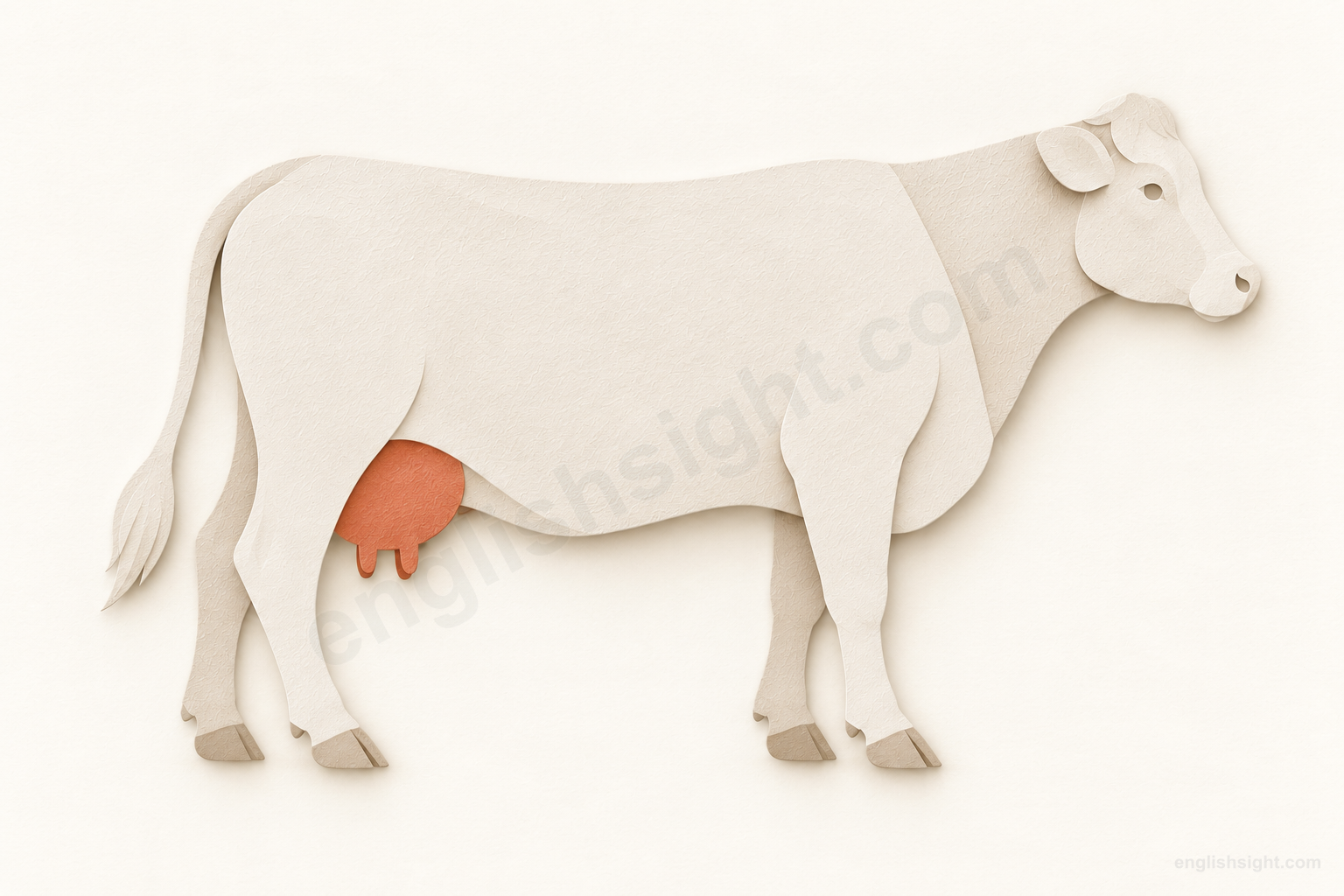
An adult farm animal stands in side view.
cow
It is identified as an adult female of cattle: a cow.
Use its bovine shape and visible udder as identification cues.
The orange udder highlights a female-animal cue; this is identification, not a change of state.
In its central animal sense, a cow is an adult female of cattle; context can widen the label, and established expressions have meanings of their own.
This is identification, not a before-and-after change. The udder is a visible teaching cue for the female animal, not a claim that every cow is currently producing milk. The intimidation verb belongs to a separate branch.
For precise animal naming, a cow is an adult female of cattle. Everyday speech can use cows more broadly for farm cattle. Start with the animal you can recognize, then let grammar and context guide the rest.
The familiar animal does not explain every expression. Have a cow, cash cow, and the verb cow need their own meanings and limits. The picture is a teaching aid, not a claim about a shared mental image in all English speakers.
01
Animals, farming, and careful naming
Begin with a visible animal. Then distinguish precise names, farm expressions, and a separate offensive use directed at people.
01
a / the + cow; number + cows
a cow / two cows
name a farm animal, precisely an adult female
Situation / starting point
You see an adult female farm animal.
What is identified or expressed
You identify her as a cow.
The central noun labels an animal; it does not describe an action.
In precise animal naming, a cow is an adult female of cattle. In casual descriptions, cows can also refer to farm cattle without specifying sex. Use the precise meaning when sex matters.
A bull is an adult male; a calf is a young animal. Cow is countable: a cow, one cow, several cows. Say cow /kaʊ/ and cows /kaʊz/, with a voiced final sound in the plural.
In a sentence
A cow and her calf stood beside the gate.
Watch the difference A calf is not the plural of cow. The normal modern plural is cows.
02
a cow is; cows / cattle are; a herd of cows / cattle
cows / cattle
choose a countable animal name or a plural group term
Situation / starting point
You describe a mixed group of farm animals.
What is identified or expressed
You choose cattle when sex is not the point.
Cattle is plural in grammar; cow has a regular singular and plural.
Cattle includes males and females. Compare The cow is outside with The cattle are outside. For an individual, use a cow, a bull, a calf, or one animal as appropriate; do not say a cattle.
A herd of cows describes cows together; a herd of cattle can be a mixed group. A farmer may also count twenty head of cattle: head remains unchanged in this counting expression. These are noun phrases, not new senses of cow.
In a sentence
The cattle are in the lower field, but one cow is near the house.
Watch the difference Use cattle, not cattles, for this plural animal term.
03
dairy + cows; milk + a cow; cow’s + milk
dairy cows / milk a cow / cow’s milk
describe milk production and its source
Situation / starting point
You explain the work on a dairy farm.
What is identified or expressed
You distinguish the animal, the milking action, and the milk.
Cow names the animal; milk can be an action or a substance.
Dairy cows are kept for milk. In milk a cow, milk is the verb and a cow is its object. In The cow gives milk, the animal produces the milk. The noun cow itself does not mean produce.
Cow’s milk identifies the kind or source of milk, often in contrast with goat’s milk. Milk is normally uncountable here: some cow’s milk, not a cow’s milk. A label such as cows’ milk can use the plural possessive; the apostrophe is a grammar choice, not a different drink.
A cow can moo, graze, and chew the cud. In The cows are grazing, cows is the subject of graze, not a verb. These familiar activities help you understand farm descriptions without treating every combination as an idiom.
In a sentence
They milk the dairy cows before breakfast and sell cow’s milk locally.
Watch the difference Cow’s milk names a source; it is not the same structure as a cow gives milk.
04
cow + species noun; a cow in a clear species context
a cow elephant / a cow (female whale)
identify a female of certain other large mammals
Situation / starting point
A wildlife report specifies an animal’s sex.
What is identified or expressed
Cow tells you the animal is female; the species comes from context.
This animal term is not restricted to domestic cattle.
Cow is also used for the female of certain other mammals, including elephants and whales. In a cow elephant, elephant supplies the species while cow specifies the sex. In a report already about whales, a cow can refer to a female whale.
This is an established naming convention, not a rule for every female animal. Do not invent combinations for arbitrary species. The farm-animal drawing shows the central learning example, not every animal that can be called a cow.
In a sentence
The guide pointed out a cow elephant with a calf beside her.
Watch the difference A cow elephant is an elephant, not a farm cow that resembles one.
05
call + someone + a cow
call a woman a cow
recognize an offensive insult
Situation / starting point
A speaker uses an animal word to attack a woman.
What is identified or expressed
The listener hears contempt, not neutral animal classification.
The human-directed noun is derogatory and offensive.
When cow is directed at a woman as an insult, it conveys hostility or contempt. It is not a neutral way to describe a personality or appearance. Learn to recognize the use in stories or arguments rather than adopt it as an ordinary description.
In call someone a cow, call takes a person and a label. Contrast They called the animal a cow, which can be literal identification. The target and context determine the interpretation.
In a sentence
The character calls his neighbour a cow, revealing his contempt for her.
Watch the difference Do not use this animal word as a friendly substitute for woman.
02
Recognize the whole expression
These combinations have established meanings in conversation and discussion. Naming an animal does not predict what the complete expression means.
06
verb + till / until the cows come home
till / until the cows come home
say that something can continue for a very long time
Situation / starting point
An argument keeps going without changing anything.
What is identified or expressed
You emphasize its potentially endless duration.
The complete time expression exaggerates length.
Till the cows come home and until the cows come home mean for a very long time. They often occur with activities such as talking or arguing, especially when more of that activity will not achieve the intended result.
Till and until introduce a whole clause here. The image of returning animals is a memory aid; the idiom does not set an actual farm schedule. Keep cows plural and learn the usual wording till / until the cows come home as a whole expression.
In a sentence
We could argue until the cows come home and still disagree about the ending.
Watch the difference This does not promise that someone will literally wait for cattle to return.
07
person + have / has / had a cow; don’t have a cow
have a cow
react with strong anger or anxiety
Situation / starting point
Someone learns that a small mistake occurred.
What is identified or expressed
Another speaker describes an intense reaction.
Have a cow is an informal reaction idiom, especially in North American English.
In this idiom, have a cow means become very angry or anxious. It describes the reaction as intense, often excessive from the speaker’s point of view. No animal is being acquired.
Don’t have a cow is a casual way of telling someone to calm down. Because it can sound dismissive, it may worsen a serious disagreement. Compare have a cow on the farm, which can simply mean own one; context matters.
In a sentence
My brother had a cow when he saw the scratch on his bike.
Watch the difference The idiom uses a cow, not cows; it does not mean give birth in this conversational use.
08
Holy cow! + optional following sentence
Holy cow!
express surprise or excitement
Situation / starting point
You see an unexpectedly impressive result.
What is identified or expressed
You react with an informal exclamation.
This is a complete exclamation, not a label for a person or animal.
Holy cow! marks surprise or excitement. It can react to good news, a remarkable sight, or a sudden alarming event. The surrounding sentence supplies what surprises the speaker.
Unlike have a cow, this expression does not itself say that someone becomes angry or anxious. It is informal, so a neutral That is surprising may fit better in formal discussion.
In a sentence
Holy cow! That tiny team built the whole bridge model.
Watch the difference Do not add an article inside this exclamation: Holy cow!, not Holy a cow!
09
a cash cow; a cash cow for + business
a cash cow
describe a dependable source of business profit
Situation / starting point
A company has one highly profitable product.
What is identified or expressed
Its earnings support other parts of the business.
The metaphor concerns financial return, not an actual animal.
A cash cow is a product or part of a business that reliably brings in profit, often helping finance other activities. The expression is common in business discussion; it is not simply anything expensive or a company with a lot of equipment.
The animal producing milk provides a useful teaching analogy for a business repeatedly producing money. That analogy helps you remember this established compound; it does not license arbitrary combinations such as money cow as equivalents.
In a sentence
The repair service became a cash cow for the small company.
Watch the difference The normal plural is cash cows. Cash describes the type; cow is the pluralized head.
10
a sacred cow; treat + something + as a sacred cow
a sacred cow
criticize an idea or practice treated as beyond challenge
Situation / starting point
A team wants to question a long-standing rule.
What is identified or expressed
The rule’s defenders treat it as untouchable.
The figurative expression questions protection from criticism.
A sacred cow is an established belief, practice, or system that people resist questioning or changing. Calling something a sacred cow is usually disapproving: the speaker implies that it should be open to scrutiny.
In a literal religious or cultural context, sacred and cow can simply describe a real animal regarded as sacred. In workplace discussion, the figurative compound usually concerns a protected policy or idea, not religion or livestock.
In a sentence
The annual printed report had become a sacred cow that nobody dared to question.
Watch the difference A sacred cow is not automatically a good or morally admirable idea; the phrase often criticizes its protected status.
03
A separate verb: pressure through fear
In reports and more formal writing, cow can mean intimidate. Read who applies the pressure, who experiences it, and whether a resulting action is stated.
11
cow + person; be / feel cowed by + person or pressure
be cowed by threats
be intimidated so that confidence or resistance weakens
Situation / starting point
A person faces threats or forceful pressure.
What is identified or expressed
The pressure may make that person afraid to resist.
The passive names the affected person; by identifies the source of intimidation.
The verb cow means intimidate or overpower someone’s courage. It is separate from the animal noun; do not explain it as turning a person into a farm animal. Collins marks this use formal, and Oxford notes that the passive is usual.
In She was cowed by their threats, she is affected and the threats provide the pressure. She refused to be cowed says the intimidation did not defeat her resistance. A negative sentence does not imply successful submission.
The active is possible: Their threats cowed the witness. Forms are cow, cows, cowed, cowing. This transitive verb takes a person or group as its object; frightened describes fear more broadly, without necessarily emphasizing reduced resistance.
In a sentence
The volunteers refused to be cowed by the threatening messages.
Watch the difference Cowed /kaʊd/ is the past form of cow, not the adjective cowardly. Refusing to be cowed does not mean feeling no fear.
12
cow + someone + into + noun / -ing; be cowed into + noun / -ing
cow someone into silence / doing something
use intimidation to produce a state or action
Situation / starting point
Someone wants a witness to stop speaking.
What is identified or expressed
Fear is used to bring about silence or compliance.
Into supplies the resulting state or action, not a physical destination.
Cow someone into silence names a result of intimidation. Cow someone into signing names an action brought about through fear. In the passive, the affected person becomes subject: She was cowed into signing.
Into is a preposition here: use a noun or an -ing form after it. This is a result construction, not a separable particle verb. You cannot move into after its complement as if it were a movable particle.
Compare cowed by threats, which identifies the cause, with cowed into silence, which identifies the result. Both can occur together. In They tried to cow him into silence, tried to makes the outcome uncertain; the attempted pressure need not succeed.
In a sentence
They tried to cow the witness into changing her account, but she refused.
Watch the difference Use into changing, not into change or into to change. A result complement and an attempted result must be read with the rest of the sentence.
Keep the branches distinct
A useful picture has a boundary
The animal drawing teaches the central noun. It does not prove an origin story for each idiom, and the separate verb should not be derived from a supposed cow-like personality.
Context can broaden or narrow the label
Casual cows may include cattle generally; precise sex-specific descriptions distinguish cow, bull, and calf. For certain other mammals, the species must be supplied or clear from context.
An animal and its meat have different usual names
Cow normally names the animal. Beef is the usual food word for meat from cattle; dairy describes milk production, not a separate species.
Offensive and regional meanings
The insult directed at a woman is offensive. Oxford also records an Australian and New Zealand use for an unpleasant person, thing, or situation; Collins marks the regional use slang and lists a fair cow for something objectionable. That regional extension is recognition material here, not a general-purpose description to imitate.
Scope of this lesson
The selection covers the animal noun, useful farm grammar, familiar fixed expressions, and the intimidation verb with passive and into patterns. Archaic kine, specialist livestock terminology, disease terminology, botanical names, and the many compounds beginning with cow are not expanded. There is no productive everyday family of separable cow phrasal verbs to memorize.
Choose the meaning that fits
Use the situation and the whole construction, not just the animal image.
1. You describe a group containing cows and bulls. Which is standard?
2. You say an argument could continue for a very long time without changing anyone’s mind. Which fits?
3. In They cowed him into signing, what does into signing tell us?
4. A profitable repair service finances other company activities. What might a business writer call it?
5. The workers refused to be cowed by threats. What does this tell us?
Sources and teaching notes
Animal meanings, expressions, and verb patterns were checked against the publisher pages below. The explanations and examples are original; visual cues and analogies are teaching aids.
This picture helps identify the central animal sense; it does not represent every use or every speaker’s mental image.