Learn how crack connects physical splits with sounds, lost steadiness, access, and fixed expressions.
From holding together to a visible split
From holding together to a visible split
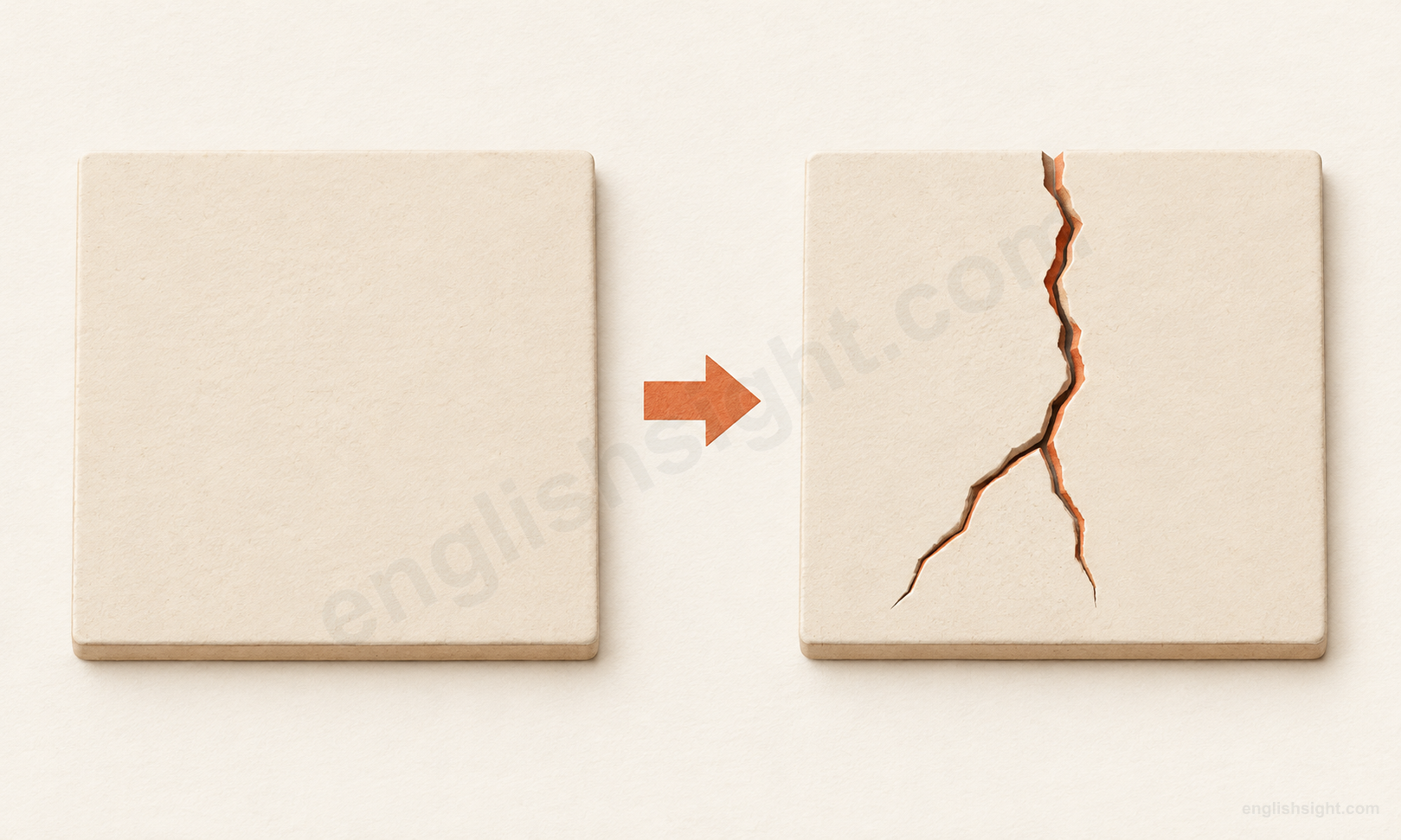
The tile has one continuous surface.
crack
The tile is cracked but remains in one piece.
A narrow split develops in the material.
A split appears without the tile breaking into separate pieces.
A hard surface that held together develops a split; it may remain in one piece or open further.
The same tile is shown before and after a fracture appears. No person is needed for this change of state. The physical relation supports some comparisons, but does not predict every idiom or other word class.
A crack can be a thin split in a hard surface; crack can also describe the change that produces it. An object may stay in one piece, or a shell may open far enough to expose what is inside.
This gives useful comparisons for a steady voice that falters, pressure that becomes too much, or a difficult problem finally opened to understanding. Sharp sounds and established expressions add other branches. The whole construction decides the meaning.
The before-and-after sketch is a teaching model for the physical family, not a claim that every English speaker shares one mental picture. The adjective expert and the regional social noun need separate explanation.
01
Splits, openings, sounds, and impacts
Start with actual materials and events. A fracture, a narrow gap, a sharp sound, and a hard knock are related uses, but one does not guarantee the others.
01
something cracks; crack + object; a crack in + thing
crack / a crack in something
develop or cause a split; the resulting line of damage
Situation before
The tile has an unbroken surface.
What changes or is meant
A thin split appears, though the tile stays in one piece.
The verb describes the change; the countable noun names the split.
The tile cracked has no object: the material changes. I cracked the tile names the thing I damaged. Heat, dryness, pressure, and impacts can all be causes; a deliberate human action is not required.
A crack in the tile names the damaged line. The tile is cracked describes its condition. Cracked glass may still hold together, whereas shattered glass has broken into many pieces.
The same verb is used in crack a bone, and of surfaces such as dry mud or paint. A scratch is a mark made along a surface; a crack is a split in the material.
In a sentence
The tile cracked when the heavy pot landed on it.
Watch the difference Crack does not always mean that something falls into separate pieces. Do not confuse a crack with a surface scratch.
02
crack + egg / nut; crack an egg into + container; crack + object + open
crack an egg / crack a nut
break a shell to reach what is inside
Situation before
The shell encloses the food.
What changes or is meant
The shell is broken and the contents can be used.
The object is the egg or nut; the shell is what you break.
In cooking, crack an egg into a bowl includes breaking its shell and letting the contents fall into the bowl. Into names the destination; it does not mean that the bowl breaks.
Crack a nut similarly means breaking its hard shell. Crack the egg open emphasizes the open result; crack open the egg is another possible order. With a pronoun, use crack it open.
Unlike an accidental crack in a tile, opening a shell may separate it into pieces. The basic physical family therefore includes both a narrow fracture and breaking something open.
In a sentence
Crack two eggs into the blue bowl.
Watch the difference Do not say crack into two eggs when you mean break their shells into a bowl.
03
a piece cracks off + larger thing; crack into + pieces
a piece cracks off
break away from a larger object
Situation before
A piece of plaster is attached to the ceiling.
What changes or is meant
The piece separates and falls.
Off marks separation from the larger whole.
A piece cracked off the ceiling tells us that the piece broke away. This goes further than The ceiling cracked, which can describe a line of damage without separation.
Here off gives a concrete result of breaking, not an unrelated idiomatic meaning. The piece is the subject in A piece cracked off; compare The tile cracked into three pieces, where into introduces the resulting pieces.
In a sentence
A small piece of plaster cracked off the ceiling.
Watch the difference Keep the object being separated distinct from the surface it came from.
04
a crack in / between / under + noun; through a crack; a crack of light
a crack in / between / under
a narrow gap, with or without damage
Situation before
Two curtains almost meet.
What changes or is meant
A little space between them lets light through.
A narrow opening need not have been created by breaking something.
A crack in the curtains may simply be the space where the curtains do not quite meet. Cracks between floorboards and a crack under a door also name narrow openings.
Through a crack describes the route of light or someone’s view. A crack of light is a thin visible strip of light. The preposition depends on the relation: in locates the gap in something, between locates it between parts, and under gives a position.
In a sentence
A crack of light showed under the door.
Watch the difference A crack in a door can mean damage; a crack between the door and its frame can be an ordinary gap. Use context.
05
open + object + a crack; crack + window; crack (open) a bottle
open a window a crack / crack it open
open something only a little, or open a container for use
Situation before
The window is shut.
What changes or is meant
It is slightly open and fresh air can enter.
The amount a crack differs from the result word open.
Open the window a crack uses the noun phrase a crack to say how far to open it. In American usage, crack the window can itself mean open it slightly. Neither requires breaking the glass.
Crack the window open is also possible. Open describes the result, but the amount depends on the object and context: crack open a bottle normally means open it to drink what is inside, not leave the bottle open only a tiny amount.
A bottle can be cracked open without the glass being cracked. With a pronoun, say crack it open, not crack open it.
In a sentence
Could you open the window just a crack?
Watch the difference A crack means a small amount; crack open does not mean a small amount with every object.
06
a crack of + source; hear a crack; something cracks
a crack of thunder / thunder cracks
a sudden sharp sound; make that sound
Situation before
The air is quiet for a moment.
What changes or is meant
A sharp sound interrupts the quiet.
The noun names what is heard; the verb says it happens.
We heard a crack and Thunder cracked both focus on sound. A branch may make a crack when it breaks, but a crack of thunder does not mean the sky physically splits.
A crack is a sudden sound, rather than an extended low rumble. In the crack of a whip, of identifies the source of the sound. Crack a whip can also literally mean make the whip produce that sound.
In a sentence
A sudden crack of thunder woke the dog.
Watch the difference The sound alone does not tell you that an object has been damaged.
07
crack + possessive + knuckles
crack your knuckles
make a popping sound with your finger joints
Situation before
The person’s hands are still.
What changes or is meant
Moving the joints produces small popping sounds.
This expression describes a sound-producing action, not necessarily a fracture.
Crack your knuckles takes the body part as object. His knuckles cracked instead makes the body part the subject. In this everyday expression, crack does not assert that the bones break.
Compare crack a bone: that belongs to the damage sense. The specific object and situation help you select the intended meaning.
In a sentence
He cracked his knuckles before he began typing.
Watch the difference Do not interpret every use of crack plus a body part as the same event.
08
crack + body part + on / against + thing; crack + person + on + body part; a crack on the head
crack your head on something
hit a body part hard; a sharp blow
Situation before
You rise beneath a low shelf.
What changes or is meant
Your head hits the shelf.
On or against names what the body part strikes.
I cracked my head on the shelf reports a hard accidental knock. It does not by itself diagnose a fractured skull. Compare I cracked a bone in my hand, which specifically reports a fracture.
Crack someone on the head is a different arrangement: a person delivers the blow, someone is the object, and on the head identifies the affected body area. The noun appears in a crack on the head.
In a sentence
I stood up and cracked my head on the shelf.
Watch the difference The word can describe an impact or a fracture. Do not assume these are identical claims.
02
When steadiness or a system gives way
A voice, composure, or an organization can lose its stability. The physical split offers a useful comparison; these uses do not describe literal broken bodies.
09
someone’s voice cracks; a voice cracks with + emotion
your voice cracks
your voice changes suddenly and uncontrollably
Situation before
The speaker’s voice sounds steady.
What changes or is meant
Its pitch or strength changes abruptly.
The voice is the subject, and the change is heard.
Her voice cracked with emotion suggests a loss of vocal steadiness. With introduces the accompanying emotion or cause; it is not an object that someone breaks.
A voice can also crack while singing or during adolescence. This is an audible interruption or change, whereas a quiet voice may remain perfectly steady.
In a sentence
His voice cracked with emotion as he thanked the team.
Watch the difference A cracking voice does not automatically mean someone is crying, lying, or seriously ill.
10
a person cracks (under pressure / the strain)
crack under pressure
lose the ability to cope or resist under strain
Situation before
A person is coping with repeated demands.
What changes or is meant
The strain becomes more than they can handle.
Pressure is figurative; crack describes giving way.
Someone who cracks under pressure can no longer keep coping or keep their composure. Under introduces the strain. The subject is the person, not a literal hard surface.
In a questioning context, The suspect finally cracked may mean they stopped resisting and disclosed information. That interpretation comes from the situation; crack does not always mean confess.
The verb here has no direct object. Compare We cracked the problem, where a problem is the object and the meaning is successful problem-solving.
In a sentence
After weeks of impossible deadlines, he began to crack under the strain.
Watch the difference Crack is an informal description of distress or loss of control, not a precise medical diagnosis.
11
cracks in + system / plan / relationship; cracks appear / begin to show
cracks begin to show
weaknesses become noticeable
Situation before
A plan appears to work well.
What changes or is meant
Delays reveal weaknesses in it.
The plural noun names faults in something that seemed sound.
Cracks in a plan, a relationship, or someone’s confidence are figurative weaknesses. The thing does not have to be completely ruined; the faults may just be becoming visible.
Cracks are beginning to show focuses on emerging evidence. The system is cracking instead treats the system as losing its ability to hold together or function. These are useful comparisons with a damaged surface, not claims about literal materials.
In a sentence
Cracks in the plan began to show when deliveries were delayed.
Watch the difference A crack can be a warning of trouble without meaning total failure has already happened.
12
paper over the cracks (in + situation)
paper over the cracks
hide problems without properly resolving them
Situation before
The team has serious disagreements.
What changes or is meant
A cheerful statement disguises the disagreement.
The surface looks better while the underlying problem remains.
Mainly British paper over the cracks pictures covering a damaged wall so the damage is harder to see. Figuratively, it criticizes an apparent solution that conceals the real difficulty.
The subject is whoever conceals the trouble; the cracks are the problems. The phrase does not mean to discover the faults or repair them successfully. Paper is a verb here.
In a sentence
The new slogan only papers over the cracks in the service.
Watch the difference Keep the full expression. Paper over the cracks is not the same as repair the cracks.
03
Getting past a difficulty or barrier
With a code, case, safe, or market, the object tells you what kind of barrier is overcome. Success is more than simply making an attempt.
13
crack + code / case / problem; crack it; get something cracked
crack a code / crack the case / crack it
work out a difficult solution
Situation before
The message or problem resists understanding.
What changes or is meant
Someone finds how it works or what happened.
The object is a difficulty successfully overcome.
Crack a code means decipher it. Crack a case means solve the investigation. You can also crack a difficult problem or say We’ve cracked it when the shared task is understood.
The shell image offers a memory link: something that was closed to you becomes accessible. This is a comparison, not a promise that every noun works naturally after crack.
The passive The code was cracked is natural. I’ve got it cracked, especially in British conversation, can mean I have worked out how to handle it. An attempt alone does not justify saying you have cracked it.
In a sentence
After comparing the clues, we finally cracked the puzzle.
Watch the difference Crack a problem means solve it; have a crack at a problem means try, whether or not you succeed.
14
crack + safe
crack a safe
gain access to a locked safe
Situation before
The safe is locked and its contents are inaccessible.
What changes or is meant
Someone defeats the lock or otherwise gets it open.
The barrier is security, not necessarily the metal surface.
Crack a safe is an informal expression for opening a protected safe, often in an account of a crime. It does not require a visible crack in the safe: the lock or combination may have been defeated.
Compare crack a code, where the main achievement is deciphering information. Both involve overcoming an obstacle, but their objects specify different achievements. This lesson explains the expression, not a method of doing it.
In a sentence
In the film, the thief cracks the safe but finds it empty.
Watch the difference Do not use crack a safe as a general synonym for unlock any ordinary door.
15
crack + market / competitive field
crack a market
overcome barriers to entry or recognition
Situation before
A business cannot yet win customers in a particular market.
What changes or is meant
It succeeds in gaining a foothold there.
The object can be a competitive area rather than a physical container.
To crack a market is to manage to enter it successfully, often after difficulty. This belongs with gaining access, not damaging the market or causing prices to collapse.
The same barrier idea can be used with a place or industry where someone seeks recognition. The object and context determine the kind of success; crack is not a general substitute for visit or arrive in.
In a sentence
The small company is trying to crack the Japanese market.
Watch the difference Trying to crack a market is not a completed success, and crack a market does not mean a stock-market crash.
16
crack a book; not / never crack a book
crack a book
open a book to read or study it
Situation before
The student has not begun studying.
What changes or is meant
The book is opened for study.
This American informal expression concerns studying, not book damage.
Crack a book is especially useful in negative observations such as He never cracks a book. It means that he does not study from books, not that he carefully avoids damaging them.
The book provides access to study material, but the expression is conventional. Do not extend it mechanically to crack a newspaper or crack a phone whenever you mean read.
In a sentence
He passed the quiz without cracking a book all week.
Watch the difference Crack a book and crack the spine of a book are different: the latter can refer to physical damage.
04
Jokes, smiles, and laughter
Learn these social expressions with their objects and particles. Telling a joke, making an unkind remark, smiling, and laughing are different actions.
17
crack a joke; crack jokes; crack wise
crack a joke
tell a joke
Situation before
The group is tense or quiet.
What changes or is meant
Someone says something intended to be funny.
The object joke names what is told.
Crack a joke is informal. It describes producing a joke, not breaking an existing one. The joke may succeed or fall flat; laughter is not guaranteed by this expression.
Crack jokes describes repeated joking. Crack wise is another informal expression for making humorous or clever remarks; wise here belongs to the fixed expression, rather than describing a broken wise thing.
In a sentence
Maya cracked a joke while we waited for the bus.
Watch the difference Say tell or crack a joke, not say a joke. Crack a joke does not by itself mean laugh.
18
make a crack / cracks about + person or topic
make a crack about someone
make a joking remark, often unkind or critical
Situation before
Someone notices another person’s appearance.
What changes or is meant
They make a pointed joke about it.
Here crack is a countable noun, not the verb in crack a joke.
Make a crack about my clothes suggests a sharp or mocking remark. About introduces its subject. The tone is often critical, so this is less neutral than make a joke about something.
Crack a joke uses crack as a verb and joke as its object. Make a crack uses make as the verb and a crack as the object. Their similar forms can hide this grammatical difference.
In a sentence
He made a hurtful crack about my old coat.
Watch the difference A crack is not necessarily friendly teasing. Context and the listener’s response matter.
19
crack a smile; someone’s face cracks into a smile
crack a smile
begin to smile, often after looking serious
Situation before
A person’s expression is serious.
What changes or is meant
A smile begins to appear.
The change is in facial expression, not a literal split in the face.
Crack a smile is informal and often occurs in negative statements: She didn’t even crack a smile. This emphasizes the absence of even a small sign of amusement.
His face cracked into a smile is a related way of describing the change. Into introduces the new expression. A smile may be the start of amusement, but it is not the same as laughing a lot.
In a sentence
Even the serious guard cracked a smile at the puppy.
Watch the difference A cracked smile is not the ordinary replacement for this verb phrase. Say He cracked a smile.
20
crack up (laughing); crack + person + up
crack up / crack someone up
start laughing a lot; make someone laugh a lot
Situation before
The listeners are trying to stay serious.
What changes or is meant
They cannot stop laughing at the story.
A person can laugh, or something can cause that person’s laughter.
We cracked up describes our own laughter. The story cracked us up makes the story the cause and us the people laughing. Both are informal.
The causative expression is separable: The story cracked the children up and The story cracked up the children are possible. A pronoun must go between the verb and particle: It cracked me up.
Up is part of this established expression, not a physical upward movement. Without a humorous context, crack up can instead mean break down under pressure.
In a sentence
Her imitation of the alarm clock cracked us up.
Watch the difference Say It cracked me up, not It cracked up me. Check context before assuming laughter.
21
a person cracks up (under the strain)
crack up under the strain
break down because pressure has become overwhelming
Situation before
A person has endured prolonged strain.
What changes or is meant
They feel unable to keep functioning as before.
The same particle verb has a serious non-laughter meaning.
I feel as if I’m cracking up can express fear of an emotional or mental breakdown. The surrounding strain or distress distinguishes it from We cracked up at the joke.
This is informal, potentially blunt language, not a clinical label. In a sensitive conversation, describe the person’s difficulty directly rather than treating crack up as a diagnosis or an insult.
In the pressure sense, the person is normally the subject with no direct object. The everyday pattern Something cracks me up usually signals laughter.
In a sentence
She feared she would crack up if the pressure continued.
Watch the difference Do not translate every crack up as laugh. Look for humor versus distress in the surrounding context.
05
Working, enforcing rules, and pushing people
The full expression supplies these meanings. Down, on, get cracking, and the whip cannot be interpreted by a picture of a broken tile alone.
22
crack down (on + person / activity); a crackdown on + noun
crack down on something
take strict action against wrongdoing
Situation before
People are ignoring a rule.
What changes or is meant
Authorities enforce it more strictly.
The authority acts; on introduces the behavior or people targeted.
Crack down is used of determined action to stop illegal or unacceptable behavior. Police, councils, employers, or other authorities can be the subject. On links the action to its target.
Crack down can stand alone if the target is understood. The noun crackdown is one word: a crackdown on illegal parking. This is a separate spelling and grammatical role.
This particle expression is not separable around the target: use crack down on it. Down does not describe a physical direction here.
In a sentence
The council is cracking down on illegal dumping.
Watch the difference Use on before the target: crack down on speeding, not crack speeding down.
23
crack on (with + task); time cracks on
crack on with something
continue or work briskly at a task
Situation before
A team has paused its work.
What changes or is meant
It gets on with the task energetically.
British informal crack on encourages progress, not breaking things.
Let’s crack on can mean let’s get on with the job. With names the task: crack on with the packing. With a pronoun, use crack on with it, not crack it on.
Time is cracking on is a related British informal use meaning time is passing quickly. It does not say time is breaking into pieces.
Crack on to somebody is a different Australian informal expression for showing sexual interest in a person. It is not the pattern for continuing a task.
In a sentence
We’ve had a break; let’s crack on with the packing.
Watch the difference Keep with for the task. Crack on to a person belongs to a different regional expression.
24
get cracking; let’s / we’d better get cracking
get cracking
start promptly and work with energy
Situation before
The job has not been started.
What changes or is meant
People begin without more delay.
Get marks the start of activity in this fixed informal expression.
We’d better get cracking urges people to begin quickly. The work is understood from context; it does not mean get something broken.
Compare crack on with the task, which often encourages continuing or making progress. Get cracking is particularly useful when the speaker wants the work to start now. Cracking is required after get in this expression.
In a sentence
The guests arrive at six, so we’d better get cracking.
Watch the difference Do not replace this with get cracked. That does not carry the same start-working meaning.
25
crack the whip
crack the whip
use authority to make people work harder
Situation before
The person in charge thinks the work is too slow.
What changes or is meant
They put strict pressure on the workers.
This idiom comments on forceful management.
Literally, cracking a whip makes a sharp sound. Figuratively, crack the whip means push others to work hard through authority and strict treatment.
The idiom may sound critical of the person doing it. It is stronger than simply give instructions or encourage someone. No real whip is required in the figurative use.
In a sentence
With the deadline approaching, the supervisor began to crack the whip.
Watch the difference Crack the whip describes exerting pressure; a fair crack of the whip describes getting a fair opportunity.
06
Attempts, opportunities, and familiar idioms
Some expressions retain an easy comparison with a gap or shell; others are fixed ways of talking about time, fairness, or reputation.
26
have / take a crack at + noun / -ing; give + person + first crack at + noun
have / take a crack at something
make an attempt, or get an opportunity to try
Situation before
A puzzle remains unsolved.
What changes or is meant
Someone has a turn at trying to solve it.
At introduces the target of the attempt, not a successful result.
Have a crack at the puzzle and take a crack at solving it are informal ways of saying try. After at, use a noun or an -ing form: at fixing it, not at fix it.
Let me have a crack at it offers to try. Give someone first crack at something gives that person the first opportunity. First describes the order of opportunity; another describes a later attempt.
You can have a crack at a problem without cracking the problem. The noun expression describes an attempt or chance, while the transitive verb describes achieving the solution.
In a sentence
Let me have a crack at fixing that lamp.
Watch the difference Having a crack does not guarantee success. Keep at before the thing you try.
27
at the crack of dawn
at the crack of dawn
very early in the morning
Situation before
The day has barely begun.
What changes or is meant
Someone is already awake or leaving.
The full expression fixes the time near the beginning of daylight.
At the crack of dawn is an informal, emphatic way to say very early. The imagined first opening of the day can help memory, but the idiom does not refer to a breaking sound.
It is not a precise clock time and can be used with humorous exaggeration. Learn at the crack of dawn as a whole expression, including at and the.
In a sentence
We set off at the crack of dawn to avoid the traffic.
Watch the difference Do not use in the crack of dawn or confuse dawn with dusk, the end of daylight.
28
give / get / have a fair crack of the whip
a fair crack of the whip
a fair opportunity to try or show your ability
Situation before
A newcomer has not had a proper chance.
What changes or is meant
They are given a reasonable opportunity.
This British informal idiom concerns fairness, not strict treatment.
Give someone a fair crack of the whip means let them show what they can do under reasonably fair conditions. It does not promise they will succeed or be selected.
Compare crack the whip: there, someone uses authority to make others work. The presence of a fair crack of changes both the grammar and the meaning.
In a sentence
Every applicant deserves a fair crack of the whip.
Watch the difference Do not shorten it to crack the whip when you mean a fair opportunity.
29
a hard / tough nut (to crack)
a hard / tough nut to crack
a difficult problem or situation to deal with
Situation before
A problem seems resistant to every easy solution.
What changes or is meant
Solving it will need serious effort.
The hard shell becomes a comparison for a resistant difficulty.
A tough nut to crack presents the problem as something difficult to get into or overcome. It describes difficulty, not an already successful solution.
To crack modifies nut: it is a nut that is difficult to crack. The core problem-solving comparison is clearer here than in many fixed expressions, but you still learn the whole phrase.
In a sentence
Finding an affordable flat near work is a tough nut to crack.
Watch the difference A hard nut describes the difficulty; we cracked it says the difficulty has been overcome.
30
use a sledgehammer to crack a nut
use a sledgehammer to crack a nut
use a much stronger response than necessary
Situation before
A small problem needs a modest remedy.
What changes or is meant
Someone proposes an excessive measure.
The mismatch between tool and task is the point.
The idiom compares an oversized hammer with a small nut. Figuratively, the action may work, but it uses disproportionate force, effort, or resources.
The criticism is about excess, not simply difficulty or failure. Contrast a tough nut to crack, which says the problem itself is hard. A sledgehammer is an unnecessarily powerful response to the task.
In a sentence
Replacing the whole computer to fix one sticky key is using a sledgehammer to crack a nut.
Watch the difference Do not interpret the idiom as praise for an efficient solution.
31
something is not all / everything it is cracked up to be
not all it’s cracked up to be
not as good as people claim
Situation before
A place has received enthusiastic praise.
What changes or is meant
Your experience does not match the praise.
The passive expression compares reputation with reality.
The hotel isn’t all it’s cracked up to be means its reputation overstates its quality. It may still be acceptable; the phrase does not necessarily mean it is terrible.
Keep be cracked up to be together. Here the expression concerns how someone presents or praises something, not laughing or an emotional breakdown. It is often used in negative evaluations and questions about exaggerated claims.
Agreement follows the subject: The resorts aren’t all they’re cracked up to be. The final be introduces the praised quality understood from context.
In a sentence
The famous café wasn’t all it was cracked up to be.
Watch the difference It cracked me up means it made me laugh. It is cracked up to be good concerns what people say about its quality.
32
fall / slip through the cracks (of / in + system)
fall / slip through the cracks
be missed by a system that should notice or help
Situation before
An organization is meant to follow up every request.
What changes or is meant
One request is overlooked.
A gap in the process lets someone or something go unattended.
An application that slips through the cracks has been missed rather than properly dealt with. A person can also fall through the cracks of a support system and fail to receive needed attention.
The physical gap is a useful metaphor for a failure of coverage. The phrase does not normally mean the person deliberately escaped or that every part of the system stopped working.
In a sentence
One urgent request slipped through the cracks during the move.
Watch the difference Keep the plural cracks in this idiom. It means being missed, not necessarily being rejected after consideration.
07
Other meanings to recognize
The adjective meaning expert and the nouns for a drug or lively conversation need their own labels. Do not force them into a single story about damage.
33
crack + noun: a crack team / technician / shot
a crack team / a crack shot
expert, highly skilled, or exceptionally capable
Situation before
A task calls for specialist ability.
What changes or is meant
A highly capable team is selected.
Crack is an adjective before the noun in this meaning.
A crack team is a very skilled team. A crack shot is someone especially accurate at shooting; shot here identifies a person by their shooting ability, not a broken projectile.
This is a separate established adjective meaning. Use an expert team or a highly skilled team as plainer alternatives. Do not try to explain it as a team damaged by pressure.
In a sentence
A crack team of technicians restored the connection.
Watch the difference For this meaning, use crack before a noun. The team is cracked suggests a different meaning, not simply expert.
34
crack; crack cocaine; crack + related noun
crack / crack cocaine
a form of the drug cocaine
Situation before
A report discusses a specific drug.
What changes or is meant
Crack identifies which form is meant.
This uncountable noun is distinct from a physical crack.
In news or social discussion, crack can name a form of cocaine. Crack cocaine makes the reference explicit. Here a crack in a wall and cracks in glass are unrelated noun uses in the immediate context.
The drug noun is normally uncountable. A crack addict and a crack-related problem use it before another noun to identify the drug involved; the word does not mean expert in those combinations.
In a sentence
The documentary examines the impact of crack cocaine on a community.
Watch the difference Do not add a to crack when naming the substance, and do not read crack addict as the adjective expert.
35
good crack / craic; a bit of crack / craic
good crack / craic
enjoyable conversation or a good time in Irish English
Situation before
Friends meet for a lively evening.
What changes or is meant
They enjoy the company and conversation.
Regional usage and spelling identify a separate social meaning.
Irish English uses crack, also spelled craic, for lively talk, enjoyable company, or a good time. This is usually uncountable or singular in this sense, rather than individual cracks in a surface.
The spelling craic makes the social sense easier to recognize. The region and context matter: outside that setting, good conversation or a good time is clearer. This branch is not presented as a literal kind of breaking.
In a sentence
There was good craic at the family gathering.
Watch the difference Do not confuse the Irish social meaning with the drug noun merely because one spelling is shared.
Let grammar and context select the branch
Forms, subjects, and objects
The verb forms are crack, cracks, cracked, cracking; cracked is pronounced /krækt/. The glass cracked is intransitive; I cracked the glass is transitive. The glass was cracked by the impact is passive; The glass is cracked can describe its current condition. Progressive forms such as The plaster is cracking describe an ongoing process. A crack / several cracks are countable damage nouns.
Break, split, and shatter
Break is the broad everyday verb. Crack often highlights a narrow fracture or the start of breaking, but cracking a shell can open it fully. Split emphasizes division; shatter suggests many pieces. A crack of sound need not involve damaged material, and a crack between curtains need not be a fracture.
A small word can change the task
Have a crack at it means try. Crack it can mean solve it. Crack up can mean laugh or break down. Crack down on it means take strict action against it; crack on with it means get on with the task. These are separate constructions, not directions that can be read mechanically from the sketch.
Scope and teaching model
This course covers modern physical noun and verb uses, common figurative constructions and idioms, plus selected meanings to recognize by word class or region. Chemistry and oil processing, technical software cracks, obsolete meanings, specialist sport uses, and additional local slang are outside the main lesson. Cracked and cracking as separate slang adjectives are not treated as replacements for the expert adjective crack.
Read the object and the whole expression
Choose the interpretation supported by the sentence and situation.
1. The bowl cracked, but it still holds together. Which description fits?
2. You want a little air without breaking any glass. Which request fits?
3. I had a crack at the puzzle, but couldn’t solve it. What happened?
4. That silly impression really cracked me up. What is the normal meaning?
5. I’m afraid I’ll crack up if this exhausting pressure continues. What does crack up mean here?
6. An authority wants to enforce parking rules more strictly. Which expression fits?
7. A new employee deserves a fair crack of the whip. What should they receive?
8. The resort isn’t all it’s cracked up to be. What does the speaker think?
Sources and teaching notes
Usage was checked against the dictionary pages below. Explanations and examples are original. Connections to the physical sketch are teaching comparisons, not a claim about a universal mental picture or the historical origin of every expression.
The sketch explains a physical change and supports some comparisons. Other meanings need their full expressions.