From a flattened can to crushed hopes, a crowded station, and an unexpected crush.
From pressure to a changed shape
Strong pressure overcomes structure
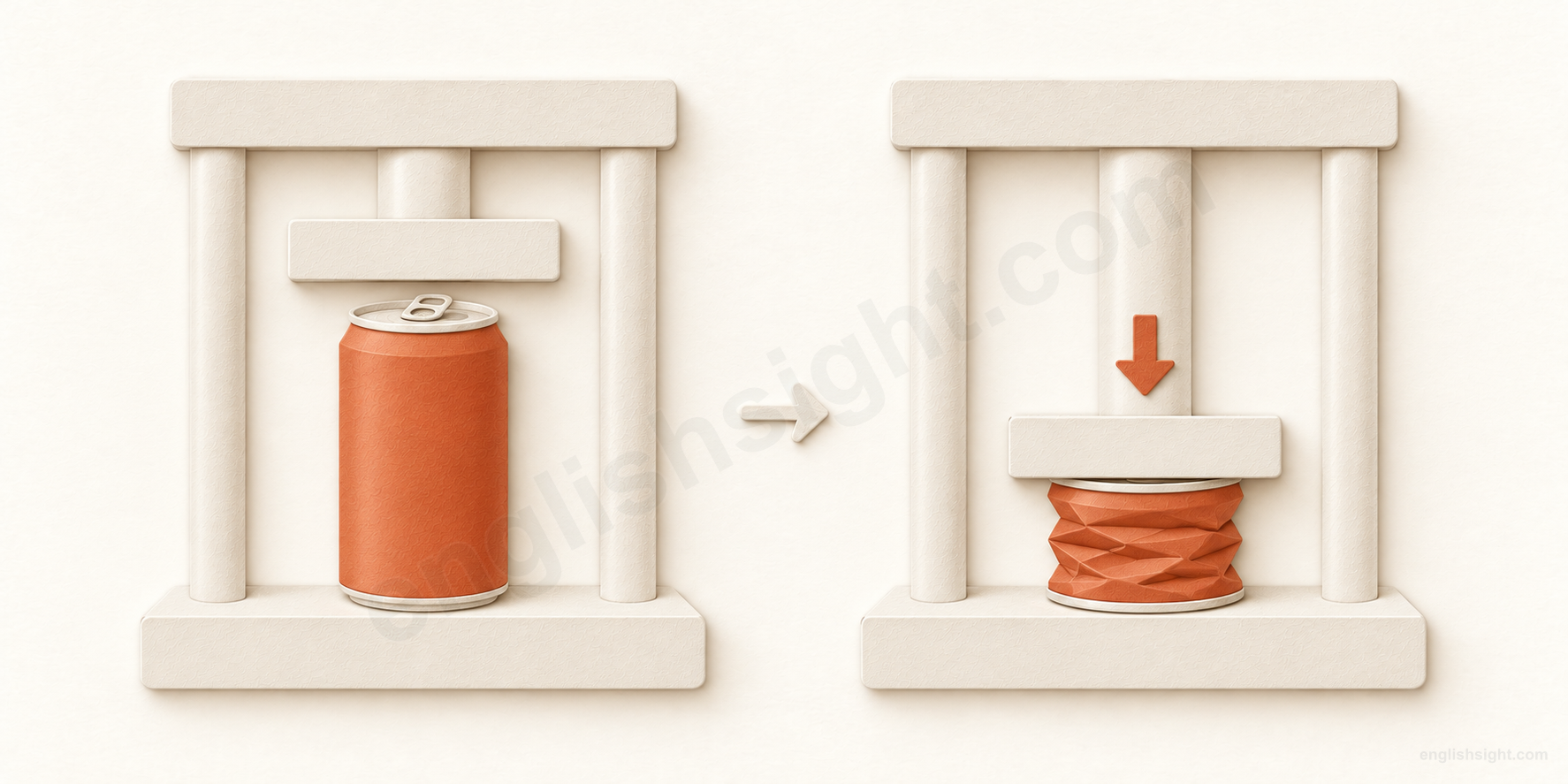
A tall can stands intact beneath the raised press plate.
crush
The same can is much shorter, with buckled, folded sides.
The press plate pushes down with strong force.
Strong pressure overcomes the can’s structure and changes its shape.
Strong pressure makes something lose its original shape or breaks its structure.
The can shows the physical relation between force and a changed object. Defeat and discouragement can be understood figuratively through overwhelming force. Romantic attraction and the success expression crush it must also be learned as established uses.
An empty can can keep its shape until strong pressure makes it buckle. This gives us a useful starting point for crush: something is squeezed, broken down, or overwhelmed.
The object and construction matter. Crushing garlic prepares food, crushing an opponent wins decisively, and having a crush on someone describes attraction. The romantic use is an established separate branch, not a rule you can derive from a can.
This lesson uses a visual teaching model to connect some uses. It does not claim that every English speaker shares one mental picture.
01
Pressure changes shape, texture, or space
Ask what receives the pressure and what changes. A can may collapse, food may become small pieces, and clothes may become creased. Into and against identify a space or surface.
01
crush + object; be / get crushed + by / under / between…
crush a can
damage or flatten something by strong pressure
Starting situation
An empty can still has its tall, round shape.
Result or relationship
The press leaves the can flattened and bent.
Crush highlights what pressure does to the object.
In The press crushed the can, the press applies force and the can is affected. The can does not have to break into separate pieces: losing its original shape is enough. Press a button describes applying pressure without this damaging result. A result adjective can make the outcome explicit: crush a can flat means press it until it is flat. Flat describes the can’s resulting state, not the way the press moves.
A passive sentence changes the viewpoint: The can was crushed by the press. With get, The flowers got crushed in my bag presents an unwanted event. With a person or body part, crushed can describe a serious physical injury; it is stronger than touched or gently squeezed.
Crush, crushes, crushed, and crushing are regular forms. The final sound in crushed is /t/, so the whole word is /krʌʃt/, with one syllable. The -es in crushes adds a syllable: /ˈkrʌʃɪz/.
An original example
The metal press crushed the empty can.
Choose carefully Crush is not a general replacement for press: you normally press a doorbell, because you want it to work, not collapse.
02
crush + ingredient; crush + object + into + result; crush something up / crush it up
crush garlic / crush up biscuits
reduce food or another material to smaller pieces by pressure
Starting situation
The biscuits are whole.
Result or relationship
They become crumbs for a dessert base.
The result can be pieces, powder, or pulp, depending on the material.
Cooking instructions use crush for garlic, nuts, seeds, ice, and biscuits. A hard ingredient may break into fragments, while a soft one may become pulp. Crushed garlic describes the prepared ingredient; it does not specify the exact tool.
Into can introduce the resulting material: crush the biscuits into crumbs. Compare cut the biscuits, which describes dividing them with a cutting action. Crush emphasizes pressure, pounding, or grinding instead.
Up can be added to emphasize breaking the material into small pieces: crush up the biscuits or crush the biscuits up. A pronoun goes between verb and up: crush them up. The particle is optional for this meaning; crush the biscuits is already complete.
An original example
Crush the biscuits into crumbs for the base.
Choose carefully Say crush them up, not crush up them. Do not assume crush must always produce a fine powder.
03
be crushed into + space; be crushed against + surface; crush + object + into + space
be crushed into / against…
be squeezed into a tight space or pressed against a surface
Starting situation
More passengers enter an already crowded train.
Result or relationship
One passenger has almost no room and is pressed against a door.
Into gives the crowded destination; against gives the surface receiving pressure.
We were crushed into the small carriage describes people being packed tightly inside it. We were crushed against the door describes pressure holding people against that surface. These prepositions add different spatial relationships.
The passive is natural when the experience of the affected people matters more than who is pushing. This crowded-space use does not necessarily assert that bones were broken, although the pressure can be uncomfortable or dangerous.
With objects, She crushed the clothes into a bag suggests forcing them in without care for their shape. Packed the clothes is more neutral. Neither into nor against adds romantic attraction: the attraction verb uses crush on someone, while the noun patterns include have a crush on someone and my crush.
An original example
I was crushed against the train door during the rush hour.
Choose carefully Do not automatically interpret a crowded-space sentence as a report of a crushing injury; read the context.
04
crush + paper / fabric; paper / fabric + crushes + easily
the fabric crushes easily
become creased or crumpled under pressure
Starting situation
A shirt is smooth before being packed.
Result or relationship
Packing leaves unwanted folds in the fabric.
The affected material can be the subject without a passive auxiliary.
Crush can be transitive: Don’t crush the paper decorations. It can also describe the material’s tendency to lose its smooth shape: This fabric crushes easily. In the second pattern, fabric is the subject and there is no object.
Easily describes susceptibility, not deliberate action by the fabric. Compare The fabric was crushed in the suitcase, which reports a particular event. Crease and crumple can be clearer everyday alternatives when folds are the main point.
This use fits the pressure model, but the result is wrinkles rather than crumbs. The exact physical outcome comes from the material and context, not from crush alone.
An original example
I won’t pack that shirt; the fabric crushes too easily.
Choose carefully Crushes easily is an active form with an affected subject, not an instruction to make the fabric crush something else.
02
Defeat, discouragement, and heavy burdens
Figurative crush suggests an overwhelming effect. The object tells you whether someone loses a contest, a movement is suppressed, or a person loses hope or confidence.
05
crush + opponent / team; be crushed + in + contest; a crushing victory / defeat
crush an opponent
defeat an opponent by a very large margin
Starting situation
Two teams begin a match.
Result or relationship
One wins so decisively that the other offers little effective resistance.
The pressure image becomes overwhelming competitive superiority.
In sports or competition, crush takes the losing person or team as its object. It describes a decisive defeat, not physical harm. Our team crushed theirs can be lively reporting or boasting; beat is less emphatic.
The related adjective crushing describes the scale or impact of a result: a crushing victory for the winners, a crushing defeat for the losers. A narrow win is not normally described as crushing.
The passive keeps the same result but changes the subject: Our team was crushed in the final. Check which team is the grammatical subject before deciding who won.
An original example
The visitors crushed the home team six–nil.
Choose carefully Crush is stronger than win or beat; it usually suggests much more than a close victory.
Force suppresses its ability to continue that resistance.
The object is resistance or the people offering it.
News and history use crush with rebellion, revolt, uprising, resistance, or opposition. The verb portrays the response as overwhelming and often violent. The rebels were crushed focuses on the defeated people instead of their movement.
A government may suppress resistance without resolving the complaints behind it. Crush describes what happens to the opposition’s activity or power; it does not by itself say that the action was justified.
This is a figurative extension of overpowering pressure. Against is not required to mark the target: crush the rebellion already contains a direct object.
An original example
The regime used force to crush the uprising.
Choose carefully Say crush the uprising, not crush against the uprising. The target is a direct object.
An event leaves that person with little or no hope of success.
The object names what is psychologically overwhelmed.
Crush someone’s hopes or dreams presents disappointment as a powerful blow to what the person hoped for. A lost opportunity, a refusal, or harsh words can be the subject. No physical squeezing is involved.
Crush someone’s confidence or spirit similarly names an inner resource that has been badly weakened. The expression is stronger than discourage: a small inconvenience does not normally justify it unless the speaker is exaggerating.
The possessive matters: The decision crushed her hopes says whose hopes were affected. The alternative Her hopes were crushed emphasizes the result and can leave the cause unstated.
An original example
The cancellation crushed our hopes of performing at the festival.
Choose carefully Do not interpret hopes as physical objects. This is figurative language for a severe emotional effect.
08
feel / be + crushed; be crushed by + event / words
feel crushed / be crushed by…
feel deeply upset or discouraged
Starting situation
A person receives a painful rejection.
Result or relationship
The person feels emotionally overwhelmed.
A person can be crushed emotionally without being physically injured.
I felt crushed describes the person’s emotional state. I was crushed by the rejection identifies its cause. This is a strong reaction, closer to devastated than mildly disappointed.
With feel, crushed works as an adjective-like description; with was crushed by, it can be understood as a passive result. Both keep attention on the affected person. Crushing criticism instead describes the criticism’s damaging effect.
Context decides the reading of She was crushed. A report about a falling wall suggests bodily injury; a story about rejection suggests emotional pain. The same form does not guarantee the same meaning.
An original example
I felt crushed when my closest friend forgot my birthday.
Choose carefully Crushed is much stronger than sad. It is not the same as having a crush on someone.
09
be crushed by + debt / burden / pressure
be crushed by debt
be severely weighed down by an overwhelming burden
Starting situation
A business has debts it struggles to pay.
Result or relationship
The debt severely limits its ability to operate.
An abstract burden acts like an excessive weight.
Crushed by debt presents financial obligations as a weight that leaves little room to act. Similar contexts can involve overwhelming responsibility or pressure. The burden is figurative, but the hardship described may be real.
This use need not mean that the person or business has already stopped functioning. It emphasizes severe constraint and distress. Have debts is a neutral factual description; be crushed by debt evaluates how overwhelming they are.
By introduces the cause in this passive pattern. Compare crushed under a fallen beam, where under usually describes the location of literal physical pressure.
An original example
The small business was crushed by debt after a year of poor sales.
Choose carefully Do not read the figurative weight as proof of a specific legal outcome such as bankruptcy.
03
A packed crowd, an attraction, or a drink
The noun has several established uses. A crowd connects with physical pressure; romantic attraction is a separate meaning to learn. Menu wording can also use crush for a fruit drink.
10
a crush of + people; in / through + the crush
a crush of people / in the crush
a crowd packed so tightly that movement is difficult
Starting situation
Many people gather near an entrance.
Result or relationship
Their close packing makes it difficult to move freely.
The noun names the crowded mass or crowded situation.
A crush of fans is a tightly packed crowd, not just a large number of fans. In the crush refers to being among those pressed-together people. The noun connects directly with the physical pressure family.
This sense is countable, but is often used in the singular: a crush, the crush. Of identifies the people making up the crowd. In identifies where someone is within that crowded situation.
Crowd is more neutral: people in a crowd may have plenty of space. Crush emphasizes limited space and pressure. The word alone does not tell you whether anyone was injured.
An original example
We lost sight of each other in the crush outside the station.
Choose carefully In a crush of fans, of introduces the crowd’s members. It does not introduce a romantic target.
11
have / develop + a crush on + person; get over + a crush
have a crush on someone
have a strong, often temporary romantic attraction
Starting situation
Someone feels excited and drawn to another person.
Result or relationship
They describe that attraction without claiming an established relationship.
A crush is a feeling; on introduces its target.
Have a crush on someone is informal. It commonly describes an intense attraction that may be private, unreturned, or short-lived. It does not establish that the two people are dating, and the expression is not restricted to children.
Develop a crush on someone describes the feeling beginning. Get over a crush describes the feeling fading or being left behind. Those changes come from develop and get over, not from a new sense of crush.
Learn this romantic noun as an established branch. The can-and-pressure sketch is not a literal explanation of attraction, and it cannot predict the preposition on.
An original example
Maya has a crush on someone in her evening class.
Choose carefully Use a crush on him, not a crush with him. Having a crush does not mean having a boyfriend or girlfriend.
12
possessive + crush; someone + is + possessive + crush
my crush
the person someone is attracted to
Starting situation
A person has a romantic attraction to someone.
Result or relationship
They refer to that other person as their crush.
The same noun can name the feeling or its target.
My crush can identify the person I am attracted to, rather than the feeling itself. My old school crush might mean a person from school or the feeling I had then; the rest of the sentence resolves the ambiguity.
A possessive often helps identify whose attraction is involved: her crush, his crush, my crush. This informal label does not imply a mutual relationship. Calling someone my partner would make a different claim.
Compare My crush waved to me, where a person waves, with My crush on her faded, where a feeling fades. The noun’s role and the surrounding verb help you choose the reading.
An original example
My crush sat next to me at lunch, and I suddenly felt shy.
Choose carefully A crush is not automatically a partner, and the person may not know about the attraction.
13
fruit name + crush; a glass of + fruit name + crush
orange crush
a fruit drink described as crush
Starting situation
A menu lists several cold drinks.
Result or relationship
A customer chooses a drink described by its fruit ingredient.
Menu context identifies this separate noun use.
Crush can name a fruit-juice drink, as in orange crush. This is a secondary use useful for recognizing menus and drink descriptions; it is not a synonym for every glass of juice.
The fruit name modifies the noun: orange describes the kind of crush. Depending on whether the speaker means the drink as a substance or one serving, the noun can be uncountable or countable.
Compare crushed oranges, where crushed describes what has happened to the fruit. Orange crush names a drink; its name alone does not give an exact recipe, sweetness level, or carbonation.
An original example
The café serves a chilled orange crush with lunch.
Choose carefully The drink name does not specify an exact recipe, and not every glass of fruit juice is called a crush.
04
Two informal expressions with different grammar
Crush on someone describes attraction. Crush it praises success. Learn the whole expression and its tone instead of applying the pressure picture literally.
14
crush on + person; be crushing on + person
crush on someone
feel strongly attracted to someone
Starting situation
A friend repeatedly thinks about a person they like.
Result or relationship
The friend describes that attraction informally.
Here crush is a verb, and on belongs to its attraction pattern.
She’s crushing on him uses the informal verb pattern crush on someone. It means she has a crush on him, rather than she is pressing down on his body. This use is especially associated with North American English.
Progressive forms are natural when discussing an ongoing attraction: I’ve been crushing on her for months. The target remains after on, even when it is a pronoun: crush on him. Do not move him before on.
The noun pattern is more widely useful as a first expression to learn: have a crush on someone. Both belong in informal personal conversation; neither says that the attraction is returned.
An original example
I think Leo is crushing on his new neighbor.
Choose carefully Say crushing on her, not crushing her on. Crushing her without on suggests a different meaning.
15
crush it; crushed it; be crushing it; be going to crush it
crush it
perform extremely well or achieve an impressive success
Starting situation
A person prepares for a performance.
Result or relationship
Their performance is a clear success.
The whole informal expression praises success rather than damage.
You crushed it! can praise a presentation, performance, competition, or other demanding task. It is enthusiastic and informal. The listener uses the situation to understand what it refers to; there need not be a physical object.
You’re going to crush it can offer encouragement before the event. She’s crushing it can describe current success. The form changes with time, but the established success meaning stays.
Compare Crush it before recycling, said about a can: there, it refers to a physical object and the meaning is literal. Context determines whether the same two words describe damage or success.
An original example
Your presentation was excellent—you really crushed it!
Choose carefully This is informal praise. It does not mean that the presentation was ruined, and it is not a separable particle verb.
Keep the construction and context together
Pressure is not always damage
Squeeze can describe a gentle hug, and press can describe using a switch. Literal crush normally emphasizes deformation, fragmentation, forceful compression, or injury. In the crowded-space use, injury is possible but not asserted by every sentence.
One spelling, different branches
I was crushed reports physical or emotional harm, depending on context. I have a crush on her describes attraction. I crushed it can praise success. These are not interchangeable statements.
Active, passive, and result
The press crushed the can names the source of force. The can was crushed by the press makes the affected object the subject. The fabric crushes easily describes susceptibility in an active form. A result adjective is possible after the object, as in crush a can flat. This does not make crush a general causative verb like make: there is no productive crush someone to do pattern.
Scope and register
The lesson covers modern practical uses, with the fruit-drink sense included for recognition. Literary crush someone to one’s breast means embrace tightly; it is not a neutral everyday replacement for hug. Specialized livestock equipment, technical production quantities, and informal or archaic drinking uses are outside the lesson.
Read the object and the pattern
Choose the sentence or interpretation that fits the situation.
1. You need to ring a working doorbell. Which instruction is natural?
2. You are telling someone to make biscuit crumbs. Replace the biscuits with them.
3. Which sentence describes attraction without claiming a relationship?
4. After an excellent performance, a friend says, “You crushed it!” What do they mean?
5. “We could hardly move in the crush outside the stadium.” What is the crush?
6. After a painful rejection, Ava says, “I feel crushed.” Which interpretation fits?
Sources and teaching notes
Dictionary entries support the uses and patterns below. The lesson explanations and examples are original; the pressure diagram is a teaching model with limits.
The diagram illustrates pressure and a changed shape; it is not a mental picture shared by every native speaker.