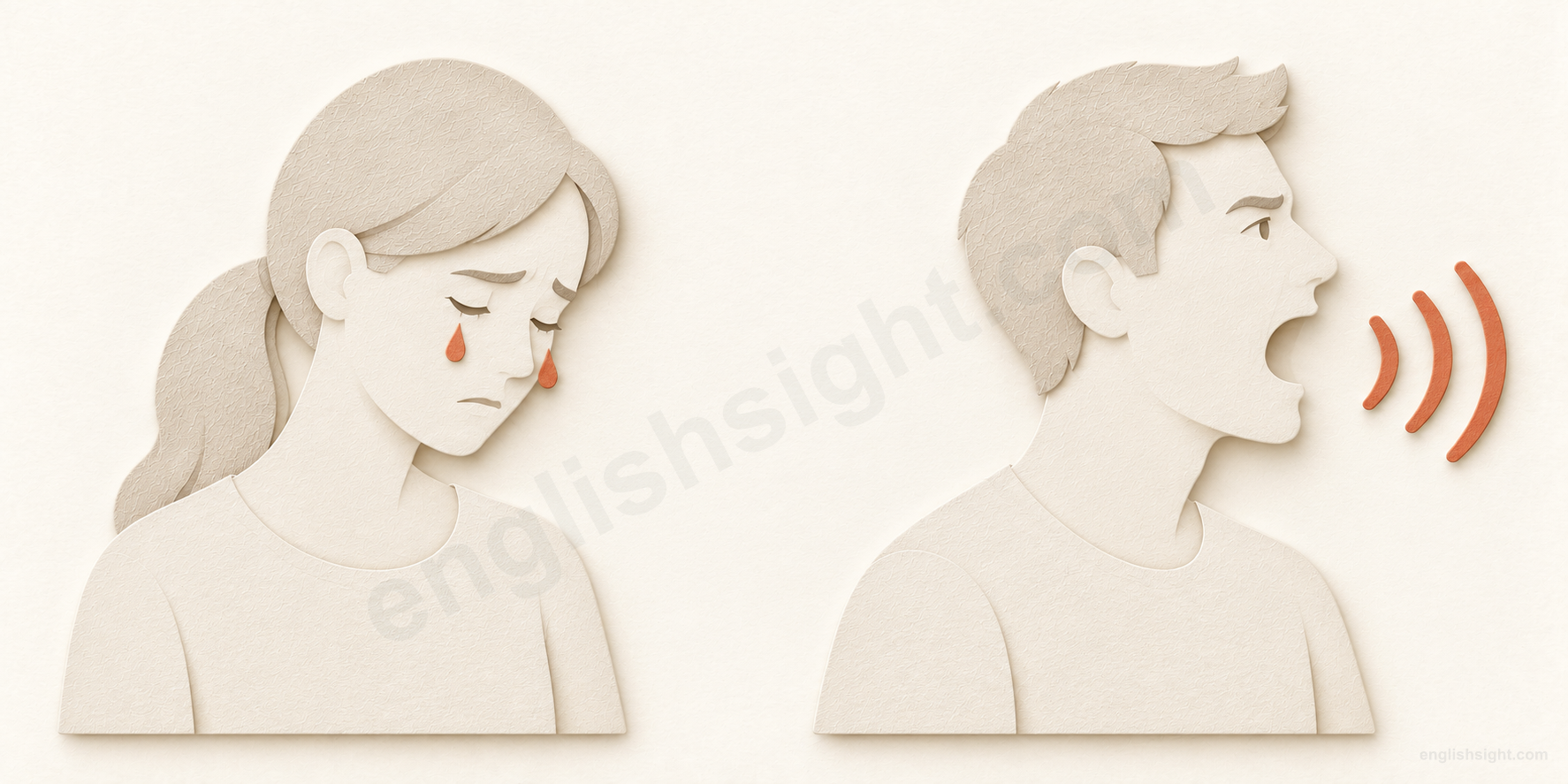
Use cry for an emotional response, a vocal call, and the expressions built around them.
A feeling finds expression
A feeling finds expression
On the left, a woman sheds tears with her mouth closed.
cry
On the right, a man calls out with his mouth open and dry cheeks.
The two portraits show alternatives, not a sequence.
Tears and a loud call are two uses of cry; neither requires the other.
Cry can describe emotion or distress coming out as tears; it can also describe a loud call, with or without tears.
The sketch shows two alternatives, not a required before-and-after sequence. A cry can be involuntary, and a call need not be answered. Animal calls and fixed idioms have their own usage limits.
A person may cry quietly with tears, or cry out loudly without tears. Look at the construction and situation before deciding which meaning is intended.
The two-part sketch connects visible tears with an audible reaction as a teaching aid. It does not claim that all uses share one literal scene or that every English speaker imagines the same picture.
01
Tears, feelings, and crying episodes
Describe who is crying, what causes the tears, and whether you mean an urge, an activity, or a whole episode.
01
cry; start / stop + crying; feel like + crying; make + person + cry
cry / start crying
have tears because of a feeling or hurt
Situation
A child is frightened by a sudden noise.
Response or meaning
Tears run down the child’s face.
Crying need not be loud, deliberate, or caused by sadness.
The person having the experience is the subject: I cried; the baby is crying. You can cry silently. The word alone does not tell us how much noise there is.
Start crying and start to cry describe the beginning; stop crying describes the end. I feel like crying describes an urge and does not say tears have already appeared.
To describe a cause acting on someone, use make someone cry: The ending made me cry. Cry someone is not the ordinary causative pattern.
In a sentence
The ending of the film made me cry.
Watch the difference Say It made me cry, not It cried me or It made me to cry.
02
cry about / over + noun or -ing form
cry about / over something
be in tears because of an event, loss, or person
Situation
Someone has lost a meaningful photograph.
Response or meaning
They cry because the loss upsets them.
About and over introduce what the tears concern.
Use about or over before the matter that upsets someone. Cry over a person may concern losing or missing them; it does not describe a position above their body.
The preposition supplies the topic or cause. Compare cry for help, where for introduces what the caller wants, and cry with relief, which names the accompanying emotion.
In a sentence
He cried over the loss of his family photographs.
Watch the difference Do not put the event directly after cry: cry about the argument, not cry the argument.
03
cry with + emotion; cry tears of + emotion
cry with relief / cry tears of joy
have tears from a strong emotion, including happiness
Situation
A missing pet returns safely.
Response or meaning
Its owner has tears of relief and happiness.
The emotion can be positive; tears alone do not identify it.
With can name the feeling present during crying: cry with relief, rage, or frustration. The tears are the response; the following noun tells us what kind of feeling is involved.
Cry tears of joy uses tears as a limited kind of object: it names what comes from the eyes. This does not make cry a general verb for acting on people or things.
In a sentence
When our dog came home, we cried tears of joy.
Watch the difference Crying does not necessarily mean someone is unhappy.
04
cry for + person / thing
cry for someone / something
cry because you want someone or something
Situation
A tired baby wants a familiar caregiver.
Response or meaning
The baby cries for that person.
For names the wanted person or thing, rather than a direct object.
The crying person is the subject; the person wanted follows for. A baby crying for its mother wants her presence or care.
For does not always mean because of. Here the baby-and-caregiver situation makes the wanting interpretation clear; in cry for help, it introduces the assistance sought.
In a sentence
The baby was crying for her father.
Watch the difference Compare cry over someone, which typically concerns distress about them, rather than this request for their presence.
05
cry + myself / yourself / himself / herself / ourselves / themselves + to sleep
cry yourself to sleep
cry until you fall asleep
Situation
Someone lies awake feeling deeply upset.
Response or meaning
They eventually fall asleep while crying.
The reflexive pronoun refers back to the person who cries.
The pattern combines an activity with the state reached: to sleep gives the endpoint. It does not mean someone deliberately uses tears as a sleep technique.
Match the reflexive to the subject: I cried myself to sleep; she cried herself to sleep. The result belongs to the whole construction, not to cry alone.
In a sentence
After the painful goodbye, she cried herself to sleep.
Watch the difference This describes the same person crying and sleeping; it is not a pattern for putting another person to bed.
06
cry + possessive + eyes out
cry your eyes out
cry intensely or for a long time
Situation
Someone receives heartbreaking news.
Response or meaning
They cry a great deal.
This informal exaggeration expresses intensity, not physical damage.
Eyes out belongs to a fixed expression. Choose the possessive to match the person crying: I cried my eyes out; he cried his eyes out.
Out does not describe eyes actually leaving the body. Unlike a literal object-and-direction pattern, the expression cannot be freely rebuilt with other body parts.
In a sentence
I cried my eyes out when my best friend moved away.
Watch the difference Keep the whole expression together; cry out my eyes is not this idiom.
07
have + a + (good / long) + cry
have a good cry
spend a period crying
Situation
Someone has been holding back tears.
Response or meaning
They allow themselves a long period of crying.
Cry is a singular event noun here.
Have a cry turns the activity into an episode. Good often suggests a thorough or long cry, sometimes with a feeling of relief afterward.
It does not describe a happy occasion or guarantee that someone will feel better. The indefinite article belongs to the event noun: a cry.
In a sentence
I went somewhere quiet and had a good cry.
Watch the difference Say had a good cry, not had a good crying in this expression.
02
Calls, words, and animal sounds
A cry may be a vocal reaction or a loud call. Tears are optional in these uses; the words and context identify what happened.
08
cry + quoted speech; cry that + clause
“Wait!” she cried.
say something loudly and emotionally
Situation
Someone notices a friend about to leave.
Response or meaning
They call out a word to stop the friend.
In a speech report, cry may describe a loud voice without tears.
The quotation gives the spoken words. In stories, cried often works as an emotional reporting verb; the context decides whether tears are also present.
For ordinary instructions in conversation, said, called, or shouted may fit better. Oxford marks this shouting use of cry as rather formal or literary; do not use it as a neutral replacement for say everywhere.
In a sentence
“Wait for me!” Nina cried as the bus doors began to close.
Watch the difference Cried after a quotation does not by itself prove that the speaker was weeping.
09
cry out; cry out in + pain / fear / surprise
cry out in pain
make a sudden loud vocal reaction
Situation
A sharp pain catches someone by surprise.
Response or meaning
They make an involuntary loud sound.
Cry out can be a sound without words.
Out emphasizes the audible call or exclamation. In pain, in fear, or in surprise explains the circumstances of the sound.
This is different from crying quietly with tears. A person may cry out once without continuing to cry afterward, and the call need not contain a word.
In a sentence
He cried out in pain when he twisted his ankle.
Watch the difference Do not infer tears simply from cry out.
10
cry out + name / words; cry out + quoted speech
cry out a name / “Stop!”
call particular words loudly
Situation
Someone sees a friend across a crowded station.
Response or meaning
They call the friend’s name.
The words may be supplied as a noun phrase or quotation.
Cry out can introduce content: cry out a name or cry out “Stop!” Here the name is what is shouted, not the person being made to cry.
Learn the clear full-noun order cry out her name. For routine attempts to attract a friend’s attention, call her name is often a simpler everyday choice.
In a sentence
I cried out Maya’s name, but she did not hear me.
Watch the difference A call does not guarantee a response. Keep this distinct from cry your eyes out.
11
cry (out) for + help; cry out + “Help!”
cry / cry out for help
call loudly to ask for assistance
Situation
A person cannot get out of a locked room.
Response or meaning
They call so that someone may help.
For names the assistance sought, rather than the words spoken.
Cry for help and cry out for help can describe an actual vocal appeal. Cry out “Help!” instead quotes the word that is spoken.
The speaker may be frightened, but tears are not required. A request can go unheard: the expression describes the appeal, not a successful rescue.
In a sentence
The hikers cried out for help when the path collapsed.
Watch the difference The phrase can also be figurative in other contexts; this sentence describes people actually calling.
12
bird / animal + cry; the cry of + bird / animal
a gull cries / the cry of a gull
make, or name, an animal’s characteristic call
Situation
Gulls circle above the harbor.
Response or meaning
Their calls can be heard overhead.
Animal cry describes a sound; it does not establish a human emotion.
Birds and some other animals can cry or cry out. The related noun names their call: the cry of a gull.
This is an independent sound use connected to the vocal branch. Do not interpret it automatically as an animal shedding tears; use the actual context to identify the sound.
In a sentence
We heard the cry of a gull above the harbor.
Watch the difference Cry is possible for various animals, but specific verbs such as bark or meow identify a particular call more precisely.
03
A sound, an appeal, or a shared slogan
As a noun, cry can name a brief sound, a request for support, or words that bring people together.
13
give / let out + a cry of + feeling; a cry of + quoted words
a cry of pain / joy / alarm
a short vocal expression of a feeling
Situation
Someone sees a child about to fall.
Response or meaning
They let out a sharp cry of alarm.
Cry is countable and names a sound, not necessarily an episode of tears.
Use a cry or plural cries for separate vocal sounds. Give a cry and let out a cry describe producing such a sound.
Of names the feeling, or introduces quoted content: a cry of “Fire!” The cry may be wordless or contain words, depending on what follows.
In a sentence
She let out a cry of joy when her name was announced.
Watch the difference A cry of joy is a sound; crying tears of joy explicitly refers to tears.
14
a cry / cries for + requested thing
cries for help / justice
appeals or demands for something needed
Situation
Residents need repairs after a flood.
Response or meaning
They make public appeals for assistance.
A noun cry can represent an appeal, not just its volume.
For introduces the thing requested: cries for help, justice, or change. Public appeals may be spoken, written, or reported collectively.
Compare cries of anger, where of identifies the feeling being expressed. A cry for justice can express anger, but the grammar foregrounds the demand.
In a sentence
The council ignored residents’ cries for help after the flood.
Watch the difference Cries for help may mean actual shouts or broader appeals; the surrounding situation tells you which.
15
behavior / message + be + a cry for help
a cry for help
behavior or a message that signals a need for support
Situation
Someone is struggling but cannot explain directly.
Response or meaning
Their behavior alerts others that support may be needed.
The figurative cry can be a signal rather than a loud spoken request.
A person’s message or behavior may be described as a cry for help even when no one literally calls or weeps. The expression interprets it as an appeal for care or support.
Context is essential: a late reply alone does not prove that someone needs help. This phrase describes an interpretation, not a diagnosis.
In a sentence
In the story, the character’s sudden withdrawal is a cry for help.
Watch the difference Do not assume every unusual action is a cry for help.
16
a rallying / battle / war + cry; a rallying cry for + group / cause
a rallying cry / battle cry
words that unite people around a cause or action
Situation
A group wants others to support a shared goal.
Response or meaning
A short phrase becomes a call to join them.
The cry functions as a slogan or shared call.
A rallying cry encourages support. A battle cry can be a literal call in battle or a forceful slogan for a campaign.
The whole compound identifies the social function of the words. It does not mean the group is sad, and the slogan need not always be spoken loudly.
In a sentence
“Keep the park open” became a rallying cry for local families.
Watch the difference Rallying describes gathering support, not an episode of weeping.
04
Strong needs and changed plans
Learn crying out for as a strong-need expression, and cry off as a British informal expression for withdrawing from an arrangement.
17
be crying out for + noun / needed action
be crying out for something
need something very much or obviously
Situation
A library has too few chairs for its visitors.
Response or meaning
The shortage makes the need for seating clear.
The subject can be a place, organization, or situation with no voice.
This figurative expression presents a strong need. The library is not literally calling or producing tears. For introduces the missing thing or needed action.
The progressive is especially usual: is crying out for. Simple cries out for is possible too, as in This problem cries out for a solution. This is distinct from a person literally crying out for help.
In a sentence
The library is crying out for more seating.
Watch the difference Keep for before the need: crying out for repairs, not crying repairs out.
18
cry off; have to cry off
cry off
withdraw from something you agreed to do
Situation
A friend has agreed to come to dinner.
Response or meaning
They say that they can no longer come.
The full phrasal verb means withdraw; it does not require tears.
Cry off is British and informal. It describes telling someone that you cannot keep an arrangement or promise.
Learn it as an established expression. Off does not describe turning tears off. Had to cancel or could not come is a clearer broadly understood alternative in many international conversations.
In a sentence
Jon had agreed to join us for dinner but cried off that afternoon.
Watch the difference Cry off is not the expression for stopping someone from crying.
05
Established expressions in conversation and writing
These phrases carry meanings and tones of their own. Learn the whole expression and the situation it suits.
19
cry wolf
cry wolf
raise a false alarm and damage your credibility
Situation
Someone repeatedly warns of trouble that is not real.
Response or meaning
People become less likely to trust a later warning.
The fixed expression includes the risk of not being believed.
Use cry wolf for an unfounded alarm, especially where false warnings undermine trust. Neither real wolves nor tears need be involved.
It does not simply mean ask for help often. A person with repeated genuine emergencies is not therefore crying wolf.
In a sentence
After several false warnings, nobody knew whether the guard was crying wolf again.
Watch the difference No article is used in the idiom: cry wolf, not cry a wolf.
20
cry foul
cry foul
claim that something is unfair or improper
Situation
Rules change after a competition has started.
Response or meaning
Some participants publicly object.
The expression reports an accusation, not proof of wrongdoing.
Cry foul is used when someone complains that another party has acted unfairly or against the rules. It occurs in sport and in wider disputes.
The connection is to a vocal protest, but the whole phrase is established. The complaint may be written; the verb does not require actual shouting.
In a sentence
Several teams cried foul when the rules changed halfway through the contest.
Watch the difference Saying that someone cried foul does not settle whether their complaint was justified.
21
there is no use / point (in) crying over spilt / spilled milk
cry over spilt / spilled milk
dwell on a past loss that cannot be undone
Situation
A nonrefundable ticket has already been wasted.
Response or meaning
Someone urges the group to stop dwelling on the loss.
The spilled milk stands for an irreversible past event.
This idiom often follows no use, no point, or don’t. Spilt is the usual British form in the saying; spilled is usual in American English.
The advice concerns unproductive regret, not a ban on learning from a mistake. Using it about another person’s serious loss can sound dismissive.
In a sentence
There’s no point crying over spilled milk; let’s plan the next trip.
Watch the difference Keep over in this idiom. It need not involve actual milk or actual tears.
22
be + a shoulder to cry on (for someone); offer + someone + a shoulder to cry on; cry on + possessive + shoulder
a shoulder to cry on
someone who listens and offers sympathy
Situation
A friend is upset and wants to talk.
Response or meaning
Another person makes time to listen kindly.
The shoulder represents support, with or without physical contact.
The patterns be a shoulder to cry on and offer someone a shoulder to cry on describe sympathetic listening. Tears and a literal shoulder are possible, but neither is required.
The expression describes emotional support rather than a promise to fix the practical problem. Keep the final on: the shoulder is what someone could cry on in the literal image.
Cry on someone’s shoulder describes the other side of the interaction: telling your troubles to a sympathetic listener. After a difficult day, I cried on Ana’s shoulder means I turned to Ana for comfort, whether or not there were literal tears.
In a sentence
When I needed a shoulder to cry on, Ana stayed and listened.
Watch the difference This is more personal than a neutral offer of practical assistance.
23
for crying out loud + ! / question / request
For crying out loud!
express impatience, annoyance, or emphatic surprise
Situation
Someone asks the same question after several explanations.
Response or meaning
The reply shows irritation.
The whole exclamation conveys tone; it is not a request to cry.
This informal spoken expression can stand alone or add force to a question or request. It may sound sharp or exasperated.
For is part of the fixed wording. The expression does not describe the purpose of a crying event, and it is a poor choice when you want a calm, tactful request.
In a sentence
For crying out loud, can we finish one thing before starting another?
Watch the difference Compare cry out loud, which can literally describe making an audible sound; for crying out loud is an exclamation.
24
be + a far cry from + noun / -ing form
a far cry from something
very different from something else
Situation
Someone compares their current home with an earlier one.
Response or meaning
They emphasize a large difference between the two.
Far is about degree of difference, not necessarily distance.
Be a far cry from compares two situations, experiences, or things. It does not describe a distant person crying.
The contrast may be an improvement or a disappointment; context provides that evaluation. From introduces the comparison point.
In a sentence
Our quiet village is a far cry from the city where I grew up.
Watch the difference Keep a and from: a far cry from, not far cry than.
25
laugh until / till + subject + cry
laugh until / till you cry
laugh so hard that tears form
Situation
Friends hear an extremely funny story.
Response or meaning
They laugh with tears in their eyes.
The laughter produces tears; it does not necessarily turn into sadness.
Until or till gives the endpoint reached by intense laughter. Change the pronoun to match the subject: we laughed until we cried.
This illustrates the tears branch of cry in a joyful context. It does not say that every long laugh must produce tears.
In a sentence
We laughed until we cried at Ravi’s story.
Watch the difference Do not interpret the sentence as saying that the story later made everyone unhappy.
26
not know whether to laugh or cry
not know whether to laugh or cry
feel torn between amusement and distress
Situation
A carefully planned event goes absurdly wrong.
Response or meaning
Someone is unsure how to react.
The expression describes a mixed reaction, not necessarily either action.
Use this informal expression for something unfortunate that also seems absurd or ridiculous. Whether introduces the two possible reactions.
You need not actually laugh or shed tears. Unlike laugh until you cry, this expression does not describe laughter causing tears.
In a sentence
When the replacement printer broke too, I didn’t know whether to laugh or cry.
Watch the difference Whether to laugh or cry gives alternatives; until you cry gives an endpoint.
27
raise / cause + a hue and cry + about / over + issue
raise a hue and cry
cause or make a loud public protest
Situation
A proposal angers many residents.
Response or meaning
Strong objections spread through the community.
The fixed pair refers to an outcry, especially in written reporting.
Raise a hue and cry about or over something presents a noisy or forceful public reaction. Collins labels this use written.
Hue here belongs to the idiom; it is not the color word used literally. The expression does not require people to weep.
In a sentence
The plan to close the playground raised a hue and cry among parents.
Watch the difference Learn hue and cry as a unit; do not replace and with or.
28
be + in full cry
be in full cry
be expressing views or pursuing activity with great energy
Situation
A campaign is gathering momentum.
Response or meaning
Its supporters are making their views known forcefully.
This established phrase describes intensity, not a full quantity of tears.
In full cry can describe people talking or shouting enthusiastically, or a campaign operating vigorously. It is useful for recognizing commentary and written reporting.
Literal hunting uses also exist, but you do not need to imagine hounds to understand this modern figurative use. Read the subject to identify the activity.
In a sentence
By Friday, the campaign was in full cry, with supporters speaking at every meeting.
Watch the difference Do not use in full cry as the ordinary expression for a person crying hard; use crying hard or crying their eyes out.
Choose the branch and the construction
Forms and pronunciation
Cry /kraɪ/ is both a verb and a noun. The verb forms are cry, cries, cried, cried, crying; the noun plural is cries. Crying keeps the y, while cries and cried change it to i. He cries and her cries contain the same spelling with different grammatical jobs.
Cry, sob, weep, shout, and scream
Cry is the general verb for emotional tears and may be quiet. Sob adds noisy, broken breathing. Weep is more formal or literary. Shout foregrounds a loud voice; scream typically suggests a high, intense sound. Cry as a reporting verb is common in stories, rather than a universal substitute for say.
Objects, causes, and passives
The tears use normally has no object: she cried. Limited objects such as tears of joy name the tears; quoted words can be the content in the vocal use. Use make someone cry for a cause. Do not build a passive such as she was cried to mean she was made to cry. Progressive forms are natural for an activity: she is crying.
Scope and the picture
This lesson covers modern tears and voice uses, noun calls and appeals, familiar idioms, and the marked British cry off. It does not expand historical street selling, Scottish regional senses, hunting terminology, or every phrase containing cry. The picture explains two branches; it cannot predict the meaning of every fixed phrase.
Choose the meaning in context
Check whether the sentence describes tears, a call, a need, or a fixed expression.
1. A story says: “Stop!” he cried. What can you safely conclude?
2. Which sentence naturally says that a sad song caused you to have tears?
3. “The school is crying out for more teachers.” What does this mean?
4. A person repeatedly invents emergencies, and others stop trusting the warnings. Which expression fits?
5. “After the funeral, I went home and had a good cry.” What is a cry here?
6. “This tiny room is a far cry from the spacious office we expected.” What is emphasized?
Sources and teaching notes
Usage was checked against the dictionary pages below. The explanations and examples are original; the visual connection is a teaching model rather than a claim about every speaker’s mental image.
The sketch shows two possible responses, not a universal mental picture or a required sequence.