Connect the drinking vessel to servings, measures, curved hands, and familiar expressions.
An open hollow that holds
An open hollow contains or supports something
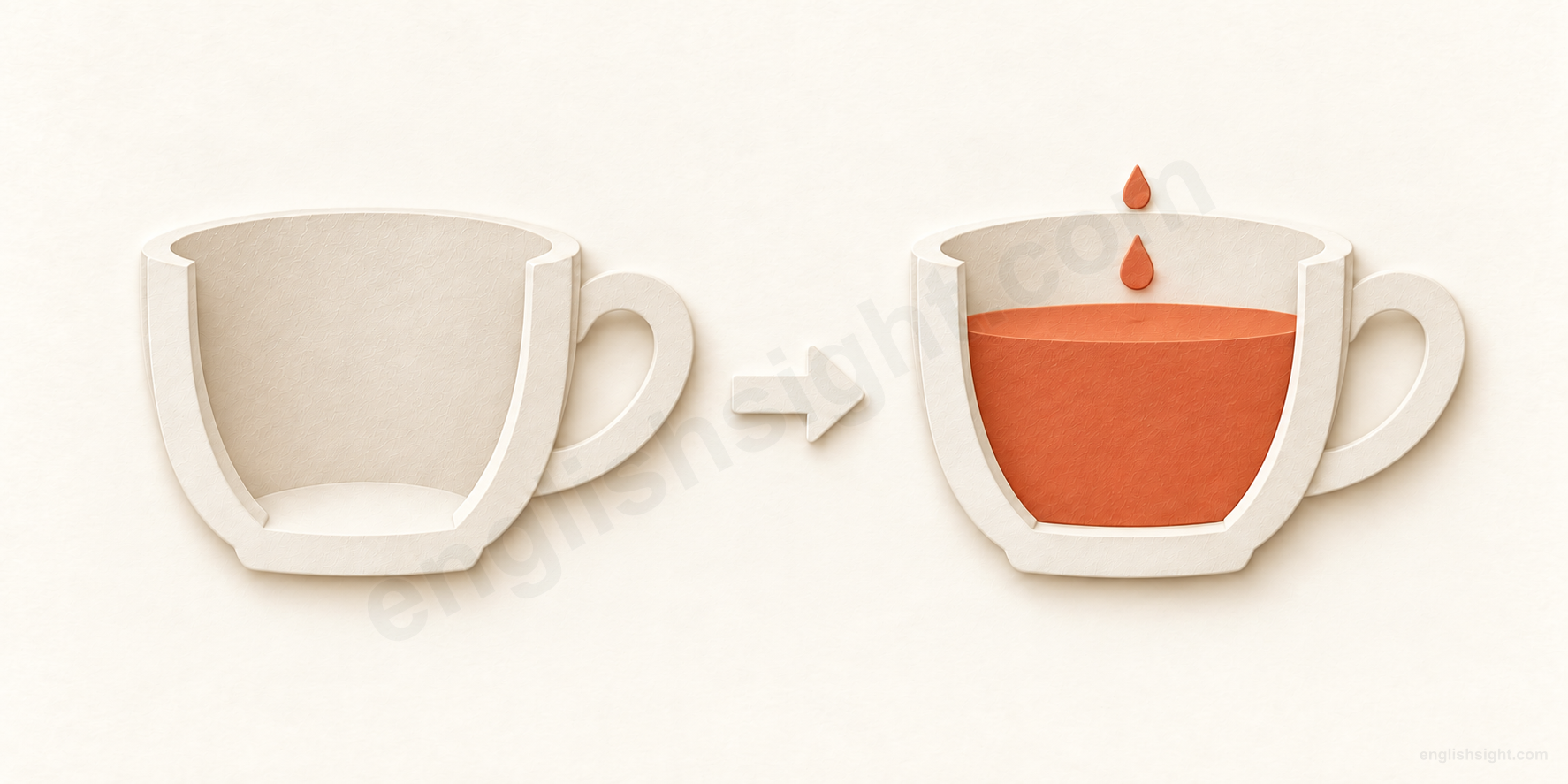
The empty cup has an open hollow.
cup
The same cup holds the liquid within its sides and above its base.
Liquid enters through the open top.
An open top lets liquid in; the sides and base hold it.
A cup has an open top and a hollow that holds something; the verb cup can describe hands making a similar hollow to support or enclose an object.
The diagram shows the physical starting point. Servings and measures depend on contents or quantity; trophy and competition uses depend on convention. The preference idiom must be learned as a whole.
Start with an open vessel: its curved sides and base make a hollow that can hold a drink. Cup can name the vessel, a serving of its contents, or another object with a related shape.
That connection helps with many uses, but context and established expressions still matter. A sports Cup is an event, and not my cup of tea is about preference. The diagram is a teaching model, not a claim about every speaker’s mental picture.
01
Drinking, serving, and measuring
The vessel, what it contains, and a recipe quantity are related but answer different questions.
01
a / the + cup; material / drink + cup; fill a cup with something
a cup; a coffee cup
a small vessel for drinking
Situation / starting point
You need something to drink from.
Meaning in context
You pick up a cup.
Cup names the container, whether empty or full.
A cup has an open top and a hollow that holds a drink. Many cups have a handle, but a paper cup need not have one. Paper and plastic specify the material in paper cup and plastic cup; coffee in coffee cup names its intended use.
Use a cup for one and cups for more than one. A cup and saucer is a cup with the small plate it rests on. In Fill the cup with water, the cup is the container and with introduces its contents.
A coffee cup may be empty. A cup of coffee normally includes the drink. This small contrast helps you ask for the object or for a serving.
In a sentence
Please put a clean cup beside each plate.
Watch the difference A handle is usual, not essential: paper cups are still cups.
02
a / another cup of + drink; number + cups of + drink
a cup of coffee
a drink served in a cup, or a cup-sized serving
Situation / starting point
Someone offers to make a drink.
Meaning in context
You request one serving.
Cup can count servings rather than separate physical containers.
In a cup of coffee, of connects the serving to what is served. Two cups of coffee can mean two drinks in separate cups or two successive servings in the same cup. Context tells you which.
Make someone a cup of tea and pour someone a cup of coffee are ordinary offers. If the drink is already understood, another cup is enough: Would you like another cup?
A drinking cup is not a precise measuring standard. Saying that you had three cups of tea reports servings, without specifying an exact volume.
In a sentence
I had two cups of coffee during the meeting.
Watch the difference Drank a cup normally means drank its contents, not swallowed the vessel.
03
number + cups of + ingredient; half a cup of + ingredient
a cup of flour; a measuring cup
a cooking measure and the tool used for it
Situation / starting point
A recipe gives quantities in cups.
Meaning in context
You measure the ingredients before mixing.
A recipe cup measures volume, including the volume of dry ingredients.
In a recipe, cup can be a standardized volume measure. Flour and rice can be measured in cups even though they are not liquids. A measuring cup is the marked tool used to measure that volume.
Two cups of flour counts two measures, not two drinking vessels left in the mixture. Half a cup of milk gives part of the measure; a quarter of a cup gives a smaller part.
Use the measuring system specified by the recipe rather than choosing an arbitrary tea cup. Cup measurements are especially associated with US recipes; cup does not by itself name a weight.
In a sentence
Add half a cup of milk and two cups of flour.
Watch the difference A cup of flour and a cup of milk have the same measured volume, not necessarily the same weight.
02
The shape in other objects
A hollow or curved part can be called a cup even when nobody drinks from it.
04
suction / egg + cup; the cup of + object
a suction cup; an egg cup
an object named for its hollow shape or supporting function
Situation / starting point
You see a small curved holder or attachment.
Meaning in context
The surrounding noun tells you its particular function.
Cup-shaped objects need not be drinking vessels.
A suction cup is the small hollow attachment used to fasten something to a smooth surface. The cup-like part is relevant, but suction contributes how it stays attached; cup alone does not mean stick to a wall.
An egg cup supports an egg for eating. It is not an egg-flavored drink. These are compound nouns: the first word narrows what kind of cup is meant.
This shape connection also helps with descriptions such as the cup of a flower. Learn the actual object name rather than calling every curved object a cup.
In a sentence
The mirror has a suction cup that holds it against the tile.
Watch the difference Do not confuse a suction cup with a drinking cup held against a wall.
05
bra cup; cup size; a + letter + cup
a bra cup; a C cup
one of the shaped parts of a bra
Situation / starting point
You compare the fit of a garment.
Meaning in context
You discuss the part supporting each breast.
Cup here names a garment part, not a drink or a recipe quantity.
A bra has two shaped cups. The same word can occur in swimwear with a similar construction. The curved supporting shape provides a useful connection to the vessel, while the clothing context gives the exact meaning.
A C cup uses a letter as a cup-size label. In cup size, cup modifies size. This is clothing vocabulary; it is not a way to measure flour or coffee.
In a sentence
The straps fit, but the cups are too small.
Watch the difference Do not interpret cup-size letters as cooking measurements.
03
Prizes, competitions, and sports equipment
Sports uses include both a prize and the event associated with it, as well as particular pieces of equipment.
06
win / lift / present + a / the cup
win the cup; lift the cup
a trophy awarded to a winner
Situation / starting point
A team wins a competition.
Meaning in context
The team receives or raises its trophy.
Cup can refer to a physical prize shaped like an ornamental vessel.
A prize cup often has a base, a stem, and handles. Win a cup refers to receiving it as a prize. Present someone with the cup describes giving the trophy in a ceremony.
Lift the cup can describe raising the trophy, and sports reports also use it to mean winning the competition. The action of raising the prize stands for the victory; cup alone does not mean win.
In a sentence
The captain lifted the cup while the crowd cheered.
Watch the difference A trophy cup is not an ordinary cup of tea, even though their names share a shape connection.
07
the + name + Cup; cup + final / match / competition / run / tie
the World Cup; a cup final
a sports competition associated with a cup prize
Situation / starting point
Teams enter a tournament.
Meaning in context
They compete through rounds toward its final.
Cup can name the event rather than the metal trophy.
In the World Cup or the FA Cup, Cup belongs to the competition’s name. In They reached the cup final, cup modifies final and refers to the tournament, not to the object’s shape.
A cup match is a match in such a competition. In British sports reporting, a cup run is a team’s progress through a series of rounds; a cup tie is a match between opponents in a cup competition.
They won the cup can emphasize either the tournament victory or the trophy awarded for it. Use the surrounding words to decide whether an event or an object is in focus.
In a sentence
Our local team has reached the cup final.
Watch the difference Capitalize Cup in an official name such as World Cup; generic a cup final normally uses a small c.
08
into / in / past + the cup
the ball drops into the cup
the golf hole or its liner
Situation / starting point
A golfer sends the ball across the green.
Meaning in context
The ball falls into the target hole.
In golf, cup is the receptacle or the hole itself.
A golf cup is the container fitted into the hole on the green; the word also names that hole. In The ball missed the cup, it is the target, not a prize sitting nearby.
The cup-like hollow makes the shape connection clear. The sporting context is essential because cup has other sports meanings, especially trophy and tournament.
In a sentence
The ball stopped just short of the cup.
Watch the difference A cup on the green is a target; winning the cup usually concerns a trophy or tournament.
09
wear + a (protective) cup
wear a protective cup
a shaped protector worn in some sports
Situation / starting point
A player puts on protective equipment.
Meaning in context
A rigid curved piece protects the groin.
North American sports usage can give cup an equipment meaning.
In North American English, a cup can be a shaped protector worn over the male genitals during sport. Protective cup makes the purpose clearer outside a shared sports context.
This is another shape-based object name. It is separate from a cup that the player might drink from and from the cup awarded to a winning team.
In a sentence
The coach reminded the players to wear protective cups.
Watch the difference Context matters: Put on your cup is about protective equipment, not picking up a drink.
04
Making a hollow with your hands
As a verb, cup describes curved hands or the way those hands hold something.
10
cup + your hand(s) + (around / over something); cupped hands
cup your hands
curve your hands into a hollow shape
Situation / starting point
Your hands are open or flat.
Meaning in context
You curve them to make a small hollow.
The hands themselves are the object being shaped.
Cup your hands asks you to make a hollow with them. You might do this to catch a little water. Cupped hands describes the resulting shape.
Cup your hands around your mouth places the curved hands beside the mouth, for example when calling to someone. Cup a hand behind your ear or cup your ear describes a curved hand placed to help you listen.
Around, over, and behind specify position; they do not create a family of phrasal verbs with unrelated meanings. In ordinary use this verb takes an object: cup your hands, not simply cup when the object is unknown.
In a sentence
She cupped her hands to catch water from the tap.
Watch the difference Cup your hands changes their shape; clap your hands brings them together to make a sound.
11
cup + object + in your hand(s); object + be cupped in a hand
cup something in your hands
support or partly enclose something with curved hands
Situation / starting point
A small object needs gentle support.
Meaning in context
Your rounded hands hold it from below and around its sides.
The supported object, rather than the hands, follows the verb.
In cup the stone in your hands, the stone is what you hold. The phrase in your hands tells us where and how it is supported. Compare cup your hands, where the hands themselves are being curved.
Cup often makes the enclosing shape more vivid than the general verb hold. The grip need not be tight: a small object can rest in the hollow. A chin cupped in one hand describes the same relationship in a passive form.
Forms are cup, cups, cupped, and cupping. Double the final p before -ed and -ing. Cupping can describe an action in progress; a separate medical use of the word belongs to a different topic.
In a sentence
He cupped the smooth stone in both hands.
Watch the difference Cup the stone is not a direction to put it into a drinking vessel; the hand phrase makes the intended action clear.
05
A familiar way to express taste
The whole expression cup of tea can refer to what suits someone’s interests.
12
something + be + (not) + possessive + cup of tea
not my cup of tea
not something I enjoy or find suited to my taste
Situation / starting point
Someone suggests an activity.
Meaning in context
You explain that it does not appeal to you.
The whole expression gives a personal preference, not a judgment about tea.
Something is not my cup of tea means it is not the kind of thing I like. A film, a hobby, a style, or even a person can be described this way. Change my to her, his, or your to identify whose taste is involved.
The expression is informal and especially useful for a mild personal objection. Saying a concert is not my cup of tea does not claim that the music is bad for everyone.
The positive form is possible too: If that is your cup of tea, try it. Learn cup of tea as an established expression; its preference meaning is not a general rule that cup always means liking.
In a sentence
Camping in winter is not really my cup of tea.
Watch the difference A literal cup of tea is a drink; not my cup of tea is normally about personal taste.
Keep the shape, contents, and context distinct
Cup, mug, and glass
A mug is typically a larger, fairly straight-sided drinking vessel with a handle; glass names a drinking vessel usually made of glass. These labels overlap in real objects. Cup does not require one material, a handle, or a fixed volume.
Countability and forms
The everyday noun is countable: a cup, two cups. In a cup of coffee, coffee names what is served. The ordinary verb is transitive: cups, cupped, cupping. Passive wording such as a chin cupped in a hand is possible; there is no everyday particle-verb series to memorize here.
Recognition beyond the main course
In your cups is an old-fashioned way to say drunk. There’s many a slip ’twixt cup and lip is a saying warning that something can still go wrong before a result is secured. Medical cupping, religious uses, technical cup-shaped parts, and the mixed drink called cup are outside the detailed practice here.
Choose the right use of cup
Use the object, action, and surrounding words to work out the meaning.
1. You need an empty vessel to pour coffee into. Which request makes that clearest?
2. A recipe says two cups of flour. What should you use?
3. You hold a stone in the hollow made by your curved hands. Which description fits?
4. A newspaper says the team reached the cup final. What is cup doing?
5. A friend says, “Horror films aren’t my cup of tea.” What do they mean?
Sources and teaching notes
Definitions and usage were checked against the sources below. Explanations, example sentences, and the diagram were written for this lesson; the visual connection is a teaching interpretation.
This diagram helps explain a connection; it is not a picture shared by every native speaker.