Distinguish moving water and charge from present situations and accepted ideas.
A flow can carry something along
A flow can carry something along
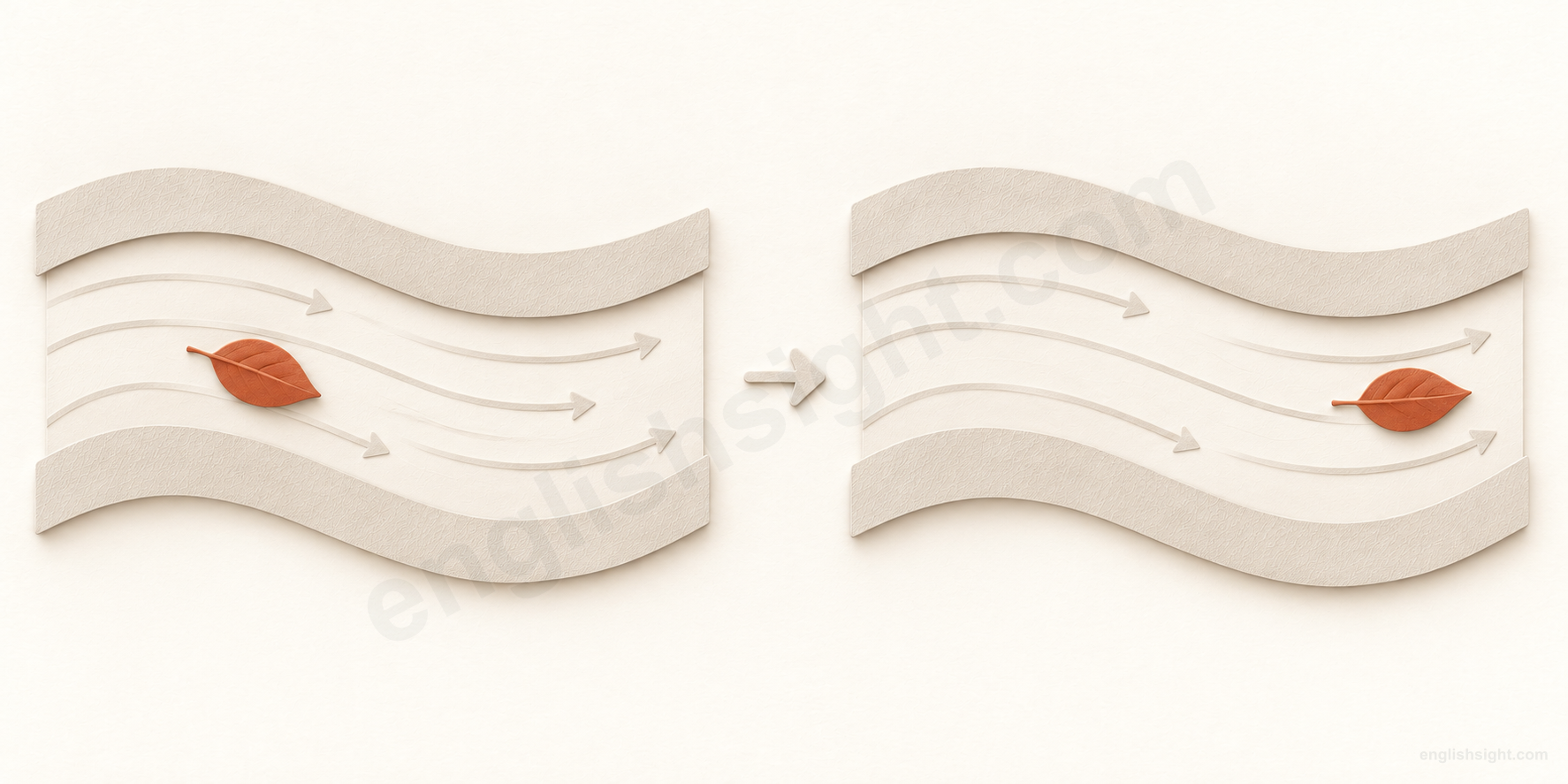
A fallen leaf floats near the left end of a river reach.
current
The same leaf is farther downstream in the later view.
The flowing water carries the leaf to the right.
The current is the moving water; the two views show one leaf carried downstream.
A current is a continuing directional flow within water or air. Something in that flow can be carried along with it.
Electric current names charge flow, and a current of opinion extends the flow idea metaphorically. Current as an adjective usually identifies what exists or is accepted at the relevant time. The sketch illustrates the physical noun rather than all these branches.
A leaf can drift in a current; a person can describe a current job. The noun and adjective do different jobs. Start with the sentence pattern, then ask whether the topic is a flow, an influence, or something that applies at the relevant time.
The flow sketch is a memory aid for the noun. The adjective’s present-time meanings form a separate teaching branch; a river cannot predict every use, and no single image is shared by every English speaker.
01
Water, air, and electricity
As a noun, current names a flow. Notice what is flowing and what, if anything, it carries. Prepositions show how another movement relates to it.
01
a / the + adjective + current; river / ocean currents
a strong current
a flow within a river, lake, or sea
Situation / starting point
Water is moving through the river.
Meaning / result
A floating object can be carried downstream.
The current is moving water, not the object it carries.
Picture a leaf drifting along a river. The leaf moves because the surrounding water is flowing; that flow is a current. River current and ocean current identify where the flow occurs.
A current can be strong, weak, fast, or slow. Strong describes its force; fast describes its speed. A current need not be dangerous or unusually fast to be called a current.
For a particular flow, use a current or the current; for several distinct flows, use currents. Current does not simply mean a wave: a wave and a current describe different features of moving water.
In a sentence
The current carried a fallen leaf past the bridge.
Watch the difference A river is a body of water; its current is the movement of that water.
02
an air current; a current of + adjective + air
a current of air
air moving in a particular direction
Situation / starting point
Cool air enters through an opening.
Meaning / result
You feel a continuing movement of air.
Of air names what is flowing.
Air current and a current of air use the same flow sense as the river example. The moving material is air rather than water. Warm air currents can carry birds upward; they need not move horizontally.
A current of cool air is a natural description of air moving through a room. In ordinary conversation, a draught in British English or draft in American English often describes an unwanted flow of air indoors.
Current of + noun can name the material flowing. Do not treat of as a verb particle or assume that current of always has a physical meaning: a current of opinion is figurative.
In a sentence
A current of cool air came through the open window.
Watch the difference Air is normally uncountable here: a current of air, not a current of an air.
03
go / swim / row + with / against the current; be carried + by the current
with / against the current
in the same or opposite direction to a flow
Situation / starting point
A boat has its own direction of travel.
Meaning / result
That direction agrees with or opposes the water’s flow.
With and against compare two directions.
Go with the current means move in the direction in which the water flows. Go against the current means move in the opposite direction. Current names the flow; the preposition supplies the relationship.
The same contrast works with swim, row, or paddle. These are ordinary verb-plus-prepositional-phrase combinations, not phrasal verbs formed from a verb current.
In The boat was carried along by the current, by introduces the cause in a passive sentence. The flow acts on the boat; this does not make current a verb.
In a sentence
We rowed against the current on the way back.
Watch the difference Against the current does not mean across the river; opposite and sideways are different relationships.
04
current flows / passes through + something; something carries / draws current
electric current
the flow of electric charge
Situation / starting point
A circuit can provide a path for charge.
Meaning / result
Current flows through the circuit when the conditions allow it.
The flowing quantity is electric charge, not water.
An electric current is a flow of electric charge. In everyday descriptions you may hear current flows, a wire carries current, or a device draws current. The flow idea connects this noun use with water, but electricity is not literally a liquid.
Current also refers to the rate of charge flow, measured in amperes, often called amps. Current and voltage name different electrical quantities; the words are not interchangeable.
Both countable and uncountable uses occur: a small electric current describes a particular flow, while The motor draws current treats it as a quantity. Use currents when comparing separate flows or types.
In a sentence
The sensor measures the current flowing through the wire.
Watch the difference An electric current is not a store of electricity; a battery and the current it can supply are different things.
05
alternating current (AC); direct current (DC)
alternating current / direct current
two named types of electric current
Situation / starting point
An electrical flow has a direction.
Meaning / result
The direction either reverses repeatedly or stays the same.
Alternating and direct specify the behavior of the current.
Alternating current, abbreviated AC, changes direction repeatedly at regular intervals. Direct current, abbreviated DC, flows in one direction. Learn both full terms and their abbreviations.
These names classify electric current; direct does not mean that a wire must be straight. Current itself does not guarantee a single unchanging direction, so the river sketch illustrates one physical flow rather than every electrical case.
In a general statement the terms can be uncountable: This device uses direct current. A particular alternating current or several electric currents can also be discussed.
In a sentence
The display is designed to run on direct current.
Watch the difference AC and DC distinguish direction over time, not simply high current and low current.
02
A direction in thought or feeling
A flow is also a useful metaphor for an influence within a group. These uses belong to discussion and commentary as well as literal movement.
06
a current of + opinion / thought / feeling; currents of + thought
a current of opinion
a tendency of thought or feeling within a group
Situation / starting point
People share or develop an outlook.
Meaning / result
That outlook forms a recognizable influence in the group.
Thought and feeling can be described as a figurative flow.
A current of opinion or a current of thought is a recognizable direction of thinking within society or a group. Several currents of thought can coexist; the expression does not say that everyone agrees.
A current of excitement similarly describes a feeling present among people. Nothing needs to travel along a literal river. This is a metaphorical extension of the noun’s flow sense.
These phrases often occur in journalism, history, and discussion. In casual conversation, Many people support the idea may be more direct than naming a current of opinion.
In a sentence
The proposal reflected a growing current of opinion within the town.
Watch the difference In current opinion, current is an adjective meaning present or prevailing; in a current of opinion, it is the head noun.
07
swim against the current
swim against the current
oppose the prevailing way of thinking
Situation / starting point
Most people favor one approach.
Meaning / result
Someone chooses a different course despite that influence.
The river image becomes a comparison for social resistance.
If a person swims against the current in a debate, they resist the prevailing opinion rather than literally enter water. The familiar expression borrows the effort of moving against a physical flow.
The surrounding topic decides the reading. A boat trip may involve a literal current; a disagreement about school policy points to the figurative expression.
This expression identifies opposition, not whether the person is wise, mistaken, successful, or unsuccessful. Learn swim against the current as a whole expression rather than assigning the entire meaning to swim.
In a sentence
By supporting the unpopular plan, Eva was swimming against the current.
Watch the difference The expression is about resisting a prevailing view, not just any difficult task.
03
What exists or is in use now
As an adjective, current can locate a job, rule, price, or publication in the relevant present. It can also describe something still accepted, information kept up to date, or payments that are not behind schedule.
08
current + noun; my / the + current + job / manager / situation / year
my current job
a situation or role that exists at the relevant time
Situation / starting point
You compare earlier circumstances with the present ones.
Meaning / result
You identify the situation that applies now.
Current before a noun selects the present situation.
My current job is the job I have now. The current manager, current rules, and the current situation use the same adjective pattern. Something current may change later; the word does not promise permanence.
The current month or current year names the period now in progress. In a story about the past, the relevant present can be the time being described: In 2018, she disliked her current job.
For this ordinary time sense, put current before a noun. Say My current job is nearby or My job is in the town centre. My job is current is not the neutral way to say which job you have now.
In a sentence
My current job lets me work from home twice a week.
Watch the difference Actual means real or exact, not current: actual costs may differ from estimated costs, while current costs are the costs now.
09
at current prices / rates; at the current + singular rate
at current prices
using the prices that apply now
Situation / starting point
You need a value or cost estimate.
Meaning / result
You calculate using present prices rather than earlier ones.
At introduces the price basis; current identifies its time.
At current prices means using the prices now available as the basis for a calculation. The same time sense appears in current rates, the current exchange rate, or current levels.
Current does not mean cheap, expensive, high, or low. A rate can be current and still be lower than last year’s. In a comparison, name both the time and the quantity clearly.
Use an article where the noun phrase needs it: at current prices has plural prices; at the current exchange rate has a particular singular rate. These are noun phrases, not separate new senses of current.
In a sentence
At current prices, replacing all the chairs would cost more than repairing them.
Watch the difference Current and constant are different: prices now can change, while constant prices in economic comparisons use a fixed price basis.
10
the current + edition / issue / version
the current edition
the most recent edition or issue now in use or available
Situation / starting point
Several editions or issues exist.
Meaning / result
You choose the one that counts as current now.
The publishing context gives current a latest-available reading.
The current issue of a magazine normally means its latest available issue. The current edition of a guide normally contrasts with older editions. A publication can remain current for a long time if no new edition replaces it.
With software or instructions, the current version may be the version now in use; the latest version may be newer than the one you have installed. Context determines whether current and latest refer to the same version.
The newest publication is not automatically correct in every detail. Current locates its status in time; it does not certify the truth of all its information.
In a sentence
The current edition of the guide includes a new map.
Watch the difference Current is an adjective, so it needs a noun here; currently is an adverb and cannot replace it before edition.
11
be (still / no longer) current; current thinking / usage
no longer current
no longer in general use or acceptance
Situation / starting point
A word or practice was once familiar.
Meaning / result
It remains in use, or it has fallen out of use.
This sense concerns circulation and acceptance, not just date.
A word, expression, idea, or custom can be current when people still use or accept it. No longer current means it has ceased to be part of that general use. This sense can follow be: That expression is no longer current.
Current thinking describes ideas accepted or discussed at the time. Such ideas may be challenged later; current does not mean proven or universally accepted. A current rumour is one circulating at the time; current does not say that the rumour is true.
The relevant time can be historical: a custom current in the nineteenth century was used then, even if it is unfamiliar today. This differs from saying that the custom is current now.
In a sentence
That expression is no longer current in everyday speech.
Watch the difference Do not extend this predicative pattern to every time phrase: an expression can be current, but current job normally keeps current before job.
12
keep / stay current with + developments / information
keep current with…
stay informed about recent developments
Situation / starting point
Information and practices change.
Meaning / result
You keep your knowledge up to date.
Keep describes maintaining a state of being up to date.
To keep current with developments is to continue learning enough to stay informed. Here current follows keep and describes the person’s state. The phrase is especially useful in work and study contexts.
With introduces the area you follow: keep current with research, with changes in the law, or with new methods. Keep up to date with is another natural way to express this idea.
This pattern does not turn current into a verb. Keep is the verb, current is an adjective complement, and with begins a prepositional phrase.
In a sentence
I read the journal to keep current with new teaching methods.
Watch the difference Do not say I current the methods; use I keep current with them or I update my knowledge.
13
be / stay current on + payments; payments are current
be current on payments
have made the payments due so far
Situation / starting point
Payments fall due on a schedule.
Meaning / result
The required payments are up to date.
Current describes payment status, not a type of account.
In American payment and loan language, being current on your payments means you are up to date with the payments required so far. It does not mean you have repaid the entire loan: future payments may still be due.
Be current on payments describes a state. Bring payments up to date describes catching up after falling behind. This is a practical up-to-date use of the adjective, distinct from current meaning simply happening now.
Compare my current payment, which can mean the payment due now, with I am current on my payments, which describes whether the required payments are up to date. Compare also a current account in British banking: that names an account type, not a payment record.
In a sentence
We are current on our monthly payments, but the loan runs for another year.
Watch the difference Current on payments does not mean debt-free or that no future payments remain.
04
News and everyday banking
Learn these combinations as established terms. Their full meanings are more specific than the adjective current by itself.
14
discuss / follow + current affairs / current events; a current affairs programme
current affairs / current events
important public events happening now
Situation / starting point
Public events develop around you.
Meaning / result
News coverage helps you follow the present issues.
The whole phrase names a news and discussion topic.
Current affairs refers to important political or social events of the present time. Current events is a closely corresponding term, especially in North American English; current affairs is especially associated with British English.
These are plural expressions. You can discuss current affairs or watch a current affairs programme. Before programme, the phrase describes the subject of the programme.
Affairs here means public matters, not romantic relationships. The expression covers significant public developments rather than every small thing someone is doing at this moment.
In a sentence
We discuss current affairs at the start of our English class.
Watch the difference Use the full expression: an affair on its own can have other meanings.
15
open / have + a current account; pay money into + a current account
a current account
a bank account used for everyday payments in British English
Situation / starting point
Money needs to be available for everyday use.
Meaning / result
The account supports deposits, withdrawals, and payments.
Current account is an established banking term.
In British English, a current account is an everyday bank account from which you can make payments and take money out. American English normally uses checking account; Canadian English also uses the spelling chequing account.
Open a current account and pay money into a current account are natural combinations. The whole expression names a type of account, rather than merely whichever account you happen to have now.
In economic news, a country’s current account refers to a category in its international balance of payments. A current-account deficit in that context is not the same as a person having too little money in an everyday bank account; the technical calculation is outside this lesson.
In a sentence
I opened a current account for my salary and everyday bills.
Watch the difference A current account is not simply any account that is currently open; it is a named account type.
Choose the noun or adjective first
Current and currently
Current is a noun or adjective here. Currently is the related adverb: I am currently working at home. Compare my current job. Actual means real or exact, and actually does not mean currently.
Current and currant
Current and currant sound alike in usual pronunciations, but a currant is a small fruit. Spell the flow and present-time word current. British pronunciation is commonly /ˈkʌrənt/; American dictionaries also give /ˈkɜːrənt/.
Countability and grammar
Use a current and currents for identifiable flows or tendencies; electric current can also be uncountable. Current has no ordinary verb, causative, or particle-verb family in this lesson. A passive such as was carried by the current belongs to carry.
Limits of the picture
A current does not always run in one fixed direction forever: alternating current reverses. The river sketch shows one flow carrying an object, while the adjective branch and established banking term need their own explanations.
Read the whole expression
Choose the sentence or meaning that fits the situation.
1. You want to name the job you have now. Which sentence fits?
2. The water flows east, but the boat travels west. Which description fits?
3. In a policy discussion, what does “Eva is swimming against the current” usually mean?
4. Which term names electric current that repeatedly reverses direction?
5. A British bank offers you a current account for your wages and bills. What is it?
6. A historian says a phrase “was current in 1890.” What does this tell you?
Sources and teaching notes
The sources below support the meanings and constructions. Explanations, examples, and the flow sketch were written for this lesson; the visual connection is a teaching interpretation.
The sketch illustrates a physical current. It does not claim that every speaker pictures current in the same way.