Connect rounded shapes and bending paths with graphs, learning, and familiar expressions.
A smooth change of direction
A smooth change of direction
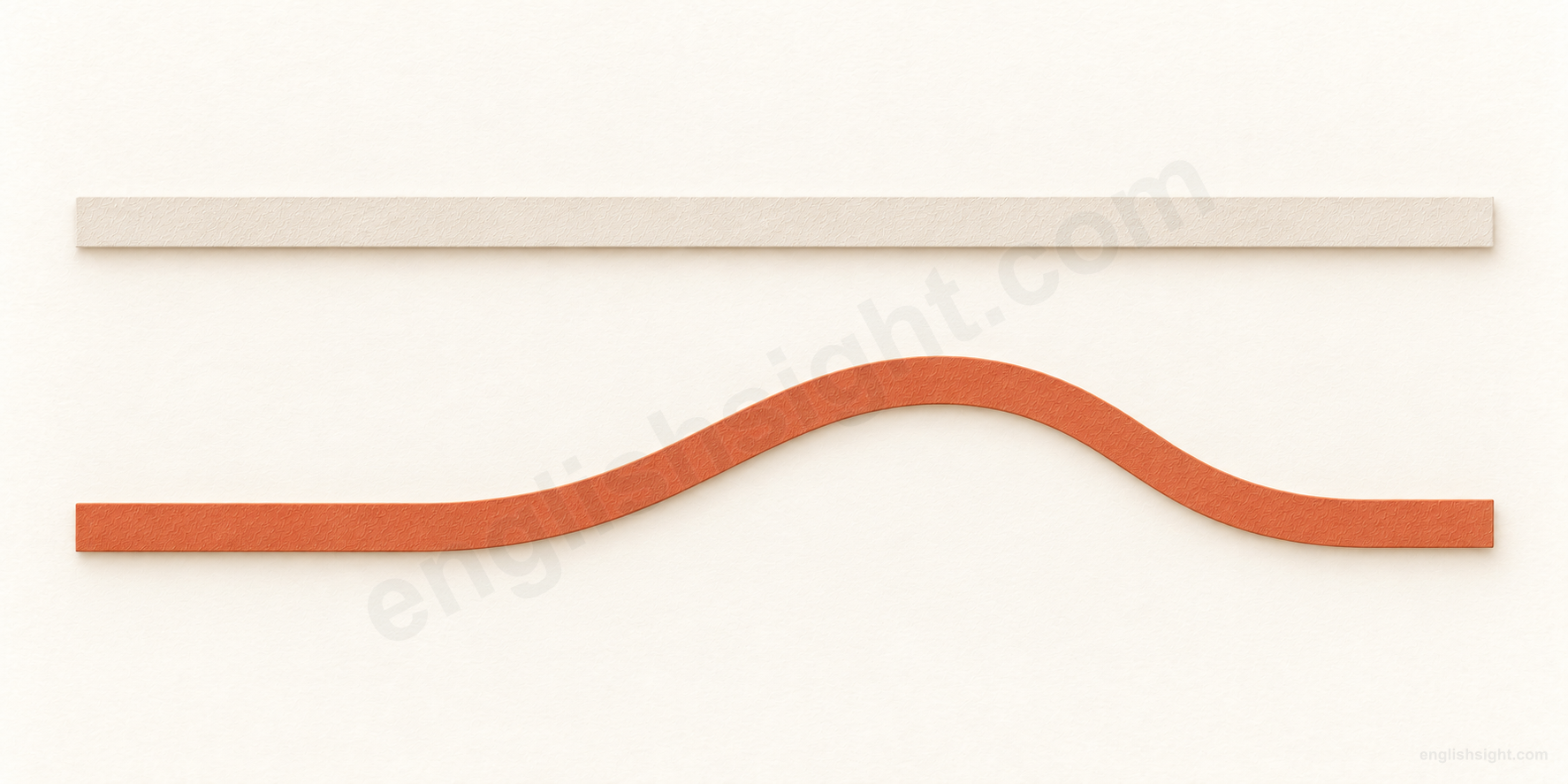
A straight ivory strip provides a reference.
curve
The bend remains continuous, without an angular corner.
The orange strip bends smoothly upward and back down.
The orange strip curves smoothly. The picture compares shapes; it does not show motion or a change from straight to curved.
A line, edge, or path changes direction smoothly rather than making an abrupt corner.
This is a teaching model for ordinary shapes and paths. It does not require movement or a previously straight object, and it does not replace the meanings of fixed expressions or technical mathematical definitions.
A curve changes direction smoothly. You can notice it in a bowl’s edge, a road, or a ball’s flight. The noun names the shape or route; the verb describes having, following, or making it.
Graph vocabulary and established expressions extend this connection. Read their full patterns: being ahead of the curve is not a position on a winding road.
01
Lines, outlines, and roads
Name the bending shape itself or the part of something that bends. A curve need not be a whole circle.
01
a curve; curves; the curve of + noun; a curved + noun
a curve / the curve of…
a smoothly bending line, edge, or surface
Situation / starting point
You compare a ruler’s edge with the edge of a bowl.
Meaning in context
You name the bowl’s rounded outline.
Curve names a shape; curved describes something with that shape.
A curve is countable: one curve, several curves. The curve of the bowl identifies which outline you mean; of connects the shape with its object.
Compare a curved edge with a straight edge or an angular corner. Bend is broader and can suggest a change caused by folding or pressure. An arc is a particular curved line, often part of a circle; a curve need not be circular.
In a sentence
The designer repeated the curve of the bowl in the handle.
Watch the difference Use a curved handle to describe its shape, not normally a curve handle.
02
a curve in + road; around / on a curve
a curve in the road
a section where a road changes direction
Situation / starting point
The road ahead stops following a straight route.
Meaning in context
You describe or approach the bending section.
A sharp curve turns tightly; it can still have a smooth outline.
A curve in the road is a bend, especially in North American road vocabulary. Around a curve describes going past that bend; on a curve locates something within it.
Gentle, wide, tight, and sharp describe the bend’s shape or degree. Sharp here means a strong turn, not a pointed corner. Compare The car went around the curve with The road curves: the first describes the car’s movement, the second the road’s layout.
In a sentence
A cyclist appeared as we came around a sharp curve.
Watch the difference A curve can refer to a road section, not just a line drawn on paper.
03
the curve of + body part; someone’s curves
the curve of a neck / someone’s curves
the rounded outline of a body part or body
Situation / starting point
You look at an illustration of a person.
Meaning in context
You describe the rounded contours.
The plural curves can refer to body shape rather than separate drawn lines.
The curve of a neck describes a specific contour. The established plural someone’s curves often refers to the rounded shape of a woman’s body, particularly in clothing descriptions.
This is a physical-description use, not another kind of movement. Describing a garment as following the wearer’s shape is different from making unsolicited comments about that person’s body.
In a sentence
The jacket was cut to follow her curves.
Watch the difference In this use curves is plural; it does not mean that the person is moving in circles.
02
Being curved, moving, and shaping
The subject can have a curved shape or move along a curved route. With an object, curve can describe making that shape or movement.
04
road / path + curve(s) + direction or place phrase
curve around / away / to the left
extend along a bending route
Situation / starting point
You trace a path on a map.
Meaning in context
Its direction changes smoothly beside a lake.
The path can curve even while nobody is moving along it.
With a road, river, or staircase as subject, curve can describe layout rather than an event. The present simple suits a stable route.
Around the lake identifies what the route bends around; away gives a direction relative to a viewpoint. These are ordinary spatial additions, not separate idiomatic phrasal verbs. Around also occurs as round, especially in British English.
In a sentence
The path curves around the lake and then climbs the hill.
Watch the difference The path curves around the lake does not necessarily mean that it forms a complete circle.
05
moving thing + curve(s) / curved + direction or place phrase
curve through the air
move along a bending path
Situation / starting point
You follow a ball after it is kicked.
Meaning in context
Its flight changes direction.
Here the moving thing is the subject, not the route itself.
A ball, vehicle, or other moving thing can curve. The verb describes its route; it does not mean that the object’s physical shape becomes bent.
Through the air supplies the space traversed. In The ball is curving away, the progressive follows the movement as it happens; contrast the stable layout in The road curves away.
In a sentence
The ball curved away from the goal.
Watch the difference Curve alone does not tell you why the direction changed.
06
curve + object; object + be curved
curve something
make something take a bending shape or path
Situation / starting point
A craftsperson works with a flexible strip.
Meaning in context
The strip now has a smoothly bending shape.
The object is what someone shapes or sends along a curved path.
Curve can take an object: curve the strip. In The strip curves, the strip is the subject; in Curve the strip, someone shapes it. This is the direct transitive pattern, not curve someone to do something.
The passive is possible when the shaping matters: The strip was curved to fit the frame. Curved can also describe a result or existing shape without identifying who made it. With a ball as object, curve can instead mean make it follow a bending flight: She curved the ball around the wall.
In a sentence
Curve the paper strip gently before attaching it to the model.
Watch the difference Drop the final e in curving; keep it in curved. Forms: curve, curves, curved, curved, curving.
07
lips / mouth + curve into a smile; a smile + curve + lips
curve into a smile
take on the curved shape of a smile
Situation / starting point
Someone hears a welcome suggestion.
Meaning in context
The corners of their mouth lift.
Into introduces the resulting expression.
With lips or mouth as subject, curve can describe forming a smile. It is a descriptive way of writing about a visible change in expression.
Her lips curved into a smile has the lips as subject. A smile curved her lips makes smile the subject and lips the object; it is more literary than She smiled. Neither pattern means that the person’s whole body turned.
In a sentence
His mouth curved into a smile when he saw the drawing.
Watch the difference A smile is one context for curve, not the meaning of curve in every sentence.
03
Graphs, learning, and comparison
A curve can represent data. Some familiar expressions extend this graph vocabulary to learning, grading, and keeping up with developments.
08
plot / draw + a curve; a growth / demand / supply curve
plot a curve / a growth curve
a graph line showing variation or a relationship
Situation / starting point
You collect measurements over several months.
Meaning in context
A plotted line shows how the values vary.
Read the axes to find out what the curve represents.
A curve can show data or a model: a growth curve, demand curve, or supply curve. Plot a curve means draw or calculate the line from the relevant values.
An upward curve may show an increase, but its meaning depends on the axes. In mathematical language curve is broader than the everyday rounded shape: some technical definitions include straight lines. This lesson does not teach those formal definitions.
In a sentence
The chart’s growth curve shows how the seedlings changed over six weeks.
Watch the difference A steep graph line does not by itself mean good or bad; check what is measured.
09
a learning curve; be on / face + a steep learning curve
a learning curve / a steep learning curve
the process or rate of learning something new
Situation / starting point
A new tool is unfamiliar.
Meaning in context
Experience and mistakes help you learn it.
The expression often describes a learning experience without a real graph.
A learning curve can refer to the progress involved in acquiring a skill. Starting a job can put someone on a learning curve; nobody has to draw a chart.
A steep learning curve commonly suggests a demanding period with much to learn quickly. Do not assume it always means learning is easy because a graph rises steeply. If difficulty or speed matters, state it directly: It takes weeks to learn, or We learned a lot in two days.
In a sentence
Running the school website was a steep learning curve for me.
Watch the difference The expression does not promise that every learner improves at the same rate.
10
a bell curve; follow + a bell curve
a bell curve
a rounded graph of a normal distribution
Situation / starting point
You compare many measurements.
Meaning in context
A graph shows many near the middle and fewer at either end.
Bell names the graph’s raised middle and lower sides.
A bell curve represents a normal distribution. In an introductory picture, values cluster around the middle and become less frequent toward the extremes.
The name describes the shape of a graph, not a bell-shaped physical object. It is useful vocabulary for discussing statistics; it does not mean that every collection of scores or measurements must follow this pattern.
In a sentence
For this exercise, imagine that the measurements follow a bell curve.
Watch the difference Do not infer a bell curve merely because a chart contains a rounded line.
11
grade / mark + on a curve; curve + an exam / grades
grade on a curve / curve an exam
assign or adjust grades relative to a group’s performance
Situation / starting point
A teacher has a set of test results.
Meaning in context
The grading scale uses the group’s results.
Here curve belongs to an established grading practice.
Especially in American education, grade on a curve describes grading in relation to how a group performs. Curve the exam or curve the grades can name applying an adjustment to the grading scale.
Policies vary: the phrase alone does not tell you the formula or whether every score will rise. The exam was curved is a possible passive. Ask how the system works rather than assuming a fixed number of extra points.
In a sentence
Our instructor grades on a curve, so the final boundaries depend on the class results.
Watch the difference On a curve in a grading discussion is different from on a curve in a road description.
12
be / stay + ahead of the curve; be / fall + behind the curve
ahead of / behind the curve
more advanced than others, or slower to keep up
Situation / starting point
Organizations adopt a new practice at different times.
Meaning in context
You compare their progress with wider developments.
The curve represents a trend, not a literal bend in a road.
Ahead of the curve means leading developments or using ideas before others do. Behind the curve means lagging in those developments. These expressions are familiar in business and technology discussion.
Stay ahead of the curve describes maintaining that position; fall behind the curve describes losing ground. Name the area when useful: ahead of the curve in accessible design. The comparison does not prove that the early choice is better in every respect.
In a sentence
The library stayed ahead of the curve by lending digital books early.
Watch the difference Keep the in this established expression: ahead of the curve.
13
flatten + the curve; the curve + flatten(s)
flatten the curve
reduce a rapid rise or peak in an amount over time
Situation / starting point
A graph would otherwise rise to a high peak.
Meaning in context
The rise or peak is made less extreme.
The graph is a way to describe controlling an increase.
Flatten the curve is used when action aims to prevent an amount from increasing too sharply within a short period. It is especially recognizable in discussion of new infections and hospital demand.
The expression concerns the shape of the trend; it does not automatically mean reducing the amount to zero. Use context to explain what is counted and over what period.
In a sentence
The report explores whether the proposed measures could flatten the curve of new cases.
Watch the difference Flatter is a comparison of graph shapes; read the time scale and quantities too.
04
A pitch and an unexpected problem
Baseball supplies another connection: a ball changes course, and a figurative curveball disrupts what someone expected.
14
throw / pitch + a curve / curveball
throw a curve / a curveball
a baseball pitch that follows a curving flight
Situation / starting point
A pitcher throws toward a batter.
Meaning in context
The ball’s route bends as it travels.
Curve can name the pitch as well as describe a ball’s motion.
In baseball, a curve or curveball is a kind of pitch. Here throw a curve is literal: the pitcher throws an actual ball.
Compare The ball curved away, where curved is a verb describing movement. In She threw a curve, curve is a countable noun naming a pitch. The verb alone does not identify a specific baseball technique.
In a sentence
The pitcher followed two fastballs with a curve.
Watch the difference Not every ball that follows a curved route is called a baseball curveball.
give someone an unexpected complication or surprise
Situation / starting point
You expect a familiar question or a settled plan.
Meaning in context
An unforeseen question or change forces you to respond.
The whole expression transfers the idea of a surprising pitch to a situation.
Throw someone a curve or curveball is informal and especially associated with North American English. An unexpected question, changed plan, or event may be the curveball; it need not be a deliberate trick.
Curveball is often one word; curve ball also occurs. A cancelled booking threw us a curveball makes the cancellation the subject and us the affected people. Learn the whole expression rather than interpreting curve as any kind of problem.
In a sentence
The venue closure threw us a curveball two days before the concert.
Watch the difference This is an idiom, not a phrasal verb; ball is part of a noun, not a verb particle.
Keep shape, grammar, and idiom separate
Curve, curved, and curving
Curve is normally a noun or verb in modern everyday English. Use curved for a shape: a curved screen. Curving can suggest a bending outline or route: a curving staircase. The old standalone adjective curve is not a productive model for beginner descriptions.
No required cause or completed action
The river curves describes its layout. The ball is curving describes current movement. Curve the strip describes shaping it. A smooth bend may be tight or sharp in degree without having an angular corner.
Coverage boundary
The lesson includes everyday shapes, routes, graph vocabulary, and selected established expressions. Formal mathematical definitions, technical pitch mechanics, drafting tools called French curves, rare older senses, and slang curve meaning reject someone are not expanded here.
Choose the meaning in context
Look at the subject, the grammar, and any established expression.
1. The road curves beside the beach. What does this sentence directly describe?
2. A craft instructor wants you to give a paper strip a rounded shape. Which instruction fits?
3. A company was ahead of the curve in offering remote work. What is being compared?
4. A last-minute cancellation threw us a curveball. What happened?
5. The instructor says she grades on a curve. What should you conclude?
Sources and teaching notes
The linked dictionary entries support the senses, patterns, and expressions. Explanations and examples are original; the smooth-direction model is a teaching connection.
The diagram is a teaching aid, not a claim that every English speaker pictures the word in the same way.