From a pad on a chair to protection against a setback.
Support that softens the effect
Support that softens the effect
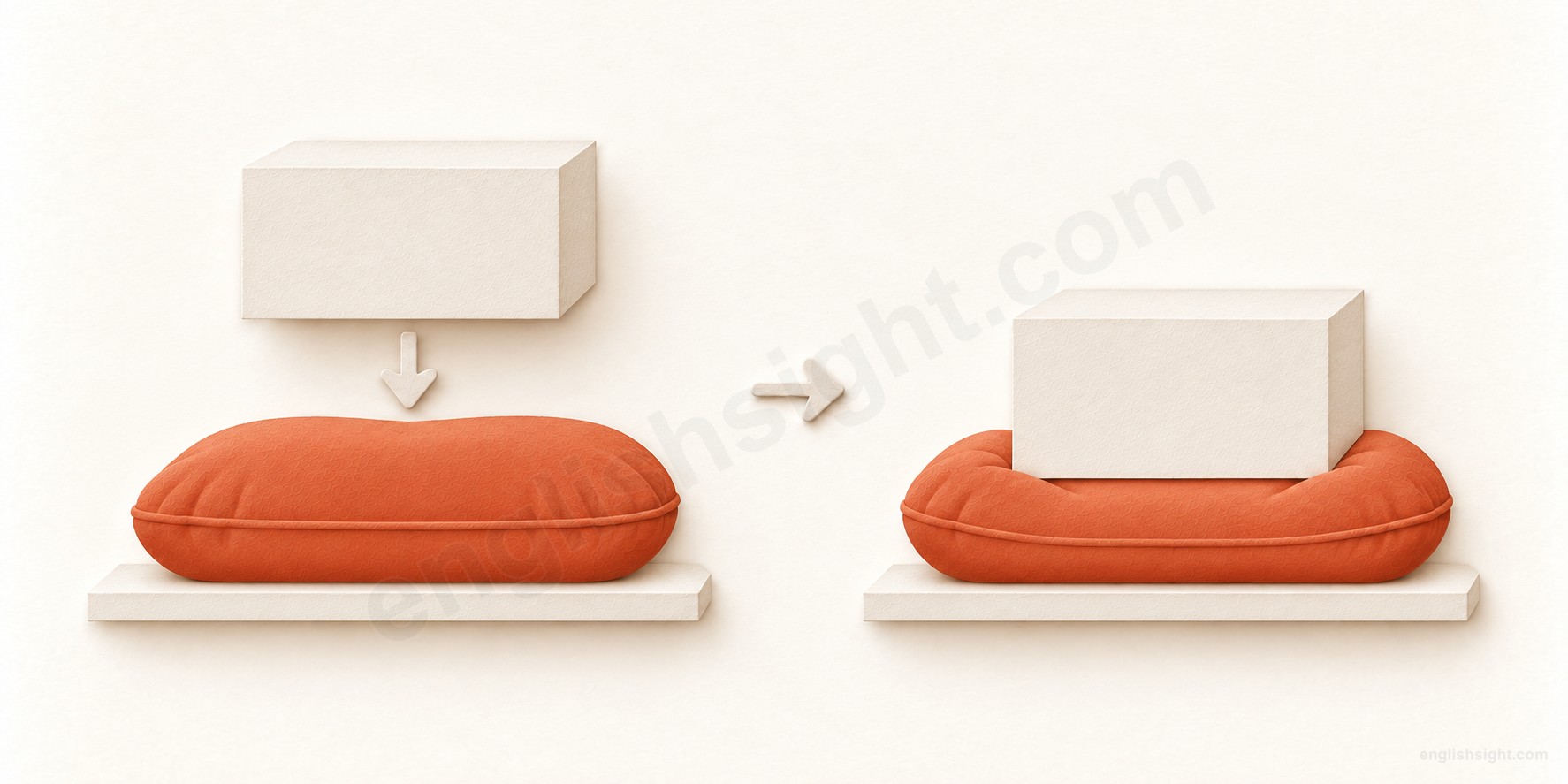
A block descends toward a plump cushion on a hard surface.
cushion
The cushion yields beneath the block, softening its contact with the surface.
The block lands and presses the soft cushion down.
The yielding cushion softens the landing; it does not prevent the fall.
A cushion provides a yielding support or protective margin; to cushion is to soften an impact or reduce an adverse effect.
This is a teaching connection, not a claim about one mental picture shared by all speakers. A physical cushion can also support steady pressure, and a table cushion can cause a ball to rebound.
A cushion can be something you sit on. The same word also helps you talk about a softer landing, money kept in reserve, and help that makes bad news easier to bear.
A useful connection is yielding support or protection from the full force of something. Read the whole construction to see whether cushion names the support, a protective margin, or the action of reducing an effect.
01
Soft support and physical protection
Start with a soft pad, then notice how a layer or material can reduce pressure and impact. A noun names the support; a verb describes what it does.
01
a / the cushion; cushions; sit on / lean against a cushion
a cushion on the sofa
a soft pad for sitting on or leaning against
Starting situation
The wooden chair feels hard against your back.
Support or result
A soft pad makes the chair more comfortable.
The noun names a separate support, often with a filled cover.
Use a cushion for one pad and cushions for more than one. Seat cushion, sofa cushion, and floor cushion name its position or use; a cushion cover is the outer case, not the filling.
Put a cushion behind your back or sit on a cushion. These prepositions describe position; they do not create new meanings of cushion. Plump up a cushion means make it full and rounded again.
For the support under your head in bed, pillow is the usual word. In North American English, pillow can also name a decorative sofa cushion. This is a tendency in word choice, not a strict difference in what objects can do.
In a sentence
I put a small cushion behind my back before sitting down.
Watch the difference A bare singular count noun needs a determiner: buy a cushion, not buy cushion.
02
a cushioned + noun; cushion + object + with + material
a cushioned seat
a seat made softer with padding
Starting situation
The seat needs a softer surface.
Support or result
Padding has been added for comfort.
Cushioned describes the seat; cushion can also be a verb meaning supply padding.
A cushioned seat has soft padding. Compare a seat cushion, which names the pad itself. The adjective tells you a property of the seat, not whether the pad is removable.
The verb can describe adding that support: We cushioned the bench with foam. Here the bench is the object, and with foam names the material. In The bench is cushioned with foam, the passive focuses on the bench.
In a sentence
The new waiting area has cushioned seats.
Watch the difference “Cushioned seats” describes padded seats; “seat cushions” names the pads. They are not the same grammatical structure.
03
a cushion of + material; a cushion between + surfaces
a cushion of air
a layer that supports or separates surfaces
Starting situation
A vehicle would otherwise rest directly on the surface below.
Support or result
Air forms a supporting layer between them.
The cushion can be a layer rather than a fabric bag.
In a cushion of air, of air tells you what forms the supporting layer. A cushion between two surfaces describes its position. A hovercraft uses this kind of air support.
A cushion of moss can describe a soft, padlike growth. This extends the shape or supporting quality of the familiar object; it does not mean someone has sewn a cushion and filled it with moss.
In a sentence
The hovercraft travels on a cushion of air above the water.
Watch the difference Of names the material here. It has a different job in a cushion of two goals, where it gives the size of a lead.
04
cushion + fall / landing / impact / object; be cushioned by + material
cushion a fall / an impact
make a collision or landing less severe
Starting situation
A falling object is about to meet a hard surface.
Support or result
A yielding layer absorbs some of the impact.
The verb describes reducing a physical shock, whether or not a cushion is present.
In Foam cushioned the impact, foam is what reduces the shock; the impact is the object of the verb. You can also name the thing protected: Foam cushioned the camera inside the case.
The impact was cushioned by foam is passive: by names what softened it. Cushion a landing and cushion a fall use the same physical sense. The word alone does not guarantee that nothing is damaged.
In a sentence
The thick mat cushioned the box’s fall from the shelf.
Watch the difference Cushion does not mean prevent: the box still fell, but the impact was reduced.
02
Money and room for setbacks
A reserve or a lead can protect you from immediate trouble. The cushion is a useful margin, not a piece of furniture.
05
build up / provide a (financial) cushion; a cushion against + difficulty
a financial cushion
money available to make financial trouble easier to manage
Starting situation
An unexpected bill could leave you short of money.
Support or result
Some money kept in reserve helps you cope.
The reserve gives protection rather than physical softness.
Build up a cushion means accumulate a reserve. Provide a cushion against something names the difficulty it helps you face. This figurative noun is often singular: a financial cushion, a cash cushion. More broadly, a cushion against hardship can be support such as a benefit, not just money saved in advance.
The link with the physical pad is a teaching comparison: the reserve reduces the immediate force of a setback. It does not mean the problem disappears or that the money is enough for every possible expense.
In a sentence
We saved a little each month to build up a cushion against unexpected bills.
Watch the difference A cushion against a problem is protection from its effects, not money being used to cause that problem.
06
a + number-goal / number-point + cushion; a cushion of + number + goals / points
a two-goal cushion
a lead that gives room for a setback
Starting situation
The teams are close enough for one goal to change the result.
Support or result
One team has a larger lead and can afford to concede a goal.
The cushion is the margin ahead, not a promise of victory.
A two-goal cushion is a lead of two goals. You can also say a cushion of two goals. The number measures how far ahead the team is.
The reserve idea applies to the score: some of the lead can be lost before the teams are level. This meaning is useful in sports reports; it is not a new object on the field.
In a sentence
Their late goal gave them a two-goal cushion with five minutes left.
Watch the difference Before cushion, use singular goal in the compound two-goal; after of, use plural goals: a cushion of two goals.
03
Making difficulties less severe
Choose the object carefully: cushion an effect, cushion the people affected, or use the established expression cushion the blow.
07
cushion + the impact / effect of + change
cushion the impact of a price rise
reduce the harmful consequences of a change
Starting situation
A change will put extra pressure on people’s budgets.
Support or result
Help makes the consequences less severe.
The object is the effect or change being made easier to bear.
Here impact is figurative: it means the consequences, not a physical collision. Cushion the effect of a change follows the same pattern.
In The grant cushioned the impact of higher fares, the grant is the help and higher fares cause the difficulty. Cushion does not say the fares stayed unchanged. This wording is especially useful in news, work, and policy discussions.
In a sentence
The travel grant helped cushion the impact of higher bus fares.
Watch the difference Cushioning an impact reduces its severity; reversing the decision or removing the cause would be a different claim.
08
cushion + somebody / something + against / from + difficulty; be cushioned against / from
cushion people against / from hardship
protect people or organizations from the full effects of a difficulty
Starting situation
People are exposed to a difficult change.
Support or result
Support limits the harm they experience.
The object names who is protected; against or from introduces the difficulty.
Compare cushion the impact, which names the adverse effect as object, with cushion families from the impact, which names the protected people as object. The choice changes the sentence structure, not the basic protective relation.
Both against and from occur with this sense. Against presents the difficulty being guarded against; from introduces what people are shielded from. Passive wording is common too: Families were cushioned from the increase by extra support.
These are a transitive verb followed by a prepositional phrase, not separable particle verbs. A pronoun goes directly after cushion: cushion them against hardship.
In a sentence
Extra support cushioned families from the worst effects of the rent increase.
Watch the difference Say cushion them from the increase, not cushion from them the increase. Protection need not be complete.
09
cushion the blow (of + setback); cushion the blow with + help
cushion the blow
make a disappointment or shock easier to accept or endure
Starting situation
Someone is about to face unwelcome news or a setback.
Support or result
Help or considerate action makes it less painful.
Blow refers to the setback; cushion describes reducing its effect.
Cushion the blow is an established expression, also said as soften the blow. The blow may be bad news, rejection, or a practical loss; no one needs to be physically hit.
An offer of another opportunity can cushion the blow of rejection. Gentle delivery can also help with shocking news. Learn the whole expression: cushion does not itself mean announce bad news or hide the truth.
In a sentence
The college offered her a place on another course to cushion the blow of missing her first choice.
Watch the difference The setback still happened. Cushioning the blow describes easing its effect, not turning a rejection into acceptance.
04
A specific meaning in cue sports
In pool, snooker, and billiards, cushion names part of the table. Learn this as a particular sporting use.
10
hit the cushion; bounce off a cushion
hit the cushion
strike the springy inner edge of a billiard, pool, or snooker table
Starting situation
A ball rolls toward the side of the table.
Support or result
It meets the padded edge and rebounds.
Cushion is the name of a table part in this sporting context.
A cushion is the resilient inner edge that a ball can bounce off. The table has cushions along its sides; these are not loose sofa pads placed on the playing surface.
This use is related to the soft, yielding material of a cushion, but the important action here is a rebound. The lesson’s landing diagram does not describe every result of contact with a cushion.
In a sentence
The white ball hit the cushion and rolled back toward the middle.
Watch the difference The context determines the meaning: on a pool table, the cushion is the inner edge, not the pocket.
Keep the object and the construction clear
Support is not a guarantee
Cushion usually suggests reducing pressure, shock, or harm. Do not assume that it prevents the event, removes every effect, or guarantees success.
Forms and grammar
The noun is countable: a cushion, two cushions. Verb forms are cushion, cushions, cushioned, and cushioning. The verb is normally transitive in these uses, and passive forms are natural: the fall was cushioned. With + material, by + source in a passive, and against/from + difficulty do different jobs.
Related words overlap
A pad is a broad word for a soft or protective piece of material. A pillow usually supports the head in bed, though American English also uses it for sofa decoration. A buffer can protect against a shock or setback too; it need not be a fabric cushion.
Scope
This lesson includes everyday home use, physical and figurative protection, reserves, sporting leads, and the cue-sport table part. Specialized anatomy, architecture, machinery, historical suppression senses, and named products such as a whoopee cushion are not developed here.
Choose what is being cushioned
Check whether the sentence names a pad, a protective margin, an effect, or the people protected.
1. You want to name the removable soft pad on a chair. Which phrase names the pad itself?
2. A mat cushioned the box’s fall. What does that tell you?
3. Complete the sentence: Extra support cushioned ___ from the rent increase.
4. A team has a two-goal cushion. What does it have?
5. An alternative offer cushioned the blow of a rejection. What happened?
Sources and teaching notes
The dictionary entries below were read to check senses, constructions, and boundaries. Explanations and examples are original; the connection between uses is a teaching model.
The diagram illustrates a teaching connection; it is not a mental image shared by every speaker.