From a blade in material to smaller amounts, interrupted connections, and familiar fixed phrases.
A continuous whole becomes divided
A continuous whole becomes divided
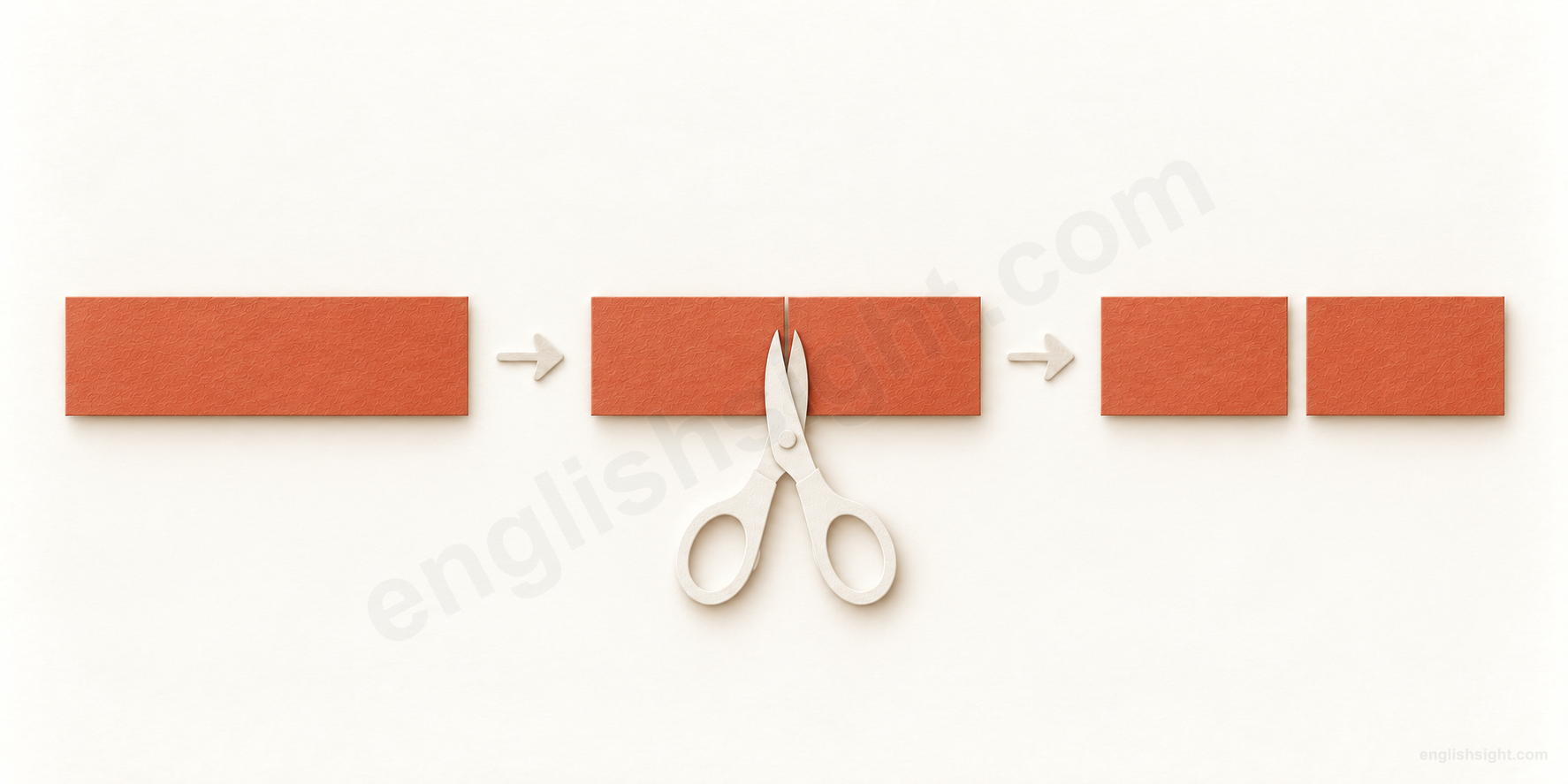
One continuous paper strip
cut
Two pieces with a gap between their cut edges
Scissors cut across the strip.
The sharp edges break the paper’s continuity. This cut separates the strip completely; a cut can also leave an opening without dividing the whole.
In physical cutting, a sharp edge breaks continuity in material, leaving an opening or separated parts; related uses reduce an amount or interrupt a connection.
The diagram shows one clear case of physical division. A surface can also be cut without complete separation. Fixed expressions are explained separately.
Cut often involves an edge breaking the continuity of material: it may leave an opening, divide a whole, remove a piece, or shape what remains. Common extensions concern reducing an amount or interrupting a connection.
This is a useful teaching connection, not an explanation that predicts every expression. Cut class, be cut out for, and cut it fine need their own constructions and contexts.
01
Separate, shorten, and shape
A sharp edge can open a surface, divide material, remove a piece, or give something a new shape. The object and result phrase tell you which.
01
cut + object + in half / in two / into + pieces
cut something in half / into pieces
divide material with a sharp edge
Situation before
One sheet of card is intact.
What changes or is meant
Two separate pieces remain.
The object is divided; the result phrase specifies its new parts.
Cut names the action on the material; with scissors names the tool. In half gives two equal parts, in two gives two parts, and into strips specifies their shape. Into does not always introduce a place.
I cut the card yesterday and I have cut it already both use cut. The forms are cut, cuts, cut, cut, cutting. Do not add -ed to the past tense.
Cut the pack of cards means lift off a portion of the deck and divide it as part of preparing a card game. For example: After shuffling, ask another player to cut the cards. No card is damaged.
Example in context
I cut the card in half with a pair of scissors.
Avoid this confusion Cut is broader than slice or chop: slice suggests thin flat pieces, while chop suggests repeated blows or smaller chunks.
02
cut + body part + on + sharp object; cut + reflexive pronoun
cut a finger / cut yourself
make an opening in the skin
Situation before
A sharp broken edge touches a hand.
What changes or is meant
There is a small wound.
A cut need not divide the whole object in two.
The body part can be the object: I cut my thumb on the lid. On names what caused the injury. With a knife identifies an instrument and may suggest a different situation.
If the injured person is also the subject, use a reflexive pronoun: I cut myself. This alone does not tell you whether the injury was accidental; the context does. The noun is countable: a cut on my thumb.
Example in context
I cut my thumb on the sharp edge of the lid.
Avoid this confusion A cut is different from a bruise, which need not involve broken skin.
03
cut + hole + in + material; cut + shape + out of + material
cut a hole / cut a shape
create a form by removing material
Situation before
A sheet has no opening.
What changes or is meant
An opening has been made.
The object can be the result created, rather than the material acted on.
In cut a hole in the fabric, hole is what you create and fabric is the material. In cut the fabric into squares, fabric is the object and squares are the result.
Cut a circle out of paper emphasizes producing and removing a shaped piece. The surrounding construction tells you whether the speaker wants the hole, the piece, or a reshaped object.
A result adjective can describe an opening or release: The rescuers cut the trapped driver free means they cut what was holding the driver. Cut the bag open means make an opening in it. Free and open describe the object’s resulting state.
Example in context
She cut a round hole in the fabric for the cord.
Avoid this confusion Do not assume the direct object must always be the thing that existed before cutting.
04
cut + person + portion; cut + portion + for + person
cut someone a slice
prepare a piece for somebody
Situation before
A loaf is whole.
What changes or is meant
A slice is ready for a guest.
The person receives the portion; the person is not being cut.
Cut me a slice means cut a slice for me. The two objects identify a beneficiary and the thing prepared. From the loaf can identify the larger source.
The bare word cut does not itself mean give. You can cut a slice for someone and leave it on a plate for later.
Example in context
Shall I cut you a slice of bread for your soup?
Avoid this confusion Compare cut me with cut me a slice: the added object changes the interpretation completely.
Cut can shorten something while leaving most of it in place.
Cut hair, cut the grass, and cut your nails identify familiar maintenance jobs. Trim usually suggests a small, careful reduction; mow is specific to grass or a crop.
Cut the hedge short uses short as the resulting state. Cut flowers are flowers whose stems have been severed for display, rather than flowers still growing in a bed.
Example in context
We cut the hedge short so it would not block the window.
Avoid this confusion Cutting a tree down removes the standing tree; cutting a hedge back usually leaves it growing.
06
have / get + object + cut; be + cut
have / get your hair cut
arrange for somebody else to do the cutting
Situation before
Your hair needs attention.
What changes or is meant
A hairdresser has shortened it.
The object comes before the past participle in the service construction.
I had my hair cut commonly means a hairdresser did it for me. I cut my hair normally presents me as doing the cutting. Get my hair cut is also common, especially in conversation.
My hair was cut describes the event from the hair’s side. Have/get + object + cut adds the idea of arranging a service in this context. By contrast, He had his finger cut off in an accident describes an unwanted experience, not an appointment.
Example in context
I’m getting my hair cut before the wedding.
Avoid this confusion Have my hair cut is different from have cut my hair, which is a present perfect verb phrase.
07
tool + cut; material + cut + easily / well
This knife won’t cut / This fabric cuts easily
describe cutting ability or how material responds
Situation before
You try the tool or material.
What changes or is meant
You discover how well it can be used.
A tool can cut; material can also cut easily without being an agent.
This knife won’t cut means it fails to cut, often because it is blunt. Won’t here can describe a practical failure rather than a decision or refusal.
This fabric cuts easily means it is easy for someone to cut the fabric. This is an active form with a passive-like interpretation, often with easily or well. It does not mean the fabric is wielding a blade.
Example in context
This fabric cuts easily, but the thick lining does not.
Avoid this confusion The material is not normally said to be cutting itself in this use.
08
cut + object + off / away / up
cut off / cut away / cut up
remove a part or divide the whole into smaller pieces
Situation before
You prepare a damaged piece of cloth.
What changes or is meant
An unwanted edge is removed and the rest becomes pieces.
Off and away emphasize removal; up emphasizes division into smaller parts.
Cut off the label detaches it. Cut away the torn material emphasizes taking damaged material away. Cut up the cloth makes smaller pieces from it.
These object-taking particle patterns allow cut the label off and cut off the label. A pronoun normally goes in the middle: cut it off, cut it away, cut it up.
Example in context
Cut the label off, then cut the cloth up for cleaning rags.
Avoid this confusion Cut it up is the usual pronoun order; not cut up it.
09
cut + tree + down; cut + bush / branches + back
cut down a tree / cut back a bush
fell a tree or prune a plant
Situation before
A tree stands beside an overgrown bush.
What changes or is meant
One may be felled while the other is reduced.
Down describes the tree falling; back describes growth being reduced.
Cut down a tree means cut it near the base so it falls. Cut back a bush means remove branches to make it smaller. A gardener may cut a plant back without killing it.
Both expressions can take a noun before or after the particle: cut the tree down, cut down the tree. Use cut it down and cut it back with pronouns.
Example in context
We cut the bush back instead of cutting it down.
Avoid this confusion Do not use cut down on a tree to mean fell it: on introduces a different reduction pattern.
02
Make less, leave out, or end early
Amounts and activities can be cut without a blade. Distinguish a smaller quantity, an omitted part, and a complete stop.
10
cut + amount / costs / prices; amount + be cut
cut costs / cut prices
reduce an amount
Situation before
Running the shop is expensive.
What changes or is meant
The shop spends less or charges less.
An abstract quantity can become smaller without physical cutting.
Cut costs means reduce what you spend; cut prices means charge customers less. These can have different effects on a business. Taxes, emissions, staffing, and journey times can also be cut.
Compare The shop cut prices and Prices were cut. The passive is natural when the decision-maker is unimportant or unknown. A cut in prices is the related noun phrase.
Example in context
The shop cut its prices to attract more customers.
Avoid this confusion Cut costs and cut prices are different decisions; do not treat the objects as interchangeable.
11
cut + object + by + change / to + new amount / from + old + to + new
cut by / cut to / cut from… to…
state the size or endpoint of a reduction
Situation before
The fee is one hundred pounds.
What changes or is meant
It becomes eighty pounds.
By gives the change; to gives the new level.
Cut the fee by twenty pounds subtracts twenty. Cut it to eighty pounds gives the final amount. Cut it from one hundred to eighty names both endpoints.
Cut the fee in half makes it fifty per cent of its previous level. The same distinction works with numbers of staff, word counts, and percentages, but always check what the percentage measures.
Example in context
They cut the fee by £20, from £100 to £80.
Avoid this confusion Cut by 20% leaves 80%; cut to 20% leaves 20% of the original amount.
12
cut down / back on + noun / -ing; cut + amount + down / back
cut down on / cut back on
use, spend, or do less
Situation before
A habit is using too much time.
What changes or is meant
You reduce how much you do it.
On introduces the activity or resource being reduced.
Cut down on screen time and cut back on spending describe doing less. After on, a verb takes the -ing form: cut down on checking messages.
You can also cut spending back or cut production down. With the on construction the object stays after on: cut back on it. If the activity is already clear, I’m trying to cut down can stand alone.
Example in context
I’m cutting down on checking my phone during meals.
Avoid this confusion Reducing is not necessarily stopping: cut out usually makes the stronger claim.
13
cut + item / activity + out (of + routine); cut out + -ing
cut something out of your routine
stop doing or consuming something
Situation before
You buy a snack every day.
What changes or is meant
That snack is no longer part of the routine.
Out emphasizes omission or removal from a larger pattern.
Cut out sugary snacks means stop having those snacks, while cut down on them means have fewer. The scope matters: cutting out one snack does not mean cutting out all food.
You can cut sugar out of a recipe or cut it out of your diet. You can also cut out sugar, but with a pronoun use cut it out. Cut out buying bottled water means stop that activity.
Cut out can also mean block something unwanted: Thick curtains cut out the streetlight means they keep it from entering the room. No curtain or light source is being removed.
Example in context
We cut out buying bottled water and started carrying refillable bottles.
Avoid this confusion To express a smaller amount rather than none, use cut down on or cut back on.
14
cut + passage + from + text; cut and paste + selection
cut a paragraph / cut and paste
remove text, or move it elsewhere digitally
Situation before
A draft contains a repeated paragraph.
What changes or is meant
It is removed or moved to another place.
In editing, a cut removes material from its current position.
Cut a paragraph from the report can mean omit it entirely. Cut the report down to two pages reduces the whole text. The object helps distinguish removing a part from shortening the whole.
On a computer, cut and paste moves a selection: cut removes it from the current location and makes it available for pasting. Copy and paste keeps the original. This is a software operation, not a physical blade action.
Example in context
Cut this paragraph and paste it below the table.
Avoid this confusion Cutting is different from copying: the original selection is removed when the operation is completed.
15
cut + event + short; event + be cut short
cut a visit short
end something before its planned finish
Situation before
A visit was meant to last a week.
What changes or is meant
An urgent problem makes it end early.
Short describes a shortened duration, not the size of an object.
Cut a visit short means bring it to an early end. Cut short a visit is also possible. The passive is common: Our visit was cut short by a problem at home.
Cut my hair short describes a physical result; cut my holiday short describes an early ending. In both, the adjective belongs with the object, but the relevant dimension changes.
Example in context
We had to cut our visit short when the heating failed at home.
Avoid this confusion Use cut it short with a pronoun; short does not mean the visit never started.
16
cut it out!; cut + engine / noise; engine + cut out
Cut it out! / cut the engine
stop annoying behavior or stop a machine
Situation before
Noise or machinery is continuing.
What changes or is meant
Someone demands or causes a stop.
Cut can mean stop, but the wording and tone depend on the object.
Cut it out! is an informal and often irritated demand to stop doing something annoying. It is stronger than a neutral request such as Please stop. Cut the chatter has a similarly direct tone.
Cut the engine means switch the engine off. The engine cut out means it stopped unexpectedly. An automatic device may cut in when it starts operating; these are different patterns, not interchangeable commands.
Example in context
Please cut the engine while we wait outside.
Avoid this confusion An engine cutting out usually describes an unwanted stop; cutting the engine describes someone stopping it.
17
cost / demand + cut into + resource
cut into profits / time
take away part of an available amount
Situation before
A shop expects a profit.
What changes or is meant
Unexpected fees leave less money.
Something consumes or reduces a resource that would otherwise be available.
Costs cut into profits when they leave less profit than expected. An extra task can cut into your free time. The subject is the thing using up the resource.
In this meaning, keep into before the resource: cut into it. Cut it into pieces is a different construction in which it is the material physically divided.
Example in context
The longer commute is cutting into my free time.
Avoid this confusion Cut into my time does not mean physically dividing time or deliberately cutting my schedule with a tool.
03
Interrupt and disconnect
Off often marks separation from a supply, place, or conversation. In often marks entry into something already happening. These are established expressions with different grammar.
18
cut + supply / person + off; be / get cut off
cut off the water / be cut off
stop a supply or connection
Situation before
Water reaches a building.
What changes or is meant
The supply is stopped.
Off marks a broken connection, whether or not a pipe is physically severed.
Cut off the water can mean close a valve or otherwise stop the supply. A service may be cut off after nonpayment. My parents cut me off can mean they stop providing money; context may also concern inheritance.
On a call, We got cut off means the connection failed. It need not mean either speaker chose to end the call. The passive often leaves the cause unstated.
Example in context
Sorry, we got cut off before you gave me the address.
Avoid this confusion Cut off can mean a complete interruption; a cut in the supply may instead mean a reduction.
19
be / feel cut off from + person / place; cut yourself off from
be cut off from
be unable to reach people or a place
Situation before
A village has one road to the town.
What changes or is meant
Snow blocks access.
From identifies the place or contact that is no longer accessible.
Be cut off from the town means normal access has been interrupted. Be cut off from friends describes lack of contact. Physical distance alone does not necessarily produce this state.
Cut yourself off from others adds the idea that you withdraw or cause your own isolation. The adjective-like description feel cut off reports how isolated a person feels.
A wall can cut off the view of the river: it blocks the view rather than severing a physical connection. This blocking sense concerns access to sight.
Example in context
Heavy snow left the village cut off from the nearest town.
Avoid this confusion Keep from with its complement: cut off from them, not cut from them off.
20
cut + speaker + off; cut in (on + speaker / conversation)
cut someone off / cut in
stop a speaker or enter their conversation
Situation before
A person is explaining a problem.
What changes or is meant
Another voice interrupts.
Cutting in enters the talk; cutting someone off stops their turn.
He cut me off before I finished focuses on my interrupted speech. He cut in while I was speaking focuses on his entry. Cut in on our conversation adds the conversation after on.
The object-taking off pattern uses cut me off. The interrupting in pattern does not take the interrupted person as a direct object: say cut in on me, not cut me in. Cut me in has a different share-related meaning.
Example in context
I was explaining the delay when Dan cut in with a question.
Avoid this confusion Cut someone in on a deal means include them in it, not interrupt their speech.
21
vehicle + cut in (in front of + vehicle); cut + driver + up (British); cut in line
a car cuts in / cuts you up
move abruptly into another vehicle’s space
Situation before
A driver has room ahead.
What changes or is meant
Another vehicle moves into that gap too closely.
The movement interrupts another road user’s space or progress.
A car cut in in front of me describes a sudden, close move into the space ahead. British speakers also say The car cut me up. These expressions imply a discourteous or dangerous maneuver.
Cut in also describes unfairly moving ahead of people waiting, especially in North American English: He cut in line. British English often uses push in for that queue behavior.
Example in context
A van cut in just as I was slowing down.
Avoid this confusion Cut up has several meanings; a traffic context is essential for this British driving use.
22
cut + person + out of + activity / group
cut someone out of
exclude a person from involvement
Situation before
A person used to join decisions.
What changes or is meant
Others stop including that person.
Out of identifies the group, activity, or relationship from which someone is excluded.
Cut someone out of the discussion means deliberately leave them without a role in it. Cut someone out of a will means exclude them from inheriting under it.
Use cut her out of the plan with a pronoun. Be cut out of an activity is different from be cut out for it: one concerns exclusion, the other suitability.
Example in context
Please don’t cut Maya out of the planning discussions.
Avoid this confusion Out of and for create different expressions: exclusion versus being suited to something.
23
cut + person + in (on + deal / profits)
cut someone in on
give someone a share in a deal or profit
Situation before
Two people control a small venture.
What changes or is meant
They offer a third person a share.
The person goes before in; on introduces the activity or proceeds.
Cut me in on the deal is an informal request to be included in the benefits or participation. It often involves money, but it does not automatically say the deal is illegal.
Compare He cut in on our conversation: there is no object before in, and the meaning is interruption. The noun my cut can name the share I receive.
Example in context
They offered to cut me in on the profits if I helped sell the tickets.
Avoid this confusion Cut me in and cut in on me have different structures and meanings.
24
cut + ties / links / contact + with + person / organization
cut ties / cut links with
end a relationship or communication
Situation before
An organization has a business connection.
What changes or is meant
It ends that connection.
The connection ends; no physical cord is required.
Cut ties with a supplier means end the relationship. The noun ties names the connection, while with identifies the other party. Cut all contact with someone similarly means stop communicating.
Cut somebody off may concern a particular call or money supply. Cut ties with someone describes the wider relationship, so the expressions need not describe the same event.
Example in context
The club cut all ties with its former sponsor.
Avoid this confusion Cut ties with does not automatically mean there was an argument; the reason comes from context.
04
Cross a space or get past an obstacle
Cut across and cut through can describe direct routes. With abstract objects, learn the particular relationship rather than imagining literal damage.
25
cut across / through + place; cut a path through + obstacle; boat + cut through + water / waves
cut across / through a place; cut through water
take a more direct route, or move smoothly through something
Situation before
The road goes around a park.
What changes or is meant
You walk across the park instead.
A shorter route crosses a space without necessarily damaging it.
Cut across the square and cut through the park can describe taking a shortcut. Across highlights crossing the area; through highlights passing within it.
You may cut through a station using its public passage without cutting any material. But cut a path through thick branches can involve real cutting. Read whether a path already exists and whether a tool is involved.
Cut through can also describe smooth or easy movement through a substance: The sailing boat cut through the water. This does not have to involve a shortcut or damage to solid material; the boat moves through the water.
Example in context
We cut through the park to reach the station sooner.
Avoid this confusion The place stays after across or through: we cut through it, not cut it through in this route meaning.
26
issue / concern + cut across + groups / boundaries
cut across boundaries
apply to groups that are usually separate
Situation before
People are grouped by age.
What changes or is meant
The same concern is shared across those groups.
A relationship crosses categories rather than reducing them.
A concern that cuts across age groups affects people in several age categories. It does not mean the age groups are being abolished or their members physically separated.
This is often used for political, social, or organizational divisions. Keep across before the category or boundary: the issue cuts across them.
Example in context
The need for affordable housing cuts across age groups.
Avoid this confusion Cut across groups describes reach across categories, not necessarily agreement by every member.
27
sound / explanation + cut through + obstacle; message + cut through (to + audience)
cut through noise / confusion
be heard or understood despite an obstacle
Situation before
Noise or complexity hides the main point.
What changes or is meant
A clear sound or explanation gets through.
The obstacle can be physical, perceptual, or informational.
A clear voice can cut through background noise. A plain explanation can cut through confusing language. The latter treats confusion as something that blocks understanding; it does not claim that every complication disappears.
A message that cuts through gets people’s attention. It can cut through to an audience. In cooking, a sharp flavor may cut through richness by providing a contrast, rather than by removing the rich ingredient.
Example in context
Her simple diagram cut through the confusion about the route.
Avoid this confusion Cut through red tape means deal directly with obstructive procedures, not physically cut red ribbon.
05
Suitability, standards, and everyday judgments
These expressions belong to the whole phrase. The physical picture may help you remember some of them, but cannot predict their meanings.
28
be cut out for + noun / -ing; be cut out to be + role
be cut out for / to be
have the qualities needed for a role
Situation before
You consider the demands of a job.
What changes or is meant
You judge whether a person suits them.
The fixed expression describes suitability, often in negative statements.
Be cut out for teaching means have the temperament or abilities that teaching needs. For is followed by a noun or -ing form. Be cut out to be a teacher uses an infinitive.
This is not a normal passive report that someone literally shaped the person. I’m not cut out for night work expresses a judgment about fit, not a legal ban or exclusion.
Example in context
I’m not cut out for working alone all week.
Avoid this confusion Be cut out of the project means excluded; be cut out for it means suited to it.
29
have + possessive + work cut out (to + verb)
have your work cut out
face a difficult task
Situation before
There is much to do in little time.
What changes or is meant
Success will require considerable effort.
Work cut out describes a demanding task, not work that has been removed.
You’ll have your work cut out to finish today means finishing today will be difficult. The expression can also stand alone when the challenge is already clear.
This is different from We cut some work out of the schedule, which means removing work. Learn have your work cut out as one idiom.
Example in context
We’ll have our work cut out to repair everything before Monday.
Avoid this confusion Do not interpret cut out as a promise that the work is already done.
30
not / won’t cut it; make / miss the cut
not cut it / make the cut
be good enough or pass a selection standard
Situation before
A team evaluates several proposals.
What changes or is meant
Only suitable proposals are accepted.
One expression judges adequacy; the other describes passing a threshold.
This plan won’t cut it means it is not good enough for the situation. It is informal. Make the cut means reach the required standard or be selected; in golf it concerns qualifying for the next stage.
A scene that makes the cut remains in the edited film. A scene can be beautifully made but still not make the final cut because it does not suit the final version.
Example in context
Only three designs made the cut for the final exhibition.
Avoid this confusion The it in won’t cut it belongs to an idiom; it need not refer to a material being sliced.
31
cut corners (on + task)
cut corners
save effort by skipping necessary care
Situation before
A deadline is approaching.
What changes or is meant
Someone skips important checks.
The idiom commonly criticizes careless shortcuts.
Cut corners often implies that saving time or money has made the work less thorough than it should be. It is not a neutral name for every improvement in efficiency.
We can save time by simplifying the form does not necessarily involve cutting corners. The negative judgment depends on neglecting something that matters.
Example in context
We cannot cut corners on checking the climbing equipment.
Avoid this confusion Do not use this idiom to praise a sensible shortcut unless the context makes the intended judgment clear.
32
cut + possessive + losses
cut your losses
stop an unsuccessful activity before it becomes worse
Situation before
An old machine keeps needing costly repairs.
What changes or is meant
You stop spending more on it.
The idiom limits future loss rather than undoing past loss.
Cut your losses means accept that an attempt has gone badly and stop putting more money, time, or effort into it. It can apply to projects and relationships as well as money.
It does not mean you recover everything already spent. The point is to avoid making the situation worse by continuing.
Example in context
After a third failed repair, we cut our losses and replaced the machine.
Avoid this confusion Cut losses by 10% can simply describe a numerical reduction; cut your losses is a decision to stop.
33
cut to the chase; to cut a long story short, + outcome
cut to the chase
move directly to the main point
Situation before
A discussion has many preliminary details.
What changes or is meant
You ask for the central issue.
The whole phrase asks for directness.
Let’s cut to the chase invites people to discuss the essential point without more preliminaries. It is informal and can sound impatient, depending on tone.
To cut a long story short similarly introduces the outcome without all the details, especially in British English. American English commonly uses to make a long story short. For example: To cut a long story short, we missed the flight and had to stay another night.
Example in context
Let’s cut to the chase: can we finish the job this week?
Avoid this confusion These expressions manage a conversation; they do not involve a literal chase or damage to a story.
34
cut + person + some / a little slack
cut someone some slack
be less strict or demanding toward someone
Situation before
A new colleague makes a small mistake.
What changes or is meant
You allow some room to learn.
The expression asks for leniency, often because of someone’s circumstances.
Cut her some slack means judge her less harshly or ease your demands. Some slack is part of the fixed expression; it does not mean literally cutting a loose rope.
This is informal language. It does not necessarily remove every responsibility or excuse serious harm; it asks for more tolerance in the situation.
Example in context
Cut him some slack; it is only his second day here.
Avoid this confusion Use the person before slack: cut him some slack, not cut some slack him.
35
cut it / things fine
cut it fine
leave very little time to spare
Situation before
Your train leaves at nine.
What changes or is meant
You plan to arrive just before departure.
Fine describes a narrow margin in the idiom.
You’re cutting it fine warns that there is barely enough time. It can describe a plan that might succeed but leaves little room for delay. Here fine is an adverb within a fixed expression.
Cut the onion fine is a cooking instruction about small pieces. Cut it fine, when talking about a deadline or departure, is an idiom about timing.
Example in context
If we leave at eight fifty, we’ll be cutting it fine.
Avoid this confusion The phrase does not guarantee that you will be late; it warns of a small margin.
36
action / argument + cut both / two ways
cut both ways
have opposite effects or implications
Situation before
A rule gives flexibility.
What changes or is meant
The same rule also creates uncertainty.
A single action or argument can support contrasting results.
An argument that cuts both ways can help one position and also be used against it. A policy can have benefits and drawbacks for the people concerned.
Both does not mean twice as effective. The phrase asks you to notice opposing consequences or applications of the same thing.
Example in context
Flexible hours cut both ways: they help us plan, but make meetings harder to arrange.
Avoid this confusion Do not use cut both ways merely to mean that two unrelated things happened.
37
cut + class / school; remark + cut + person + deeply; be cut up about; cut a tooth
cut class / cut someone deeply
recognize a few established verb meanings
Situation before
A student misses a lesson; a remark upsets a listener.
What changes or is meant
The lesson is skipped; the listener feels hurt.
The object and context can select a meaning far from a blade.
Cut class means miss a class you should attend, especially in informal North American English. They cut class to go to the beach reports deliberate absence. Cut the class in half instead means divide the group into two parts.
Her remark cut him deeply describes emotional hurt. Be cut up about something is another informal expression for being very upset: She was cut up about the cancellation.
A baby cutting a tooth means a tooth beginning to come through the gum: The baby cut her first tooth last week. This is a further established use, not a rule for all new objects.
Example in context
His dismissive reply cut her deeply.
Avoid this confusion Cutting a class can mean skipping it; cutting class sizes means reducing the number of pupils.
06
Recognize the noun and fixed descriptions
A cut may be a mark, a reduction, a portion, a style, or an edited version. Articles, prepositions, and surrounding words help select the meaning.
38
a cut in + material; a cut on + body part; make / get a cut
a cut in / on something
an opening or wound made by a sharp edge
Situation before
A sharp edge has passed over a surface.
What changes or is meant
A mark or opening remains.
The noun names a result or incision rather than the action’s tense.
A cut in the sleeve is a slit in fabric; a cut on your arm is a wound. Both are countable, so a singular example usually needs a determiner: a cut, the cut, or this cut.
Make a cut describes causing an incision. Get a cut describes receiving an injury. The same spelling is also the verb’s past tense, so I cut my arm and I have a cut on my arm use different grammar.
Example in context
There is a small cut in the sleeve of my jacket.
Avoid this confusion Cut is not always a verb just because it looks like the past form.
39
a cut in + amount / service; pay / job / budget cuts; a power cut
a pay cut / cuts in services
a reduction in money, quantity, or provision
Situation before
A service has its current level of funding.
What changes or is meant
Less money or service is available.
A cut in names what is reduced; compound nouns name the type of reduction.
A pay cut reduces someone’s pay; job cuts remove jobs. A cut in funding names the resource reduced. A ten per cent pay cut means pay falls by ten per cent.
A power cut is a period when electricity is unavailable, especially in British English; power outage is a common American equivalent. This is a complete interruption for that period, rather than simply using less electricity.
Example in context
The library reduced its opening hours after a cut in funding.
Avoid this confusion A cut of the profits is a share you receive; a cut in profits is a reduction.
40
take / get + a cut of + proceeds; a cut of + meat
a cut of the profits / a cut of meat
a share or portion of a larger whole
Situation before
Money is earned or meat is divided.
What changes or is meant
A portion is allocated or chosen.
Of can identify the whole from which a portion comes.
An agent’s cut is the share of the proceeds they receive, usually in informal language. A ten per cent cut of sales gives the agent one tenth of the sales income.
A cut of meat is a particular piece or kind from an animal. It can identify a part suited to a certain cooking method, not merely the act of slicing. Neither use means a price reduction by itself.
Example in context
The organizer takes a small cut of each ticket sale.
Avoid this confusion The share can be legitimate; cut does not automatically imply dishonest payment.
41
the cut of + garment / hair; a final / director’s cut; cut to + scene
the cut of a jacket / the final cut
a style made by cutting, or an edited version
Situation before
Fabric or recorded material is worked on.
What changes or is meant
A particular form or version results.
Cut can name the form produced by selecting and shaping material.
The cut of a jacket means its shape and style. The jacket is cut loosely describes how it is made to fit. A cut at a hair salon is a haircut; a short cut can also describe a short hairstyle.
The final cut of a film is the final edited version, while cuts in the film are omissions. Cut to the next scene describes a sudden change of shot or scene. A director calling Cut! orders filming to stop.
For example: The film cuts from the kitchen to a crowded street. The audience sees a direct scene change, not a person using scissors on screen.
Example in context
I prefer the cut of the blue jacket, but the green one fits better.
Avoid this confusion A director’s cut is a version, not one missing scene; a haircut is different from a shortcut route.
42
be a cut above + comparison; be cut and dried; a cut-and-dried + noun
a cut above / cut and dried
better in quality, or definite and settled
Situation before
You compare quality or assess whether an issue is clear.
What changes or is meant
You make an evaluation using a fixed phrase.
These familiar descriptions cannot be assembled from literal cutting alone.
A cut above the others means better than the others of its kind. It is an informal comparison, not a statement that something is physically higher: The new microphone is a cut above our old one.
A situation that is cut and dried is clear and definite. It is often negated: The answer isn’t cut and dried means the matter is more complex or uncertain. Before a noun, write a cut-and-dried answer.
Example in context
The answer is not cut and dried; both choices have disadvantages.
Avoid this confusion A cut above evaluates relative quality; cut and dried evaluates how clear or settled a matter is.
Read the object and the whole construction
Forms and grammar
The forms are cut, cuts, cut, cut, cutting. Cut can take an object, occur without one, take a result phrase, appear in a passive, or occur in have/get something cut. The object and complement distinguish these uses; no single formula replaces their meanings.
Particles and prepositions
Use cut it off, cut it out, and cut it up with object pronouns. In cut down on it, cut into it, and cut across it, the pronoun follows the preposition. These are different constructions, even though dictionaries may list them together under phrasal verbs.
Limits of the picture
A smaller amount, an omitted paragraph, and a disconnected call are useful extensions of division or removal. Suitability, standards, and conversational idioms require separate learning. The diagram is a teaching model, not a universal mental image or a claim about historical origins.
Scope
This lesson selects modern everyday meanings and useful idioms, not every specialist or regional use. It does not teach sports strokes, drug dilution, engraving or recording terminology, geographical cut, or all derived compounds. Dictionary numbering differs because some entries group results and actions while others separate them.
Choose the meaning and construction
Use the object, preposition, and context to decide what cut contributes.
1. A £100 fee is cut by 20%. What is the new fee?
2. You still have coffee, but only once a day instead of four times. Which expression fits?
3. A hairdresser shortened your hair this morning. Which sentence makes the service arrangement clear?
4. You want a friend to remove a label. Which pronoun order is natural?
5. Someone says, “I’m not cut out for teaching.” What do they mean?
6. An agent takes a cut of the profits. What does cut mean here?
Sources and teaching notes
Definitions and usage were checked against the sources below. Explanations, example sentences, and the diagram were written for this lesson; the visual connection is a teaching interpretation.
The diagram illustrates a teaching connection; fixed expressions also need their own contexts.