Describe harm to a condition, a function, or a valued situation—and distinguish the harm from compensation.
A harmful change of condition
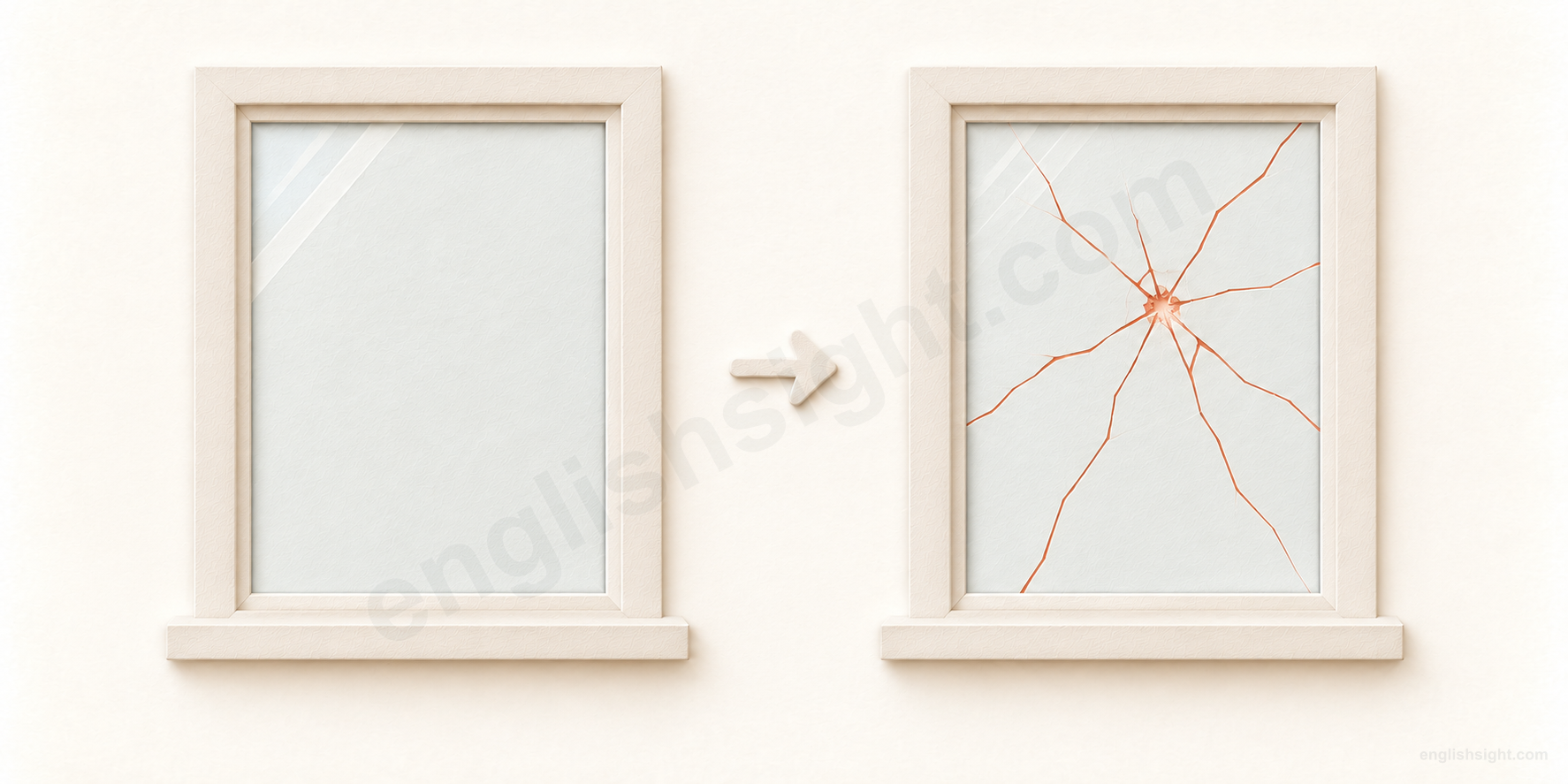
From sound condition to a harmed condition
The window pane is intact.
damage
The pane is cracked but remains in its frame.
An impact leaves branching cracks in the glass.
The pane has lost its sound condition while remaining in its frame.
Damage is harm that worsens something’s condition, function, value, or prospects; to damage something is to cause such harm.
Harm can be slight or serious, visible or invisible, repairable or lasting. The picture illustrates physical harm; abstract uses and fixed expressions need their own context.
A cracked pane, weakened trust, and reduced chances are different kinds of harm. Damage lets us talk about the harmful change or its result without specifying one particular action.
This lesson uses a before-and-after window as a teaching model. It does not claim that every English speaker imagines the same picture, or that every fixed expression can be worked out from a crack.
01
Name the harm and its extent
The noun describes what has gone wrong with a condition, function, or valued situation. Identify what is affected, then describe how much harm there is.
01
damage to + affected thing; damage from + cause; water / fire / property damage
damage to a window
physical harm to something
Situation before
A window has an intact pane.
Harm or response
The pane has a crack, but remains in its frame.
Damage names the loss of sound condition; complete destruction is not required.
The noun damage can describe a scratch, a crack, or a loss of working ability. Something may still function after it has suffered damage. The word alone does not tell us whether repair is possible.
Use damage to name the harm, and to to identify the affected thing: damage to the roof. From or by can identify the source: damage to the roof from falling branches, or damage caused by a storm. In water damage or fire damage, the first noun names the cause. In property damage, it names what is affected. Brain damage and nerve damage concern body tissues or their function.
In this meaning damage is uncountable: some damage, a lot of damage, or no damage. For separate faults, name them: two cracks, rather than two damages.
In a sentence
The fallen branch caused damage to the window.
Watch the difference Say There is some damage, not There is a damage. A damage report is a report about damage; report is the countable noun.
02
damage to + reputation / relationship / confidence / economy
damage to trust / a reputation
harm to something that is valued but not a physical object
Situation before
Customers trust the company’s promises.
Harm or response
After a false promise, they trust it less.
A useful or valued condition can be harmed without a visible crack.
Damage also describes harmful effects on trust, a reputation, a relationship, a business, or the economy. Emotional and psychological damage describe harm to a person’s mental or emotional well-being.
The connection with the window is a decline in something valued. It is a teaching comparison: a reputation has no literal glass surface, and the word does not specify exactly how trust changes.
The noun remains uncountable in this use. Damage to their relationship means harm affecting that relationship; it does not automatically mean the relationship has ended.
In a sentence
The false report did lasting damage to the charity’s reputation.
Watch the difference Do not assume that damage is always visible, physical, or permanent.
03
minor / serious / extensive / permanent damage; assess the damage
minor / serious / irreparable damage
describe the amount, severity, or lasting nature of harm
Situation before
An inspector checks a roof after a storm.
Harm or response
The report describes the harm and whether it can be put right.
Different modifiers answer different questions about the same harm.
Minor damage is relatively slight; serious or severe damage is substantial. Extensive damage affects a large area or many parts. Assess the damage means examine or estimate what harm has occurred; the extent of the damage is how far it reaches.
Permanent or lasting damage concerns duration. Irreparable damage cannot be repaired, while irreversible damage cannot be reversed. Do not silently add these stronger meanings when the sentence says only damage. Damaged beyond repair similarly says that the affected object cannot be repaired.
Use much with the uncountable noun in questions and negatives: How much damage is there? There wasn’t much damage. In affirmative conversation, a lot of damage is natural.
In a sentence
We need to assess the damage before deciding what to replace.
Watch the difference Extensive describes extent; irreparable describes inability to repair. They are not interchangeable.
02
Describe the cause and the response
Use established verb–noun combinations to explain what caused the harm, who experienced it, and what can be repaired.
04
cause / do + damage + to + thing; inflict damage on + thing
cause / do damage to…
say that something produces harm
Situation before
Water reaches a wooden floor.
Harm or response
The floor warps and needs repair.
The cause produces damage; to names the affected thing.
Cause damage and do damage are ordinary ways to describe harmful effects. The subject may be a person, an accident, a substance, or an activity. Do here is a light verb; it does not mean that someone performed damage as a task.
The spill damaged the floor and The spill caused damage to the floor describe the same basic relationship with different grammar. The verb damage takes the floor directly; the noun construction uses to.
Inflict damage on something is another established combination, often used when describing serious harm. Learn on with inflict rather than copying the to from damage to something. These are verb–noun combinations, not phrasal verbs.
In a sentence
The leaking pipe did considerable damage to the floor.
Watch the difference Use cause damage or do damage, not make damage. Compare damage the floor with do damage to the floor.
05
affected thing + suffer / sustain + damage
suffer / sustain damage
say that a person or thing experiences harm
Situation before
A building stands in the path of a storm.
Harm or response
Its roof and walls are harmed.
The affected thing can be the subject without being a conscious sufferer.
The house suffered damage puts the house, rather than the storm, at the start of the sentence. Suffer does not mean that the house feels pain. The construction reports harm that it experienced.
Sustain damage has a similar meaning and is more formal, often appearing in reports. Both take damage directly: the vehicle sustained damage. Use damage to a part if specifying where the harm occurred.
Compare The storm damaged the house: here the cause is the subject. Damage alone is not the recommended everyday intransitive form for the house becoming harmed; was damaged or suffered damage is clearer.
In a sentence
The museum suffered water damage during the storm.
Watch the difference Suffer damage means experience harm; cause damage means produce it.
06
repair / undo / limit / reduce / pay for + the damage
repair / undo / limit the damage
respond to harm that has happened
Situation before
A mistake or accident has harmful consequences.
Harm or response
People try to restore what was lost or prevent further harm.
Repair aims at restoration; limiting aims at keeping harm from growing.
Repair the damage can refer to fixing physical harm, such as a damaged wall. It can also be used for attempts to restore a reputation or a relationship. The phrase does not guarantee that the attempt will succeed.
Undo the damage focuses on reversing harmful effects. Limit or reduce the damage focuses on making the total harm smaller, even if what has already happened cannot all be reversed.
In pay for the damage, the money normally covers the cost resulting from harm, such as repairs. This ordinary expression is different from the legal plural damages.
In a sentence
We apologized and tried to repair the damage to our friendship.
Watch the difference Repairing damage is a response to harm; it does not mean the harm never happened.
03
Use damage as a verb
The active verb takes the affected object directly. Passive forms and the adjectives damaged and damaging show different sides of the same relationship.
07
subject + damage + direct object
damage something
cause physical harm to something
Situation before
A tool is in good condition.
Harm or response
A careless action bends or scratches it.
The object after damage is the thing that is harmed.
As a verb, damage is normally transitive in everyday learner English: you damage a screen, a roof, or a machine. The subject is the cause; the direct object is what it affects. The action may be accidental or deliberate.
The word also works with body parts and health: damage your skin, damage a nerve, or damage your hearing. Damage the environment concerns harm to natural conditions and living systems, rather than one necessarily visible break.
Damage does not specify a particular physical action. Scratch, crack, bend, and burn can tell us how the harm occurred. Destroy is stronger and normally means something is ruined or made unusable; a damaged object may still be usable.
In a sentence
Dragging the chair damaged the wooden floor.
Watch the difference Say The chair damaged the floor, not The chair damaged to the floor.
An applicant has a realistic chance of getting a job.
Harm or response
False information makes that chance smaller.
The harmed object may be an opportunity or a social judgment.
Damage your chances means make success less likely. Damage a reputation means harm the way others regard someone. The verb can also take confidence, relations, or the economy as its object.
These uses share a negative effect with physical damage, but do not describe something snapping or shattering. The context tells you which quality or possibility has been reduced.
Compare hurt someone’s feelings, injure someone in an accident, and damage someone’s reputation. Their meanings overlap, but their usual objects differ. Damage a person is possible, especially for lasting psychological harm, but I hurt my arm is a more ordinary way to report a simple injury.
In a sentence
Missing the deadline could damage her chances of getting the grant.
Watch the difference Damage someone’s chances does not necessarily mean success has become impossible.
09
be / get + damaged; damaged by + cause; damaged in / during + event
be / get damaged
focus on the affected thing or its resulting condition
Situation before
A parcel is sent with an intact lamp inside.
Harm or response
The lamp is harmed during transport.
The passive makes the harmed item the sentence’s starting point.
The lamp was damaged during delivery reports what happened to the lamp. By can identify the cause or agent: damaged by water. In a fire and during delivery describe the event or time, not the grammatical agent.
The lamp got damaged is a conversational way to describe the event. The lamp is damaged can describe its present condition, and a damaged lamp uses the past participle before a noun.
The lamp was being damaged describes harm in progress; has been damaged connects an earlier event with the present. Damage has ordinary active and passive forms because it takes an object. Badly damaged says how seriously something was harmed, not how badly a person performed a task.
In a sentence
The lamp was damaged during delivery, but it still works.
Watch the difference Do not use a bare past form for the passive: The lamp damaged during delivery does not give the intended standard passive sentence.
10
be damaging to + thing; a damaging + noun
damaging to…
having a harmful effect
Situation before
A decision threatens a local river.
Harm or response
The decision may cause harm to the river’s ecosystem.
Damaging describes the cause of harm; damaged describes what has been harmed.
A damaging report can harm a reputation; a damaged report might have torn pages or a corrupted file. The -ing adjective describes a harmful effect, while the -ed form usually identifies the affected thing or its condition.
With the adjective, use damaging to something: damaging to the environment. With the finite verb, use a direct object: It damages the environment. To belongs to the adjective construction here.
In The leak is damaging the floor, is damaging is a progressive verb form and the floor is its direct object. In The leak is damaging to the building, damaging is an adjective followed by to. Read the whole construction.
In a sentence
The misleading story could be damaging to her reputation.
Watch the difference Compare damaging to her reputation with damages her reputation; do not mix the two constructions.
04
Money and established expressions
Legal damages and the joking question about cost need their own explanations. Other familiar expressions focus on consequences or attempts to contain them.
11
claim / award / pay + damages; sue for damages; an amount + in damages
claim / award / pay damages
compensation connected with a legal claim
Situation before
Someone has suffered a loss and brings a claim.
Harm or response
A court may order money to compensate them.
Legal damages are money, not a count of scratches or other physical faults.
Damages is a plural noun for money claimed or awarded as compensation for harm or loss. A person may claim damages or sue for damages; a court may award damages; the responsible party may be ordered to pay them.
In The tenant was awarded damages, the tenant receives the award. In The court awarded the tenant damages, the court is the subject and damages is what it awards. An amount can be expressed as £2,000 in damages.
The fire caused damage names the harm. The court awarded damages names the compensation. Damages may relate to injury, reputation, or financial loss as well as property.
In a sentence
The court awarded the tenant £2,000 in damages.
Watch the difference Legal damages takes plural agreement: The damages were substantial. Ordinary physical damage takes singular agreement: The damage was minor.
12
the damage is done; the damage has (already) been done
the damage is done
the harmful consequences have already happened
Situation before
A private message is sent to the wrong group.
Harm or response
Other people have already read it.
It is too late to prevent those consequences, even if some repair remains possible.
The damage is done often responds to an apology or an attempt to stop a problem too late. The speaker stresses that the harmful effect has already occurred.
Here done means caused or brought about, not repaired. The expression does not say that every consequence must last forever. You may still reduce further harm or try to put things right.
The damage has already been done and The damage was done before we arrived are ordinary tense variations. The full expression carries the familiar conversational point.
In a sentence
I deleted the message, but the damage was already done: everyone had read it.
Watch the difference Do not interpret done as meaning the repairs are finished.
13
do damage control; an exercise in damage limitation
damage control / damage limitation
efforts to contain harmful effects
Situation before
An organization has made a public mistake.
Harm or response
It corrects information and tries to stop the situation getting worse.
Control here aims to reduce harm, rather than cause or celebrate it.
Damage control describes efforts to limit the bad effects of an event. Damage limitation is another established term; Oxford identifies damage control as especially North American.
After a public mistake, issuing accurate information and addressing complaints may be part of damage control. The phrase can also concern physical harm. It names a response, and does not promise that all damage can be repaired.
The compound is a noun phrase: The team is doing damage control. Doing damage means causing harm; doing damage control means trying to contain it. The final noun changes what the activity is.
In a sentence
The company began damage control after customers discovered the error.
Watch the difference Damage control is not the same as do damage. Keep control in the phrase.
14
What’s the damage?
What’s the damage?
informally ask how much something costs
Situation before
A meal or repair has to be paid for.
Harm or response
Someone asks for the amount with a joking expression.
The fixed question uses damage as a lighthearted reference to expense.
What’s the damage? can mean How much do I owe? or How much will it cost? It is informal and often humorous, for example when asking about a bill.
The expression does not normally suggest that the food or service physically harmed anything. However, after an accident the same words can genuinely ask what harm occurred. The setting distinguishes the two readings.
This cost use is conventional. Do not assume that damage can replace cost freely in neutral questions or formal invoices.
In a sentence
“That’s the meal finished. What’s the damage?” asked Ben as he reached for his wallet.
Watch the difference Use How much is it? for a neutral question. The damage question can sound too casual in a formal setting.
15
damaged goods; treat / regard someone as damaged goods
damaged goods
harmed merchandise, or a dismissive description of a person
Situation before
A shop receives items with defects.
Harm or response
Those items cannot be sold as undamaged stock.
The literal phrase concerns products; the figurative phrase judges a person as less acceptable.
Damaged goods can literally mean products that have been harmed. A shop might separate damaged goods from undamaged stock. Here damaged is an ordinary adjective describing goods.
As an informal expression about a person, damaged goods means someone regarded as no longer having the qualities others want, perhaps because of past problems. It presents a dismissive judgment, not a diagnosis or an objective measure of human worth.
Goods has a plural form. These goods are damaged talks about products. The figurative phrase can describe one person: She was unfairly treated as damaged goods. Recognize this use when reading, but avoid using it as a casual label for people.
In a sentence
The shop keeps damaged goods on a separate shelf.
Watch the difference Do not transfer the product comparison to people as a neutral description. Its figurative use can be demeaning.
Keep the harm, the grammar, and the money distinct
Damage is not automatically destruction
A small scratch can be damage. Destroy usually suggests much more complete loss of use or existence. Harm overlaps with damage; hurt often focuses on pain or feelings, while injure is common for harm to a person or body part.
Forms and pronunciation
Damage /ˈdæmɪdʒ/ has two syllables, with stress on the first. Verb forms are damage, damages, damaged, damaging; damaged ends in /d/, without an extra syllable. Damages /ˈdæmɪdʒɪz/ can be a present-tense verb or the plural legal noun: read the sentence.
Use ordinary object and passive patterns
For everyday production, use The water damaged the floor or The floor was damaged. Some general dictionaries also record intransitive damage meaning become damaged, but this lesson does not teach that less usual pattern as the default. There is no common particle-verb family to build here; damage control is a noun compound.
A model with limits
The window helps show a harmful change of condition. It does not predict the compensation meaning of damages, the joking cost question, or judgments made about people. Those require the established expression and its context.
Choose what the sentence means
Check whether the sentence describes harm, the cause, an attempt to contain it, or compensation.
1. You find several scratches on a table. Which sentence uses the ordinary noun correctly?
2. Water harms a floor. Which sentence uses damage as a verb?
3. A court awards a tenant £2,000 in damages. What does damages mean?
4. A secret has already been shared. Someone says, “The damage is done.” What is the point?
5. A report may harm someone’s reputation. Which description gives that meaning?
6. After a mistake, a team does damage control. What is it trying to do?
Sources and teaching notes
Dictionary entries support the usage coverage below. Explanations and examples are original; the window model is a teaching interpretation.
The diagram is a teaching aid, not a picture shared by every native speaker.