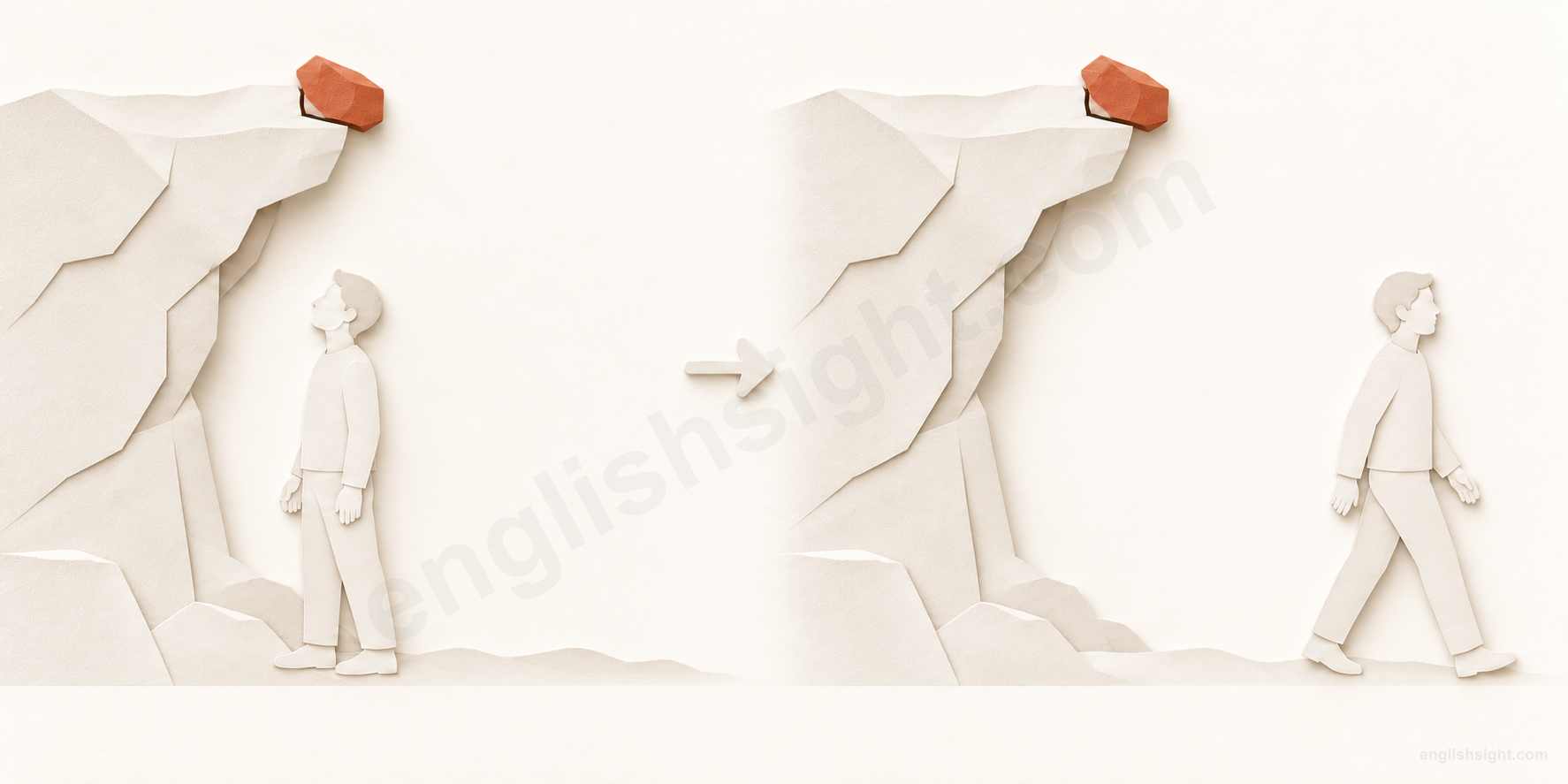
Harm is possible, even before anything goes wrong.
Use danger for a threatened state, a harmful source, or an unwanted possibility.
A threat and something exposed to it
A threat and something exposed to it
A walker stands below a loose rock.
danger
The rock remains on the ledge, and the walker is farther away.
The walker moves beyond the rock’s possible fall area.
Harm is possible below the loose rock. Moving away ends this particular exposure; the rock has not fallen.
Someone or something is exposed to possible harm or loss; danger can name that possibility or its source.
The rock is one physical example of the relation. Jobs and plans can also be in danger. Possibility is central: neither injury nor escape is an inevitable result of the word.
A loose rock can put a walker in danger without ever falling. Danger directs attention to what could harm someone or damage something, rather than saying harm has already occurred.
The same connection extends to losing a job or missing an important deadline. The grammar tells you whether you are naming the exposed person, the source of harm, or the possible bad outcome.
01
Who or what could be harmed?
Use in danger for exposure to harm, add of to name a possible outcome, and use out of danger when that threat no longer applies.
01
person / thing + be + in (serious / immediate) danger
be in danger
be exposed to possible harm or loss
Situation
A walker stops below a loose rock.
What could happen / what changes
The rock could fall and hurt the walker, though no injury has occurred.
The subject is the person or thing threatened.
In danger describes a situation, not an injury that has already happened. The walker is exposed to something harmful. A life, a building, or even a job can also be in danger.
Here danger is uncountable: say in danger, not in a danger. Serious or grave danger strengthens the description; immediate danger concerns a threat present now, and mortal danger concerns possible death.
In a sentence
The walkers are in danger below the loose rocks.
Watch the difference She is in danger says she could be harmed. She is dangerous says she could cause harm. These put her on different sides of the relation.
02
be in danger of + noun / -ing form
be in danger of losing…
be at risk of a specified unwanted outcome
Situation
A small café has very few customers.
What could happen / what changes
It might have to close; closure is not certain.
Of introduces what may happen to the subject.
In danger of connects an exposed person or thing with the possible outcome: in danger of falling, in danger of losing a job, or in danger of extinction. Physical injury is only one application.
The subject usually supplies the understood subject of the -ing form: The café is in danger of closing means the café may close. Compare The owner is in danger of losing the café: the owner may lose it.
In a sentence
The café is in danger of closing this winter.
Watch the difference Of is a preposition: say in danger of closing, not in danger to close. Use being plus a past participle when needed: in danger of being forgotten.
03
be / get out of danger; the danger has passed
be out of danger
no longer face the relevant serious threat
Situation
A person has been seriously ill in hospital.
What could happen / what changes
The threat to life has passed, but recovery is continuing.
Out of removes the person from the threatened state.
In general use, people can get out of danger by reaching safety. In medical reports, out of danger means someone is no longer expected to die from the illness or injury being discussed.
This does not mean fully recovered or free of every possible future risk. The danger has passed similarly says a particular threat is over; it does not erase what happened earlier.
In a sentence
Sam is out of danger, but he still needs care.
Watch the difference Use out of danger without an article in this expression. Do not treat it as a promise of complete health.
02
What creates the danger?
A danger can be a harmful person, object, or situation. To names what is threatened; from names the source; of can connect dangers with an activity.
04
source + be / pose / present + a danger to + person / thing
be / pose a danger to…
be or create a source of possible harm
Situation
A damaged balcony hangs above a public path.
What could happen / what changes
People using the path could be hurt.
The subject is the source; to names the threatened person or thing.
Calling something a danger treats it as one identifiable source of harm, so a is natural. The balcony is a danger to pedestrians places the balcony on the harmful-source side, unlike Pedestrians are in danger.
Pose a danger to and present a danger to describe creating a threat. They are somewhat more formal than be dangerous to. A person can also be a danger to themselves or others; the wording does not say they intend harm.
In a sentence
The damaged balcony poses a danger to people below.
Watch the difference To identifies what could be harmed, not what the source plans to do. A danger to children is different from children in danger.
05
the dangers of + noun / -ing form
the dangers of…
the harmful possibilities associated with an activity or thing
Situation
Someone is considering sharing private information online.
What could happen / what changes
You discuss the different things that could go wrong.
Plural dangers can identify several harmful possibilities.
The dangers of sharing personal details groups possible harmful consequences connected with the activity. Plural dangers does not mean several people feel afraid; it counts threats or harmful possibilities.
Danger of can name one possible bad event, whereas the dangers of an activity often surveys several problems associated with doing it. The following noun or -ing phrase and the context guide the reading.
In a sentence
We discussed the dangers of sharing passwords.
Watch the difference Say the dangers of sharing, not the dangers of share. Do not assume danger of always identifies the source rather than the possible result.
06
danger to + affected person / thing + from + source
danger from…
possible harm coming from a named source
Situation
Loose tiles remain on the roof.
What could happen / what changes
The source of possible harm is falling material.
From identifies where the threat comes from.
Danger from falling tiles points to the source of the threat. Danger to pedestrians points to the people exposed. You can combine both: danger to pedestrians from falling tiles.
This is a noun with a prepositional phrase, not a phrasal verb. Without danger from a particular source rules out that threat in the stated context, not every conceivable danger.
In a sentence
The path is closed because of danger from falling tiles.
Watch the difference Compare danger from falling tiles, the source, with danger of falling, a possible event affecting the person who might fall.
03
What bad result might happen?
Danger also reaches beyond physical injury to unwanted outcomes such as losing work, missing a deadline, or damaging a plan. Choose a noun, an -ing form, or a full clause.
07
there is + a danger of + noun / -ing form
there is a danger of…
an unwanted event is possible
Situation
Two classes may need the same room at the same time.
What could happen / what changes
A scheduling problem could result.
There introduces a possible problem; of names it.
There is a danger of a clash introduces a bad possibility without first naming a person in danger. A danger of losing information similarly identifies a possible result.
Compare We are in danger of missing the bus, which starts with the people affected, and There is a danger of missing the bus, which introduces the possibility. Danger implies an unwelcome result from the speaker’s viewpoint; chance can also introduce a welcome one.
In a sentence
There is a danger of a clash between the two classes.
Watch the difference A danger presents one identified bad possibility here. Danger can also be uncountable: There is danger of flooding. In the fixed state expression in danger, do not add a.
08
there is a danger that + clause; the danger is that + clause
there is a danger that…
state a possible bad result as a full clause
Situation
A delivery has been delayed.
What could happen / what changes
A separate event, missing a deadline, may follow.
That allows the possible result to have its own subject and verb.
That introduces the content of the danger: the deadline may be missed. Unlike of plus an -ing form, it lets you state a subject explicitly and choose the tense or modal that fits.
The danger is that… identifies the main problem rather than merely introducing one. A real danger that… presents the possibility as something worth taking seriously; it does not make the outcome certain.
In a sentence
There is a danger that the parts will arrive too late.
Watch the difference Say danger that the parts will arrive late, not danger of the parts will arrive late. Of cannot directly introduce that finite clause.
09
there is no / little danger of + noun / -ing form; no danger of that
no danger of that
say an unwanted possibility will not arise
Situation
A friend worries that your group will leave without her.
What could happen / what changes
You reassure her that this will not happen.
That refers back to the previously mentioned event.
There is no danger of that can reassure someone that the feared event will not happen. Little danger of is weaker: the speaker considers the event unlikely, rather than ruling it out.
In conversation the expression may be playful or ironic. If someone asks whether Pat will arrive early, No danger of that! can mean Pat certainly will not. The tone comes from context and the whole expression; danger does not become a general word for a welcome opportunity.
In a sentence
“Will you leave without me?” “There’s no danger of that.”
Watch the difference No danger is the speaker’s assessment, not evidence that every risk has been measured. Check what that refers to.
04
Creating, noticing, and describing danger
Use familiar combinations to describe exposure, warning, hazardous areas, and serious illness. The verbs and longer expressions contribute meanings of their own.
10
put + person / thing + in danger; expose + person / thing + to danger
put someone in danger
cause someone or something to be exposed to harm
Situation
A driver reads messages instead of watching the road.
What could happen / what changes
Other people are exposed to a possible crash.
Put adds causation to the state in danger.
Put someone in danger means cause the dangerous situation, not necessarily move the person physically. Put lives in danger and put yourself in danger follow the same pattern. The single verb endanger also takes the person or thing threatened as its object.
A passive form is possible: Their lives were put in danger by the delay. Here the passive belongs to put; danger remains a noun. Expose someone to danger also describes bringing them into contact with a threat.
In a sentence
Reading messages while driving puts other people in danger.
Watch the difference Use endanger lives or put lives in danger, not danger lives in ordinary modern English.
11
face / sense / recognize + danger; in the face of danger
face / sense danger
encounter a threat or become aware of it
Situation
Rescue workers approach a damaged building.
What could happen / what changes
They confront possible harm and notice warning clues.
Face is about encountering danger; sense is about awareness.
Face danger means have to deal with possible harm. It does not literally require turning your face toward something, and it does not say the person is unafraid. In the face of danger means when confronted with it.
Sense danger means become aware that something may be wrong, perhaps before the threat is clear. Recognize or spot a danger suggests identifying it. None of these expressions says that an injury has occurred.
In a sentence
The rescue team stayed calm in the face of danger.
Watch the difference Facing danger and causing danger are different. The person facing it need not be the source of the threat.
12
danger sign(s); warn + person + of danger / about the dangers of…
danger signs / warn of danger
notice or communicate clues that harm may occur
Situation
A roof develops cracks before any material falls.
What could happen / what changes
The cracks alert people to a possible problem.
A sign can be evidence of danger, not only a printed notice.
Danger signs can mean indications that something is wrong, such as cracks, smoke, or unusual behavior. A danger sign may also be a physical warning notice. On a notice, Danger! can stand alone to draw attention to a threat.
Warn someone of danger or warn someone about the dangers of an activity describes communicating a warning. Warn does that work; danger names the threat being communicated. A warning does not by itself remove the threat.
In a sentence
The cracks were danger signs that the owners had ignored.
Watch the difference Danger is a noun used before signs. In a normal description of a hazardous object, use dangerous: a dangerous roof.
13
in / enter / leave / move out of + the danger zone
a danger zone
an area where the risk of harm is high
Situation
An unstable wall threatens the area beside it.
What could happen / what changes
People leave the area where falling bricks could hit them.
Zone makes the location explicit.
A danger zone is an area where the risk of harm is high. Leave the danger zone and evacuate people from the danger zone describe getting beyond that area.
The expression can also be used figuratively for an area of activity that is likely to cause trouble. The two positions relative to the rock in the teaching diagram illustrate exposure and safety without drawing a fixed boundary; most uses of danger do not require a marked zone.
In a sentence
Workers moved everyone out of the danger zone beside the wall.
Watch the difference A danger zone names an area. In danger names a threatened state, even when there is no particular physical zone.
14
be on / off the danger list
on / off the danger list
be, or cease to be, critically ill
Situation
A hospital patient is so ill that survival is uncertain.
What could happen / what changes
Later news may report that the critical threat has eased.
The expression reports a medical condition, not a list of dangerous people.
In British English, on the danger list means seriously ill and possibly dying. Off the danger list means the person is no longer in that critical condition.
This is an established medical-reporting expression. It is not a literal list that every hospital must keep. Out of danger is another way to describe the improvement, but neither expression necessarily means the patient can go home.
In a sentence
Her uncle is off the danger list but remains in hospital.
Watch the difference A person on the danger list is at risk; the phrase does not mean that the person is a danger to others.
15
task / journey / plan + be fraught with danger
fraught with danger
full of serious hazards or harmful possibilities
Situation
A planned mountain crossing has several serious hazards.
What could happen / what changes
The route is described as highly hazardous.
Fraught with characterizes the situation as full of danger.
Fraught with danger is a fairly formal way to describe a task, journey, or plan as full of threats. It is stronger and more descriptive than simply saying that one small risk exists.
Danger itself does not mean full of: that contribution comes from fraught with. This is a fixed adjective-and-preposition combination, not a phrasal verb and not movement through a container.
In a sentence
The winter crossing was fraught with danger.
Watch the difference Learn with as part of fraught with. Do not substitute of or treat fraught as a form of danger.
Keep the roles and word forms clear
Danger, dangerous, and endanger
Danger is normally a noun in modern everyday English. The cable is a danger names a harmful source; the cable is dangerous describes its quality; the cable endangers workers names the people exposed. The worker is in danger places the worker on the receiving side. The old verb danger is archaic, not the ordinary modern choice.
Countable and uncountable
Use uncountable danger for exposure in general: face danger, in danger, without danger. Use a danger or plural dangers for an identified source or harmful possibility. The danger refers to a particular threat already known or specified. Do not use an article just because a person is singular.
Danger and risk overlap
Both can describe bad possibilities: a danger of failure and a risk of failure. Risk often fits discussion of likelihood or a decision to take a chance; danger draws attention to threatened harm. This is a useful tendency, not an absolute division. Neither word requires that the person exposed chose the situation. Say in danger or at risk, rather than at danger.
Seriousness, timing, and fear are different
Serious or grave describes severity; imminent means about to happen; potential means possible. Hidden danger may not have been noticed. Danger does not name the feeling of fear: someone can feel afraid in a safe place or remain calm in danger.
Scope of this lesson
This lesson covers the modern noun, its main prepositions, everyday warnings, and selected established expressions. The noun has no verb tense or particle-verb family. In the passive example, put carries the tense and voice; danger remains a noun. Historical power/jurisdiction senses, specialized technical compounds, and a full lesson on the separate adjective dangerous are outside this scope.
Choose the role or construction
Check who could be harmed, what could cause harm, and what follows the preposition.
1. A walker is below loose rocks. Which sentence says the walker could be harmed?
2. An unstable wall threatens people passing it. Which sentence identifies the source and the people threatened?
3. The café may have to close. Choose the standard pattern.
4. A patient is out of danger but still in hospital. What does the update mean?
5. You want to state that parts may arrive late, using a complete clause. Choose the natural construction.
Sources and teaching notes
Modern meanings and constructions were checked against the dictionary pages below. The explanations and examples are original teaching material; the diagram illustrates a connection rather than proving a definition.
The diagram is a teaching aid, not a picture shared by every native speaker.