Learn when dark describes what you can see, what something looks like, or what you do not know.
Less light makes details harder to see
Less light makes details harder to see
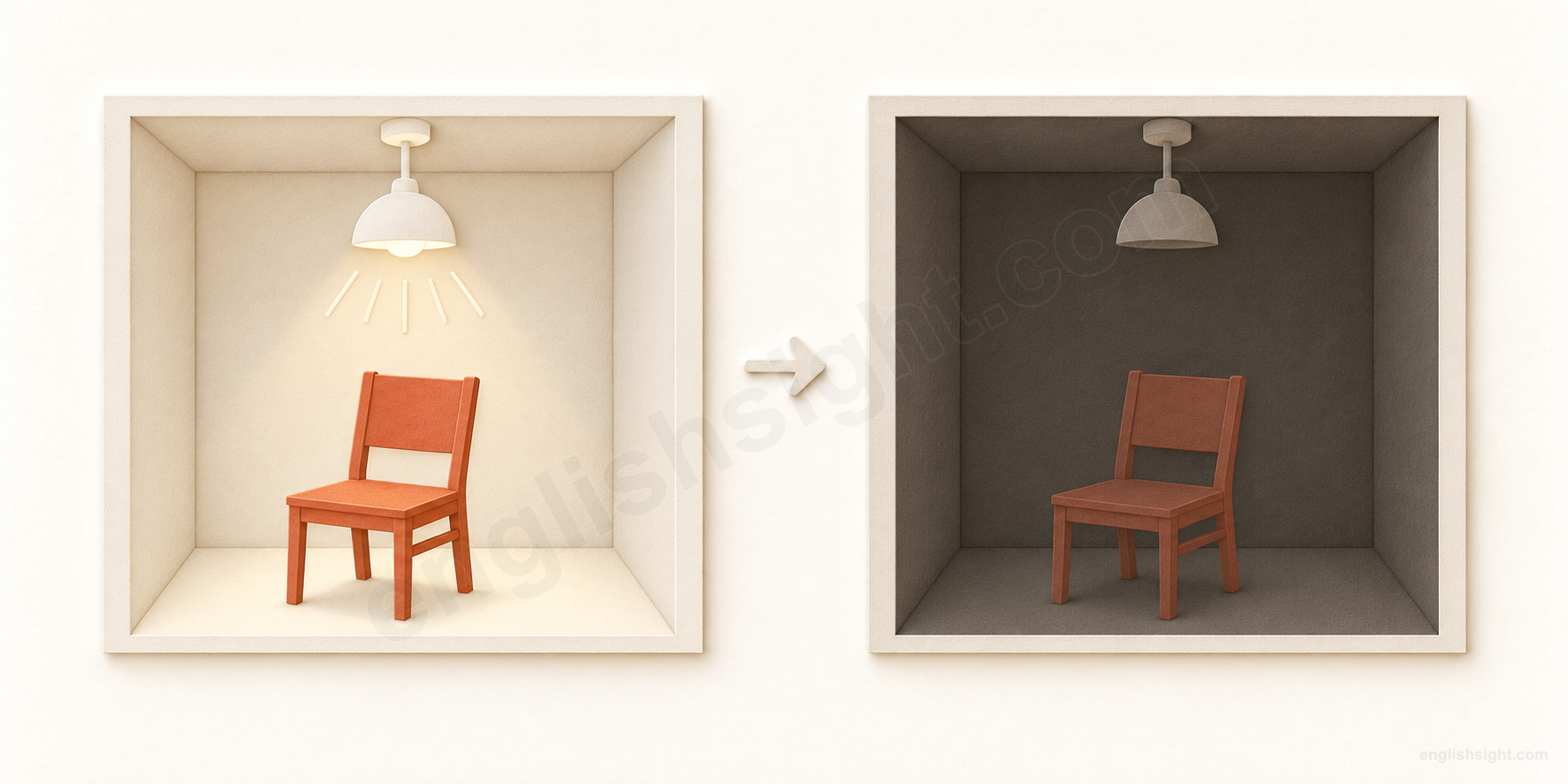
The lamp is on; the chair is easy to see.
dark
The lamp is off; the chair remains, but is harder to see.
The lamp goes out; the same room becomes dark.
The light changes; the chair stays. Dark here describes the room's lighting, not a change in the chair's colour.
Dark describes little or no light; it also describes colours with low lightness and, figuratively, things that are hidden or troubling.
The room comparison illustrates illumination only. A dark blue coat stays dark blue in bright light. The figurative branches and fixed expressions must be learned with their contexts.
Picture a familiar room with its lamp on, then with the lamp off: the furniture remains, but its details become harder to see. This is a useful starting point for dark in the sense of little or no light.
Dark also describes colours, natural colouring, and figurative ideas such as secrets or difficult times. These are related teaching branches, not one physical event repeated in every phrase. The following noun and the whole construction guide the meaning.
01
Light, visibility, and nightfall
Describe a place, a change in its lighting, or the time when daylight is gone. Notice when dark is an adjective and when the dark is a noun phrase.
01
dark + noun; subject + be / look / seem + dark; it is dark
a dark room / It is dark
having little or no light
Situation / starting point
The room has no lamp switched on.
Meaning in context
You cannot easily make out the furniture.
Dark describes the available light, not the colour of the furniture.
Dark can describe a room, street, forest, or night. It is an adjective before a noun, or after a linking verb: The hallway is dark. It need not mean that there is absolutely no light.
In It is dark outside, it is a grammatical subject for the surrounding conditions. Dark does not name an object receiving an action. A dark room may have white walls; the problem is its lighting.
In a sentence
The hallway is dark, so I will turn on a light.
Watch the difference Dark is an adjective: say The room is dark, not The room is darkly.
02
get / grow / go + dark
get / grow / go dark
become dark as daylight fades or a light stops shining
Situation / starting point
The room or sky is still light.
Meaning in context
Less light remains, gradually or suddenly.
The verb carries the change; dark names the resulting state.
It gets dark describes the arrival of darkness; It is getting dark presents the change as happening now. Grow dark can describe a gradual change and is a little more descriptive.
The room went dark often suggests a sudden loss of light. Compare The sky grew dark as the storm approached: the setting can supply the cause without night arriving. Dark alone does not tell us whether the change is gradual.
In a sentence
The room went dark when the lamp was unplugged.
Watch the difference Get dark has no object here. To describe causing a change, use make the room dark or darken the room.
03
too dark + to-infinitive; dark enough + to-infinitive; pitch-dark; darker / darkest
too dark to see / pitch-dark
describe the degree of darkness and its practical effect
Situation / starting point
You need enough light to read a label.
Meaning in context
The available light is below what you need.
Too gives a limit for an activity; pitch-dark emphasizes near-total darkness.
Too dark to read means the darkness prevents reading in the situation. Dark enough to see the stars uses enough for a different purpose: less competing light helps you see them. Too and enough depend on the task, not on one fixed light level.
Pitch-dark is an emphatic adjective for completely or extremely dark conditions: a pitch-dark cellar. Ordinary dark allows some remaining light. Darker and darkest compare degrees: This corner is darker than the doorway.
In a sentence
It is too dark to read the label without a torch.
Watch the difference Too dark is not simply very dark: too links the degree to a problem or limit.
04
in the dark; afraid of the dark; glow in the dark
in the dark / afraid of the dark
refer to darkness as a condition or surroundings
Situation / starting point
The lights are off.
Meaning in context
Someone sits, moves, or feels afraid without light.
The dark is a noun phrase; in the dark can be literal.
The dark names the absence of light: We waited in the dark. After afraid of, the same noun phrase names what causes fear: My brother is afraid of the dark. The article belongs to these ordinary expressions.
A toy that glows in the dark gives off visible light when its surroundings are dark. Compare a dark room, where dark is an adjective. Darkness is another noun: We waited in darkness is possible, with a different wording.
In a sentence
The little stars on the ceiling glow in the dark.
Watch the difference Literal in the dark concerns light; the same phrase also has an information meaning taught below.
05
before / after dark
before / after dark
before or after daylight has faded into night
Situation / starting point
You are arranging a walk and a return time.
Meaning in context
Your time limit is nightfall, not a clock number.
Dark names the onset of night in these time phrases.
Before dark means before it becomes night; after dark means once it is night. The exact time varies with the place and season. The phrase does not mean before entering a dark room.
Use no article in these usual time expressions: after dark. Contrast after the dark film, where dark modifies a named film and after relates to the film finishing.
In a sentence
We should finish the walk before dark.
Watch the difference Keep before dark for nightfall and in the dark for being in darkness.
02
Colours, appearance, and everyday objects
Here dark concerns colour or a familiar category of things. A dark object can be seen clearly in a well-lit room.
06
dark + colour name; dark + noun; darker than
dark blue / a dark coat
describe a colour with relatively low lightness
Situation / starting point
You compare two blue coats in daylight.
Meaning in context
One shade is closer to black than the other.
Dark can qualify a colour even when the lighting is bright.
Dark blue keeps the colour blue but specifies a deeper shade. A dark coat leaves the exact colour open: it could be black, deep brown, navy, or another dark colour. Dark is not a synonym for black in every context.
Compare a dark room and a dark coat in a bright room: the first usually concerns illumination, the second colour. Dark clouds concern their dark appearance and can also reduce the light below them.
The same colour meaning helps with the familiar interface label dark mode: a display uses a dark background. That label does not mean the device is switched off.
In a sentence
I chose the dark green coat rather than the pale green one.
Watch the difference Light is the usual opposite for a shade; bright can describe vivid colour, so bright and dark are not always opposites.
07
dark + hair / eyes / skin; dark-haired + noun
dark hair / eyes / skin
describe relatively deep natural colouring
Situation / starting point
You need to describe someone’s appearance.
Meaning in context
You name the feature and its colouring.
Dark refers to colour, without making a judgment about character.
Dark hair and dark eyes commonly mean brown or black. Dark skin describes skin colour relative to a lighter range. These are descriptions of features, not claims about nationality or personality.
A dark-haired person has dark hair; the hyphen helps join the description before person. In descriptions such as tall, dark, and handsome, dark often points to hair and colouring, but naming the feature is clearer when precision matters.
In a sentence
The child in the photograph has dark hair and blue eyes.
Watch the difference Do not transfer the negative figurative meanings of dark to descriptions of people’s natural colouring.
08
dark glasses; a pair of dark glasses
dark glasses
glasses with tinted, dark-coloured lenses
Situation / starting point
The light is strong outside.
Meaning in context
Someone wears glasses with dark lenses.
The darkness belongs to the lenses, not to the room or the wearer’s eyesight.
Dark glasses is a plural noun phrase for glasses with dark lenses, commonly sunglasses. The expression does not require black frames. Transparent glasses with a dark frame are not necessarily dark glasses.
Say a pair of dark glasses when you want a singular counting expression. The noun glasses takes plural agreement: Her dark glasses are on the table.
In a sentence
He took off his dark glasses when he came indoors.
Watch the difference Do not say a dark glasses; use dark glasses or a pair of dark glasses.
09
the darks; lights and darks
wash the darks separately
group dark-coloured clothes together
Situation / starting point
You are sorting laundry by colour.
Meaning in context
The dark-coloured items form one group.
Darks is a plural noun for dark-coloured items in this context.
In laundry instructions, the darks means the dark-coloured clothes. Lights and darks name groups rather than the lighting conditions where you wash them.
An artist can also talk about the lights and darks in a picture, meaning its lighter and darker tones. The subject area tells you what the noun refers to; it is not a general substitute for every dark object.
In a sentence
I put the darks in one basket and the white shirts in another.
Watch the difference Darkness is not the laundry group. Darks has a specialized plural noun use here.
10
dark chocolate; a bar / piece of dark chocolate
dark chocolate
name a dark, cocoa-rich style of chocolate
Situation / starting point
You are choosing chocolate for a recipe.
Meaning in context
You choose a type different from milk or white chocolate.
The whole food name identifies a category, not the lighting around it.
Dark chocolate is a familiar food name for dark-brown chocolate, typically made without added milk and tasting more bitter than milk chocolate. It contrasts with milk chocolate and white chocolate. British English also uses plain chocolate.
Chocolate is normally uncountable when naming the substance: some dark chocolate or a bar of dark chocolate. The phrase is a food description; it does not itself specify every ingredient in a particular product.
In a sentence
Melt a little dark chocolate and spread it over the biscuits.
Watch the difference The adjective dark does not turn chocolate into a description of burnt food.
11
dark meat; dark meat rather than white meat
dark meat
name the darker meat from a bird’s legs
Situation / starting point
You are choosing a portion of cooked chicken.
Meaning in context
You choose leg meat rather than breast meat.
This is a food category within poultry.
Dark meat refers to the darker meat from the legs of chicken, turkey, or similar birds. In that setting it contrasts with the lighter breast meat called white meat.
The meaning is not meat that has been left in a dark place, and dark meat is not simply another name for red meat. The food category is established usage, so learn the two-word name together.
In a sentence
For the sandwiches, I prefer dark meat from the chicken legs.
Watch the difference Do not use dark meat to mean that any meat has gone bad.
03
Secrets, trouble, and an unsettling tone
These uses move beyond physical light. The following noun helps you decide whether dark suggests something hidden, unhappy, threatening, or grimly funny.
12
dark + secret / past; dark + corner / recess
a dark secret / a dark past
suggest something hidden, often shameful or disturbing
Situation / starting point
Part of a person’s history is not openly discussed.
Meaning in context
A story hints that troubling information is concealed.
Not being visible becomes a teaching link to not being known.
A dark secret usually suggests more than private information: it carries an unsettling or shameful tone. A dark past similarly suggests troubling events in someone’s earlier life. Dark contributes that tone; secret or past names what is being described.
In more literary descriptions, a dark corner of someone’s mind or an unexplored dark region can suggest something not fully known. This is a metaphorical link, not a rule that all unknown things are bad.
In a sentence
The novel slowly reveals a dark secret from the family’s past.
Watch the difference Use private for neutral personal information. Calling it a dark secret adds a stronger implication.
13
dark days / times / thoughts; a dark view of + noun
dark days / dark thoughts
describe suffering, pessimism, or a grim view
Situation / starting point
A situation causes fear, grief, or loss of hope.
Meaning in context
Someone describes the period or their thoughts as dark.
Dark evaluates the experience; it need not describe night.
Dark days and a dark period describe difficult or distressing times, including times that happen in full daylight. The darkest period uses the superlative to emphasize the worst part of an experience.
The phrase dark thoughts is often literary or descriptive: the thoughts may be gloomy, fearful, or disturbing, and the surrounding story decides the precise content. A dark view of the future is pessimistic. Do not assume that the word by itself states a particular intention or diagnosis.
In a sentence
Those were dark days, but her friends helped her through them.
Watch the difference A dark day may literally lack daylight or figuratively be distressing. Read the surrounding facts.
14
the dark side of + noun; dark forces
the dark side / dark forces
describe harmful or frightening aspects
Situation / starting point
Something appears attractive or respectable.
Meaning in context
A harmful aspect is brought into view.
Dark can express moral danger or menace, not just lack of information.
The dark side of something is its harmful or troubling aspect: The report shows the dark side of the business. It need not mean that nobody previously knew about it. A dark side can be openly discussed.
Dark forces is dramatic wording for evil or threatening powers, especially in stories. These negative associations belong to figurative descriptions; they are not inherent judgments about dark colours or dark skin.
In a sentence
The film explores the dark side of sudden fame.
Watch the difference A dark side can also be a literal unlit side of an object; the noun and context decide.
15
give / shoot + person + a dark look / glance
a dark look / glance
show anger, disapproval, or menace in an expression
Situation / starting point
Someone hears an unwelcome remark.
Meaning in context
Their facial expression communicates displeasure.
The adjective describes the emotional message of the look.
A dark look or glance suggests anger or a warning. It is descriptive language often found in stories: She gave him a dark look. It does not mean that her face became difficult to see.
Gave him a dark look has him as the person receiving the look; dark modifies look. For a plain account of emotion, an angry look is more direct. A dark threat similarly sounds menacing and is more dramatic.
In a sentence
Nina gave him a dark look when he laughed at her mistake.
Watch the difference Dark eyes describes eye colour; a dark look describes an expression.
16
dark humour / humor; a dark comedy
dark humour / a dark comedy
find humour in grim or disturbing subjects
Situation / starting point
A story treats an upsetting subject.
Meaning in context
It makes jokes while keeping an unsettling tone.
Dark identifies the subject matter and tone of the humour.
Dark humour finds comedy in serious, disturbing, or grim situations. A dark comedy is a work that uses that kind of humour. A joke can be funny and unsettling at the same time.
Humour is the British spelling; humor is the American spelling. Dark does not tell us whether a joke is clever, acceptable to everyone, or told angrily. It signals the kind of material and treatment.
In a sentence
The play uses dark humour to explore the family’s arguments over an inheritance.
Watch the difference Do not confuse dark humour with an ordinary bad mood or an angry look.
04
Information, guesses, risks, and surprises
Learn each expression as a whole. Similar images of darkness do not make these phrases interchangeable.
17
be in the dark about + noun; keep + person + in the dark; be kept in the dark
be / keep someone in the dark
lack information, or prevent someone from receiving it
Situation / starting point
A decision is being discussed without you.
Meaning in context
You still do not know what has been decided.
The person lacks information, not necessarily light.
Be in the dark about something means not know the relevant information. About introduces the topic: I am in the dark about the new schedule. You can say this while sitting in bright sunlight.
Keep someone in the dark describes withholding information from that person. The passive, be kept in the dark, focuses on the uninformed person: We were kept in the dark about the changes. It does not mean that the person is unintelligent.
In a sentence
We were kept in the dark about the office move until Friday.
Watch the difference Compare literal We sat in the dark after the lights failed. Context distinguishes the two meanings.
18
keep + information / it + dark
keep something dark
keep information secret
Situation / starting point
You know the plan but do not want it discussed yet.
Meaning in context
The information remains undisclosed.
The thing kept dark is the secret information.
Keep something dark is an informal British expression for not telling others about it. In Keep it dark for now, it stands for the information. The phrase can concern a harmless surprise, not only a disturbing secret.
Contrast Keep me in the dark: me is the person who is not told. Keep it dark places the secret itself as the object. Do not confuse these two object patterns.
In a sentence
We are planning a surprise party, so keep it dark for now.
Watch the difference This is not a separable particle verb: dark is an adjective complement after the object.
19
a shot / stab in the dark; take a shot in the dark
a shot / stab in the dark
make a guess with little useful information
Situation / starting point
You do not have the data needed for a sound estimate.
Meaning in context
You offer an uncertain answer anyway.
The whole expression names an unsupported attempt or guess.
A shot in the dark is a guess made with insufficient knowledge. A stab in the dark is a similar expression. Take a shot in the dark can introduce the act of guessing; be a shot in the dark evaluates the guess.
The expression does not automatically say that the answer is wrong. It describes the basis for the attempt, not its eventual success. In ordinary figurative use, no weapon or physical darkness is involved.
In a sentence
My estimate of fifty guests was just a shot in the dark.
Watch the difference An educated guess uses relevant evidence; a shot in the dark stresses the lack of a useful basis.
20
take / be + a leap in the dark
a leap in the dark
take action without knowing how it will turn out
Situation / starting point
You must decide before the result is predictable.
Meaning in context
You act despite that uncertainty.
The emphasis is a consequential step, rather than simply an answer.
A leap in the dark describes an action taken without knowing enough about the situation or outcome. The image helps you remember uncertainty, but the expression does not require literal jumping.
Compare a shot in the dark: that often concerns a guess. A leap in the dark emphasizes committing to action, such as accepting an unfamiliar kind of work. It can be used of a hoped-for opportunity as well as a dangerous decision.
In a sentence
Accepting the job abroad felt like a leap in the dark.
Watch the difference The expression describes uncertainty; it does not guarantee either failure or success.
21
a dark horse; a dark horse for + award / title
a dark horse
a little-known contender, or a person with surprising hidden qualities
Situation / starting point
Others know little about someone’s abilities.
Meaning in context
That person’s potential or achievement surprises them.
Dark points to limited public knowledge, not to skin or hair colour.
In a competition, a dark horse is a contender whose ability or chances are not widely recognized, or one considered unlikely to succeed. A team can be a dark horse for a title before the result is known; victory is not required by every use.
In British conversation, a dark horse can be someone who says little about their own life or abilities and then surprises others with an unexpected talent or interesting fact: You never told us you could sing! This use need not involve any competition.
In a sentence
The small local team is a dark horse for the championship.
Watch the difference Do not read dark horse as a description of the contestant’s appearance or as a promise that they will win.
22
go dark; a theatre / theater is dark
go dark / a dark theatre
stop operating, transmitting, or giving performances
Situation / starting point
A service or venue is active.
Meaning in context
It becomes unavailable or stops its public activity.
Context can make darkness a description of inactivity.
A screen going dark may literally stop showing light. A service going dark can instead mean that it stops operating or goes offline. In communications, go dark means stop transmitting; it need not describe a lighting change.
A theatre that is dark has no performances during the stated period, a recognized theatre use, especially in American English. The street outside may still be brightly lit. The schedule or service context supplies the intended meaning.
In a sentence
The radio station went dark during the power failure.
Watch the difference Go dark does not always mean keep a secret, and a dark screen does not by itself prove that the whole device is off.
23
whistle in the dark
whistle in the dark
act confident to hide or resist fear
Situation / starting point
Someone has reasons to be afraid.
Meaning in context
They put on a confident front.
This idiom concerns a response to fear, not an actual lighting condition.
To whistle in the dark is to pretend not to be afraid. In an argument, it can suggest that someone’s confident claims are a way of reassuring themselves despite danger.
The phrase is useful mainly for recognition in commentary and stories. If a child literally whistles while walking along an unlit path, context may allow the literal meaning instead. The idiom does not require an audible tune.
In a sentence
He says the project cannot fail, but I think he is whistling in the dark.
Watch the difference This is different from being in the dark: an anxious person may know the facts perfectly well.
Keep the branches and grammar clear
Adjective, noun, and change of state
Dark is usually an adjective in a dark room and get dark. The dark is a noun phrase in afraid of the dark; before dark is a time expression without the. Darks is a separate plural noun use for colours or clothes. The comparison forms are darker and darkest.
Dark, dim, black, and darken
Dark concerns little light or a deep shade. Dim often describes faint light or poor visibility. Black names a colour and is more specific than dark. To describe a change use get dark or darken; dark is not an ordinary modern verb for turning off lights. There is no productive passive or separable particle-verb family to learn for this adjective.
Colour is not character
Dark hair and dark skin are appearance descriptions. Dark in a dark secret or dark forces has a figurative association supplied by that context. Do not treat natural colouring as carrying those negative meanings.
A diagram is a learning aid
The lamp comparison explains the literal lighting branch. It cannot predict dark horse or every fixed combination, and it is not a claim that all English speakers picture the same scene.
Choose the meaning and pattern
Use the noun, the situation, and the complete expression to choose.
1. A room has white walls, but its lamp is off and you cannot see well. Which description fits?
2. Two blue coats are under the same bright light. One is closer to black. Which phrase describes that shade?
3. You want to finish your walk while daylight remains. Choose the usual time expression.
4. Nobody told you about the new timetable. What can you say even in a brightly lit office?
5. You want a friend to keep your surprise plan secret. Which instruction fits?
6. You named a likely price without any supporting information. Which expression evaluates your guess?
7. An overlooked team may surprise everyone in a tournament. Does calling it a dark horse guarantee victory?
8. A broadcasting service goes dark while the offices remain brightly lit. What has happened?
Sources and teaching notes
The dictionary pages below were consulted for senses, constructions, idioms, and usage labels. Explanations and examples are original; the room comparison is a teaching aid, not dictionary evidence for a universal mental image.
The diagram illustrates one useful connection; speakers need not share one mental picture.