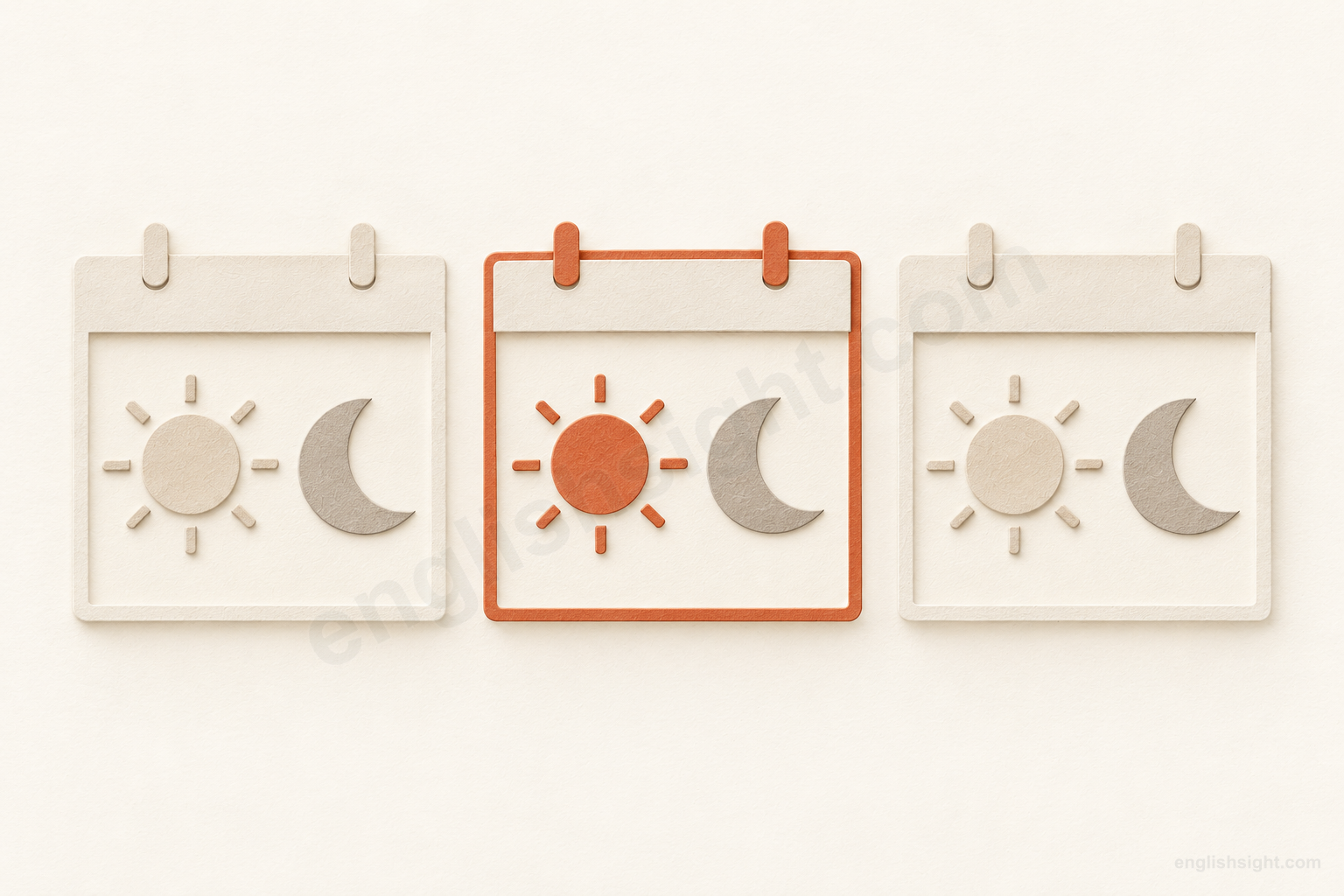
Count days, locate events, describe routines, and recognize expressions that reach beyond the calendar.
One stretch within a repeating rhythm
One stretch within a repeating rhythm
The previous day.
day
The following day.
One whole calendar day contains both daylight and nighttime.
The orange outline selects one whole day, including light and darkness. The sun alone represents daylight.
Day marks a recognizable stretch of recurring time: a whole calendar unit, its light or activity, or, by extension, a period of life.
A calendar day includes nighttime. In its daylight sense, day excludes nighttime. Neither the sketch nor this teaching model predicts the meanings of fixed expressions such as call it a day.
Day /deɪ/ is a noun; its plural is days /deɪz/. Three days counts units, during the day contrasts light with night, and my student days names a stage of life. The surrounding words select the sense.
A useful teaching model is a recurring stretch of time that can hold events and experience. Its limits change with the expression. This connection helps organize uses; it is not an account of a picture shared by every English speaker.
01
What kind of day?
Choose the whole unit, daylight, the hours occupied by activity, or a day identified by an event. These senses overlap in ordinary conversation.
01
a day; number + days; What day is it?
three days
count complete time units
Situation / reference point
A trip begins on Tuesday and ends on Friday.
Meaning in context
Its length is measured in days.
A counted day can include night.
The countable noun gives a standard unit for measuring a stay, delay, or journey. Two days is not restricted to two periods of sunlight: an overnight journey still uses this unit.
Use plural days after numbers greater than one. What day is it? usually asks for the weekday; What’s the date? asks for the calendar date.
Example in context
The repair took three days, including the weekend.
Watch the difference Do not confuse a day with daytime: a hotel booking for two days may include nights.
02
during the day; by day; on a sunny day
during the day / by day
refer to daylight rather than night
Situation / reference point
The market closes when it gets dark.
Meaning in context
Shopping happens in the light part of the cycle.
The same word can name only part of a full day.
During the day locates something in daytime. By day is a compact counterpart of by night; it is especially useful in descriptions of routines or contrasts.
A short winter day has fewer daylight hours, not fewer hours in the calendar unit. Day shift similarly contrasts with night shift. At break of day means at dawn and sounds literary.
Example in context
The square is quiet by night but crowded during the day.
Watch the difference Use on a sunny day for a day described by its weather; do not substitute at day for during the day.
03
a working / school day; take / have a day off; How was your day?
a working day / a day off
refer to time occupied by work or released from it
Situation / reference point
A shift lasts eight hours.
Meaning in context
Those hours form a working day, not a full 24-hour shift.
The relevant activity sets the practical limits.
A working day can mean the hours you work: an eight-hour day. In delivery and office contexts, working days are days on which that organization normally operates. Check its stated calendar rather than assuming every country follows the same schedule.
A day off is a day when you are excused from normal work or duties: I’m taking Friday off. A day at school or a school day similarly organizes time around an activity.
How was your day? asks about your experiences. It’s been a long day often conveys tiredness after much activity; it need not mean the clock ran slowly.
Example in context
After four ten-hour days, I need a day off.
Watch the difference A day off concerns time away from duties; the phrase does not mean an entire 24 hours of sleep.
04
the day (that) + clause; the day of + event; named event + Day
the day we met / New Year’s Day
identify a day by what happens on it
Situation / reference point
Two people remember their first meeting.
Meaning in context
That event identifies the day being discussed.
A date can be selected through an event.
The day we met contains a relative clause identifying which day. The day of the interview uses an of-phrase for the same identifying job.
Opening day names an event’s start. Named holidays and observances may include capitalized Day, as in New Year’s Day; ordinary a rainy day has no such capital. These names need to be learned with their usual spelling.
Example in context
I still have the ticket from the day we met.
Watch the difference The day of the interview means its date; the day before the interview selects an earlier day.
05
a + number-day + noun; last + number + days
a two-day course
use day inside a duration modifier
Situation / reference point
A course lasts two days.
Meaning in context
The duration identifies the kind of course.
The compound uses singular day before a noun.
Compare The course lasts two days with a two-day course. In the compound adjective, number and day form one modifier, normally linked with a hyphen in writing.
The same pattern gives a three-day visit and a five-day week. The number can exceed one while day stays singular inside the modifier.
Example in context
We booked a two-day course in first aid.
Watch the difference Write a two-day course, not a two-days course. Ordinary counting still requires two days.
06
a / one day’s + noun; number + days’ + noun
a day’s work / two days’ notice
measure an amount associated with a day or days
Situation / reference point
A task occupies one working day.
Meaning in context
That amount can be described as a day’s work.
The possessive marks a time-based measure.
One day’s work means the work belonging to or fitting into one day. With a plural, put the apostrophe after s: two days’ work, three days’ notice.
In a few days’ time means after a few days have passed. Compare an ordinary plural with no following noun: We waited two days. The apostrophe does not belong in every plural days.
Example in context
Please give us two days’ notice before collecting the chairs.
Watch the difference Two days’ notice measures notice; a two-day visit uses a compound modifier and no apostrophe.
02
Dates, duration, and reference points
Prepositions and determiners tell us whether a day locates an event, measures its duration, or relates it to another event.
07
on + identified day; that day as a time phrase
on that day
locate an event on an identified day
Situation / reference point
An event belongs to a particular calendar day.
Meaning in context
The sentence places it there.
On selects a day; a following noun phrase identifies it.
Use on with an identified day: on that day, on the day of the exam, on a cold winter’s day. During the day instead locates something within daytime.
We met that day is also natural, without on. Expressions such as every day and the next day normally work as time phrases without adding on.
Example in context
The library opened on the day of the town festival.
Watch the difference Do not generalize on to every time phrase: I read every day, not I read on every day in the ordinary routine meaning.
08
for / in / within + number + days; number + days ago / later
for two days / in two days / within two days
distinguish duration, delay, and a time limit
Situation / reference point
A visitor needs to understand how long or when.
Meaning in context
The preposition gives a different time relationship.
Days supplies the units; the preposition supplies the relationship.
For two days answers How long?: We stayed for two days. In two days can mean after a two-day wait: We leave in two days. With a completed task, it can instead measure time needed: She painted the room in two days.
Within two days sets an upper limit, allowing completion sooner. Two days ago counts backward from now; two days later counts forward from a reference event in the story. These are time constructions, not new meanings of the noun.
Example in context
The reply arrived within two days, so we did not have to wait all week.
Watch the difference I’ll stay for two days gives a duration; I’ll arrive in two days gives a future arrival time.
09
the next / following / previous day; the day before; another day
the next day / another day
use a reference point or postpone to a different day
Situation / reference point
A story begins with an arrival on Monday.
Meaning in context
The next day in that story is Tuesday.
Next is relative to a reference day.
The next day and the following day usually follow a day already mentioned. The day before points backward from a reference. The day before yesterday and the day after tomorrow instead anchor the count to today.
Another day means a different or additional day: We can discuss it another day postpones the discussion. It does not promise tomorrow. A day or two gives a small approximate number of days.
Example in context
We arrived on Monday and visited the museum the next day.
Watch the difference The next day in a past story need not mean tomorrow from the speaker’s present viewpoint.
10
one day + past / future clause; some day; one of these days
one day / some day
leave a past or future day unspecified
Situation / reference point
A person imagines a future move.
Meaning in context
The plan has no fixed date yet.
Tense and context distinguish a past episode from a future possibility.
One day I’ll live near the sea refers to an unspecified future time. One day a stranger knocked on the door introduces an unspecified day in a past narrative. Neither sentence means every day.
Some day also refers to an unknown future time; someday is an alternative spelling for this future adverb. One of these days often suggests a future event before too long, sometimes as a warning: One of these days you’ll lose those keys.
Example in context
One day I’ll return to the village where I grew up.
Watch the difference One day in a past story is not a future promise. Read the verb tense as well as the phrase.
11
the other day as a past-time phrase
the other day
refer casually to the recent past
Situation / reference point
You remember a conversation from a few days ago.
Meaning in context
You mention it without giving an exact date.
This fixed time phrase looks backward.
The other day means a few days ago. It is a convenient conversational reference when the exact date does not matter.
Compare another day, which can offer a different future date: Let’s meet another day. The small change in determiner creates a different expression.
Example in context
I found your scarf in the car the other day.
Watch the difference Use the other day for a recent past event, not as a way to say tomorrow.
12
any day now; any day; would choose A over B any day
any day now / any day
express nearness, free choice, or a strong preference
Situation / reference point
A parcel is expected but has no confirmed arrival date.
Meaning in context
The speaker expects it very soon.
Now makes the imminent-arrival reading explicit; context can supply it without now.
Any day now means very soon: The parcel should arrive any day now. Any day can also express this expectation without now: The parcel should arrive any day. In You can come any day, however, it offers a choice among days; it does not predict a visit soon. The verb and situation determine the reading.
In informal comparisons, I’d choose the train over the bus any day means I strongly prefer the train. Give me a quiet evening at home any day is another preference pattern. This force belongs to the whole expression.
Example in context
The new chairs should arrive any day now.
Watch the difference Any day now is an expectation, not a guaranteed deadline.
13
a / number + year(s) to the day since / after
a year to the day
state an exact calendar anniversary
Situation / reference point
An event occurred exactly one year earlier.
Meaning in context
The date matches rather than merely being close.
To the day emphasizes precision.
A year to the day since an event means exactly a year since it happened. The phrase can modify other counted intervals too, such as two years to the day.
The expression checks a precise calendar match; it does not describe a whole day’s activity. Almost a year to the day softens that precision explicitly.
Example in context
We reopened the café a year to the day after the flood.
Watch the difference To the day is exactness; to this day means continuing until now.
03
Routines and changes across days
Distinguish daily frequency, a whole day’s duration, repeated experience, gradual development, and variation.
14
every / each day; every other day; everyday + noun; it’s not every day (that) + clause
every day / every other day
state a routine or an alternating schedule
Situation / reference point
A person follows a regular timetable.
Meaning in context
The phrase tells how often the activity recurs.
Each selected day is one unit in a schedule.
Every day means on each day; each day can emphasize the individual occasions. Every other day means on alternate days, with a day between visits.
Every day is a two-word time phrase: I use it every day. Everyday is an adjective meaning ordinary or usual, as in everyday clothes. It cannot simply replace the time phrase.
It’s not every day (that) highlights an unusual or special opportunity: It’s not every day you get to meet your favourite author. This is stronger than merely saying that a routine skips some dates. Compare I don’t swim every day, which can simply describe frequency.
Example in context
The cleaner comes every other day, not daily.
Watch the difference I practise every day uses two words. My everyday routine uses the adjective everyday.
15
once / twice / number + times a day; amount a / per day
twice a day / per day
give a frequency or rate for each day
Situation / reference point
An instruction gives two practice sessions for each day.
Meaning in context
The sentence expresses a daily rate.
A means per in this rate construction.
Twice a day means two times each day. Ten pages a day gives an amount for each day. Per day is common in prices, formal information, and measurements; a day is natural in ordinary speech.
A daily rate is different from the total for the entire stay. Read whether a price says per day or for three days before comparing totals.
Example in context
The bike costs twelve euros per day to rent.
Watch the difference A rate per day does not tell you the total without the number of days.
16
all day (long); an all-day + noun; not have all day
all day (long)
describe duration across a relevant day
Situation / reference point
You worked from morning until evening.
Meaning in context
The activity filled the practical day.
Duration within a day differs from frequency across days.
All day extends over the day under discussion. All day long emphasizes the duration. In conversation, this often means the relevant waking or working period, rather than a literal 24 hours.
An all-day meeting lasts through the working day. I don’t have all day is an impatient way to say that time is limited. It is not a claim about the length of the calendar.
Example in context
We waited all day, but the technician never came.
Watch the difference All day answers How long? Every day answers How often?
17
day after day; day in, day out; day in and day out
day after day / day in, day out
emphasize repeated experience over successive days
Situation / reference point
The same noise interrupts work on successive mornings.
Meaning in context
The repetition feels persistent.
The focus is recurrence, often with a sense of monotony.
Day after day highlights something happening on successive days. It often carries frustration or tiredness, though a positive context is possible.
Day in, day out, also day in and day out, stresses a long-running routine. Neither expression by itself says that an activity continues through every night. Compare day and night for continuous coverage.
Example in context
Day after day, the builders started drilling before breakfast.
Watch the difference Do not read day in, day out as literal movement into and out of a day.
18
change + day by day; comparative + by the day; day-by-day + noun
day by day / by the day
track development as days pass
Situation / reference point
A seedling becomes a little taller on successive days.
Meaning in context
Its development is described gradually.
The repeated units let us compare stages.
Day by day commonly accompanies gradual change: confidence grew day by day. It does not itself mean improvement; a condition can worsen day by day too.
By the day often intensifies a changing comparison: The queue is getting longer by the day. A day-by-day account presents each day separately and need not describe a gradual change.
Example in context
Day by day, the rescued dog became less afraid of us.
Watch the difference Gradual development comes from the whole clause; day by day does not guarantee a positive result.
19
change / vary from day to day; from one day to the next; day-to-day + noun
vary from day to day
describe differences between successive days
Situation / reference point
Demand is high on Monday and low on Tuesday.
Meaning in context
The amount does not stay constant.
A comparison between days need not have one direction.
Change or vary from day to day compares one day with another. Unlike gradual improvement day by day, the variation can go up, down, and back again.
From one day to the next can likewise emphasize uncertainty. Day-to-day costs or day-to-day management uses a hyphenated modifier for ordinary daily needs or operations.
Example in context
The number of visitors varies from day to day.
Watch the difference Do not assume from day to day means a steady increase.
20
live from day to day
live from day to day
manage immediate needs without looking far ahead
Situation / reference point
A household cannot make reliable plans for next month.
Meaning in context
It concentrates on the next day’s needs.
Here the time frame limits planning.
Live from day to day can describe dealing only with immediate needs, often because the future is insecure. Context may also present it as a chosen way to focus on the present.
The same surface phrase in Prices change from day to day describes variation, not a person’s approach to life. The verb and subject help choose the interpretation.
Example in context
With no steady income, they were living from day to day.
Watch the difference The phrase does not tell us whether this situation is voluntary; context does.
21
work / run / continue + day and night; be like / as different as night and day
day and night / night and day
describe continuous activity across both periods
Situation / reference point
A pump must keep running after sunset.
Meaning in context
The service continues through daylight and darkness.
The two parts together cover the whole cycle.
Day and night, or night and day, can mean continuously. In a statement about a machine, this may be literal; I worried day and night can be emphatic rather than a precise log of every moment.
Contrast every day, which only says that something recurs on each day. A shop that opens every day may still close each night.
In a different construction, like night and day means completely different: The two offices are like night and day: one is silent, and the other is always noisy. As different as night and day makes the contrast explicit. This compares opposites rather than describing continuous activity.
Example in context
The pumps ran day and night until the basement was dry.
Watch the difference Day and night with run or work can describe continuity; like night and day compares completely different people or things. Every day alone does not promise 24-hour service.
04
Present times, earlier lives, and stages
Day can expand beyond one calendar unit. These uses organize periods by the people, activities, or situations that characterize them.
22
these days; in this day and age; the present day; present-day + noun
these days / in this day and age
refer to the present period
Situation / reference point
You compare current habits with earlier habits.
Meaning in context
Day expands to modern or present times.
The plural does not mean only the last few calendar days.
These days means nowadays, often with an implied contrast to the past: I cycle to work these days. It need not refer to a precisely bounded week.
In this day and age emphasizes the modern world and can convey surprise that something still happens. The present day is a noun phrase; present-day technology uses a hyphenated modifier.
Example in context
These days, most of our bookings arrive online.
Watch the difference These days describes a present period; the other day refers to a recent past occasion.
23
in those days; in someone’s day; back in the day; of the day
in those days / in my day
describe an earlier era or someone’s earlier life
Situation / reference point
A speaker recalls conditions during childhood.
Meaning in context
The phrase establishes an earlier period, not one date.
The person or situation supplies the period’s boundaries.
In those days points to a past period already established. In my day often means when I was young or active; in her day can refer to her successful period. Back in the day is an informal, usually nostalgic reference to the past.
The good old days and Those were the days! present the past as happier. They express a viewpoint, not proof that every aspect of that period was better. The issues of the day are issues belonging to the period being discussed, whether present or past.
Example in context
In my grandfather’s day, the village had no paved road.
Watch the difference In my day is not normally a claim about today’s date.
24
possessive + student / younger / playing days; the rest of someone’s days
student days / the rest of her days
name a life stage or remaining lifetime
Situation / reference point
A person remembers the years spent studying.
Meaning in context
Days names a phase defined by that activity.
Plural days can reach over years.
My student days means the period when I was a student. Her playing days were over means that stage of her career ended, not merely that one game finished.
The rest of her days can mean the rest of her life. End one’s days in a place or condition describes the last stage of life and is more literary than an ordinary holiday plan.
Example in context
We became friends in our student days and still meet every summer.
Watch the difference Student days is a life-stage expression, not necessarily a count of class days.
25
from day one; on day one
from day one
emphasize the beginning of a process
Situation / reference point
A rule applies as soon as a project starts.
Meaning in context
Its effect has been present from the start.
Day one acts as the starting stage.
From day one is an informal way to say from the very beginning. It can be literal on a course schedule, but in conversation it often emphasizes the start without counting exact days.
Compare on day one, which locates an event on the first day, and from day one, which looks forward from that beginning.
Example in context
The whole team supported the idea from day one.
Watch the difference From gives a starting point; on locates an event on the first day.
26
it’s (still) early days (yet); the early days of; late in the day
it’s early days (yet)
say that a result is too soon to judge
Situation / reference point
A new service has operated for only a short time.
Meaning in context
The speaker avoids a final verdict.
Early refers to a stage of development.
It’s early days, or It’s early days yet, is especially British usage for saying that it is too soon to know how a situation will develop. It is about limited evidence or unfinished development.
In the early days of the company is a descriptive noun phrase for its initial period. Late in the day can mean too late in a process to act effectively, even if the clock says morning.
Example in context
The new café looks promising, but it’s early days yet.
Watch the difference It’s early days does not simply mean that today began early.
27
to this day + continuing state / practice
to this day
stress that something continues until now
Situation / reference point
An experience happened many years ago.
Meaning in context
Its effect remains in the present.
The phrase links a distant past to now.
To this day means still now, often after a surprisingly long time. It works with a continuing state, memory, custom, or unanswered question.
The phrase does not mean exactly one day or on this particular date. Compare a year to the day for an exact anniversary.
Example in context
To this day, she keeps the first letter her sister sent her.
Watch the difference To this day is continuity; to the day is precision.
28
someone / something has had their / its day
have had its day
say that a period of usefulness or success is over
Situation / reference point
A once-popular format is no longer widely used.
Meaning in context
Its successful period is presented as finished.
The day here is a period of prominence.
This format has had its day judges that its main period of popularity, influence, or usefulness has passed. A person can also be said to have had their day, often rather dismissively.
The perfect have had matters: The format had a good day describes a particular successful day; it does not carry the same verdict about its future.
Example in context
Some people think printed catalogues have had their day.
Watch the difference This can sound dismissive; it is a judgment about relevance, not simply an item’s age.
29
someone / something has seen better days
have seen better days
describe something worn or in poor condition
Situation / reference point
An old armchair has torn fabric and sagging cushions.
Meaning in context
The speaker implies that it used to be in better condition.
Past days provide an implied comparison.
This chair has seen better days is an often gently humorous way to call it old or worn. A person or organization may also be described this way when their situation has declined.
Unlike has had its day, this phrase focuses on present condition or fortunes, not necessarily on whether something is permanently obsolete.
Example in context
The hotel lobby has seen better days, though the rooms are clean.
Watch the difference Seen is figurative here: furniture does not need to see anything.
05
Whole expressions to learn in context
In these expressions, happiness, rescue, stopping, judgment, or uncertainty comes from the established phrase. The calendar model alone is not enough.
30
something / someone + make + possessive + day
make someone’s day
give someone a particularly happy experience
Situation / reference point
A small kindness changes someone’s mood.
Meaning in context
The recipient feels delighted.
The whole phrase evaluates the experience emotionally.
You made my day is an informal, warm response to news, a gift, or kindness that makes you very happy. My identifies the person whose experience improves.
It does not mean creating 24 hours or arranging someone’s schedule. Your message made my day is natural even when the pleasant event takes only seconds.
Example in context
Your handwritten note really made my day.
Watch the difference Use the possessive: made her day, not made she day.
31
save the day; win / carry the day
save the day / win the day
rescue a situation or achieve success
Situation / reference point
An event seems likely to fail.
Meaning in context
An intervention prevents that failure.
Day stands for the situation or contest.
Save the day means prevent a likely failure: a spare cable can save the day at a presentation. No physical day has to be rescued.
Win the day or carry the day means succeed against opposition or prevail in an argument, rather than necessarily rescuing a failing plan. These forms sound more formal than save the day. Learn the verbs with their different outcomes.
Example in context
The projector failed, but a borrowed screen and laptop saved the day.
Watch the difference Saving the day averts trouble; winning the day emphasizes prevailing over opposition.
32
call it a day; let’s call it a day
call it a day
decide to stop an activity
Situation / reference point
A group has worked long enough for now.
Meaning in context
It agrees to stop.
The expression closes a period of effort.
Let’s call it a day usually proposes stopping the current work or session. It can be said at lunchtime; the calendar day does not need to end.
In a career or business context, call it a day can mean retire or stop permanently. Context tells us whether the stopping is for now or for good.
Example in context
We have finished the shelves, so let’s call it a day.
Watch the difference Keep the fixed it: call it a day. This is not a command to name a date.
33
at the end of the day + clause; at the end of the day as a time phrase
at the end of the day
give a final practical judgment, or locate a literal ending
Situation / reference point
People debate several options.
Meaning in context
A speaker identifies the decisive consideration.
The figurative ending is the end of consideration.
At the end of the day, we need a safe building means that safety is the decisive consideration after weighing everything. It is an informal, often spoken way to sum up a judgment.
We lock the office at the end of the day is literal scheduling. The same words can therefore give either a time or a conclusion; read what follows.
Example in context
The cheaper option is attractive, but at the end of the day, reliability matters more.
Watch the difference The figurative phrase does not postpone a decision until evening.
34
it’s been one of those days; it’s not someone’s day; an off day
one of those days / not my day
react to a run of annoying mishaps
Situation / reference point
Someone misses a bus and then loses a key.
Meaning in context
They describe the day as unusually unlucky.
Shared experience makes those understandable without a named date.
It’s been one of those days informally suggests that several things have gone wrong. It’s not my day or It’s just not your day conveys a similar run of bad luck.
One of these days instead points to a future occasion. Those and these belong to different established expressions here, not interchangeable translations of one idea. An off day is a day of poorer performance than usual; a day off is time away from duties.
Example in context
I missed the bus and spilled my coffee; it’s been one of those days.
Watch the difference An off day concerns performance; a day off concerns freedom from normal duties.
35
take it / things one day at a time
take it one day at a time
focus on manageable immediate steps
Situation / reference point
A long uncertain process feels overwhelming.
Meaning in context
The person handles the present instead of demanding a full forecast.
One unit limits the planning horizon.
Take it one day at a time is an informal way to face uncertainty by concentrating on the immediate stage. It can be advice or a description of how someone is coping.
It does not forbid all planning or promise that everything will be resolved tomorrow. The aim is to make an uncertain process manageable.
The saying Rome wasn’t built in a day similarly encourages patience with a large task: Keep practising—Rome wasn’t built in a day. It says that worthwhile results take time, rather than giving a one-day deadline.
Example in context
We don’t know when the repairs will end, so we’re taking it one day at a time.
Watch the difference It refers to an approach to uncertainty, not a schedule requiring exactly one task per day.
36
save / keep something for a rainy day; a rainy-day fund
save for a rainy day
keep resources for a possible future need
Situation / reference point
A household sets aside money now.
Meaning in context
It has a reserve for future difficulty.
The imagined rainy day stands for a time of need.
Save money for a rainy day means keep it for a future time when it may be needed. The weather need not actually be rainy.
A rainy-day fund is such a reserve. Contrast a literal plan to visit a museum on a rainy day, where the weather really selects the occasion.
Example in context
We keep a little money aside for a rainy day.
Watch the difference For a rainy day does not by itself mean saving for a holiday in wet weather.
37
something is all in a day’s work (for someone)
all in a day’s work
treat a task as a normal part of the job
Situation / reference point
A visitor is surprised by a difficult repair.
Meaning in context
The worker presents it as routine.
The whole expression normalizes the task.
It’s all in a day’s work says that an effort, difficulty, or unusual experience is normal for the person’s job. It can be a modest response to thanks.
The phrase does not claim that every worker does the task or that it took a full day. The person’s occupation supplies the standard of what is normal.
Example in context
Finding the hidden leak was all in a day’s work for the plumber.
Watch the difference Do not interpret it as a literal duration of one working day.
38
have a day out; go on a day trip; make a day of it
a day out / make a day of it
organize an enjoyable outing around a day
Situation / reference point
A short visit can be combined with lunch and a walk.
Meaning in context
People turn it into a full day’s leisure.
The day holds the planned experience.
A day out, especially in British English, is a day spent away from home for enjoyment. A day trip is a journey to a place and back on the same day, without an overnight stay.
Make a day of it means extend an enjoyable activity to occupy a whole day: see the exhibition, have lunch, and explore the town. It is different from make my day, which expresses delight.
Example in context
Let’s take a picnic to the lake and make a day of it.
Watch the difference A day trip returns the same day; a day off only says you are free from normal duties.
39
(as) clear / plain as day; see the light of day; in the cold light of day
clear as day / see the light of day
use daylight for obviousness or public appearance
Situation / reference point
A fact is easy to recognize, or a hidden project finally appears.
Meaning in context
The full expression selects clarity or emergence.
The daylight association supports two different expressions.
As clear as day, or as plain as day, means very obvious: The mistake is as clear as day. The simile uses daylight as an image of visibility.
An unpublished story that finally sees the light of day becomes available or known. This is an established emergence expression, not a statement about reading outside. In the cold light of day suggests a calmer, clearer reassessment after excitement or emotion.
Example in context
After years in a drawer, her story finally saw the light of day.
Watch the difference Clear as day evaluates obviousness; see the light of day describes emergence. They are not synonyms.
40
pass the time of day with someone; not give someone the time of day
pass the time of day / not give someone the time of day
describe brief friendly contact or pointed disregard
Situation / reference point
Two neighbors exchange a few friendly words.
Meaning in context
They maintain casual social contact.
The full expression concerns interaction, not clock reading.
Pass the time of day with someone means exchange a greeting and brief conversation. It is more than simply asking what time it is.
Not give someone the time of day means refuse to acknowledge or speak to them, often from dislike or disrespect. Contrast the literal question What time of day does the train leave?, which asks when within the day.
Example in context
We often pass the time of day while waiting for the lift.
Watch the difference Pass the time of day is a complete social expression, not a way to say that you spend an entire day together.
41
someone’s / something’s days are numbered; days as + role
someone’s days are numbered
predict that an existence or role will soon end
Situation / reference point
An outdated service is scheduled to close.
Meaning in context
It is presented as having little time left.
A limited remaining count stands for an approaching end.
The service’s days are numbered means that it will not continue for much longer. A person’s days as chair can be numbered without implying death; the role is ending.
Without a role or context, saying a person’s days are numbered can suggest death and sound ominous. Choose the subject carefully.
Example in context
With the new bridge almost ready, the old ferry’s days are numbered.
Watch the difference The phrase predicts a near end; it need not give an exact date or literal number.
42
That’ll be the day!
that’ll be the day
reply with ironic disbelief
Situation / reference point
Someone promises an event you think extremely unlikely.
Meaning in context
You reject the expectation sarcastically.
The imagined future day is treated as unlikely ever to arrive.
That’ll be the day is an informal, ironic response meaning that you do not expect the event to happen. Tone matters: it can be playful between friends or dismissive in an argument.
Compare One day he’ll apologize, which can express genuine hope. The short reply That’ll be the day! questions that hope instead of choosing a calendar date.
Example in context
“He says he’ll wash all the dishes.” “That’ll be the day!”
Watch the difference This is sarcasm, not enthusiastic agreement. It may sound rude in a serious discussion.
Keep the unit, grammar, and expression apart
A noun with several ranges
Day is not an ordinary modern verb in this lesson. Passive, causative, and phrasal-verb inventories therefore do not apply. In day shift and day trip, a noun modifies another noun; a label such as modifier does not create a new action meaning.
Calendar time and lived time
In ordinary scheduling, a day is a 24-hour unit and a calendar date runs from midnight to midnight. All day in conversation can cover the relevant waking or working hours. This lesson does not teach astronomical day measurements or clock-change exceptions.
Articles, plurals, and apostrophes
Countable day needs the appropriate determiner in the singular: a day, that day, the day we met. Learn by day and day after day as complete patterns. Compare two days, a two-day course, one day’s work, and two days’ work; their grammar differs even when all involve time.
Do not read an idiom word by word
A daylight sketch cannot tell you that make my day concerns happiness or that call it a day means stop. Those are conventional expressions. Register and context matter: a sarcastic reply can sound unfriendly even when its grammar is correct.
A routine farewell
Have a nice day! and Have a good day! wish someone a pleasant day, often at the end of a brief interaction. They do not ask how the day has been; How was your day? does that. Soup of the day means the soup offered for that particular day; it need not name a permanent item on the menu.
Choose the day that fits
Use the situation and the whole construction to choose an answer.
1. A shop opens every afternoon and closes every evening. Which description avoids promising overnight service?
2. You will remain in town for a two-day visit. Which sentence gives the duration?
3. You mention a conversation that happened a few days ago. Which expression fits?
4. Which phrase uses the usual duration modifier before course?
5. Demand rises on some days and falls on others. Which wording describes this without suggesting steady progress?
6. An event happened exactly one year ago today. Which phrase emphasizes that match?
7. It is only noon, but the team has done enough work and wants to stop. Which expression fits?
8. You are excused from work on Friday. Which phrase names that break from duties?
Sources and teaching notes
Definitions and usage were checked against the sources below. Explanations, example sentences, and the diagram were written for this lesson; the visual connection is a teaching interpretation.
The sketch organizes a time relationship; it is not a shared mental picture of every speaker.