Use death for the end of life, a particular loss, and established expressions about endings or extremes.
Life and its permanent end
Alive → life permanently ended
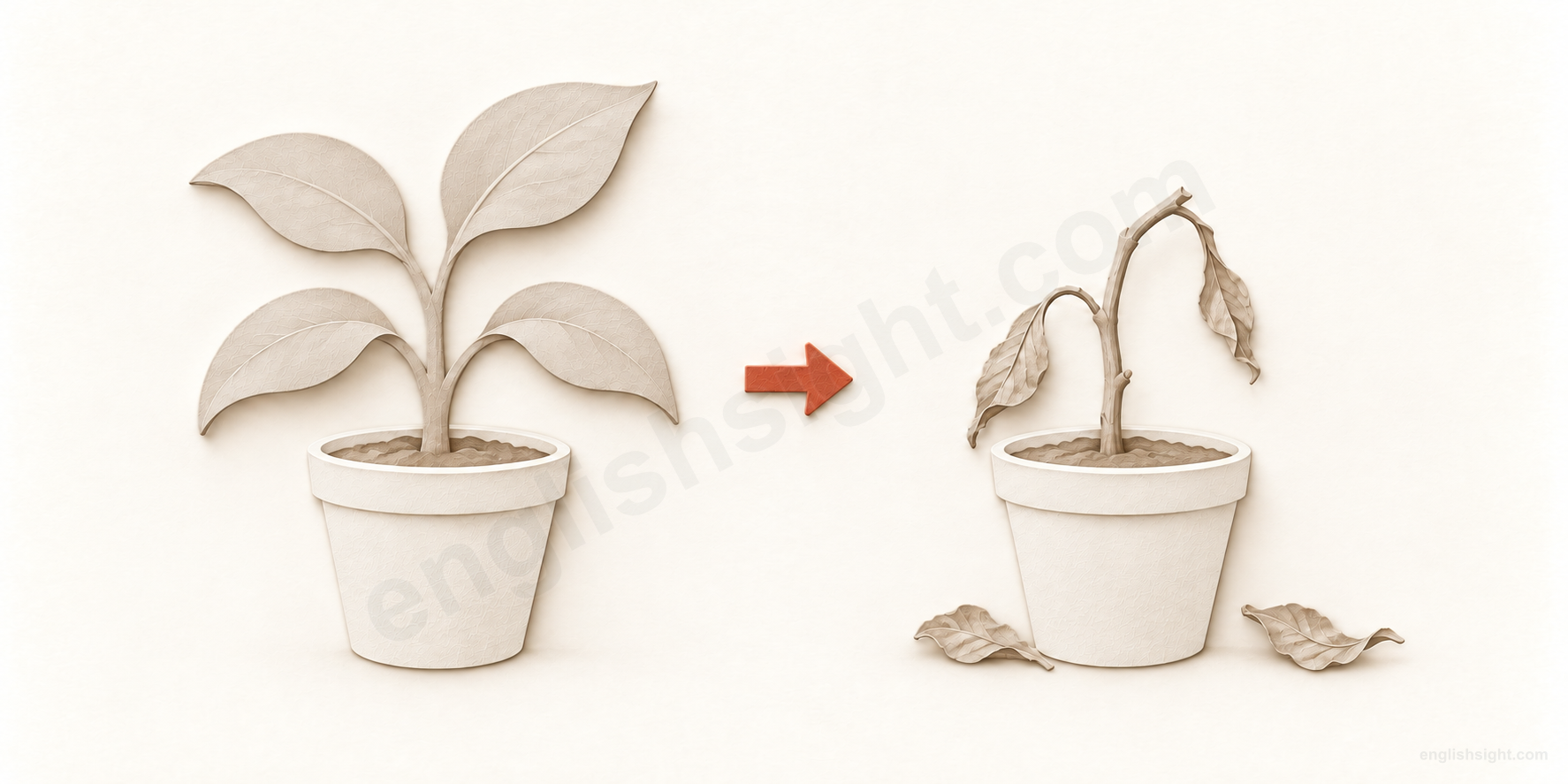
The plant is alive, with an upright stem and four full leaves.
death
The plant is dead; two dry leaves remain attached and two have fallen beside the pot.
The same plant's life ends permanently.
The same plant: alive, then dead.
Death is the permanent end of a living thing’s life. English also extends that ending to activities and ideas, or uses death in emphatic fixed expressions.
The literal meaning concerns life ending, not merely stillness, sleep, or temporary weakness. Idioms can describe risk, feelings, or failure without reporting a death.
Death names the end of life or the state that follows. It can also name an individual event: a death, her death, or several deaths. Start with that noun meaning, then read the words around it.
An idea can have a figurative death, and a person can be bored to death without dying. These extensions are useful, but their tone and meaning come from familiar whole expressions. The diagram is a teaching aid, not a claim about a picture shared by all English speakers.
01
Life, a death, and its circumstances
Choose a noun form for the end of life, an individual event, its cause, or its timing. Death names the event or condition; it is not the verb die.
01
death as an uncountable noun
death
the permanent end of life, or the state of being dead
Situation
A living thing is alive.
Meaning in context
Its life has ended permanently.
Death is a noun; die describes the event and dead describes the resulting state.
Use death without a or a plural when discussing the general fact or state: fear of death, near death, or life after death. A person, an animal, or a plant can die; the noun is not limited to people.
Compare The plant died, The plant is dead, and The death of the plant surprised me. The first is a verb statement, the second describes a state, and the third makes the event a noun phrase.
The plant contrast in the diagram is a teaching model of a permanent end. A drooping plant might still be alive, so the sketch is not a way to diagnose death. Life after death names a belief or possibility, not a biological conclusion supplied by this lesson.
In a sentence
The book explores our fear of death.
Watch the difference Say The plant died or The plant is dead, not The plant is death.
02
a death; number + deaths; possessive + death; the death of + person
a death / deaths / the death of…
an individual occurrence of someone dying
Situation
You hear that someone in a family has died.
Meaning in context
You refer to that event as a death.
Countable death lets us identify or count individual events.
A death in the family means that a family member has died. Deaths is the plural when a report counts people who have died; no deaths means nobody died in the situation being described.
Use her death or the death of her sister to identify whose life ended. Her death already has a possessive determiner: do not add the before her. After the news, I’m sorry to hear about your sister’s death is a direct expression of sympathy.
In a sentence
There were no deaths in the fire.
Watch the difference Death is sometimes countable and sometimes uncountable; choose according to whether you mean particular events or the general concept.
03
a/an + adjective + death; die a/an + adjective + death
a natural / sudden / premature death
a death described by its manner or timing
Situation
You know that a person died.
Meaning in context
You specify what kind of death it was.
The adjective describes the event; it does not change death into a verb.
A natural death contrasts with death caused by violence or an accident. Sudden describes how unexpectedly or quickly death occurs; premature and untimely describe death as earlier than expected or appropriate.
Die a peaceful death uses a noun phrase after die to describe the manner of dying. This is an established pattern, not a claim that die normally takes a person as its object. A person can also suffer a painful death; the adjective provides the particular description.
In a sentence
She hoped that her old dog would die a peaceful death.
Watch the difference Sudden death in an ordinary report can be literal; sudden death in a game has a separate sporting meaning.
04
cause of death; death from + cause; death by + means / process
cause of death / death from / death by
identify what brought about a death
Situation
An investigation asks why someone died.
Meaning in context
A cause or means is identified.
Of identifies the event in cause of death; from and by introduce a cause or means.
Cause of death is a noun phrase naming the reason a person died. Death from pneumonia names an illness as the cause; death by drowning names a means or process. These are common tendencies, not an absolute rule that every cause accepts only one preposition.
Contrast the death of a swimmer with death from exposure: of names who died in the first phrase, while from names why. A particular sentence may combine both: the death of the climber from exposure.
In a sentence
The report listed drowning as the cause of death.
Watch the difference Do not confuse the death of someone with death from something.
05
before / after + possessive + death; on + possessive + death; in death
after her death / on his death / in death
place events before, at, or after a death
Situation
A person dies, leaving work and relationships behind.
Meaning in context
You describe a time or the state that follows.
The preposition supplies the time relation.
Before and after locate another event relative to a death: after her death means later than when she died. At the time of his death focuses on that moment. More formal on his death means when he died, often in accounts of inheritance.
In death means in the state of being dead, as in describing how someone is remembered. It is more solemn or literary than ordinary after she died. It does not normally mean a place where death is located.
In a sentence
Her letters were published after her death.
Watch the difference After her death does not tell us how long after; it is not the same as because of her death.
02
Results, reports, and serious decisions
These patterns describe fatal results, public records, danger, and punishment. Read the whole construction to see what has happened and what has only been threatened or ordered.
06
verb + to death; verb + person + to death
freeze / starve / bleed to death
an action or process ends in actual death
Situation
A harmful process continues.
Meaning in context
It causes someone to die.
To death supplies the fatal result, rather than a physical destination.
In freeze to death and starve to death, the subject undergoes the process and dies. In beat someone to death, someone causes another person’s death; the person affected is the object. The noun death stays unchanged while the main verb changes tense.
Almost froze to death says death was narrowly avoided, not that the person died. Compare frightened to death in everyday conversation, which is usually exaggeration. The words to death alone do not settle whether a statement is literal.
In a sentence
The lost hikers nearly froze to death before help arrived.
Watch the difference Do not use to the death in freeze to death; the fixed result phrase has no the.
07
sentence + person + to death; put + person + to death; the death penalty
sentence someone to death / put someone to death
order execution or carry it out as punishment
Situation
A court imposes a punishment.
Meaning in context
A death sentence may later be carried out.
A sentence is an order; putting someone to death is the killing itself.
A court sentences a person to death when it orders execution. The passive is common in reports: was sentenced to death. This does not say that execution has already happened. Put someone to death means execute them as a punishment, not merely move them somewhere.
The death penalty names execution as a form of punishment; a death sentence is an individual sentence imposing it. On death row describes prisoners awaiting execution. These are vocabulary distinctions, not statements about the current law of any country.
In a sentence
The history book says the prisoner was sentenced to death but later pardoned.
Watch the difference Was sentenced to death and was put to death report different stages.
08
the death toll; a high / low death rate
death toll / death rate
report totals or the frequency of deaths
Situation
A report collects information about deaths.
Meaning in context
It presents a total or a rate.
Toll and rate contribute different ways of measuring.
A death toll is the number killed in an accident, disaster, war, or similar event. A death rate measures deaths over a period, often relative to a population; some reports use it for deaths in a particular group or from a disease.
A rising death toll means the reported total is increasing. A lower death rate is a statement about the specified measure, not automatically a smaller total in every setting. Check the population, period, and units used in a report.
In a sentence
The report compares death rates in two age groups.
Watch the difference Death toll is a total; do not automatically treat it as a population rate.
09
a death certificate / notice; plural death certificates / notices
death certificate / death notice
an official record or an announcement of a death
Situation
A death needs to be recorded or announced.
Meaning in context
A document or notice provides information about it.
The following noun tells us the kind of record.
A death certificate is an official document recording a person’s death, with information such as its time and cause. A death notice is an announcement, for example in a newspaper. A notice and a certificate have different purposes.
Here death modifies certificate or notice. The head noun takes the plural: two death certificates, not two deaths certificate. This noun-modifier pattern also appears in death threats and death rates.
In a sentence
The office asked for a copy of the death certificate.
Watch the difference A newspaper death notice is not the same document as a death certificate.
10
make / receive + a death threat; plural death threats
a death threat
a threat to kill someone
Situation
Someone sends a threatening message.
Meaning in context
The recipient is threatened with being killed.
A threat names a stated intention, not an event that has already happened.
Receive a death threat means be told or warned that someone intends to kill you. Death specifies the harm threatened; threat is the head noun. A report about death threats does not itself report any deaths.
Compare a threat of death with a risk of death: a threat may come from a person’s words, while a risk can arise from dangerous conditions without anyone making a threat.
In a sentence
The journalist reported the death threats to the police.
Watch the difference Do not infer that a person has died merely because a death threat is mentioned.
03
Endings and extreme feelings
Death can describe the end of something that is not alive. Established expressions also exaggerate boredom, fear, exhaustion, or frustration; their meanings belong to the whole phrase.
11
the death of + non-living thing; die a/the death (British informal)
the death of an idea / tradition
the end or destruction of something that is not alive
Situation
An idea, activity, or tradition continues to exist.
Meaning in context
It comes to an end or is presented as doing so.
The literal permanent ending is extended to something without biological life.
The death of a tradition treats that tradition as if it had a life that can end. The phrase is stronger and more dramatic than a temporary decline. Death of does not by itself tell us what caused the ending.
British informal die a death can mean fail completely: Our proposal died a death at the meeting. In this use nobody dies; the proposal fails. Treat this as an established expression rather than assuming every occurrence of die a death is figurative.
In a sentence
The closure marked the death of a local tradition.
Watch the difference A short pause or a small loss of popularity is not automatically the death of something.
12
be bored / scared / worried to death; scare / worry + person + to death
bored / scared / worried to death
feel something extremely strongly
Situation
A long, dull journey or a sudden noise affects you.
Meaning in context
You describe extreme boredom, fear, or worry.
In these informal expressions death is usually exaggeration, not the outcome.
Bored to death usually means extremely bored; scared to death means extremely frightened. A speaker saying The noise scared me to death is normally alive and emphasizing the fright. Context determines whether any real danger is involved.
The construction also appears in worry someone to death and worry oneself to death. A reflexive object such as myself shows that the worried person and the subject are the same. Learn familiar combinations; to death is not a neutral replacement for very before every adjective.
In a sentence
That sudden bang scared me to death.
Watch the difference Scared to death usually intensifies fear; starved to death normally reports actual death.
13
be sick to death of + noun / -ing
sick to death of…
completely fed up with something
Situation
The same unwelcome problem keeps happening.
Meaning in context
You strongly express that you have had enough.
Of introduces what annoys you; to death intensifies sick of.
I’m sick to death of these delays expresses strong irritation, not a diagnosis of illness. After of use a noun, pronoun, or -ing form: sick to death of waiting.
Compare sick with the flu, which concerns illness, and sick of the noise, which concerns being fed up. The whole sick of construction supplies the attitude; death adds emphasis.
In a sentence
I’m sick to death of resetting this password.
Watch the difference Keep of before the thing or activity: sick to death of waiting, not sick to death to wait.
14
work + person / reflexive pronoun + to death
work someone / yourself to death
make someone work excessively hard
Situation
A deadline leads to an exhausting workload.
Meaning in context
Someone complains about extreme effort or unfair pressure.
The object tells us who bears the workload.
They work us to death is often an emphatic complaint about being made to work far too hard. I’m working myself to death puts the same person in the subject and object roles. In everyday complaints, neither sentence necessarily reports an actual death.
In accounts of fatal exploitation or overwork, the wording can be literal. Compare I worked late, which gives a time fact without the extreme evaluation conveyed by to death.
In a sentence
You’re working yourself to death; take a break.
Watch the difference The phrase often exaggerates, but a serious context may describe a fatal outcome.
15
do + something + to death; be done to death; flog + something + to death
do something to death
repeat something until it loses interest or effect
Situation
A joke or idea is used again and again.
Meaning in context
People become tired of it.
Repetition wears out the effect; nobody has to die.
A joke has been done to death means it has been used too often. The passive is natural because the focus is on the overused material. It is not the same as doing a job thoroughly once.
British informal flog an idea or story to death makes a similar complaint about overuse. The ordinary meaning of do or flog alone does not fully explain this established combination.
In a sentence
That plot has been done to death in television dramas.
Watch the difference Do not use done to death as a neutral compliment meaning completed carefully.
16
be + the death of + person
be the death of someone
cause someone great worry, frustration, or upset
Situation
Someone’s behavior repeatedly causes trouble.
Meaning in context
Another person makes a dramatic complaint.
The full expression often exaggerates the effect on the speaker.
You’ll be the death of me! can be an informal, sometimes humorous complaint to someone who causes worry or exasperation. The person being addressed is presented as a cause of the speaker’s distress.
In a serious context, Smoking will be the death of him may predict a literal fatal cause. Tone and context matter; the same surface pattern is not always a joke.
In a sentence
These last-minute changes will be the death of me!
Watch the difference The death of me is fixed here; do not replace it with my dead.
04
Recognizing familiar fixed expressions
Learn these expressions with their grammar and tone. Some refer to real danger; others are informal comparisons or language used in games.
17
a matter of life and/or death; a life-or-death + noun
a matter of life and death
a situation of the greatest seriousness
Situation
A decision has very serious consequences.
Meaning in context
You stress that it matters enormously.
The expression can be literal or dramatic.
A matter of life and death can mean someone’s survival actually depends on the outcome. It can also emphasize a crucial business or personal situation. Life or death is another established form.
Before a noun, life-and-death or life-or-death works as a compound adjective: a life-or-death decision. The full expression supplies the seriousness; death alone does not turn every noun phrase into an emergency.
In a sentence
For the stranded climbers, finding shelter was a matter of life and death.
Watch the difference In ordinary conversation, check whether the stakes are real survival or strong exaggeration.
18
be / feel + at death’s door
at death’s door
extremely ill and possibly close to dying
Situation
Someone is very seriously ill.
Meaning in context
They are described as close to death.
The doorway is an idiomatic image of nearness, not a real location.
At death’s door describes someone who is so ill that they may die. It is also used humorously to exaggerate a less serious illness; near death is a more direct phrase.
A speaker can say I felt at death’s door yesterday after a bad illness without saying that a medical professional judged death imminent. This expression describes a state of danger or an exaggerated feeling, not a completed death.
In a sentence
He was at death’s door, but he recovered.
Watch the difference At death’s door does not mean already dead; retain the possessive death’s.
19
cheat / escape death; be saved from death
cheat death
survive a situation that could have killed you
Situation
Someone faces a potentially fatal event.
Meaning in context
They survive it.
Death is imagined as an opponent that failed to claim the person.
Cheat death is common in dramatic reporting of survival. The subject is the survivor; the phrase does not mean committing fraud or tricking another human being.
Compare escape death or be saved from death, which also describe survival. A person who cheated death has not died and returned to life; the danger was survived.
In a sentence
The sailor cheated death when a passing boat rescued her.
Watch the difference The phrase suggests a close escape; it is stronger than simply avoiding a minor inconvenience.
20
dice with death
dice with death
knowingly take a dangerous risk with your life
Situation
Someone chooses an extremely dangerous action.
Meaning in context
Their choice exposes them to possible death.
This is about risk, not proof of a fatal result.
Dice with death is informal: it pictures taking a life-threatening chance as gambling. A report can say someone diced with death even if the person survived.
Compare cheat death, which focuses on survival after danger, with dice with death, which focuses on taking the risk. The preposition with belongs to the established expression.
In a sentence
Crossing the flooded river was dicing with death.
Watch the difference Do not read dice as a literal requirement to play a game.
21
be / prove + the kiss of death for + something
the kiss of death
something that ruins a chance of success
Situation
Something happens to a project or reputation.
Meaning in context
It is seen as making failure certain or very likely.
Death represents failure; kiss is part of the fixed image.
The kiss of death for a project is something that makes it fail. The idiom may involve an apparently helpful event that backfires, though the phrase is also used more generally for something disastrous.
Calling something the kiss of death expresses a strong judgment or prediction. It does not supply evidence that failure is inevitable, and it need not involve anyone kissing anyone.
In a sentence
That bad review was the kiss of death for the new show.
Watch the difference Keep the whole idiom; a kiss alone does not carry this meaning.
22
look / feel + like death warmed up (BrE) / warmed over (NAmE)
look / feel like death warmed up
look or feel extremely ill or exhausted
Situation
Someone has been ill or has had very little rest.
Meaning in context
They make an informal, dramatic comparison.
Like introduces a comparison; the person is alive.
British English uses like death warmed up; North American English also uses like death warmed over. Look describes appearance, while feel reports the person’s own experience.
This informal expression can sound blunt if said about someone else. I feel like death warmed up after the flu describes feeling terrible, not a literal return from the dead.
In a sentence
After that sleepless night, I felt like death warmed up.
Watch the difference Do not replace the fixed comparison with I am death warmed as an ordinary description.
23
fight to the death; a fight to the death; hold on like grim death
fight to the death
fight until someone dies, or continue with extreme determination
Situation
Two sides are in a serious conflict.
Meaning in context
The struggle continues to its ultimate limit.
The fixed phrase to the death presents death as the ultimate limit of the struggle.
In a literal fight to the death, at least one participant is expected to die. The expression can also be figurative: someone may promise to fight to the death to defend a principle, meaning resist with total determination.
Compare hold on like grim death, especially in British English: hold very tightly or refuse to let go, often from fear. These expressions evoke death differently; neither is a general formula for all actions.
In a sentence
They said they would fight to the death to keep the village school open.
Watch the difference Fight to the death has the; freeze to death and bored to death do not.
24
sudden death; a sudden-death + noun
sudden death
a tiebreaking phase that can end the contest immediately
Situation
A game finishes its normal play with equal scores.
Meaning in context
A decisive score or advantage settles the result.
The sporting expression concerns immediate elimination, not loss of life.
In sports, sudden death is a way to break a tie: play continues until a decisive advantage produces a winner. Exact procedures depend on the game; the vocabulary alone does not tell you its detailed rules.
Write a sudden-death play-off when the expression modifies a noun. Compare a report of someone’s sudden death, where sudden simply describes an unexpected literal death.
In a sentence
The tied game went to sudden death.
Watch the difference Do not interpret a sports headline about sudden death as reporting that a player died.
Keep the word class and the tone clear
Death, die, dead, and dying
Death is a noun, with plural deaths when counting events. Die is the verb: die, dies, died, dying. Dead is an adjective: the tree is dead. Dying describes the process or someone near the end of life; it is not interchangeable with already dead.
Literal results versus exaggeration
Starved to death normally reports a fatal result. Bored to death normally emphasizes boredom. Near death and at death’s door concern danger or illness; a death threat and a death sentence do not themselves mean that someone has died.
Choose a suitable tone
Death and died are clear, direct words. Passed away is a softer expression for a person’s death, but the appropriate wording depends on the listener and situation. Jokes such as You’ll be the death of me can sound insensitive around an actual bereavement.
The limits of this lesson
This is a noun lesson, so tense, progressive forms, causatives, and particle verbs apply to surrounding verbs, not to death itself. Medical criteria, legal procedures, specialized compounds, and religious claims require their own context. Capitalized Death can also personify the force of death in literature; it is not an ordinary person named by the noun.
Read the full expression
Choose the sentence or interpretation that fits the situation.
1. A plant’s life ended yesterday. Which sentence has the right word class?
2. A report says that nobody died in an accident. Which noun phrase fits?
3. Someone says “That lecture bored me to death” and then discusses it with you. What do they normally mean?
4. A prisoner was sentenced to death and later pardoned. What does the first phrase tell us?
5. A sailor survived a potentially fatal accident. Which expression focuses on surviving it?
6. The tied game went to sudden death. What does the sporting phrase mean?
Sources and teaching notes
Dictionary sources support the usage distinctions below. The teaching explanations, examples, and visual model were created for this lesson.
The diagram is a teaching model, not a picture shared by every English speaker.