Use decision for what is chosen, the act of choosing, and judgments that settle a matter.
From an open question to a settled choice
From an open question to a settled choice
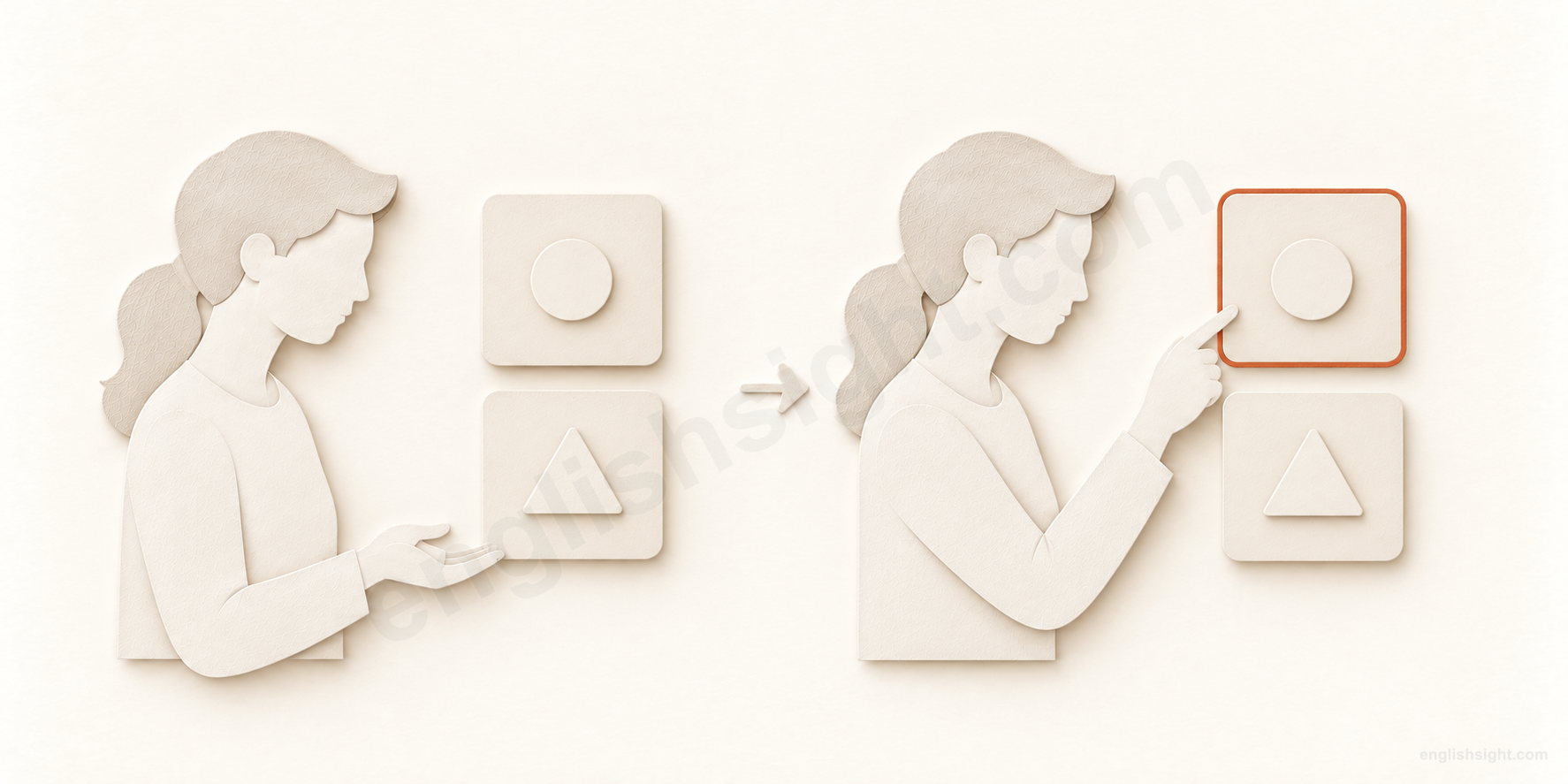
Two possibilities remain open; neither card is selected.
decision
The upper card is marked as selected; the lower one remains visible.
The woman settles on the upper option.
An open question becomes one settled choice. Choosing does not itself carry out the plan.
A person or group settles what to do or how a matter is to be judged; the decision is that choice or judgment, or the act of reaching it.
The picture models choosing. Formal decision meaning firmness, and the technical sports result, need their own usage explanations. No physical movement is required.
Should we stay or move? Which plan will we use? A decision settles such a question for the person or group choosing. It can be small and personal or an official ruling that affects other people.
Think of possible answers becoming one selected answer. This is a teaching model, not a claim that every English speaker has the same mental picture. A decision does not prove that the answer is right, that the action has happened, or that nobody can reconsider.
01
Making a choice and saying what it concerns
Start with the chooser, then use the following words to identify the action, question, or topic being settled.
01
make / take + a decision; a decision + be made / taken
make a decision / take a decision
settle what you will do
Before the choice
You are considering two travel dates.
Choice or result
You choose one date.
The decision is the choice, not the journey.
Make a decision is a useful everyday way to say that you settle an open question. I decided to leave is shorter than I made a decision to leave; the noun version gives the choice more attention.
Take a decision is also established, especially in British and institutional English. Make a decision works widely across varieties. Neither expression means physically making or taking an object.
Decision is countable here: a decision, my decision, or several decisions. A decision was made uses the passive of make, leaving the chooser unnamed.
In a sentence
We made a decision to travel on Tuesday.
Watch the difference Say make a decision, not do a decision. A choice may later change.
02
reach a decision; come to / arrive at a decision
reach / come to / arrive at a decision
finish considering a question
Before the choice
The group has discussed several options.
Choice or result
The discussion produces a settled choice.
Reaching emphasizes an endpoint in the deciding process.
Reach a decision often suggests that thinking or discussion has led to a result, perhaps after difficulty. It does not tell you whether the result is wise.
Come to a decision and arrive at a decision offer similar endpoint language. Keep their different prepositions: reach has no to here; come takes to; arrive takes at.
In a sentence
After comparing the rooms, we finally reached a decision.
Watch the difference Not reached to a decision or arrived to a decision. These are verb–noun combinations, not a family of decision phrasal verbs.
03
decision + to-infinitive; decision + not to + verb
a decision to do / not to do something
name the action chosen
Before the choice
The café owners consider a longer opening day.
Choice or result
They choose to open earlier.
The infinitive gives the content of the choice.
A decision to open says what action has been chosen. The choice can be made today even if the opening time changes next month.
A decision not to open would choose against that action. Put not before to for a straightforward negative form. Compare no decision to open: that can mean nobody has yet chosen to open.
In our decision to move, our identifies the decision-makers; the context tells us who will move. A decision about moving only names the topic and need not tell us the result.
In a sentence
Their decision to open at seven surprised the regular customers.
Watch the difference Use decision to open, not decision to opening. The action does not have to have happened yet.
04
decision + on / about + whether / what / how-clause
a decision on whether / what / how…
identify the question needing an answer
Before the choice
You have not settled whether to renew a contract.
Choice or result
The question will be settled at a later meeting.
A question after decision need not state which answer was chosen.
Whether introduces alternatives: a decision on whether to renew concerns renewing versus not renewing. What to buy and how to proceed identify other kinds of open question.
You can use an infinitive when the person doing the action is understood, or a full clause: a decision on whether we should renew. About can also introduce these questions.
Compare the decision to renew, which states the selected action, with the decision on whether to renew, which identifies the issue. Context may supply the answer, but whether alone does not.
In a sentence
Next week, we will make a decision on whether to renew the contract.
Watch the difference Do not read whether to renew as a promise to renew.
05
decision + that + subject + verb
a decision that…
state what has been settled in a full clause
Before the choice
A group discusses how the building will be used.
Choice or result
The group settles that the room will remain open.
The that-clause gives the content, including its own subject.
A decision that the room should stay open reports the content of the decision. The clause has its own subject and verb, so it can name people or things other than the decision-maker.
Compare our decision to leave, in which we normally understand us as the people leaving. In our decision that the room should stay open, we choose and the room stays open. That is a clause marker, not a pointer to a distant object.
The decision that surprised us is different: that begins a relative clause describing which decision, not what was decided.
In a sentence
The committee announced its decision that the reading room should stay open.
Watch the difference Do not omit the subject inside the content clause: that the room should stay open, not that should stay open.
06
decision + on / about + noun phrase; decision + by + decision-maker
a decision on / about something
name the matter being settled
Before the choice
A family is discussing a possible move.
Choice or result
The conversation concerns their next home.
On and about point to the topic, not the person who receives an object.
A decision about our next home and a decision on our next home both identify what is at issue. About is natural in everyday conversation; on is also frequent with an issue awaiting an answer.
The preposition does not itself tell you the answer. A decision on the application might approve or reject it. A decision by the committee instead identifies who decides.
A decision between two alternatives names the options being weighed: a decision between staying and moving. Between takes the two alternatives; on or about names the wider topic.
In a sentence
Have you made a decision about your next home?
Watch the difference About is a preposition: about moving is possible, but about move is not the ordinary form.
07
it is + possessive + decision; someone’s decision
It is your decision.
identify who has the choice
Before the choice
A friend asks you to choose their course for them.
Choice or result
You leave the final choice to your friend.
The possessive identifies the chooser, not ownership of a physical thing.
It is your decision can acknowledge someone’s right or responsibility to choose. In a supportive conversation, You can ask for advice, but it is your decision leaves the choice with the listener.
Tone matters: the same words can distance the speaker from responsibility. A person’s decision is not necessarily a decision other people agree with.
In a sentence
I can explain the two courses, but it is your decision.
Watch the difference Your decision names your choice; a decision about you names a matter concerning you and may be made by someone else.
02
How a decision is made and evaluated
Adjectives distinguish evidence, speed, difficulty, and agreement. These describe a decision; they are not separate meanings of the noun.
08
make + an informed decision
an informed decision
choose with relevant knowledge
Before the choice
You compare costs, conditions, and likely consequences.
Choice or result
You choose using that information.
Evidence supports the choice; it does not guarantee the outcome.
An informed decision is based on relevant information. Read the conditions before making an informed decision connects knowing the facts with choosing.
Informed describes the basis of the decision. The right decision evaluates the choice, often with hindsight. A well-informed choice can still turn out badly when circumstances change.
In a sentence
Read both course descriptions so you can make an informed decision.
Watch the difference Informed does not mean merely announced to someone, and it does not mean infallible.
09
make + a snap / hasty / quick decision
a snap / hasty decision
choose very quickly, sometimes too quickly
Before the choice
A short-lived offer appears on your screen.
Choice or result
You accept before checking all the conditions.
Speed and care are different judgments.
A snap decision is made quickly, with little time for consideration. It can be necessary in an urgent situation; snap alone does not prove it was wrong.
A hasty decision usually criticizes the speed as excessive or the thought as insufficient. A quick decision can be more neutral. These adjectives describe the way the choice was made.
In a sentence
Do not make a hasty decision just because the offer ends tonight.
Watch the difference A snap decision is not a sudden event that happens without any chooser.
10
a difficult / tough / big decision; the right / wrong decision
a difficult / right / wrong decision
evaluate the challenge or the chosen answer
Before the choice
Two jobs each have advantages.
Choice or result
Choosing is hard, even if the eventual answer suits you.
Difficulty and correctness answer different questions.
A difficult, tough, or hard decision is hard to make, perhaps because both options matter. A big decision has important consequences. None of these automatically means a bad choice.
The right or wrong decision evaluates what was chosen. I regret my decision says I now feel unhappy about it; the noun itself does not supply regret or blame.
In a sentence
Leaving a familiar job was a difficult decision, but it was the right one for me.
Watch the difference Do not confuse difficult to decide with wrong to choose. Right can express a personal assessment rather than an objective guarantee.
11
a unanimous / majority decision
a unanimous / majority decision
show how far a group agrees
Before the choice
Five committee members vote.
Choice or result
All five, or only more than half, support the result.
Agreement concerns the voters; final concerns whether the matter is closed.
A unanimous decision has everyone in the relevant group agreeing. A majority decision has more than half supporting the outcome; some people may disagree.
Neither adjective means that the choice is certainly correct. A decision may be both unanimous and unwise, or a majority decision may be carefully justified.
In a sentence
The committee reached a unanimous decision to keep the library open.
Watch the difference Unanimous does not mean just that the largest group won.
03
Waiting, keeping, and changing a decision
A choice can be delayed, respected, carried out, or reconsidered. The accompanying verb supplies that stage of the story.
12
delay / postpone / defer + a decision
delay / postpone / defer a decision
leave the choice for later
Before the choice
You still lack a supplier’s price.
Choice or result
You wait before choosing a supplier.
Delaying the decision differs from delaying an already chosen action.
Delay or postpone a decision means you do not settle the matter yet. Defer a decision is a more formal way to say this, often in meetings or official writing.
Compare postpone a decision about buying with decide to postpone buying: the first leaves the purchasing choice unsettled; the second settles on waiting to buy.
In a sentence
We postponed the decision until we had the final price.
Watch the difference A delay is not automatically a refusal: the question may still be open.
13
reserve + (your) decision / judgement
reserve your decision / judgement
wait before reaching a judgment
Before the choice
The evidence is incomplete.
Choice or result
You withhold a conclusion until later.
This established expression leaves judgment open.
Reserve your decision or reserve judgement means wait before deciding. It is useful when more evidence or time is needed. Judgement is also spelled judgment.
A judge may reserve a decision until a later date rather than settle the case immediately. In everyday discussion, I will reserve judgement often signals that you are not ready to evaluate something.
In a sentence
The judges reserved their decision until the following week.
Watch the difference Reserve here does not mean book a seat or keep a physical decision in storage.
14
respect + someone’s decision; stick to / carry out / implement + a decision
respect / stick to a decision
accept another person’s choice or keep your own
Before the choice
Someone questions the plan you chose.
Choice or result
You continue with it, or another person accepts your right to choose.
The verbs distinguish accepting a choice from maintaining one.
Respect someone’s decision means treat their choice as something they are entitled to make, even if you disagree. It need not mean you approve of the result.
Stick to your decision means continue with what you chose rather than change it under pressure. Here stick to supplies the persistence; decision still names the choice. Carry out or implement a decision means put it into action, a later step.
In a sentence
I disagree with your decision, but I respect it.
Watch the difference Respecting does not require agreeing; making does not mean implementing. In stick to it, keep to before the pronoun.
15
reconsider / review / change / reverse + a decision; a final / firm decision
reconsider / change / reverse a decision
look again at a choice or replace it
Before the choice
New information arrives after you chose.
Choice or result
You review the choice and may select a different course.
Reviewing does not itself say that the choice changes.
Reconsider or review a decision means examine it again. You may keep it after reconsidering. Change a decision means choose differently; reverse a decision typically means replace an earlier position with its opposite.
A final decision is presented as settled, with no further discussion or ordinary review intended in that setting. A firm decision expresses commitment. These words do not prove that no future event could ever change the choice.
In a sentence
After hearing the new evidence, the manager reconsidered her decision.
Watch the difference Reconsidered does not necessarily mean reversed.
04
Official decisions and responsibility
An organization can settle a matter for other people. Distinguish the decision itself, the people authorized to make it, and later challenges.
16
a court’s / referee’s decision; a decision + in favour of / against + party
a court’s decision / a decision in favour of…
an authority settles a disputed matter
Before the choice
Two parties disagree about a rule.
Choice or result
A court gives its ruling.
An official judgment can affect people who did not choose it.
A court’s decision is its ruling on the matter before it. The same ordinary noun can describe an organization’s answer to an application or a referee’s judgment in a game.
A decision in favour of one party supports that party’s position; against signals the opposite direction. In favour of is British spelling; in favor of is American spelling. The surrounding words identify whose position succeeds.
In a sentence
The court’s decision was in favour of the tenants.
Watch the difference Decision is broader than verdict: do not assume every decision is a jury’s finding of guilt or innocence.
The verbs identify different stages and outcomes of a challenge.
Appeal against a decision is common in British English; appeal a decision is common in North American English. The person asks an authorized body to review it. An appeal does not guarantee success.
If the reviewing body upholds the decision, it lets it stand. If it overturns or reverses the decision, the earlier ruling no longer stands in its original form. Overrule a decision similarly means use authority to reject it.
In a sentence
The review panel upheld the original decision.
Watch the difference Upheld confirms the ruling; overturned removes it. The two verbs are not synonyms.
18
make + an executive decision
an executive decision
a choice made by senior authority
Before the choice
A local team cannot settle a company-wide issue.
Choice or result
Senior management settles it.
Executive identifies the level of authority.
An executive decision is made at a high level in an organization. It may come from a senior individual or leadership group; the phrase alone does not say that nobody was consulted.
In casual speech, I am making an executive decision can be playful: someone takes charge of settling an ordinary question, such as where the group will eat. The humour borrows the language of authority.
In a sentence
The move to the new office was an executive decision.
Watch the difference Executive does not mean that the decision has already been executed or carried out.
19
a decision-maker; decision-makers; decision-making + noun
decision-maker / decision-making
name the chooser or the choosing process
Before the choice
You want a proposal considered.
Choice or result
You identify who can approve it and how choices are made.
Maker names a person; making names a process.
A decision-maker is a person responsible for important choices. Decision-makers is the plural. Decision-making names the activity or process, especially in an organization.
Use decision-making before another noun too: decision-making skills or the decision-making process. These compounds help discuss how choices are produced; they do not imply that each resulting choice is good.
In a sentence
The workshop helps new decision-makers improve their decision-making skills.
Watch the difference The activity is decision-making, not decision-maker. A singular decision-maker normally needs a determiner, such as a or the. Decision-making as an uncountable process normally does not take a/an.
05
Process, firmness, and a sporting result
Recognize the uncountable uses and a sports expression without forcing every use into the picture of a personal choice.
20
the moment of decision; the power of decision
the moment / power of decision
the act of deciding or the authority to decide
Before the choice
Several possibilities remain open.
Choice or result
The point of choosing arrives, or someone has the right to choose.
Uncountable decision can refer to deciding rather than one chosen answer.
The moment of decision is the time when a choice must be made. The power of decision is the authority to decide. These more formal patterns treat decision as an activity or function rather than a separate countable result.
Compare We made three decisions, which counts three settled choices. For the general activity in ordinary conversation, making decisions is often clearer: I find making decisions difficult.
It is decision time is a compact way to say that the time to choose has arrived. Decision modifies time here; it does not name a clock or a new kind of choice.
In a sentence
The power of decision remains with the school board.
Watch the difference Do not remove the article from an ordinary single choice: We made a decision, not We made decision.
21
with decision; a person of decision
with decision / a person of decision
firmness in deciding and acting
Before the choice
A situation calls for a clear response.
Choice or result
Someone responds without hesitation.
This formal uncountable sense describes a quality, not one selected option.
In formal or literary writing, with decision can mean with firmness and determination. A person of decision describes someone able to decide firmly. This is a recognition use, not the most useful everyday way to say someone made a choice.
For everyday description, She acted decisively or She is decisive is often clearer. The quality does not guarantee wisdom: a decisive person can still make a poor decision.
In a sentence
When the alarm sounded, the supervisor spoke with decision.
Watch the difference With decision does not mean with one particular decision as a companion. Compare with a decision, where the article points to a specific choice.
22
win + by a decision; win + by a split decision
win by a decision / a split decision
win a bout through the judges’ scoring
Before the choice
A boxing match finishes without a knockout.
Choice or result
The judges’ scores determine the winner.
This sports result is a specialized judgment, not simply a boxer choosing to win.
In boxing, win by a decision means win through the judges’ scoring rather than by knockout. A split decision means two of three judges choose one competitor and the third chooses the other.
The specific sports convention supplies the meaning. Outside sports, a group can reach a decision with disagreement, but do not assume every narrow vote follows the technical boxing pattern.
In a sentence
The boxer won the close bout by a split decision.
Watch the difference A split decision is not a draw: a winner is selected.
Keep the noun, the grammar, and the context apart
Count a choice; describe a process or quality
Use a decision or decisions for selected answers and rulings. In formal expressions such as the moment of decision or with decision, the noun is uncountable. The same spelling does not make the article optional everywhere.
Decision and choice overlap, but their companions differ
You can make a choice or make a decision. An available choice can also mean an option before anyone selects it: We have three choices. We have three decisions to make means three questions need settling. A decision is not automatically one of the available options.
Learn the whole construction
Make, reach, postpone, and reverse describe different relations to a decision. To do states an action chosen; on whether to do names a question. This is mainly a noun lesson, so verb tense, causative patterns, and particle positions belong to the accompanying verbs.
Scope and pronunciation
Decision is normally a noun, with plural decisions. The middle sound is /ʒ/, as in vision, and the stress falls on the second syllable: /dɪˈsɪʒən/. The rare boxing verb decision and baseball scoring use are outside this practical course; specialized decision theory is not developed here.
Choose the expression that fits
Check whether the sentence names an action chosen, an open question, a review, or a result.
1. The team has chosen to cancel the trip. Which phrase states the chosen action?
2. The manager reconsidered her decision. What must be true?
3. A panel upheld the decision after an appeal. What happened to the earlier ruling?
4. You want a neutral everyday sentence saying the family has chosen. Which is standard?
5. Someone made an informed decision, but later events turned out badly. Is that contradictory?
6. A boxer wins by a split decision. Which description fits?
Sources and teaching notes
Definitions and usage were checked against the sources below. Explanations, example sentences, and the diagram were written for this lesson; the visual connection is a teaching interpretation.
This diagram helps explain a connection; it is not a picture shared by every native speaker.