Connect physical depth with involvement and intensity, then learn the expressions that have their own meaning.
Distance inward from a boundary
Distance inward from a boundary
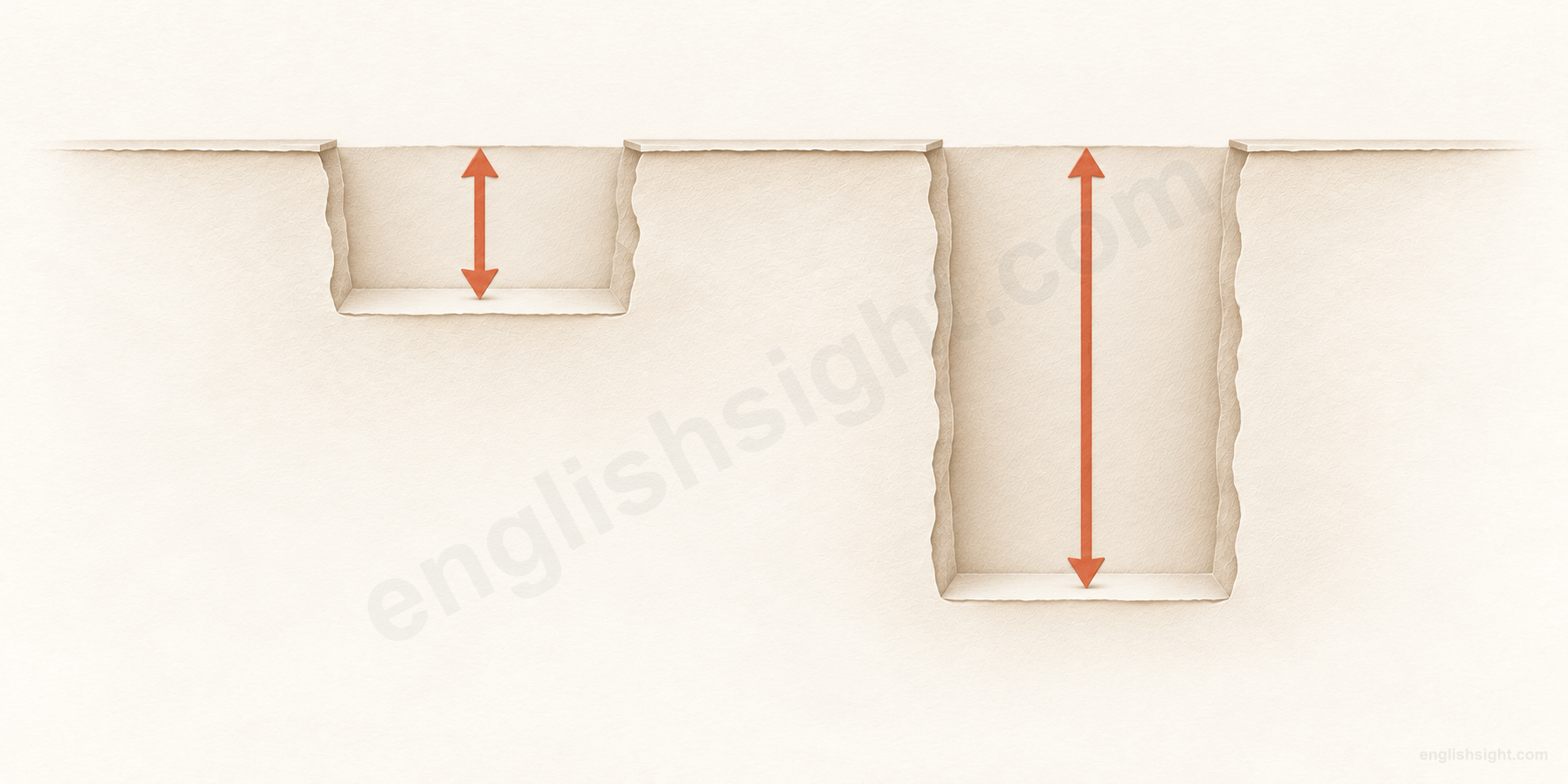
The two openings are at the same surface level.
deep
The right-hand hole extends much farther down.
Compare the distance from each opening to its floor.
Similar opening widths, different depths: the right-hand hole is deeper.
Deep marks substantial extent inward from a surface or edge; figurative uses can describe substantial involvement, understanding, or intensity.
The comparison below shows two extents, not a before-and-after action. Use it as a spatial starting point. The noun and the full construction determine what kind of depth is meant.
Deep often relates an inside point or extent to a surface, opening, or edge. Water can be deep below its surface; a cupboard can be deep from front to back. The important question is: deep from which boundary, and in which direction?
That spatial relation offers a useful teaching connection for understanding, feelings, and involvement. Some familiar uses, such as a deep voice or deep blue, depend on established meanings and collocations. A single picture cannot predict every combination.
01
Distance from a surface or edge
Start with a reference boundary: the water surface, the front of a cupboard, or the edge of a forest. Deep describes extent away from that boundary, not simply overall size.
01
deep + noun; subject + be / look + deep
deep water / a deep hole
a large distance from the surface to the bottom
Situation / reference
Two pools have similar surface areas.
Meaning in this situation
One has its bottom much farther below the water.
Depth is measured downward from a surface, not across it.
Deep describes the water or hole; it does not say that anything is moving. A deep river may be narrow. A wide river may be shallow. Deep snow likewise describes a thick layer from its top surface to the ground.
The comparison depends on the object and situation. A deep puddle and a deep ocean do not need the same number of metres. Shallow is the usual spatial opposite.
In a sentence
The pond is narrow, but the water is deep in the middle.
Watch the difference Do not use high for this measurement: a high wall rises up; a deep hole extends down.
02
a deep + container / cut / wound
a deep cupboard / a deep cut
a long distance inward from an opening or outer surface
Situation / reference
You look at a cupboard opening or the surface of a material.
Meaning in this situation
The interior or cut extends far inward.
The relevant direction can be front to back, not top to bottom.
For a cupboard, compare its front opening with the back inside. A cupboard may be low but deep enough for large boxes.
For a cut or wound, the reference is the outer surface that has been cut. Depth differs from the length of a line along that surface. This is the same distance relation with a different orientation.
Deep space refers to space far from Earth. Here the distance is outward from our familiar region, not down to a physical bottom.
In a sentence
The cupboard is so deep that I cannot reach the boxes at the back.
Watch the difference A long scratch is not necessarily a deep cut; length along a surface and penetration into it are different.
03
How deep + be + subject?; measurement + deep; a number-unit-deep + noun
How deep? / two metres deep
ask for or state an exact depth
Situation / reference
You need a dimension rather than a general impression.
Meaning in this situation
A number gives the distance from the chosen boundary.
A measurement before deep need not describe a large depth.
Put the measurement before deep after be: The water is ten centimetres deep. Even a very shallow layer can be ten centimetres deep; here deep names the dimension.
Before a noun, combine the number and unit into a modifier: a two-metre-deep pool. The unit is singular there. Compare a pool two metres deep, with the ordinary plural measurement after the noun.
In a sentence
How deep is the pool? It is two metres deep at this end.
Watch the difference Use two metres deep after is, but a two-metre-deep pool before the noun.
04
knee-deep / waist-deep + noun; be / stand + knee-deep in + noun
knee-deep / waist-deep
reaching a named part of the body
Situation / reference
A person is standing in water or mud.
Meaning in this situation
The surface reaches the knees or waist.
The body part supplies the reference level.
Knee-deep water comes up to the knees of a person standing in it. We stood knee-deep in water describes the people and their immersion. The compound can occur before a noun or after a verb.
The same pattern can be figurative: By Friday, I was knee-deep in paperwork. That means heavily occupied with it, not a measured pile reaching the knees.
In a sentence
We stood knee-deep in water beside the boat.
Watch the difference Knee-deep is not a fixed number of centimetres, and knee-deep in work is figurative.
05
stand / be arranged + number + deep
three deep
arranged in three rows or layers
Situation / reference
People gather behind the front row.
Meaning in this situation
There are three rows from front to back.
The number counts rows, not the total number of people.
A crowd standing three deep is arranged in three rows, one behind another. It does not mean only three people attended.
The same pattern can describe layers of objects. Dictionary labels vary between an adverbial use and a postpositive or compound adjective; the practical pattern is number + deep.
In a sentence
Fans stood three deep along the fence.
Watch the difference Three deep is not three feet deep: one counts rows, while the other measures distance.
06
deep + in / inside / below + place; verb + deep into + place
deep in / into / inside
far within an area, below a surface, or inward along a route
Situation / reference
You take the edge or entrance as your reference.
Meaning in this situation
The place or movement is well inside that boundary.
The preposition tells you whether you describe position or movement.
Compare a cabin deep in the forest with walking deep into the forest. In gives the location; into gives movement toward the interior. Deep adds how far inward.
Deep below the surface, deep underground, and deep inside a pocket use other reference boundaries. Dig deeper is also possible without an expressed preposition when the direction is clear.
In a sentence
We walked deep into the forest before stopping for lunch.
Watch the difference Deep does not supply the direction by itself: compare into, below, and behind.
07
verb + deep into the night
deep into the night
continuing until very late at night
Situation / reference
An activity begins earlier in the evening.
Meaning in this situation
It continues well into the night.
A time period is treated as an extent with an interior.
Into places the activity farther within the night; deep increases that extent. The expression says when the activity continued, not how intensely someone worked.
They worked late is simpler. They worked deep into the night gives a stronger sense of continuing far beyond the evening. Deeply into the night is not the ordinary choice for this time expression.
In a sentence
We talked deep into the night after the guests had left.
Watch the difference Do not interpret deep here as a description of the conversation’s subject.
02
Body, senses, feelings, and serious situations
The noun selects the kind of depth: a voice has pitch, a colour has richness, and an emotion has strength. These are familiar meanings, not measurements hidden in every sentence.
08
deep + emotion noun; deepest sympathy / sympathies
deep respect / deepest sympathy
a strongly felt emotion or attitude
Situation / reference
You want to express more than a passing feeling.
Meaning in this situation
The noun names the feeling, and deep strengthens it.
The emotion is strong; it need not be hidden.
Use deep with suitable nouns: deep affection, concern, regret, or respect. Deepest sympathy is a conventional way to express strong sympathy after someone’s loss.
Compare I deeply regret the mistake: deeply modifies the verb regret. In I feel deep regret, deep modifies the noun regret. The grammar changes, while the intended strength may be similar.
In a sentence
I have deep respect for the volunteers who kept the centre open.
Watch the difference Deep does not freely replace very: say deeply grateful, not deep grateful.
09
be in deep trouble; be deep in debt; get / sink deeper into debt
in deep trouble / deep in debt
in a serious difficulty or owing a great deal
Situation / reference
A person or organisation faces problems.
Meaning in this situation
The situation is serious or hard to escape.
The noun and preposition specify the kind of difficulty.
In deep trouble uses deep before trouble. Deep in debt puts deep before the prepositional phrase. Deep trouble describes seriousness; deep in debt describes a large burden of debt.
Getting deeper into debt adds a worsening process. Deep divisions, deep concern, and a deep recession likewise concern substantial degree, but the appropriate noun must be learned with the expression.
In a sentence
The firm is deep in debt after losing its largest customer.
Watch the difference Do not infer debt from in deep trouble; the trouble could be about work, behaviour, or something else.
10
be in / fall into + a deep sleep; sleep deeply
a deep sleep
sleep from which a person is hard to wake
Situation / reference
A sleeping person does not respond to ordinary small noises.
Meaning in this situation
Their sleep is described as deep.
Deep contrasts with light sleep.
Fall into a deep sleep describes entering that state; be in a deep sleep describes the state itself. The verb and into supply the change, not deep alone.
Sleep deeply uses the related adverb. This everyday wording does not specify the number of hours slept or identify a technical sleep stage.
Deep also combines with trance and coma. These are separate states, not synonyms for sleep; their technical definitions are outside this language lesson.
In a sentence
By the time the train arrived, Mina was in a deep sleep.
Watch the difference Deep sleep concerns the quality of sleep; a long sleep concerns its duration.
11
take + a deep breath; breathe deeply; give + a deep sigh
take a deep breath
draw in a substantial amount of air
Situation / reference
You pause before speaking or continuing.
Meaning in this situation
You breathe in fully.
Deep describes the breath; take forms the everyday action phrase.
Take a deep breath is the ordinary phrase for drawing in a lot of air. A deep sigh involves a substantial breath too, but often expresses tiredness, relief, or another feeling.
Breathe deeply uses the verb breathe and the adverb deeply. Taking a deep breath can be part of preparing yourself calmly, but calmness is the purpose in that situation, not a guaranteed result of the word deep.
In a sentence
I took a deep breath before answering the difficult question.
Watch the difference Breath is the noun; breathe is the verb: take a deep breath, but breathe deeply.
12
a deep + voice / sound; subject + have + a deep voice
a deep voice
a voice or sound with low pitch
Situation / reference
You hear someone speak or an instrument sound.
Meaning in this situation
Its pitch is low.
Pitch differs from loudness.
A deep voice can be quiet or loud. A deep roar or drum sound is described by its low tone, although a particular roar may also be loud.
The spatial drawing is only a memory aid here: sound has a conventional low/high pitch scale. There is no literal distance below a water surface to measure.
In a sentence
He spoke in a deep voice, so softly that I could barely hear him.
Watch the difference A loud voice is strong in volume; a deep voice is low in pitch.
13
deep + colour; a deep + colour noun; a deep shade of + colour
deep blue / a deep red
a rich, strong colour that is relatively dark
Situation / reference
You compare two shades of the same colour.
Meaning in this situation
One is richer and darker.
Deep modifies a colour or names the quality of a shade.
The walls are deep blue uses deep with the colour adjective. A deep red names a shade using a colour noun. Neither expression describes the thickness of the paint.
Pale blue is a useful contrast. Dark and deep often overlap, but deep particularly suits a rich colour; do not assume that every use of dark can be replaced by deep.
In a sentence
She chose deep blue curtains for the small room.
Watch the difference Write deep blue, not deeply blue, for the ordinary colour description.
14
deep cuts to / in + budget or services; deep discounts on + goods
deep cuts / deep discounts
a large reduction in money, services, or prices
Situation / reference
A budget or price is reduced.
Meaning in this situation
The reduction is substantial.
The noun supplies the idea of a reduction.
In deep cuts to services, cuts is a noun meaning reductions. Deep adds their size. No surface is physically cut, although the image of cutting far in can help you remember it.
Deep discounts similarly describes large price reductions. Compare a deep cut in a table, which has literal physical depth. Context distinguishes the two uses of cut.
In a sentence
The council announced deep cuts to the library budget.
Watch the difference Deep does not itself mean reduce: the reduction comes from cuts or discounts.
03
Attention, understanding, and lasting foundations
A surface can be a teaching metaphor for a quick first impression. Deep understanding goes further; being deep in an activity describes involvement. Keep these related but different ideas apart.
15
a deep understanding of + subject; a deep question; too deep for + person
a deep understanding / a deep question
understanding that reaches beyond basics, or an intellectually demanding topic
Situation / reference
A first explanation gives only the outline.
Meaning in this situation
Further thought addresses causes, connections, or difficult issues.
Deep can praise insight or signal difficulty, depending on the noun and context.
A deep understanding of something suggests thorough knowledge. A deep question or a discussion that is too deep for me may be difficult to understand. Difficulty and insight are related, but one does not guarantee the other.
Compare broad knowledge, which covers many areas, with deep knowledge of one area. A deeper meaning is an interpretation beyond the immediately obvious one; the phrase does not prove that such an interpretation is correct.
In a sentence
Her questions showed a deep understanding of how children learn.
Watch the difference A deep discussion is not necessarily a long discussion; depth and duration are different.
16
be + deep in thought / conversation / a book
deep in thought / conversation
fully occupied with an activity or thoughts
Situation / reference
Someone is concentrating on thinking or talking.
Meaning in this situation
Other things receive little attention.
In introduces what absorbs the person’s attention.
Someone deep in thought is thinking intently; the thoughts do not have to be philosophically profound. Someone deep in conversation is absorbed in talking with another person.
Compare deep thoughts, which describes the character of the thoughts, with deep in thought, which describes a person’s involvement. The whole pattern gives the involvement reading.
In a sentence
We were so deep in conversation that we missed our stop.
Watch the difference Use in: deep in thought, not deep on thought.
17
make / leave + a deep impression on + someone
make a deep impression on someone
have a strong effect that remains in someone’s memory
Situation / reference
An experience attracts your attention or changes how you feel.
Meaning in this situation
Its effect remains important to you afterwards.
Impression names the effect; deep describes its strength.
An exhibition, a person, or an event can make or leave a deep impression on someone. This describes a strong effect on their thoughts or feelings, rather than the physical depth of a mark.
The impression can be positive or disturbing; deep does not mean favourable. Compare I got the impression that the shop was closed, where impression means an idea or belief rather than a powerful effect.
In a sentence
Visiting the empty school left a deep impression on me.
Watch the difference Use on before the person affected: a deep impression on me. Deep does not specify whether the experience was pleasant.
18
a deep thinker; a deep person; subject + be + deep
a deep thinker / a deep person
a thoughtful person, or someone whose feelings are hard to read
Situation / reference
You try to describe how someone thinks or reveals themselves.
Meaning in this situation
The description goes beyond an obvious outward impression.
The surrounding words determine whether the emphasis is intellect or hidden feelings.
A deep thinker suggests someone who thinks carefully about important or difficult matters. Calling someone deep can also suggest that their real feelings and motives are not easy to discover.
This second use is context-sensitive and can sound admiring, puzzled, or suspicious. It is not a neutral synonym for quiet, and it does not establish that a quiet person is intelligent.
In a sentence
I find Leo hard to read; he is a deep person.
Watch the difference A deep thinker highlights thought; simply calling someone deep may highlight mystery instead.
19
have deep roots in + place / history; deep-rooted / deep-seated + noun
deep roots / deep-rooted / deep-seated
a strong foundation or a firmly established belief or problem
Situation / reference
A plant has roots below the surface, or a practice has a long history.
Meaning in this situation
It is firmly established and may be hard to change.
The literal root image supports an established figurative comparison.
A tree with deep roots has roots extending far into the ground. A custom with deep roots in a community is firmly established there. The community is not literally soil.
Deep-rooted beliefs and deep-seated fears describe strongly established attitudes or feelings. These are compound adjectives: deep modifies rooted or seated within the compound. Learn the spelling deep-seated, not deep-seeded.
In a sentence
The festival has deep roots in the town’s history.
Watch the difference Deep-rooted and deep-seated often suggest difficulty changing something; they do not always mean it is good.
04
Expressions to learn as a whole
The full expression controls the meaning. Deep down, in too deep, and off the deep end cannot be exchanged just because each contains deep.
20
deep down, + clause; know / feel + deep down + that-clause
deep down
in one’s true feelings or real character beneath appearances
Situation / reference
An outward claim or appearance suggests one thing.
Meaning in this situation
The speaker points to a less openly acknowledged truth.
Down belongs to an established expression about inner reality.
I knew deep down that I wanted to stay describes a feeling or recognition that may be hard to admit. Deep down, she is kind describes her real character despite what people may see on the surface.
Deep down inside and deep in my heart can similarly point to personal feelings. Context distinguishes these uses from the literal deep down in a mine.
In a sentence
I said I was ready to leave, but deep down I wanted to stay.
Watch the difference Do not replace deep down with deeply: deeply normally strengthens another word rather than introducing inner reality.
21
feeling / belief + runs deep; feelings + go deep
feelings run deep
feelings or beliefs are strong and often longstanding
Situation / reference
An attitude persists beyond a single event.
Meaning in this situation
The speaker stresses its strength and persistence.
Run and go form established expressions here, without literal travel.
Trust, loyalty, or resentment can run deep. The emotion is strongly rooted in people’s lives or relationships. Go deep can also describe a strongly felt emotional effect.
The saying Still waters run deep suggests that a quiet person may have substantial knowledge or strong feelings. It is a proverb, not a dependable rule for judging people.
In a sentence
Resentment still runs deep years after the factory closed.
Watch the difference Run deep does not mean that people are hiding every feeling; strength and long duration are the main ideas.
22
dig deep into + records / evidence / an issue
dig deep into the evidence
investigate information carefully beyond the obvious facts
Situation / reference
A quick look does not explain the problem.
Meaning in this situation
You examine the details and underlying evidence.
Dig supplies the searching activity; deep specifies its extent.
Literal digging goes below the ground surface. In investigation, the comparison is with moving past the first layer of information. Into introduces the material being examined.
Dig deep can stand alone when the subject of investigation is known. This is an established expression, not a separable verb that lets you place an object between dig and deep.
In a sentence
We had to dig deep into the records to explain the missing payment.
Watch the difference Say dig deep into the records, not dig the records deep, for this investigation meaning.
23
dig deep for + cause; dig deep into your pockets / savings
dig deep / dig deep into your pockets
make a substantial effort to provide money or resources
Situation / reference
A project needs more support than people have already offered.
Meaning in this situation
They are asked to contribute generously.
The whole expression concerns what people can provide.
Dig deep for a cause asks for a substantial contribution. Dig deep into your pockets means spend a lot of your own money. A pocket stands for personal funds, not just the fabric in clothing.
Compare digging deep into records, which concerns investigation. The object or situation tells you whether the expression is about information or resources; deep alone does not mean donate.
In a sentence
Local businesses dug deep to pay for the new playground.
Watch the difference For a finished past event, use dug deep, not digged deep.
24
dig deep; dig deep to + verb; have to dig deep
dig deep to keep going
make an extra effort by drawing on your strength or determination
Situation / reference
A difficult task has used much of your energy.
Meaning in this situation
You find the determination to make another effort.
The resource is personal effort, rather than money or information.
When a coach asks a tired team to dig deep, the request is for extra effort or determination. For example: With ten minutes left, the players dug deep and kept defending. No one is searching records or donating money.
The phrase also occurs outside sport when people work through a demanding challenge. Thinking of drawing on less immediately available resources is a useful memory link; deep does not itself mean succeed, and extra effort does not guarantee success.
In a sentence
We had to dig deep to complete the repairs before the storm arrived.
Watch the difference Context distinguishes effort, investigation, and financial support: dig deep alone does not tell you which resource is involved.
25
be / get + in too deep
in too deep
so involved in a difficult situation that getting out is hard
Situation / reference
You discover the risks after making a serious commitment.
Meaning in this situation
You feel unable to withdraw easily.
Too marks involvement beyond a manageable limit.
Be in too deep normally concerns a difficult commitment or situation. It does not merely mean very interested in a subject. The sense of being unable to get out belongs to the expression.
Get in too deep describes coming into that situation; be in too deep describes the resulting state. In deep without too is also used informally when the difficult involvement is clear.
In a sentence
By the time I discovered the risks, I was in too deep to cancel the agreement.
Watch the difference Compare deep in a book, which can be harmless concentration and does not imply being trapped.
26
be in / get into + deep water; in deep waters
in deep water
in trouble or a situation beyond one’s ability
Situation / reference
A task or situation becomes difficult to manage.
Meaning in this situation
The person faces serious difficulty.
Water supplies an established metaphor for trouble.
In deep water can be literal, but in a discussion of mistakes or responsibility it is often an informal idiom. Getting into deep water describes entering the difficulty.
The image of being unable to stand comfortably in water can help with memory. It does not establish the history of the expression or mean that every speaker imagines swimming.
In a sentence
We were in deep water when both technicians resigned.
Watch the difference The idiom usually uses uncountable water; deep waters also occurs, but a deep water is not the ordinary expression.
27
throw someone in at the deep end; be thrown in at the deep end; jump in at the deep end
be thrown in at the deep end
start a difficult task without enough preparation
Situation / reference
A new worker has little training for an unfamiliar task.
Meaning in this situation
They must handle the task immediately.
Throw someone into the situation differs from choosing to jump in.
The deep end literally means the deepest part of a swimming pool. Be thrown in at the deep end is an informal expression for being made to tackle something difficult before you are ready.
Jump in at the deep end describes choosing to begin that way. Collins marks this pattern mainly British. The passive thrown belongs to throw, not to deep.
In a sentence
On my first morning, I was thrown in at the deep end and asked to lead the meeting.
Watch the difference Do not confuse in at the deep end with off the deep end; the latter concerns an extreme emotional or unreasonable reaction.
28
go / went / have gone + off the deep end
go off the deep end
react with extreme anger or behave in an unreasonable, uncontrolled way
Situation / reference
An event triggers an extreme reaction.
Meaning in this situation
The person becomes very angry or acts rashly.
Off is part of a different idiom from in at the deep end.
In a dispute, going off the deep end can mean suddenly losing your temper. For example: Dad went off the deep end when he saw the broken window.
The expression can also describe rash or apparently irrational behaviour: After one successful sale, he went off the deep end and borrowed money to buy ten more shops. It is informal and judgmental, and is not a clinical description of someone’s mental health.
In a sentence
My manager went off the deep end over a small mistake in the report.
Watch the difference Being thrown in at the deep end is about lack of preparation; going off the deep end is about a reaction or behaviour.
29
have deep pockets; a person / company with deep pockets
have deep pockets
have substantial financial resources available
Situation / reference
An organisation considers an expensive investment.
Meaning in this situation
Its available funds make the spending possible.
Pockets stands for financial resources, not clothing dimensions.
A person, company, or investor with deep pockets has a lot of money available to spend. The phrase says what they can afford, not whether they are willing to pay.
Compare dig deep into your pockets, which describes spending or providing personal funds. One expression concerns available resources; the other concerns drawing on resources.
In a sentence
The small firm needed an investor with deep pockets.
Watch the difference Keep pockets plural in this established money expression.
30
subject + be + (only) skin-deep
only skin-deep
limited to outward appearance rather than substantial reality
Situation / reference
Something looks attractive or convincing on the surface.
Meaning in this situation
The claim does not extend to its underlying quality.
Skin sets a very shallow limit in the metaphor.
If friendliness is only skin-deep, the outward manner does not reflect a strong underlying feeling. Skin-deep is generally used after a linking verb in this figurative sense.
The saying Beauty is only skin-deep reminds people that appearance does not establish good character. It expresses a value judgment about appearance and character, not a fact about the thickness of skin.
In a sentence
Their friendliness was only skin-deep; they refused to help when it mattered.
Watch the difference Learn the compound skin-deep as a whole; skin deeply is not an alternative.
31
take / do + a deep dive into / on + topic
take a deep dive into a subject
examine a subject in detail
Situation / reference
A summary introduces the topic.
Meaning in this situation
The next discussion examines it thoroughly.
Dive contributes the investigation metaphor; the phrase names the detailed examination.
A deep dive is an informal noun phrase often used in work, journalism, and learning. Take or do a deep dive into something introduces a detailed examination; on also occurs with the topic.
A literal deep dive is a dive far below the water surface. In the figurative expression, the depth concerns detail, and the investigation need not involve any movement or water.
In a sentence
The next episode takes a deep dive into how public libraries are funded.
Watch the difference Deep dive is a noun phrase here, not evidence that deep itself is a verb.
Choose the dimension and the grammar
Deep and deeply overlap, but are not interchangeable
Deep can be an adjective or a spatial adverb: a deep hole; dig deep; deep into the forest. Deeply can also describe physical penetration, but is especially useful for degree or feeling: deeply worried, deeply grateful, love someone deeply. Use deep down for inner reality, not deeply on its own.
Deep does not mean every kind of large
Choose the relevant dimension: a tall building, a wide doorway, a long journey, a deep well. Common collocations extend the meaning selectively. A deep voice has low pitch, while deep blue describes a rich, relatively dark colour.
Word forms and grammatical scope
The adjective and spatial adverb compare as deep, deeper, deepest. Depth is the usual measurement noun: What is the depth? Deepen is a separate verb. Deep itself has no ordinary modern verb pattern here, so passive, causative, and particle-verb families are not applicable; in was thrown in at the deep end, thrown is the passive verb.
A noun in literary writing
The deep can mean the sea in literary language. The deep of winter or night refers to its middle or most intense part; deeps can refer to deep regions. Recognise these in reading, but use ordinary words such as sea or middle of the night for everyday communication.
A teaching connection, not a universal mental picture
The surface-and-interior comparison helps organise some meanings. It is not a historical proof of each idiom, a rule for inventing combinations, or a claim that all native speakers visualise the same picture.
Choose the meaning that fits
Use the noun, preposition, and situation to identify the relevant kind of depth.
1. A cupboard is low but has a long distance from its front opening to its back. Which description fits?
2. The water reaches only ten centimetres above the bottom. Which sentence gives its measurement correctly?
3. A singer speaks softly with a low-pitched voice. What can still be true?
4. You want to say that the news caused a strong feeling of worry. Which form is natural?
5. You are fully occupied with planning dinner, a simple everyday topic. Which description is possible?
6. You say you want to leave, but your real wish is to stay. Which expression introduces that inner feeling?
7. A new employee must handle a difficult meeting before receiving training. Which idiom fits?
8. An investor has plenty of money available but has not agreed to fund a project. Which statement fits?
Sources and teaching notes
Modern meanings and expressions were checked against the publisher pages below. Explanations and examples are original. The boundary-and-interior connection is a teaching model, not a claim about the historical origin of every expression.
The diagram illustrates a spatial relation that can help organise several uses.