Connect levels and measured units, then learn the academic branch and established expressions.
Different amounts on a shared scale
Different positions on the same scale
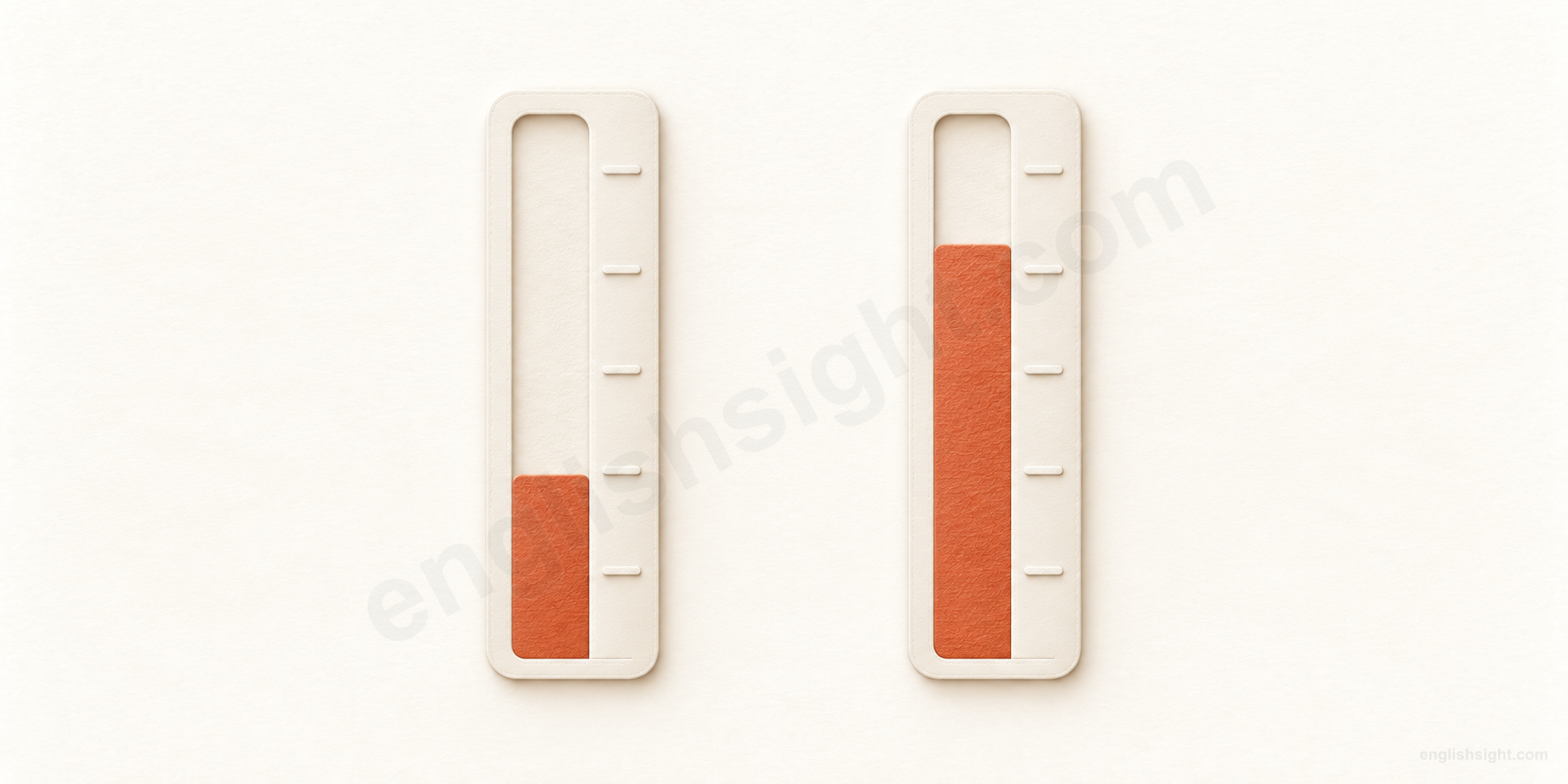
The left gauge shows a lower reading.
degree
The right gauge shows a higher reading.
Compare levels on matching scales, not successive moments.
Matching scales show different amounts, not a change over time. A degree can also be a defined measurement unit; academic degrees and fixed idioms need separate explanations.
A degree can identify an amount or level on a scale; in measurement it can also be one defined unit on that scale.
The two matching gauges compare lower and higher readings, without implying a change over time. This is a teaching model for levels and measurement, not a literal explanation of an academic award or every idiom.
Degree often helps answer how much or how far: how much skill, how hot, or how far around a turn. A scale can be an informal comparison or a precisely defined system.
A university degree and expressions such as the third degree need their own learned meanings. This lesson connects useful branches without claiming that a single picture predicts every use.
01
How much, and how far?
Describe the amount of a quality, compare levels, and qualify a claim. The scale may be an estimate rather than a numbered instrument.
01
a + adjective + degree of + noun
a high degree of skill
a high level of a quality
Situation / starting point
A repair needs precise, careful work.
Meaning in this situation
You describe how much skill it requires.
Degree measures the level of a quality, not its physical size.
Degree is a noun here. A high degree of skill means a high level of skill; of names the quality being assessed. Low, considerable, remarkable, and unusual can also describe the degree.
The scale need not have numbers: a degree of certainty, freedom, accuracy, or difficulty can be an informed judgment. High degree is more formal than a lot of, and degree does not replace every everyday quantity word.
In a sentence
Repairing this tiny watch requires a high degree of skill.
Watch the difference Say a high degree of skill, not a high degree of apples; use a large number of apples.
02
a degree of + abstract noun
a degree of independence
some real but limited amount
Situation / starting point
A teenager can make a few decisions alone.
Meaning in this situation
You acknowledge some independence without claiming complete freedom.
A degree of often recognizes a limited but meaningful amount.
Without an adjective such as high, a degree of commonly means some amount of a quality. It often suggests that the amount is limited but worth mentioning.
There is a degree of risk acknowledges that risk exists. It does not supply a percentage or promise that the risk is tiny. Use the surrounding sentence to judge the speaker’s emphasis.
In a sentence
Choosing their own projects gives the students a degree of independence.
Watch the difference Do not treat a degree of as a precise unit or as a guarantee of a very small amount.
03
with varying degrees of + noun; to varying degrees
with varying degrees of success
with different amounts of success
Situation / starting point
Several people try the same repair.
Meaning in this situation
Some succeed more fully than others.
Plural degrees compares several levels rather than counting fixed units.
With varying degrees of success says that the results differ in how successful they are. With introduces the accompanying outcome; of names the quality being compared.
To varying degrees means to different extents: The delays affected us to varying degrees. In varying degrees also occurs. These phrases need not imply that everyone succeeded or suffered equally.
In a sentence
We tried several ways to remove the stain, with varying degrees of success.
Watch the difference Varying degrees of success does not mean complete success each time.
04
clause + to some / a certain / a large degree; to a degree
to some degree / to a degree
partly or to some extent
Situation / starting point
You agree with part of a proposal.
Meaning in this situation
You qualify your agreement instead of giving an unreserved yes.
To introduces the extent to which the whole claim holds.
I agree to some degree means I agree in part. To a degree and to a certain degree are similar; certain here leaves the amount unspecified rather than making the claim completely certain.
To a large degree means largely, though it need not mean entirely. Compare a degree of agreement, a noun phrase naming an amount, with I agree to a degree, where the phrase qualifies agree.
In a sentence
The new timetable helped to some degree, but the buses are still crowded.
Watch the difference Keep to for this extent pattern: to some degree, not at some degree.
05
to a greater / lesser degree; to a greater or lesser degree
to a greater or lesser degree
more or less strongly
Situation / starting point
A change affects several households.
Meaning in this situation
Its effect is stronger for some than for others.
Greater and lesser compare extent, without naming a different kind of effect.
To a greater degree means more strongly or more fully; to a lesser degree means less so. To a greater or lesser degree allows for variation among people or cases.
You can also compare two effects directly: The noise affected my sleep and, to a lesser degree, my concentration. The second effect is smaller, not necessarily absent.
In a sentence
The roadworks disturbed everyone in the street to a greater or lesser degree.
Watch the difference Lesser compares the amount of the effect; it does not mean that the person matters less.
06
to what degree + question; the degree to which + clause; to the degree that + clause
to what degree / the degree to which
ask or state how far something is true
Situation / starting point
You want to know how much a rule has changed behavior.
Meaning in this situation
You ask about the extent of the effect.
The clause after which identifies the situation whose extent is measured.
To what degree did it help? asks how much it helped. In The degree to which it helped surprised us, the degree is a noun phrase and to which introduces the related clause.
To the degree that means to the extent that: The plan works to the degree that people follow it. This connects how far the plan works with how far people follow it; it does not automatically describe an extreme result.
In a sentence
We measured the degree to which the new lighting improved visibility.
Watch the difference Use to which in this pattern, not the degree how. How much is often the simpler conversational alternative.
07
verb + to such a degree that + result clause
to such a degree that…
so strongly or fully that a result follows
Situation / starting point
A small leak continues for months.
Meaning in this situation
The damage becomes serious enough to cause a failure.
Such describes the extent; that introduces its consequence.
To such a degree that links an amount or intensity to a result. The verb supplies the action or change; degree itself does not mean cause.
Compare The plan works to the degree that people follow it, which relates two extents. In deteriorated to such a degree that…, such sets up the result clause. In conversation, deteriorated so much that… is often less formal.
In a sentence
The cable had deteriorated to such a degree that it had to be replaced.
Watch the difference Keep the result in a full clause after that, with its own subject and verb.
08
a matter of degree; differ in degree; different in degree but not in kind
a matter of degree
a difference in amount rather than in kind
Situation / starting point
Two reports contain the same kind of error.
Meaning in this situation
One has far more of it.
Degree contrasts how much with what kind.
A matter of degree means that the important difference concerns extent or intensity. Different in degree but not in kind makes that contrast explicit.
Degree is uncountable in these expressions: there is no a before degree in a matter of degree. This is not the countable degree awarded by a university.
In a sentence
The two problems differ in degree rather than in kind: one is simply much worse.
Watch the difference A difference in degree does not necessarily mean an unimportant difference.
02
Temperature, turns, and coordinates
In measurement, a degree is a defined unit. The temperature system or the angular reference tells you what the number means.
09
number + degree(s) + Celsius / Fahrenheit; at + temperature; rise by / to + temperature
twenty degrees Celsius
a temperature measured on a named scale
Situation / starting point
You check a thermometer before going out.
Meaning in this situation
You report its reading.
The number needs a temperature scale to have a clear meaning.
A degree is one unit on a temperature scale. Twenty degrees Celsius and twenty degrees Fahrenheit are different temperatures. Say It is twenty degrees outside when the scale is already understood; name it when there could be confusion.
Use one degree but two degrees and zero degrees. Minus five degrees Celsius and five degrees below zero on the Celsius scale report the same temperature. A rise of two degrees or a temperature that rises by two degrees describes the amount of change; a rise to two degrees gives the final reading.
In a sentence
The room is at twenty degrees Celsius.
Watch the difference Keep readings and changes distinct: twenty degrees is a temperature, while a rise of twenty degrees is an increase. Name Celsius or Fahrenheit when the scale is not understood.
10
turn (through) + number + degrees; an angle of + number + degrees; a number-degree + noun
turn ninety degrees
measure how far something turns or how wide an angle is
Situation / starting point
A camera faces forward.
Meaning in this situation
It turns a quarter of a full circle to face the side.
An angular degree is one of 360 equal parts of a full turn.
A full turn is 360 degrees; a quarter-turn is 90 degrees. Turn through ninety degrees and turn ninety degrees both describe the amount of rotation. An angle of ninety degrees describes an angle rather than an action.
Before a noun, a number and degree form a compound with singular degree: a ninety-degree turn or a 90-degree angle. Say The angle is ninety degrees when the measurement follows the verb. A 180-degree turn can also describe a reversal of opinion or policy.
In a sentence
Turn the camera ninety degrees to the right.
Watch the difference A 360-degree turn brings you back to the original direction; a reversal is a 180-degree turn.
Degrees also measure latitude and longitude. Thirty degrees north means latitude measured north from the equator. Twenty degrees west means longitude measured west from the prime meridian.
These are angular coordinates, not a temperature or a number of kilometres. A precise location normally needs both latitude and longitude, with the direction or an equivalent sign convention.
In a sentence
The island lies near thirty degrees north and twenty degrees west.
Watch the difference A degree of longitude does not represent the same ground distance at every latitude.
03
University study and qualifications
A degree can be an academic qualification or, especially in British English, the course leading to it. Learn the verbs and prepositions with this branch.
12
have / hold / earn / get a degree in + subject; a degree from + institution
a degree in engineering
an academic qualification in a subject
Situation / starting point
Someone completes an approved university program.
Meaning in this situation
The university awards an academic qualification.
In names the subject; from names the institution.
A degree is a qualification awarded by a university, college, or comparable institution. Have or hold a degree describes possessing it; earn, get, receive, or be awarded a degree describes obtaining it.
A degree in engineering names the subject. A degree from a university names the awarding institution. This is an established academic branch: knowing that degree can mean a level does not tell you the requirements of a particular qualification.
In a sentence
Nora earned a degree in engineering from a university in her hometown.
Watch the difference Use a degree in a subject, not a degree of engineering. A degree is not the same as a mark or grade on one assignment.
13
study for / work toward / do / take / complete a degree; degree course / program
study for / do a degree
follow the course leading to a qualification
Situation / starting point
A student enters a university program.
Meaning in this situation
The student works toward a qualification that has not yet been awarded.
Studying for a degree does not say the student already holds it.
Study for a degree and work toward a degree describe the process. In British English, do a degree and take a degree can refer to following the course. A degree course or degree program is the organized study leading to the award.
Finish or complete a degree commonly means finish that course of study. This is why I am doing a degree and I have a degree can refer to different stages. Degree can name the qualification or, especially in British English, the course itself.
In a sentence
Sam is studying for a degree in history while working part-time.
Watch the difference Studying for a degree is not the same as already having one. Do a degree is particularly associated with British usage.
14
a bachelor’s / master’s / doctoral / honorary degree; an associate degree
a bachelor’s / master’s degree
name the type of academic award
Situation / starting point
You describe a qualification more precisely.
Meaning in this situation
You specify the award rather than saying only degree.
The word before degree identifies an established qualification type.
A bachelor’s degree, a master’s degree, an associate degree or associate’s degree, and a doctoral degree name different kinds of academic qualification. Requirements and names depend on the education system; degree alone does not specify a length of study.
Write bachelor’s and master’s with an apostrophe in these general names. A first degree in British educational usage usually means an initial undergraduate qualification. An honorary degree recognizes achievement or service rather than completion of the ordinary course requirements.
In a sentence
After her bachelor’s degree, Mei began studying for a master’s degree.
Watch the difference A degree is an academic award; a diploma can name a document or another type of qualification. Do not assume every diploma is equivalent to a degree.
04
Gradual change, extremes, and established labels
These expressions connect with stages or intensity, but their full meanings and conventions must be learned together.
15
verb + by degrees; by degrees, + clause
by degrees
little by little over time
Situation / starting point
A frightened animal keeps its distance.
Meaning in this situation
Over time it becomes less afraid.
By degrees describes gradual change, not a temperature reading.
By degrees is an established expression meaning gradually. It presents a change as happening in stages or small amounts instead of all at once.
The phrase can describe getting better or worse. By supplies the manner of progression; it does not mean someone used a degree as a tool. Gradually is a straightforward alternative in everyday conversation.
In a sentence
By degrees, the rescued cat became comfortable around us.
Watch the difference Use the plural in this fixed phrase: by degrees, not by a degree.
16
verb / description + to the nth degree
to the nth degree
to an extreme extent
Situation / starting point
A group examines every small detail of a plan.
Meaning in this situation
You emphasize how far the analysis goes.
Nth signals an extreme extent rather than a measured number.
To the nth degree is an emphatic expression for an extreme amount or intensity. It often suggests that something has been carried very far, sometimes too far.
In this idiom nth is pronounced enth. It is not a request to calculate n or report a particular temperature. The diagram’s scale can suggest intensity, but the idiom supplies the exaggeration.
In a sentence
They analyzed the seating plan to the nth degree before the wedding.
Watch the difference Keep the fixed article: to the nth degree, not to a nth degree.
17
give + person + the third degree; get the third degree
give someone the third degree
question someone intensely and insistently
Situation / starting point
Someone wants to know every detail of your evening.
Meaning in this situation
The questioning feels like an interrogation.
The whole informal idiom expresses pressure through questioning.
Give someone the third degree means ask many searching, often aggressive questions to obtain information. People also use it jokingly when ordinary personal questions feel excessive.
The person after give is the one being questioned. Get the third degree puts that person in subject position. The phrase is unrelated to a university’s third qualification; you cannot derive this meaning just by reading a numbered scale.
In a sentence
When I came home late, my brother gave me the third degree about where I had been.
Watch the difference This is informal and can sound critical or joking. It is not a neutral term for every interview.
18
first-degree / second-degree + noun; in the first degree
first-degree / second-degree
recognize a level in a named classification
Situation / starting point
A report uses a numbered label for a category.
Meaning in this situation
You identify the classification before interpreting its number.
A degree label takes its meaning from the specific system.
Degree occurs in established classifications, such as first-degree murder in news reports and second-degree burns in descriptions of injuries. These are category names, not temperatures or academic qualifications.
The numbering conventions differ between systems. Do not infer a universal ranking from first, second, or third alone. Learn the whole expression; this lesson teaches recognition of the wording, not the technical criteria for classifying a case.
In a sentence
The report used the term first-degree murder.
Watch the difference Hyphenate the compound before a noun: first-degree murder. The noun phrase murder in the first degree has a different word order.
Read the scale and the whole construction
Forms and word class
Degree is a noun; the plural is degrees, with stress on the second syllable: /dɪˈɡriː/. Measurement units and academic awards are countable. The extent sense also occurs uncountably in a matter of degree and differ in degree. Degree is not an everyday verb and has no phrasal-verb, causative, or verb-complement family to learn here.
Of, to, with, in, and from do different jobs
A degree of confidence names the quality. To some degree qualifies the extent of a claim. With varying degrees of success describes outcomes. A degree in physics names a subject; a degree from a university names an institution. Learn these constructions rather than substituting one preposition everywhere.
Degree, level, grade, and extent
Level often replaces degree when comparing skill or difficulty. Extent is especially close in to some extent. A grade usually evaluates work or names a category; a university degree is the qualification, not an exam grade. Temperature degrees require a named or understood scale.
The model has limits
The scale picture links useful meanings; it is not a shared mental picture claimed for every speaker. Technical algebraic degree, musical scale degrees, grammatical degrees of comparison, family-relationship classifications, and older social-rank senses are outside the detailed teaching scope.
Choose the meaning that fits
Use the context, the preposition, and the whole expression.
1. You support only part of a plan. Which sentence qualifies your agreement?
2. A job application asks what subject you studied. Which wording fits?
3. A camera turns a quarter of a circle. Which description fits?
4. A friend says you gave her the third degree. What is she likely complaining about?
5. The temperature rises from 18°C to 20°C. Which sentence gives the amount of change?
6. Lina has started university but has not yet completed her qualification. Which sentence states only the study in progress?
Sources and teaching notes
The sources below support the meanings and usage patterns. Lesson explanations and examples are original; the scale picture is a teaching model.
The diagram illustrates a relationship, not a mental picture shared by all English speakers.