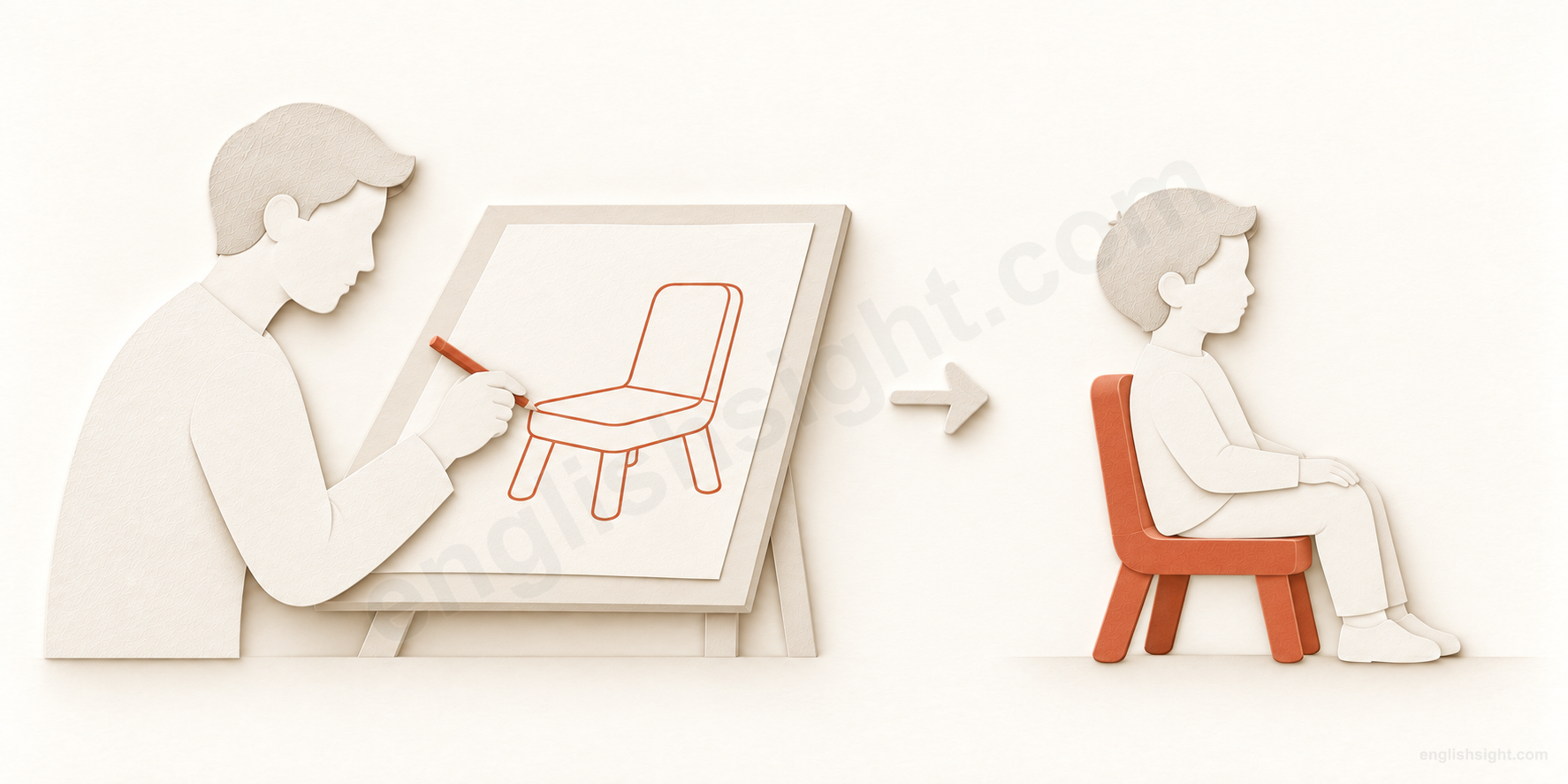
Connect a planned form, the way something works, and the intention behind it.
A planned form and an intended use
Choose a form for an intended use
A designer plans a low chair.
design
A child sits with both feet on the floor.
The chosen form is linked to its intended use.
The low seat is planned to suit a child. The right-hand scene illustrates its intended use, not a guaranteed result.
To design something is to work out how it should look or function, choosing and arranging details with a purpose in mind.
The chair illustrates a connection between a planned form and an intended user. Design also applies to abstract systems, decoration, and intentions; it does not require a finished object or guarantee that the purpose is achieved.
A chair’s height, a course’s activities, and a decorative pattern all involve choices about an arrangement. Design can name the work of making those choices, a plan that records them, or the arrangement itself.
A useful teaching connection is purposeful planning. It helps relate the main uses without turning every design into a drawing or treating every intention as successful. Established expressions still need their own contexts.
01
Work out a form or a system
The verb focuses on decisions about how something will look or work. The person who designs it need not be the person who makes it.
01
design + object; object + be designed by + designer
design a chair
decide the form and working details of something to be made
Situation / need
A workshop needs a low seat for young children.
Plan / interpretation
Maya works out its height, shape, and support.
The object of design is the thing whose form is being planned.
A designer makes choices about an object, often using drawings or models. In our chair picture, the height matters because a child will use it. Design can concern usefulness as well as appearance.
Maya designed the chair; Leo built it separates planning from making. The chair was designed by Maya is the ordinary passive: the chair becomes the subject and by names its designer. Designing does not itself guarantee that an object is built.
In a sentence
Maya designed a low chair, and Leo built it from her drawings.
Watch the difference A drawing of an existing chair may simply copy what is there. Designing a chair involves deciding how it should be.
work out how a set of actions or parts will operate together
Situation / need
Books are being returned without any record.
Plan / interpretation
The staff agree on a sequence for checking and recording returns.
The planned object can be a procedure, service, course, survey, or experiment.
Design need not produce a visible shape. When you design a system, you decide its rules and how its parts fit together. A course needs activities in a useful order; a survey needs questions that gather the information wanted.
Compare We plan to return the books tomorrow with We are designing a returns system. Plan to states an intended action; design a system concerns the arrangement that makes a process work.
In a sentence
The librarians designed a simple system for recording returned books.
Watch the difference Do not limit design to drawing or decoration. It can describe planning how an activity operates.
03
design + thing + for + client; design + person + thing
design something for someone
create a design for a client or beneficiary
Situation / need
A bakery needs a new logo.
Plan / interpretation
A designer agrees to create one for the bakery.
For can name the person or organization receiving the design work.
Design a logo for the bakery identifies whose project it is. With a person as recipient, the two-object pattern is also possible: Could you design me a logo? Me is the recipient; a logo is the thing to be designed.
Read for in context. A designer may design a poster for a café, while the poster itself is designed for customers to read. The client and the intended audience can be different.
Design can also appear without a stated object when the kind of work is clear: She designs for a local furniture company. Here for names the business she works for; design for is not a separate phrasal verb.
In a sentence
Could you design me a logo for my new bakery?
Watch the difference Keep both objects in the two-object pattern: design me a logo, not design me when you mean create a logo for me.
02
Say who or what it is intended for
For names users, uses, or conditions; to introduces an intended action; as identifies an intended role. These patterns describe an intention, which may differ from the eventual result.
04
be designed for + person / use / noun phrase / -ing
be designed for
be planned with particular users, uses, or conditions in mind
Situation / need
Some people need larger, easier-to-press keys.
Plan / interpretation
A keyboard is planned for those users.
For introduces a noun phrase or an -ing activity.
In a keyboard designed for children, for children identifies its intended users. In equipment designed for outdoor use, for outdoor use identifies its intended conditions. In shoes designed for running, for running identifies an intended activity; running follows the preposition for.
This is about the purpose built into the planning, not proof that every user will find the product suitable. Not designed for heavy loads warns that such use was outside the intended conditions.
Designed with safety in mind makes a planning priority explicit. With names the consideration guiding the choices; it does not name the person who created the design.
In a sentence
These large-key keyboards are designed for young children.
Watch the difference For children identifies users; by children would identify the designers. For and by answer different questions.
05
be designed to + base verb; design + object + to + base verb
be designed to do something
be intended to perform a function or bring about an effect
Situation / need
A door should close after someone passes through.
Plan / interpretation
A mechanism is planned to close it automatically.
The infinitive names the intended action or effect.
In The device is designed to close the door, the device is the subject and close the door is its intended function. The active form is possible too: We designed the device to close the door.
A lesson designed to build confidence and a message designed to frighten someone use the same pattern for an intended effect. The phrase does not promise success: a warning can be designed to help and still be ignored.
In a sentence
The device is designed to close the door slowly.
Watch the difference Use designed to close, not designed to closing. Use designed for closing when for introduces the activity.
06
be designed as + noun phrase
be designed as something
be planned to serve a particular role
Situation / need
A room is being planned for storage.
Plan / interpretation
People later start using it as an office.
As names the intended identity or role, which may differ from actual use.
Designed as a storeroom tells us what kind of space the planner intended. Designed for storing equipment describes its use; designed to keep equipment dry describes a function. Each construction selects a different part of the purpose.
Originally and later often make a change of use clear. Something can still have its original design even after people give it another role.
In a sentence
The room was designed as a storeroom, but we now use it as an office.
Watch the difference As needs a role here: as a storeroom. Use to store for an action, rather than as to store.
03
Talk about plans, features, and design work
The noun can name a particular proposal, an arrangement, a decorative pattern, or the activity itself. Context and countability help you choose the meaning.
07
a / the + design for + project; build / make + thing + to a design
a design for something
a particular plan, drawing, or model showing what may be made
Situation / need
The garden layout has not been chosen.
Plan / interpretation
Two proposals are available for comparison.
A countable design can exist before any construction starts.
One design, two designs, and the final design can refer to distinct proposals. Draw up, submit, approve, and revise a design describe stages in working with such a proposal.
For names the project in a design for a garden. Built to a design means made according to that plan: The bench was built to our own design. These are noun phrases, unlike We design gardens, where design is a verb.
In a sentence
We submitted two designs for the school garden before choosing one.
Watch the difference A design is not automatically a finished object. You can approve a design for a building that is never built.
08
the design of + thing; a simple / compact / modern design; simple in design
the design of something
the way the parts of something are arranged
Situation / need
A shelf is difficult to reach.
Plan / interpretation
You examine its position and the arrangement around it.
Design can describe the organization visible in the finished thing.
The design of a kitchen can include positions, proportions, and access, not just colours. Here the noun refers to the arrangement itself. A compact design names one type of arrangement; simple in design describes it from that viewpoint.
A design for a kitchen usually presents a proposal for it. The design of this kitchen often discusses the arrangement it actually has. Context can overlap, so for and of are useful clues rather than absolute dividing lines.
In a sentence
I like the design of this kitchen because every shelf is easy to reach.
Watch the difference Design includes practical organization. It need not mean only how attractive something looks.
09
a floral / geometric / abstract design; a design on + surface
a design on something
a decorative arrangement of lines, shapes, or images
Situation / need
A plain tile has no decoration.
Plan / interpretation
A pattern of leaves is added to its surface.
The design can be decoration on an object rather than the object’s structure.
A leaf design on a tile describes a decorative motif. Floral, geometric, and abstract designs are useful descriptions of different kinds of pattern. This sense is countable: a design, several designs.
Compare the design on the plate, which points to its decoration, with the design of the plate, which can include its shape and structure. A decorative design need not repeat across the whole surface.
In a sentence
She chose white tiles with a blue leaf design on them.
Watch the difference The noun phrase a design on a tile is different from the idiom have designs on something.
10
study / work in + design; graphic / interior / fashion / web / product design
study design
study or practise the work of planning how things look and function
Situation / need
Someone wants to learn how to develop useful visual forms.
Plan / interpretation
They take a course in the subject.
Design is normally uncountable when it names an activity or field.
Study design, work in design, and do design work treat design as a field or activity. Graphic design, interior design, fashion design, web design, and product design identify particular areas of that work.
Compare She studies design with She studies three designs. The first names a subject; the second says she examines three particular proposals. A design studio is a place or business doing this work, not a special verb form.
In a sentence
Nora studies product design and hopes to develop safer kitchen tools.
Watch the difference For the general subject, say She studies design, without a. Use a design for one particular proposal or pattern.
11
design + feature / flaw / fault; a flaw in the design
a design feature / flaw
a planned characteristic, or a problem in the underlying arrangement
Situation / need
Every copy of a lid is awkward to open.
Plan / interpretation
The handle’s shape is identified as the problem.
Design before another noun tells us what kind of feature or fault is involved.
A design feature is a characteristic of the arrangement, such as a wide handle. A design flaw or design fault is a weakness in that arrangement. Feature is neutral; flaw and fault mark a problem.
If every lid has an awkward handle because the plan gives it too little space, that suggests a design flaw. One lid damaged during production may instead have a manufacturing defect. The contrast locates the problem; design flaw does not mean the planner wanted the failure.
In a sentence
The narrow handle is a design flaw that makes the lid hard to open.
Watch the difference A design flaw can be unintended. Do not confuse a defect in a plan with an action done by design.
12
at the design stage; the design process
at the design stage
in the phase of working out the plan before production or construction
Situation / need
The team is still choosing dimensions and materials.
Plan / interpretation
Production has not started.
Stage and process describe where the planning work fits in a project.
At the design stage places a project in a phase where its details are still being worked out. The design process names that work over time and can include trying ideas, testing them, and revising them.
Design and development often appear together in work descriptions. They can overlap in a real project, so the phrase at the design stage is a description of its current focus, not a universal rule that all projects follow one rigid sequence.
In a sentence
The new playground is still at the design stage, so no building work has begun.
Watch the difference A project at the design stage is not necessarily ready to make. Key decisions may still change.
04
Recognize plans and established expressions
Design also connects with intention. Some expressions are neutral, while have designs on often suggests a personal ambition or an unwelcome interest.
13
a grand / larger / overall design; a design for + goal or project
a grand design
an ambitious overall plan for achieving something
Situation / need
Several separate changes are proposed for the town.
Plan / interpretation
They are presented as parts of one larger plan.
The noun can concern an intended future, without a drawing or physical product.
A grand design brings several aims or steps under one broad plan. Grand adds ambition or scale; design supplies the idea of a planned arrangement. It may concern an organization, a town, or a political aim.
Part of a larger design connects an event with an overall intention. This use can sound formal, ambitious, or skeptical in context. For an ordinary personal intention, I plan to learn French is usually more natural than I design to learn French.
Sinister designs refers to suspected harmful plans. In this context designs names intentions, not drawings or decorative patterns.
In a sentence
The new park is part of a grand design to make the town greener.
Watch the difference Grand does not prove that a plan is good or achievable. It describes its scale or ambition.
14
happen / be done + by design; by accident or by design
by design
deliberately, as an intended choice
Situation / need
A page has a large empty area.
Plan / interpretation
Its creator explains that the space was deliberately left empty.
The fixed expression concerns intention, not a drawing.
By design says that someone intended what happened or how something is arranged. By accident or by chance supplies the familiar opposite: an outcome arose without that intention.
The site collects no location data by design means that this was a deliberate choice. It need not describe decoration or a professional designer. In designed by Ana, however, by introduces the person responsible; that is a different construction.
In a sentence
The space at the top of the page is empty by design.
Watch the difference Keep the expression by design, without a. By a designer names an agent and has a different meaning.
15
have designs on + property / position / other desired thing
have designs on something
intend to obtain something for yourself, often in a way others distrust
Situation / need
A rival is interested in taking over a family’s shop.
Plan / interpretation
The family suspects a plan to acquire it.
Plural designs and on belong to an established idiom.
Have designs on the shop means want to get control or possession of it. The expression often presents the intention as selfish, unwelcome, or suspicious, and can sound formal. It does not necessarily mean a crime has occurred.
A drawing of a shop is a design for the shop. Someone who has designs on the shop has an ambition concerning its possession or control. Neither the plural nor on can be interpreted as a literal decorative surface here.
In a sentence
The family suspects that a rival has designs on their shop.
Watch the difference Use the plural in this idiom: has designs on. Has a design for the shop would describe a proposal instead.
16
have designs on + person
have designs on someone
want to begin a sexual relationship with someone
Situation / need
Someone’s attention appears to be more than friendly.
Plan / interpretation
Another person comments on the apparent intention.
With a person as target, the idiom can refer to sexual interest.
Have designs on a person can suggest wanting a sexual relationship with them. Oxford marks this use formal or humorous. It may sound teasing or disapproving, so it is not a neutral way to describe every friendship or ordinary date.
It expresses someone’s supposed intention, not the other person’s consent and not an established relationship. Context matters: with a business or a job as object, the same idiom instead concerns acquiring something.
In a sentence
“Do you have designs on Alex?” she asked teasingly.
Watch the difference The expression can sound intrusive or suggestive. For a neutral inquiry, Are you interested in Alex? is less loaded.
Read the purpose and the grammar together
Design, draw, make, and plan
Draw can represent something already there; design involves decisions about a form or process. Make can concern producing the thing. Plan is broader: you can plan to phone a friend without designing anything. Real projects may combine these activities.
Count the proposal, not the whole field
A design and several designs can name proposals, arrangements, or decorative patterns. Design as a field or activity is normally uncountable. The context determines whether the noun refers to planning, a plan, or the thing’s arrangement.
Forms and sound
The noun and verb share the pronunciation /dɪˈzaɪn/, with stress on the second syllable and no separate /ɡ/ sound. Verb forms are design, designs, designed, designing. The -ed ending in designed is /d/.
Active work and intended function
We are designing a chair is a normal progressive for ongoing work. The chair was designed by Maya identifies its creator; it is designed for children identifies its users; it is designed to fold identifies its function. A well-designed chair evaluates the planning. Before a noun, well-designed is hyphenated.
Boundaries
This lesson covers modern everyday noun and verb uses and selected established idioms. Specialized technical combinations, historical senses, and detailed design terminology are outside its scope. The diagram is a teaching model, not evidence that every English speaker imagines the same picture.
Choose the meaning in context
Use the subject, the preposition, and the situation to identify the intended meaning.
1. Maya created the plans, and Leo made the actual chair. Which sentence identifies the designer?
2. The tool was planned to open tight lids. Which sentence gives its intended function?
3. You mean Nora is taking a course in design as a general subject. Which sentence fits?
4. The empty space on a page was a deliberate choice. Which expression makes that clear?
5. A rival has designs on the shop. What is the likely meaning?
6. A lesson is designed to build confidence. Does that promise that every learner becomes confident?
Sources and teaching notes
The sources below support the meanings and constructions. Explanations, examples, and the visual teaching model were created for this lesson.
The diagram illustrates a teaching connection; individual speakers do not necessarily imagine the same picture.