Use destruction for destroying, being destroyed, and serious ruin.
From a working whole to destructive loss
A working whole loses its structure or value
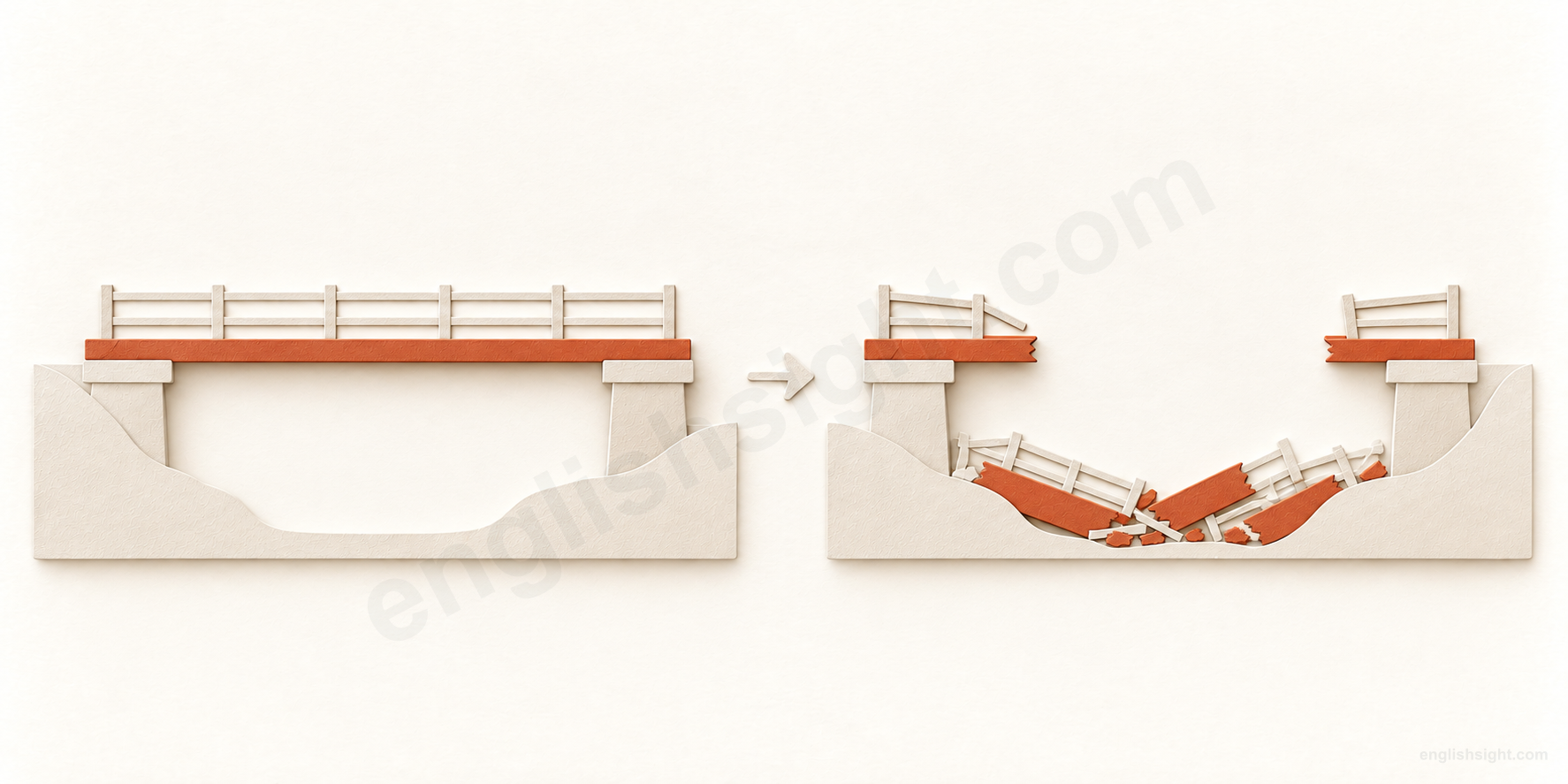
An intact bridge provides a crossing.
destruction
The piers and broken pieces remain, but the bridge can no longer be crossed.
The middle span collapses, breaking the crossing.
Destruction: the bridge loses its crossing function, although material remains.
Destruction is the process of destroying something or the state of being destroyed: a thing, its function, or its value is ruined.
A bridge illustrates physical loss. Reputations and careers can be ruined without physical fragments. Causes, intention, and prevention come from the whole expression and its context.
Destruction /dɪˈstrʌkʃən/ is a noun. It can name the process of destroying something or the resulting loss. It is usually far stronger than a small defect or inconvenience.
A useful teaching image is a bridge whose span has collapsed: the material is still there, but the crossing no longer works. This image helps connect uses; it is not a claim about a picture shared by all English speakers.
01
What is destroyed, and what remains?
Name physical loss, the loss of a habitat, or the ruin of something valuable. The noun can describe a process or its result.
01
the destruction of + thing
the destruction of a bridge
the loss of a thing’s usable structure
Situation before
The bridge carries people across the river.
Result or response
Its span collapses; it can no longer carry them.
Destruction is stronger than an ordinary scratch or repairable defect.
Destruction names destroying or being destroyed. In a physical case, a thing may lose the structure that made it useful or recognizable. The bridge in the sketch no longer provides a crossing, even though stones remain.
The destruction took several hours views the process; the destruction was visible from the hill views the result. These are related ways to view the same loss, not necessarily separate events.
Damage can be slight or severe; destruction normally suggests a much more complete loss. Compare damage to the bridge with the destruction of the bridge. Destruction does not require every piece of material to disappear.
In a sentence
The flood caused the destruction of the wooden bridge.
Watch the difference Use the noun after caused: caused destruction. For the action directly, say The flood destroyed the bridge.
02
habitat / forest / environmental + destruction; destruction of + place
habitat destruction
the loss of places where living things can survive
Situation before
Animals depend on a wetland for food and shelter.
Result or response
The wetland is removed and their habitat is lost.
A place can be destroyed as a habitat without every part of the land disappearing.
Habitat destruction focuses on the loss of a living environment. Forest destruction and the destruction of the rainforests name related losses; environmental destruction is a broader description.
In habitat destruction, habitat is a noun used before destruction to classify the loss. The destruction of the wetland names a particular affected place. These are ways to specify the same general meaning, not new meanings of destruction.
The bridge model helps with loss of function: land may remain, yet no longer support the same living community. It does not imply that a habitat must look like broken masonry.
In a sentence
Habitat destruction has left the birds with fewer places to nest.
Watch the difference Habitat loss is a useful alternative. Do not assume all environmental damage amounts to complete habitat destruction.
03
the destruction of + abstract noun; X + be + someone’s destruction
the destruction of a reputation
the ruin of something valuable but not physical
Situation before
People trust a company’s name.
Result or response
Revelations leave its reputation in ruins.
The lost thing may be trust, a career, or a way of life rather than an object.
Destruction can describe a serious loss of value, standing, or viability. A reputation is not smashed into pieces; the physical model is a memory aid for the scale of the loss.
Compare damage to her reputation with the destruction of her reputation. The second is a much stronger claim. In ordinary conversation, It ruined her reputation is often more direct than the noun phrase.
In the formal or dramatic pattern X was his destruction, X is the cause of someone’s ruin: His ambition was his destruction. Here the noun names the ruining influence, not simply the resulting state. Learn this as an established extension.
In a sentence
The scandal led to the destruction of the company’s reputation.
Watch the difference Use this strong noun when the context supports serious ruin; a minor criticism need not cause destruction.
02
Describe the cause, scale, and response
Use verbs, prepositions, and modifiers to say what caused the destruction, how extensive it was, and whether it was prevented.
04
cause / bring about / lead to / wreak + destruction; destruction of X by Y
cause destruction / the destruction of… by…
identify the cause and the thing affected
Situation before
A fire spreads through a warehouse.
Result or response
Stored goods are destroyed.
Of names what is destroyed; by can identify the destroying agent or cause.
Cause destruction and bring about destruction describe producing the loss. Lead to destruction emphasizes a consequence, which may develop through several steps. Wreak destruction is a stronger, often journalistic way to say cause it.
Compare the destruction of the files by the fire with the destruction caused by the fire. The files are affected; the fire is the cause. Destruction from the fire also identifies the source of the harm.
The fire destroyed the files has an active verb; the files were destroyed by the fire is passive. The noun destruction itself has no tense or passive form. Its modifiers and surrounding verbs supply those relationships.
In a sentence
The destruction of the stored goods by the fire left the shop with nothing to sell.
Watch the difference For the thing affected, use destruction of the goods. Compare damage to the goods; do not transfer to mechanically from damage.
05
modifier + destruction; much destruction; an act of destruction
widespread / total / wanton destruction
distinguish extent, completeness, and attitude
Situation before
Several areas are affected by destructive events.
Result or response
A report specifies the scale or deliberate nature of the loss.
Different modifiers answer different questions about the destruction.
Widespread destruction concerns a large area or many places. Total, complete, or utter destruction emphasizes the thoroughness of the loss. Widespread does not by itself mean every affected thing is completely destroyed.
Wanton destruction condemns needless, reckless, or unjustified destroying. Deliberate destruction says the action was intentional. Neither adjective alone measures the size of the affected area.
Destruction is normally uncountable: much destruction, widespread destruction, or an act of destruction. The destruction we saw uses the because a particular loss is identified. To count separate events, say three acts of destruction, not three destructions in ordinary learner usage.
In a sentence
The storm caused widespread destruction across the valley.
Watch the difference Use widespread for reach and total for completeness. Do not use a destruction to mean one damaged object.
06
order the destruction of + material; material awaiting destruction
the destruction of records
deliberately make documents or materials unusable
Situation before
Old confidential paper records are no longer needed.
Result or response
They are shredded so that their contents cannot be read.
Destruction can be planned disposal rather than an accidental disaster.
The destruction of documents can be a routine organizational process. The noun alone does not tell us whether it was sensible, lawful, accidental, or malicious; the context supplies that judgment.
Order the destruction of the records means require that the records be destroyed. Records awaiting destruction have been set aside for that process. In these formal noun phrases, the affected material follows of or appears as the subject of awaiting.
Destruction of evidence uses the same basic meaning in a different context: material that might establish what happened is destroyed. It is not a separate grammar pattern or a synonym for routine record keeping.
In a sentence
The manager ordered the destruction of the old confidential paper records.
Watch the difference The phrase says material is destroyed; it does not by itself explain why the action was taken or whether it was authorized.
07
prevent destruction; save X from destruction; X escapes destruction
save from / escape destruction
stop the loss or say that a threatened thing survived
Situation before
An old building is threatened with being demolished.
Result or response
A campaign saves it, and it remains standing.
The surrounding verb can deny or prevent the outcome that destruction names.
Prevent destruction means stop it happening. Save a building from destruction adds an affected object and the danger it is rescued from. Avoid destruction and escape destruction can describe a thing that was not destroyed despite the threat.
The paintings escaped destruction does not mean they walked out. Escape can describe remaining unharmed by a dangerous event. Likewise, destruction was prevented does not say that the destructive event actually took place.
The bridge sketch shows an outcome; these patterns ask us to imagine that outcome as a threat that was averted. Always read the verb and any negation before deciding whether destruction occurred.
In a sentence
A local campaign saved the old cinema from destruction.
Watch the difference Distinguish escaped destruction from survived the destruction of the town: a person may survive while the town is destroyed.
03
Established expressions and compounds
Learn the additional meaning supplied by each whole expression. These are noun phrases and constructions, not phrasal verbs.
08
leave a trail of destruction; leave destruction in one’s / its wake
leave a trail of destruction
leave destructive effects along a route
Situation before
A tornado moves through several settlements.
Result or response
Destroyed buildings mark where it passed.
Trail connects the destructive results to the path of a moving cause.
The whole expression describes a sequence of destructive effects left behind as something travels or proceeds. A trail need not be a neat line or a path someone can safely walk along.
It is common in disaster reporting and can also be used figuratively for repeated harmful consequences. The phrase is stronger than saying that something caused one small problem.
In its wake similarly locates effects after an event or in its aftermath: The storm left destruction in its wake. Learn wake in this expression as aftermath, not waking from sleep.
In a sentence
The tornado left a trail of destruction through three villages.
Watch the difference The trail consists of the results, not a separate force that destroys things.
09
sow the seeds of + possessive + destruction
sow the seeds of your own destruction
create conditions that later bring about your ruin
Situation before
A business repeatedly ignores complaints.
Result or response
Its choices help bring about its eventual failure.
Seeds is a metaphor for early causes whose effects develop later.
This expression links present behavior to future ruin. Sow contributes the idea of setting a process in motion; seeds contributes beginnings that can develop. No literal planting is involved.
Own points back to the person or organization whose choices create the conditions. It does not necessarily mean they want to fail, nor does it mean that every minor mistake guarantees ruin.
The seeds of destruction can also be used without sow. These are established metaphorical phrases; the collapsed-bridge picture alone cannot supply the idea of a delayed, self-created cause.
In a sentence
By ignoring every warning, the firm sowed the seeds of its own destruction.
Watch the difference Use its own for a firm and your own for the person addressed; the possessive identifies whose ruin is meant.
10
test + object + to destruction; be tested to destruction
test something to destruction
continue testing until the object fails destructively
Situation before
Engineers need to know a chair’s breaking limit.
Result or response
They increase the load until the chair breaks.
To marks the destructive endpoint of the test.
Test a product to destruction means push the testing as far as destructive failure. The test can reveal how much stress it withstands; it is not simply checking whether the product already has damage.
The construction also appears in figurative use, such as an argument tested to destruction: the idea is subjected to exceptionally severe scrutiny. Whether it survives that scrutiny depends on context.
The object goes between test and to destruction: They tested it to destruction. In It was tested to destruction, the passive belongs to test, not to the noun.
In a sentence
The engineers tested the chair to destruction by adding more and more weight.
Watch the difference Do not read to destruction as a place or as an infinitive: destruction is a noun naming the endpoint.
11
a weapon of mass destruction; weapons of mass destruction
weapons of mass destruction
a conventional term for weapons capable of enormous destructive loss
Situation before
A news report discusses certain powerful weapon types.
Result or response
The term groups them by their capacity for large-scale devastation.
Mass describes the scale; the full term has an established public meaning.
Weapons of mass destruction, often abbreviated WMD, refers to weapons such as nuclear, chemical, and biological weapons capable of very extensive harm and loss of life.
The singular is a weapon of mass destruction; the plural changes weapon to weapons. Destruction stays uncountable. The phrase concerns capability and does not say that a particular weapon has already been used.
This is useful for understanding news. The lesson introduces the language of the term, not technical classifications, weapons design, or political judgments.
In a sentence
The report discusses efforts to control weapons of mass destruction.
Watch the difference Pluralize weapons, not destruction: weapons of mass destruction.
12
self-destruction; self-destructive + behavior
self-destruction
ruin or serious harm brought upon oneself
Situation before
A person repeatedly acts against their own well-being.
Result or response
Their own conduct seriously harms their life or prospects.
Self- points to the same person as both source and affected party.
Self-destruction can describe patterns of behavior that seriously undermine someone’s life or well-being. The prefix connects the destructive action to the person affected; it does not merely mean harm caused by someone else.
It is a strong expression, not a neutral name for a single unwise choice. Depending on context it can also refer specifically to taking one’s own life, so read the surrounding account before choosing an interpretation.
Self-destructive is the corresponding adjective in self-destructive behavior. Neither this compound nor the seeds expression means every harmful consequence was deliberately intended.
In a sentence
The novel follows a talented actor’s gradual self-destruction.
Watch the difference Do not assume the noun always refers to a literal death; do not reduce its serious meaning to ordinary disappointment either.
Choose the strength and grammar carefully
Damage, destruction, and demolition
Damage can leave something usable and can range from slight to severe. Destruction presents loss of the thing, its function, or its value much more strongly. Demolition usually names the deliberate taking down of a structure; a storm can cause destruction without a planned demolition.
A noun needs the right surrounding words
Say cause destruction, the destruction of the building, and a destructive fire. Destroy is the related verb: destroyed and destroying. Destruction is not a verb and has no tense, separable-particle pattern, or causative verb construction of its own.
Scope and register
This lesson covers the modern uncountable noun, common reporting patterns, and selected established expressions. The cause-of-ruin use can sound formal or dramatic. Rare count uses, detailed legal terminology, medical tissue processes, animal-destruction terminology, and specialist theories such as creative destruction are not expanded here.
Check the relation and the whole phrase
Choose the expression that matches the situation, including whether destruction actually happened.
1. A bridge has a small scratch but still works normally. Which description fits without exaggerating?
2. A fire destroys stored records. Which phrase identifies the records as the thing affected?
3. A campaign saves a cinema from destruction. What happened?
4. Engineers test a chair to destruction. What does to destruction contribute?
5. A firm sows the seeds of its own destruction. What is the warning?
Sources and teaching notes
The linked dictionary entries support the meanings and expressions. Explanations and examples are original; the bridge is a teaching model, not evidence about how every speaker thinks.
The diagram illustrates loss of a working structure. Abstract and fixed expressions need the accompanying explanations.