Use detail for a particular feature, specific information, or close attention to particulars.
A particular within a larger whole
A particular within a larger whole
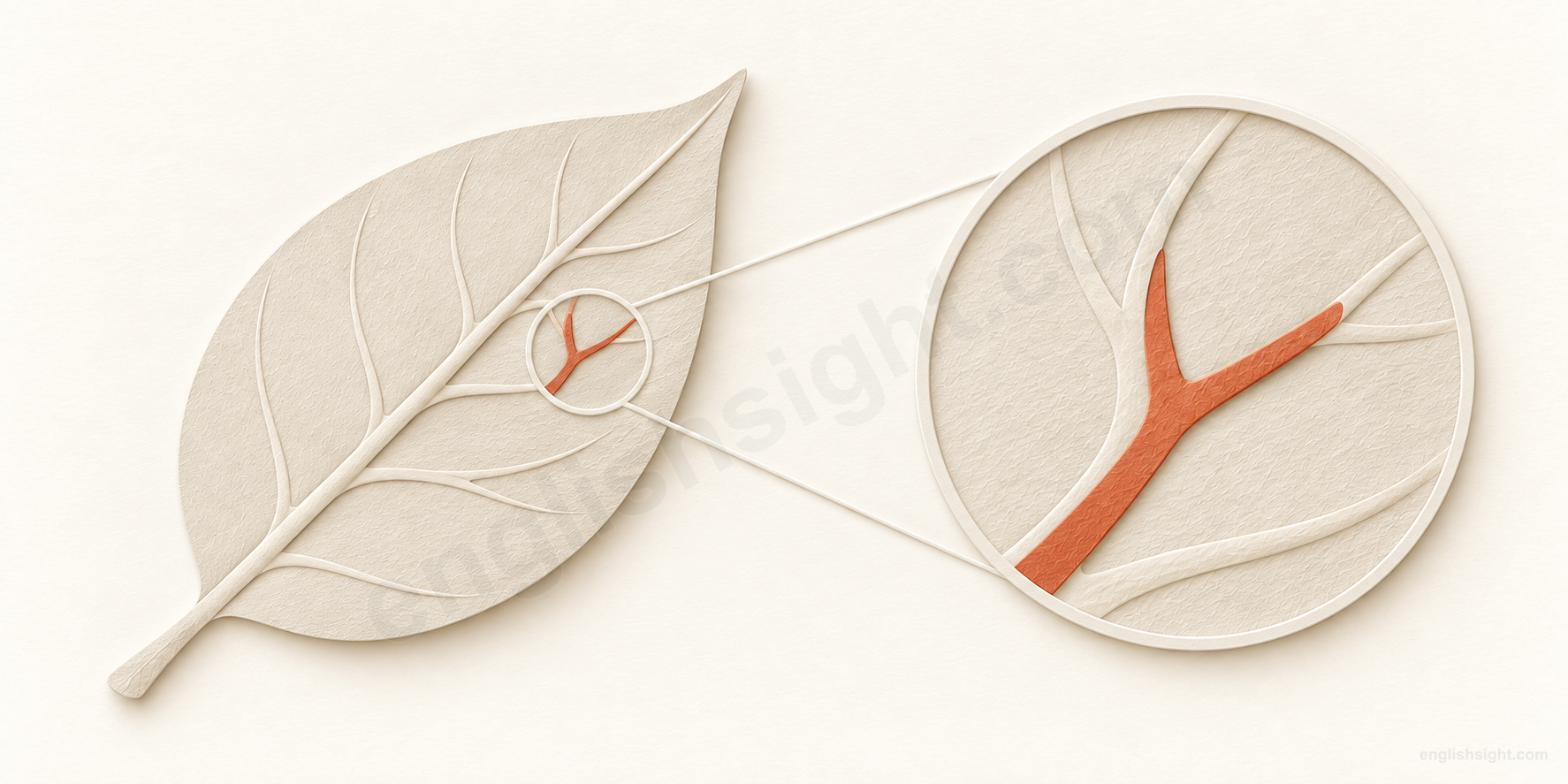
The whole leaf
detail
The same vein enlarged
Focus on one small branching vein.
The close view reveals one small feature of the same leaf; the whole remains intact.
A detail is an individual fact or small feature considered in relation to a larger whole.
The leaf is a teaching model for focusing on particulars. It supports the main noun family and the reporting connection; official assignments and vehicle services need their own contexts. It does not claim one mental picture shared by all English speakers.
A general view tells you what something is about. A detail brings one fact or feature into focus: a date in an arrangement, a vein in a leaf, or a step in an explanation. Small in scope does not have to mean unimportant.
English distinguishes a countable detail, plural details used for information, and uncountable detail used for specificity or fine features. The verb adds reporting and several established branches. Learn the whole construction when the meaning changes.
01
One feature within a whole
Start with one particular part or fact. A detail can be small, important, visible, or described in words.
01
a / one / every + detail; a detail of + whole
a detail of something
one particular feature or fact within a larger context
Whole or context
You remember a birthday party as a whole.
Particulars or close view
You pick out the color of the candles.
The detail belongs to a larger event, object, or account.
A detail is one thing you can single out within something larger. The candle color is a detail of the party; the party itself is the larger event.
Count individual items: one detail, two details, every detail. The same idea works for an object, an experience, or a story. You can notice a detail, remember it, or leave it out when speaking.
The leaf sketch offers a visual analogy: one branching vein belongs to the whole leaf. Facts in a story need not be physical pieces you can remove.
In a sentence
I remember one detail of the party: the candles were blue.
Watch the difference Every takes a singular noun: every detail, not every details.
02
minor / small / important / crucial + detail
a minor detail / an important detail
a small point whose importance depends on the situation
Whole or context
The plan is agreed, but the meeting room is undecided.
Particulars or close view
You describe the remaining point as minor.
Small in scope does not always mean unimportant.
That’s a minor detail puts a point below the main issue in importance. That’s just a detail can similarly dismiss something as secondary; that judgment comes from the speaker and the context.
An important detail or a crucial detail is equally natural. A tiny error in a house number can stop a delivery, although it occupies very little space in an address. Do not treat detail as a synonym for mistake or for something that never matters.
In a sentence
We have agreed on the budget; choosing the room is a minor detail.
Watch the difference Calling a concern just a detail can sound dismissive if the other person considers it important.
03
fine detail; a lot of detail; lose / show detail
fine detail
the small visible features of an image or design
Whole or context
A photograph shows the outline of a leaf.
Particulars or close view
A closer view also reveals its tiny veins.
Here detail concerns visible features rather than written facts.
A picture with fine detail makes small features visible. Detail is often uncountable in this use: the amount of detail can increase, or detail can be lost when an image is reduced.
You can also count particular features: The artist added three small details to the jacket. Much detail refers to richness of small features; many details counts the features individually.
In a sentence
The photograph shows fine detail in the leaf’s veins.
Watch the difference Fine here concerns small or delicate features; it does not simply mean that the photograph is good.
04
a detail from / of + painting or other artwork
a detail from a painting
a selected portion of a picture shown on its own
Whole or context
A painting contains a figure beside a window.
Particulars or close view
A book reproduces just the window area for close study.
A detail can name the selected view as well as the feature itself.
In an art caption, a detail from a painting is a reproduction or view of a small part of the original. It may be enlarged so that the reader can study it.
This is a countable noun: a detail, or two details from the same painting. The fragment represents part of a larger work; it is not necessarily a separate artwork or a damaged piece cut from the original.
In a sentence
The next page shows a detail from the painting: the open window.
Watch the difference Do not assume that a picture labeled detail shows the complete original work.
02
The information people need
Use plural details to ask for facts, complete a form, arrange a plan, or find out how something works.
05
details of / about + subject; details of how + clause or to-infinitive
details of / about something
specific facts concerning a subject
Whole or context
You know a course will run next month.
Particulars or close view
You ask for its dates, cost, and location.
Use plural details for the specific facts behind a general announcement.
Ask for details of the course or details about the course when you need its specific information. Of connects the information to its subject; about names the topic. Both are possible in many everyday contexts.
With an action or procedure, details of how to apply introduces what the application involves. You can ask for, give, check, confirm, or record details. These ordinary verb-and-noun combinations are not new senses of detail.
Details are available uses plural agreement. Information is different grammatically: information is available, or several pieces of information are available.
In a sentence
Could you send me details of how to apply for the course?
Watch the difference Use details are and some information is; do not copy the plural grammar of details onto information.
06
possessive + personal / contact / bank details; enter / take / update + details
personal / contact / bank details
a set of facts identifying a person, contact method, or account
Whole or context
A form asks how to reach you.
Particulars or close view
You enter an email address and telephone number.
The word before details tells you what information is requested.
Contact details are ways to reach someone, such as a telephone number or email address. Personal details can include a name, address, and other identifying facts. Bank details concern an account; they are a different set of information.
Give me your details or The receptionist took my details means that the person supplied or recorded the relevant information. Took does not mean that a physical object was removed.
Details is normally plural for this set. A contact detail can refer to one particular item in a suitable context, but Please send your contact details is the usual request for the set.
In a sentence
Please update your contact details if your phone number changes.
Watch the difference Read the modifier: contact details does not request a full account of your private life.
07
for further / more / full details, + instruction
for further / full details
direct someone to additional or complete information
Whole or context
A poster gives a short announcement.
Particulars or close view
It tells readers where to find application instructions.
Further adds information; full promises a more complete set.
For further details often introduces a contact address, link, or instruction. Further means additional here, not more distant in space. For more details is another natural choice.
The phrase full details promises the complete relevant particulars; the phrase exact details emphasizes precision. More details may add new items, whereas more detail can deepen the explanation of an existing item. The difference is a viewpoint, not a rigid ban on either form.
In a sentence
For further details, email the course office.
Watch the difference Details is a noun here: for further details, not for further detailed.
08
work out / sort out / finalize + the details of + plan
work out / sort out the details
decide or organize the specific parts of a plan
Whole or context
Your group agrees to hold a workshop.
Particulars or close view
You decide its times, room, and equipment.
The overall decision is followed by practical particulars.
Work out the details means develop or decide the specific arrangements. Sort out the details emphasizes organizing or resolving them. Finalize the details means bring those decisions to their finished form.
The details can be described as practical, final, or finer. Finer details are the more precise points that a broad outline leaves open; finer does not necessarily mean better.
In these expressions, detail remains the noun naming the particulars. The planning meaning of work out or sort out comes from the whole verb expression, not from detail alone.
In a sentence
We agreed to run the workshop, but we still need to work out the details.
Watch the difference Working out the details is planning; giving someone the details is communicating information already available.
03
How closely you look or explain
Uncountable detail describes the amount of specific information or fine features. Familiar expressions tell us how thoroughly someone notices, plans, or explains.
09
more / less / enough / too much + detail; a level / lack of detail
more / less detail
the amount of specific information or treatment
Whole or context
A report only states that repairs are needed.
Particulars or close view
You ask the writer to name the broken parts and required work.
Uncountable detail measures specificity rather than separate items.
An explanation needs more detail when it is too general. You can say enough detail, too much detail, a lack of detail, or a high level of detail. These expressions treat the particulars together.
Compare Add two details with Add more detail. The first asks for two countable pieces; the second asks for a fuller account without counting them. A brief answer may still contain one crucial detail.
In a sentence
Your report needs more detail about the repairs.
Watch the difference Use much detail and many details. Avoid a detail when you mean the general amount of information.
10
attention to detail; pay attention to + the details of something
attention to detail
care with small features or specific points
Whole or context
A designer checks spacing, labels, and measurements.
Particulars or close view
Small inconsistencies are corrected.
Attention to detail describes careful treatment of particulars.
Attention to detail is a useful expression for care and accuracy in work. To is a preposition linking attention with what receives it. The uncountable noun detail gathers the small points together.
Pay attention to the details is also natural when you mean a particular set of facts or features. Attention to detail names a general quality; attention to the details of this booking narrows it to the booking.
In a sentence
The repaired chair shows real attention to detail: even the joints are neatly finished.
Watch the difference Attention to detail describes care, not a guarantee that every decision or claim is correct.
11
have + an / a good / a keen + eye for detail
an eye for detail
an ability to notice small features that matter
Whole or context
Two copies of a design look almost identical.
Particulars or close view
A colleague notices a tiny change in spacing.
Eye is a figurative way to describe noticing ability.
Someone with an eye for detail notices small points that other people might miss. A good eye or a keen eye strengthens the description. It can be a useful ability in design, editing, or checking work.
Compare attention to detail, which emphasizes care, with an eye for detail, which emphasizes noticing. A person may spot a problem quickly and then need time to correct it carefully.
In a sentence
Maya has an eye for detail; she spotted the uneven spacing immediately.
Watch the difference This expression describes an ability, not a literal extra eye or a diagnosis of eyesight.
A mechanic gives you the general reason for a fault.
Particulars or close view
You ask for a closer explanation of its cause and repair.
In detail tells us how something is discussed, examined, or described.
Explain something in detail goes beyond an outline. The phrase can modify an activity such as discussing, examining, or describing; it need not refer to speech.
In more detail asks for a fuller treatment; in great detail emphasizes thoroughness. Compare a detailed explanation, where the adjective modifies a noun, with explain it in detail, where the phrase describes the explaining.
In a sentence
Could you explain the problem in more detail?
Watch the difference The established general phrase is in detail, with uncountable detail; avoid explain it in detailed.
13
go into detail(s) about + topic; go into the details of + subject
go into detail(s)
explain the particulars of a subject
Whole or context
Someone asks why a meeting was difficult.
Particulars or close view
You decide how fully to describe what happened.
Go into concerns depth of explanation, not physical entry.
Go into detail and go into details are both established. Go into detail about the meeting means explain it fully; go into the details of the meeting focuses on its particular facts.
I won’t go into details can keep an account short or protect privacy. The expression itself does not tell us which reason applies. Without going into too much detail introduces a deliberately limited explanation.
This is a familiar expression built from go into plus a noun phrase. Do not assume every occurrence of go into is a physical movement or invent a verb detail into.
In a sentence
I can explain the decision without going into the details of our argument.
Watch the difference Both singular uncountable detail and plural details are possible here; do not transfer that variation to every fixed expression.
14
plan / check + something + down to the last detail; every last detail
down to the last detail
including even the smallest particulars
Whole or context
A trip has a broad route.
Particulars or close view
Every stop and transfer has also been planned.
The phrase emphasizes completeness across large and small points.
Down to the last detail presents attention or planning as extending all the way to the smallest point. Last does not necessarily mean the final event in time.
Every last detail similarly emphasizes completeness: She remembered every last detail. In every detail can describe agreement in all particulars: The two accounts match in every detail. These are emphatic descriptions, not proof that an account is true.
In a sentence
They planned the train journey down to the last detail, including where to change platforms.
Watch the difference Down to does not describe downward movement here, and last does not identify the latest event.
15
spare + person + the details; the gory / juicy details
spare me the details
ask someone not to give a fuller account
Whole or context
A friend begins a long explanation of an unpleasant event.
Particulars or close view
You ask them to leave out the particulars.
The expression limits what you want to hear.
Spare me the details asks the other person not to tell you more. Depending on tone and relationship, it may sound playful, impatient, or dismissive. A gentler option is You don’t need to go into detail.
The gory details can be graphic or unpleasant particulars, but the phrase is also used humorously for a tedious or embarrassing account. The phrase juicy details suggests interesting private information or gossip. These adjectives add the speaker’s attitude; detail itself is neutral.
In a sentence
“Do you want to hear about every delay?” “Spare me the details—did you get home safely?”
Watch the difference Do not assume gory details always refers to literal blood, or that spare me is always polite.
16
the devil is in the details
The devil is in the details.
small particulars may contain the difficult or troublesome part
Whole or context
A plan sounds simple when summarized.
Particulars or close view
A precise condition makes it hard to carry out.
The saying warns that a promising outline can hide practical difficulty.
The devil is in the details points to problems in the specifics. It is often useful when a general agreement looks easy but implementing its terms will require careful checking.
Devil supplies the figurative trouble; details supplies the particular points where it may lie. The saying is learned as a whole. It does not mean every small feature is bad, and no literal devil is involved.
In a sentence
The offer sounds simple, but the devil is in the details: delivery is only free on weekdays.
Watch the difference This is a warning to inspect particulars, not a claim that detailed explanations are undesirable.
04
Reporting, cleaning, and official assignments
As a verb, detail can give particulars. Learn the vehicle-cleaning and official-assignment branches with their own objects and contexts.
The subject supplies the account; the object or how-clause supplies its content.
As a reporting verb, detail is transitive: a guide details a procedure, or a speaker details what happened. Detail how the system works uses a clause as the content. This reporting style is common in documents and more formal explanations; tell me the details is an easy conversational alternative.
Passive forms are natural: The steps are detailed below. Here the steps receive the description. Detailing in a guide detailing the steps is an -ing form meaning giving the particulars, not a separate noun sense.
The connection to the central model is attention to the parts of an account. The verb does not promise that the information is accurate or that literally every possible fact is included.
In a sentence
The guide details how to replace the filter without removing the cover.
Watch the difference In this reporting sense, say detail the process, not detail about the process. Say give details about it if you need about.
18
detailed + noun; be very / more detailed
a detailed explanation
an explanation that includes many specific points
Whole or context
An answer gives only a broad outline.
Particulars or close view
A fuller answer covers steps, reasons, and examples.
Detailed describes the kind of account or image.
A detailed explanation includes particulars. Detailed instructions, a detailed map, and a detailed description similarly promise more than a broad outline. Very detailed and more detailed show its ordinary adjective use.
Compare The instructions are detailed, describing their thoroughness, with The instructions are detailed on page six, which can report where they are set out. Context distinguishes the adjective from the passive reporting verb; the spelling alone cannot.
Use in detail to describe how an action is done: She explained it in detail. Use detailed to describe the explanation: She gave a detailed explanation.
In a sentence
The technician gave us detailed instructions for changing the filter.
Watch the difference Do not use detail as the adjective in a detail explanation; use a detailed explanation.
19
detail + car / vehicle; have + car + detailed
detail a car
clean a vehicle very thoroughly
Whole or context
A car needs more than a quick wash.
Particulars or close view
Someone carefully cleans its surfaces and small areas.
This established vehicle-service sense is especially North American.
Detail a car means clean it carefully and thoroughly, often including both the interior and exterior. A detailing service may offer different packages, so the word alone does not specify every operation.
I had my car detailed means I arranged for someone to do that work. The arranging meaning comes from have + object + past participle; detail supplies the cleaning action.
Attention to small areas helps as a memory connection, but this is an established service meaning. A guide that details a repair sets out information; a business that details cars performs a cleaning service.
In a sentence
I had the car detailed before showing it to a buyer.
Watch the difference Keep the regional and object restriction in mind; ordinary housecleaning is not generally called detailing a house.
20
a security / military detail; be on kitchen detail
a security detail
a group assigned a particular protective duty
Whole or context
A visiting official needs protection.
Particulars or close view
A designated group of officers accompanies the official.
In this branch, detail names an assigned group rather than information.
A security detail is the group assigned to protect someone or handle security. Military contexts also use detail for a group selected for a duty, and sometimes for the duty itself. For example, being on kitchen detail means being assigned kitchen duties.
The detail arrived takes singular agreement when treated as one group; two details refers to two groups. This countable group sense differs from plural personal details, which means information.
Learn the official-duty context directly. A small feature in a picture does not mechanically explain why a group of people is called a detail.
In a sentence
A security detail accompanied the visiting minister.
Watch the difference A detail is not a general replacement for any team; this group sense belongs especially to official or military duties.
21
detail + person + to-infinitive; be detailed + to-infinitive; be detailed to + unit
be detailed to do something
be officially assigned a specific task
Whole or context
A commander needs officers at an entrance.
Particulars or close view
Two officers receive that duty.
The person is assigned to act; this does not describe someone’s qualities.
In formal or military contexts, detail someone to do something means assign or order them to do it. The passive is especially useful: someone is detailed to guard, search, or perform another duty. A noun phrase can follow to instead: An officer was detailed to our training unit for a week. Here to introduces the unit, rather than an infinitive naming an action.
Compare The officers were detailed to guard the entrance with The guarding procedure was detailed in the manual. The first assigns people; the second describes information. The subject and complement reveal the branch.
For ordinary workplace conversation, assigned or asked is usually easier and more neutral. This is an established assignment use, not a productive rule that detail + person always means giving that person information.
In a sentence
Two officers were detailed to guard the entrance overnight.
Watch the difference The officers were detailed does not mean they were described as precise people; check whether a duty is being assigned.
Keep the count and the context
A detail, details, or detail?
Count individual points with a detail, two details, and every detail. Use plural details for a set of facts: Your details are correct. Use uncountable detail for the amount of specificity or visible fine features: There is too much detail. These are ways to view the information, not three unrelated objects.
Specific does not automatically mean true
A detail may be important or minor, relevant or irrelevant, accurate or invented. More detail makes an account more specific; it does not by itself make the account reliable.
Forms, pronunciation, and scope
The noun plural and present-tense verb form are details; the other verb forms are detailed and detailing. Oxford records /ˈdiːteɪl/ and, in North American use, /dɪˈteɪl/. This lesson covers ordinary noun uses, key expressions, the reporting verb, and labeled service/assignment branches. Technical drawing and specialist decorative senses are outside its teaching scope.
Do not invent a particle-verb family
In detail is a prepositional phrase, and go into detail(s) is an established expression with a noun. Attention to detail and an eye for detail use their own prepositions. None establishes a general rule that detail combines freely with particles to make new verbs.
Choose the right view of detail
Decide whether the sentence counts points, measures specificity, asks for information, or uses an established branch.
1. You check every individual point on a booking. Which form is standard?
2. An explanation is too general. Ask for greater specificity without counting new facts.
3. A registration page says Your contact details are required. What does it ask for?
4. You want a thorough explanation. Which sentence uses the established phrase?
5. Can a detail be crucial?
6. The report detailed how the officers entered the building. What did the report do?
7. In a North American service advertisement, Have your car detailed means what?
Sources and teaching notes
Usage and grammar were checked against the dictionary pages below. Explanations, examples, and practice are original. The whole-and-part image is a teaching interpretation, not a dictionary claim about mental imagery.
The diagram highlights a part within its whole. Some established uses need their own contexts.