Use different for contrasting features, separate identities, alternatives, and departures from the usual.
A contrast needs a reference
A contrast needs a reference
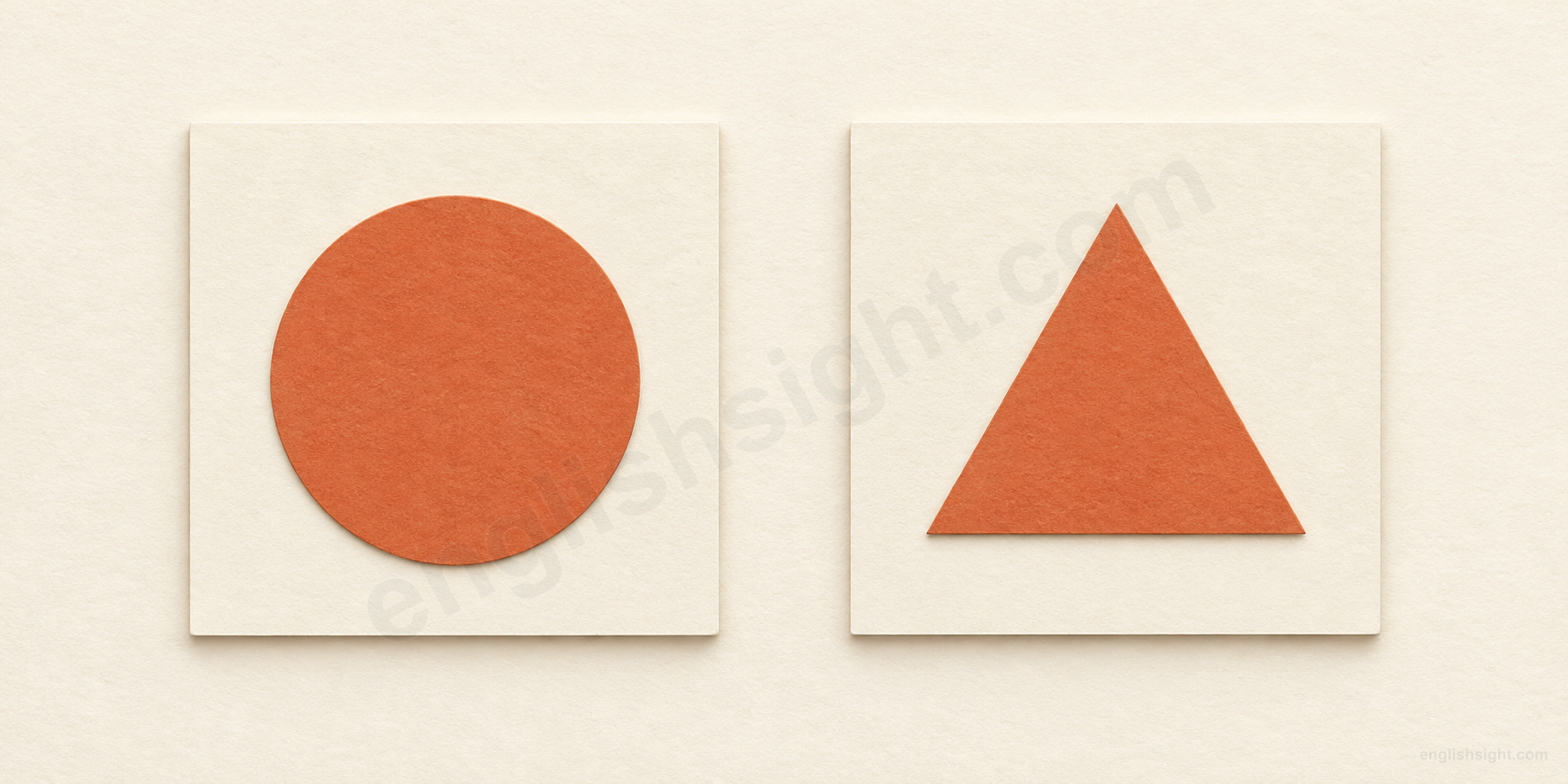
A card with a circular mark.
different
A card with a triangular mark.
Compare the shapes of the marks.
The cards match in size and color, but their marks differ in shape. Different does not mean that everything is unlike or that either card is better.
Different marks a contrast: the people, things, or situations being compared are not the same in identity or in some relevant feature.
The reference may be named, understood from context, remembered from before, or supplied by what is usual. Different does not specify which side is better.
Different directs attention to a contrast. Ask two questions: what are we comparing, and in what respect are they not the same? The comparison can concern qualities, identities, experiences, or situations.
Two different tickets may look identical but belong to separate bookings. A room can look different after repainting and still be the same room. Keep identity separate from appearance.
The diagram is a teaching model for comparison. It does not claim a single mental picture shared by every English speaker, and its shapes cannot predict every idiom.
01
Compare qualities and situations
Identify what is being compared, the relevant feature, and the size of the contrast. The comparison may be with another object, an earlier state, or an expectation.
01
different + noun; subject + be / look / feel / sound + different
be / look / feel different
have or seem to have a contrasting quality
Situation / reference
You remember the room with its old lighting.
Contrast / interpretation
Under the new light, its appearance is no longer the same.
The reference can be another thing or the same thing at another time.
Different is usually an adjective. It can describe a noun, as in different opinions, or follow a linking verb: The answers are different. With look, feel, sound, smell, or taste, the verb tells us how the contrast is experienced: This soup tastes different today.
The room looks different today compares its present appearance with an earlier one. It is still the same room. Likewise, You seem like a different person can describe a large change in someone’s mood or behavior without claiming a new identity.
In The two answers are different, the answers are compared with each other. They need not disagree on every detail: one relevant contrast is enough. Different does not by itself mean opposite, wrong, better, or worse.
In a sentence
The room looks different with the new lights.
Watch the difference The room looks different describes the room. She looks at it differently describes her way of looking or thinking.
02
A + be + different from + B; different from what + clause
different from
name the other side of a comparison
Situation / reference
You put your result beside a friend’s result.
Contrast / interpretation
You state that the two do not match.
From introduces the reference, not a starting point for movement.
In A is different from B, A is the thing being described and B is its reference. Different from works in both British and American English and is a dependable choice in international writing.
Use a matching reference: My result is different from yours compares two results. My result is different from you would compare a result with a person.
A clause can be introduced through what or a noun phrase: The ending was different from what I expected; the ending was different from the one I expected. Different from each other explicitly makes the comparison mutual.
In a sentence
My result is different from yours, so let’s check our work.
Watch the difference Do not use different as in place of different from. The same as uses a different comparison pattern.
03
different to + reference; different than + reference / clause
different to / different than
recognize regional alternatives in comparisons
Situation / reference
You compare the actual interview with your expectation.
Contrast / interpretation
You describe the contrast using a familiar regional construction.
The comparison is similar; preferences for its connecting word vary.
Different to is especially associated with British English: This version is different to mine. Different than is standard in American English: This version is different than mine. Neither should be dismissed as an error everywhere.
Than also readily introduces a clause with its own subject and verb: The interview was different than I expected. This clause pattern occurs in British English too, though speakers and editors differ in their preferences.
For broadly acceptable formal wording, use different from mine or different from what I expected. Different is not a comparative form like bigger; the use of than here is an established construction.
In a sentence
The interview was different than I expected: we solved a problem together.
Watch the difference With from, say from what I expected; do not simply replace than with from before I expected.
04
different in + feature; different for + person / group
different in size / different for everyone
specify an aspect of contrast or the people whose situations vary
Situation / reference
Two bags have the same color but unequal capacities.
Contrast / interpretation
You restrict your claim to their size.
In names a feature; for names the person or group whose situation is considered.
Different in size, color, or shape identifies the respect in which things contrast. The bags can be different in size but similar in every other relevant way. How are they different? asks for the contrasting feature.
Different for everyone instead concerns varying experiences or circumstances: Starting a new job is different for everyone. For everyone does not name a size, color, or comparison object.
Combine the roles when helpful: The two plans are different from each other in cost. From introduces what you compare; in introduces the aspect you compare.
In a sentence
The bags are different in size, but both are black.
Watch the difference Different in size does not say which bag is larger. Add that information when it matters.
05
degree word + different; no different from; not any different from; more / most different
very / slightly / no different
describe how much contrast there is, or deny a contrast
Situation / reference
You test two versions and compare the results.
Contrast / interpretation
You report a large, small, or absent contrast.
The modifier sets the degree; different alone does not mean completely unlike.
Very, quite, completely, and totally different can emphasize a contrast. Slightly different and a little different make it smaller. The intended scale comes from context, not a numerical measurement built into different.
No different from and not any different from deny a relevant contrast: This version is no different from the old one. Is it any different? asks whether there is a contrast at all.
More different and most different are possible when comparing degrees of dissimilarity: Of these three designs, the last is the most different from the original. Use more different rather than differenter.
In a sentence
The new version is only slightly different from the old one.
Watch the difference No different is a negative comparison, not a claim that every possible detail has been proved identical.
02
Choose another or distinguish several
Different can distinguish identities rather than appearances. Two separate copies can look exactly alike, and different people can give the same answer.
06
a different + singular countable noun
a different room / a different way
another item or option instead of the current one
Situation / reference
Your assigned room is too noisy.
Contrast / interpretation
You ask to use another room.
The key contrast may be identity, not appearance.
A different room can mean another room rather than this particular one. It may have the same furniture and layout. Different tells us it is not the current room, without promising better qualities.
Try a different way asks for another method. The noun supplies the kind of alternative: a different day changes the day; a different subject changes the topic.
Another room can make the same request, but another can also mean an additional room. Context determines whether you want a replacement or an extra one. A singular countable noun still needs a determiner, such as a in a different room.
In a sentence
Could we have a different room, away from the lift?
Watch the difference A different room need not be a different type of room. Identity and kind are separate questions.
07
number / several / many + different + plural noun; different kinds of + noun
three different shops / different kinds
distinguish separate individuals or kinds within a set
Situation / reference
You look for a part at several places.
Contrast / interpretation
You count three separate shops, not three visits to one shop.
The noun and context determine whether identities or types are being distinguished.
Three different shops emphasizes that there are three distinct shops. It does not require three contrasting styles of shop. Three different kinds of shop explicitly distinguishes types.
Many different ways, several different reasons, and different parts of a city spread attention across a set. Numbers and quantifiers supply the amount; different emphasizes the distinction within it.
Various can mean several different and is used with plural nouns in this sense: various shops. Different also works with a singular noun: a different shop. The two words cannot replace each other in every pattern.
In a sentence
I tried three different shops, but none had the right part.
Watch the difference Three different copies of the same book can be identical in design; they are still three individual copies.
08
different + plural noun + verb + different / the same + noun; each + noun + a different + noun
different people want different things
show variation across members of a group
Situation / reference
You are choosing activities for a group.
Contrast / interpretation
You recognize that one choice may not suit everybody.
Repeated different distributes people and choices across the situation.
Different people want different things connects variation in people with variation in preferences. It does not mean each person has a unique preference that nobody else shares.
The second different is not compulsory. Different people gave the same answer distinguishes the speakers while allowing their answers to match. Different therefore does not automatically spread to every noun in a sentence.
With each or every, the singular pattern can emphasize variation from one occasion to the next: Each session covers a different topic. Grammar supplies the distribution; different marks the relevant contrast.
In a sentence
Different guests prefer different activities, so we offer several choices.
Watch the difference Variation across a group does not mean that no two members can share the same preference.
09
something / anything / nothing + different
something / anything / nothing different
refer to an unspecified alternative or contrast
Situation / reference
You have eaten the same lunch all week.
Contrast / interpretation
You suggest a meal that is not the usual one.
The adjective normally follows these indefinite pronouns.
Something different means an unspecified thing that contrasts with the current or usual one. With something, anything, and nothing, put different after the pronoun: something different, anything different, nothing different.
Let’s try something different proposes an alternative. Have you noticed anything different? asks whether a contrast is detectable. Nothing different happened reports no relevant departure from the usual situation.
Compare a different thing, where the adjective comes before an ordinary noun. The word order changes with the grammatical construction, not because different gains a separate meaning.
In a sentence
Let’s cook something different for lunch today.
Watch the difference Say something different, not different something. Say a different meal with an ordinary noun.
03
Stand out from what is usual
When the comparison is with the ordinary or expected, different can suggest novelty. Context and tone show whether the speaker welcomes it.
10
subject + be + different; something a little different; a refreshingly different + noun
It’s different! / something a little different
unusual compared with what people normally expect
Situation / reference
A café serves a combination of flavors you have not tried before.
Contrast / interpretation
You describe it as a departure from the ordinary.
The comparison is with the usual, and the speaker’s evaluation remains contextual.
In informal conversation, That’s different! can mean that something stands out from the usual. You do not have to name a particular comparison object; the expected norm supplies the reference.
I want something a little different can express a wish for novelty. It was certainly different, said with hesitation, can avoid direct criticism. The adjective itself does not guarantee either praise or dislike.
This use often follows be or another linking verb. It can also occur before a noun when modified, as in a refreshingly different design. Learn the tone from the surrounding conversation.
In a sentence
A concert in an old swimming pool? That sounds different!
Watch the difference Different is not a dependable synonym for good. Tone and context determine the reaction.
04
Read the whole expression
These expressions compare situations, evidence, attitudes, and preferences. Their extra meanings belong to the complete phrase; the card diagram cannot predict them.
11
subject + be + a (whole) different matter / story / kettle of fish / ball game
a different matter / story / kettle of fish / ball game
a situation requiring a separate judgment or approach
Situation / reference
You can practice a skill comfortably at home.
Contrast / interpretation
Performing it in public introduces a separate challenge.
The contrast concerns conditions, difficulty, or considerations, not a literal story or game.
That’s a different matter separates one issue from another. I can repair it, but paying for the parts is a different matter contrasts ability with cost. A different story can similarly signal a contrasting case: At weekends it’s quiet; on weekdays it’s a different story.
A different kettle of fish and a whole different ball game are informal expressions for a markedly different situation. The ball-game expression often suggests that an earlier method or expectation may no longer fit. Neither requires fish or sport.
These are related expressions, not four new adjective senses. Contrast It’s a different story with The figures tell a different story: the latter is about evidence contradicting an account and is explained separately.
In a sentence
Practicing alone is comfortable; speaking to a full room is a different matter.
Watch the difference Use the established nouns in these idioms; a different fish does not carry the kettle-of-fish meaning.
12
evidence / results / expression + tell(s) a different story / tale
tell a different story / tale
provide evidence that conflicts with an account or expectation
Situation / reference
A manager reports that all deliveries arrived on time.
Contrast / interpretation
The records show delays.
Information supplies a contrasting account; no spoken narration is required.
When records, results, or someone’s expression tell a different story, they suggest a situation unlike the one claimed or expected. The subject can be evidence rather than a person.
Different keeps its contrast, while tell a story supplies the idea of an account. The complete expression invites a reader to compare the claim with the evidence.
The phrase points to conflicting information; it does not prove that someone deliberately lied. New evidence may correct an honest mistake or expose only part of the picture.
In a sentence
He says every order arrived on time, but the delivery records tell a different story.
Watch the difference Do not read story as necessarily fictional or tell as necessarily speaking aloud.
13
person / group + sing(s) / be singing + a different tune; people / groups + sing different tunes
sing a different tune / sing different tunes
express a changed attitude or contrasting opinions
Situation / reference
Someone dismisses working from home.
Contrast / interpretation
After trying it, that person speaks in favor of it.
The singular idiom usually contrasts an earlier and later stance; different tunes can contrast speakers.
Sing a different tune is an informal idiom for changing what you say or how you respond because your attitude has changed. It often draws attention to a reversal after experience or changed circumstances.
The tune represents an expressed stance; singing need not occur. In the plural, people or groups can sing different tunes when they express conflicting positions: The two departments are singing different tunes about the budget. Here the comparison is between speakers, rather than one speaker’s earlier and later views.
The idiom can sound critical or teasing, especially in You’ll be singing a different tune when…. Use change your mind for a more neutral description of changing an opinion.
In a sentence
He used to reject remote work, but after trying it he is singing a different tune.
Watch the difference Changing an opinion is the idiomatic reading here; changing the song at a concert can be literal.
14
Different strokes for different folks.
different strokes for different folks
people have varying tastes, wants, or needs
Situation / reference
One friend loves camping while another prefers a hotel.
Contrast / interpretation
You acknowledge both preferences instead of insisting on one choice.
The complete saying recognizes variation between people.
This informal saying acknowledges that what suits one person may not suit another. It can end a friendly disagreement about food, entertainment, travel, or ways of living.
Folks means people here. Strokes belongs to the established saying; it does not instruct you to hit someone or describe a medical event.
The saying can sound accepting, but an abrupt delivery can sound dismissive. It recognizes preferences or needs; it does not establish that every factual claim is equally accurate.
In a sentence
“I’d rather sleep in a tent.” “I like a proper bed—different strokes for different folks.”
Watch the difference Learn the whole fixed saying; translating each noun literally misses its conversational function.
15
march to a different drummer / beat / tune; march to the beat of a different drum
march to a different drummer / beat
follow your own ideas or values rather than the group’s
Situation / reference
Most classmates choose one conventional path.
Contrast / interpretation
One classmate chooses a path that follows her own priorities.
The contrast is with the surrounding group, not necessarily with an earlier self.
To march to a different drummer, or to the beat of a different drum, is to act according to ideas or values that differ from those around you. March to a different beat and march to a different tune are related forms.
The image of following a rhythm is figurative. The person need not march or play music. The expression may suggest independence or nonconformity, and is especially useful to recognize in profiles and journalism.
Unlike sing a different tune, it need not describe a change of mind. Someone can follow the same personal values for years while contrasting with the group.
In a sentence
While her classmates sought office jobs, Lina marched to a different beat and opened a repair shop.
Watch the difference The idiom does not automatically praise the choice or claim that the person is opposed to everyone else.
16
people / aims / considerations + pull in different / opposite directions
pull in different directions
pursue aims that conflict or make cooperation difficult
Situation / reference
One team wants the cheapest design and another wants many extra features.
Contrast / interpretation
Their competing aims make a shared decision difficult.
The direction belongs to each aim; different alone does not imply conflict.
People or considerations pull in different directions when their aims or pressures work against one another. The expression can describe a team with conflicting priorities or one person facing competing demands.
The contrast is figurative unless people are physically pulling an object. Different supplies nonmatching directions; the full pulling image conveys the difficulty of combining them.
Simply having different jobs or different opinions does not always mean pulling in different directions. Use the idiom when the aims or pressures obstruct a shared outcome.
In a sentence
The teams are pulling in different directions: one wants lower costs, the other more features.
Watch the difference Different does not always mean opposite; opposite directions is a stronger form of the expression.
17
person + know(s) different / otherwise
know different / know otherwise
have information that contradicts a claim
Situation / reference
Someone says the building is empty.
Contrast / interpretation
You know a person is still inside.
An established informal expression allows different after know.
I know different is an informal way of saying that you have information or evidence showing a claim is not true. I know otherwise expresses a similar idea.
This is a fixed use to recognize, not a model for replacing differently after every action verb. In most ordinary descriptions of manner, use the adverb: We solve it differently.
Know something different can instead mean that you know another fact or topic. The presence of something changes the grammar and does not automatically express contradiction.
In a sentence
They say the building is empty, but I know different: the caretaker is still inside.
Watch the difference Know different is an informal established phrase; for neutral wording, say I know that is not true.
18
information / event + put(s) a different / new complexion on + situation
put a different complexion on something
change how a situation is understood or judged
Situation / reference
A missing report seems to be someone’s carelessness.
Contrast / interpretation
News of a server failure changes that interpretation.
New information changes the apparent character of a situation.
To put a different complexion on a situation is to make it appear different by adding information or changing the circumstances. This expression is useful to recognize in reports and relatively formal discussion.
Complexion here concerns the apparent character of the matter, not someone’s skin. Put a new complexion on something is a related form.
Unlike the delivery records telling a different story, the emphasis is on a changed interpretation, not necessarily a direct contradiction. The facts may fit a new explanation.
In a sentence
News of the server failure puts a different complexion on the missing report.
Watch the difference The situation need not improve. The expression marks a changed view, whose direction depends on the context.
Keep the comparison precise
Different is usually an adjective
Use a different method or The method is different. For a way of acting, differently is the neutral general choice: We work differently. English also has established flat-adverb uses of different, including know different; those do not make different freely interchangeable with differently.
Different, difference, and differ
Different describes: The prices are different. Difference is a noun: There is a difference in price. Differ is a verb: The prices differ. Make a difference means affect a result and belongs to the noun expression, not to a new sense of the adjective different.
Neither opposite nor automatically better
Two things can be different and still share most features. Different people can agree. Calling a design different can express novelty, cautious criticism, or praise; the context supplies the evaluation.
Form and scope
Different has no plural ending: different ideas, not differents ideas. More different and most different express degree when useful. This adjective does not have a verb tense, object to passivize, or phrasal-verb family; the verbs in the idioms carry their own grammar. The lesson covers modern general use and selected established expressions, not every specialist compound or creative metaphor.
Choose the intended contrast
Identify the reference and read the complete construction before choosing.
1. You bought two copies of one edition. They look identical, but they are separate physical copies. Can you call them two different copies?
2. You compare your answer with Ana’s answer. Which sentence names a matching reference?
3. You prefer wording with from when comparing a trip with your expectation. Which form fits?
4. You want a change from your usual dinner. Which word order is natural?
5. The two versions have no relevant contrast. Which statement expresses that?
6. An owner says the café was busy all month, but the receipts show very few sales. Which expression presents the conflicting evidence?
7. You want neutral wording to say that your way of solving a problem differs from mine. Which form fits?
8. Someone says, with a hesitant smile, “The film was certainly different.” What can you safely conclude from different alone?
Sources and teaching notes
The sources below support the meanings and established usage. Explanations, examples, and the comparison diagram were created for this lesson; the visual model is a teaching interpretation.
The diagram highlights a comparison; it is not a mental picture shared by every native speaker.