Digestion names a process, a person’s ability to carry it out, and sometimes the careful understanding of ideas.
From food to absorbable substances
Break food down into absorbable substances
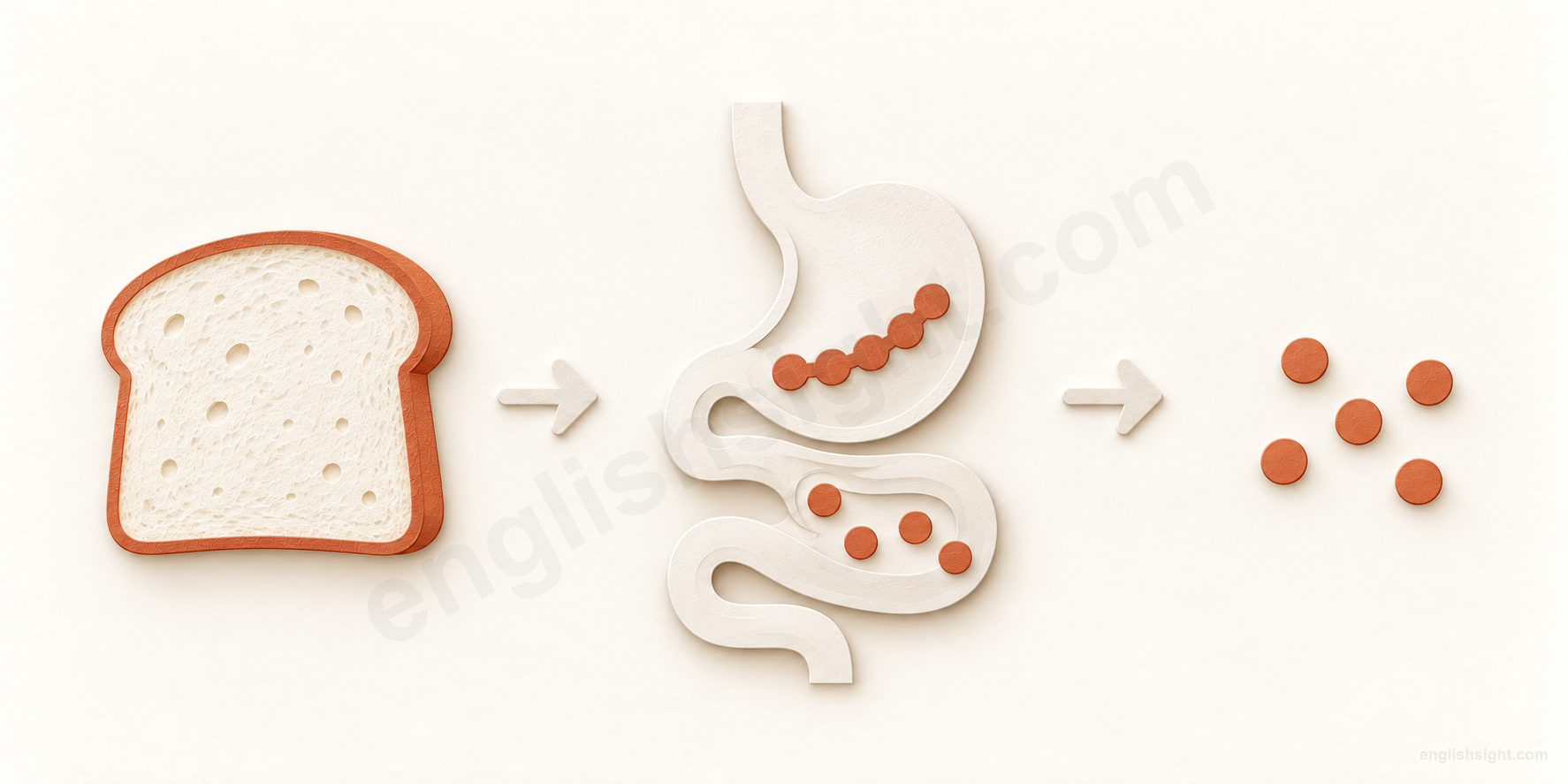
Food before breakdown.
digestion
Simpler substances ready for absorption.
Digestion breaks food down.
Digestion changes food into simpler substances the body can absorb. The organs and orange units are simplified symbols.
Digestion breaks food down into simpler substances that the body can absorb.
The physical meaning includes mechanical and chemical breakdown. The information use borrows the idea of processing something before taking it in; it does not describe a bodily event.
You eat a meal, but eating is only the beginning. Digestion is the work of breaking food down into simpler substances that the body can absorb. The word names that work, rather than a particular meal or organ.
Start with the physical process, then notice how English talks about good or poor digestion and borrows the idea for understanding information. This is a teaching connection, not a picture that every English speaker necessarily imagines.
01
Food, ability, and everyday concerns
These uses describe the bodily process, how well it works for someone, and things said to help or interfere with it.
01
digestion; during digestion; the digestion of + food / substance
digestion / the digestion of food
the process that breaks food down for absorption
Situation
A class is learning what happens to food after it is eaten.
What the expression says
The discussion names the process rather than the act of eating.
Digestion is a process noun; of identifies what is processed.
In a general statement, use digestion without an article: Digestion takes time. During digestion locates an event within this process. Digestion is uncountable in this meaning; meals are not individual digestions.
The digestion of food or the digestion of fats specifies the material being processed. Of introduces that material, not the person doing the digesting. The definite article can introduce this specified process.
Eating brings food into the body; digestion breaks it down; absorption takes substances into the body from the digestive tract. These are connected ideas, but the words do not all name the same stage.
In a sentence
The lesson explains the digestion of food.
Watch the difference For the general process, say Digestion takes time, not A digestion takes time.
02
have good / poor digestion; have a good / poor digestion; possessive + digestion + be + adjective
good / poor digestion
how well a person’s body digests food
Situation
Two people are talking about how well they handle meals.
What the expression says
One person describes their own capacity to digest food.
My digestion shifts attention from the general process to my bodily functioning.
My digestion is poor and I have good digestion evaluate how the process works for a person. The possessive identifies whose functioning is meant; it does not name food that belongs to that person.
You may also meet have a good digestion or have a poor digestion. Dictionaries allow a usually singular countable use for this personal capacity, alongside examples without a. That does not make a digestion the normal way to count meals or episodes.
Good and poor describe the quality of someone’s digestion. Poor digestion does not mean the person has little money, and strong digestion is not physical strength in the ordinary muscular sense.
In a sentence
My digestion is usually good, but it has been poor this week.
Watch the difference Do not use two digestions for two meals. The personal-ability use is normally singular.
03
aid / help / improve + digestion; aid in the digestion of + food; interfere with + digestion
aid / help digestion
help the digestive process work
Situation
A science lesson describes the role of enzymes.
What the expression says
The sentence says what supports the breakdown of food.
Digestion is the object of aid or help; the verb supplies the helping relationship.
Aid digestion and help digestion place the process after a verb meaning help. Aid is especially familiar in explanations and product descriptions. The noun keeps its physical meaning; this is an ordinary verb–noun combination, not a phrasal verb.
Aid in the digestion of food makes the material explicit and is another possible pattern. Improve digestion emphasizes making its functioning better; interfere with digestion describes hindering it.
These expressions tell you what a sentence claims. A label saying something aids digestion does not, by its wording alone, establish that the claim is true.
In a sentence
Enzymes aid digestion by breaking food down.
Watch the difference Use help digestion or help with digestion. Aid digestion is a verb followed by its object, not a two-part verb to separate.
04
problems with digestion; digestion problems; have / get indigestion
problems with digestion
difficulty with the digestive process
Situation
Someone needs to describe a problem without naming a particular condition.
What the expression says
The speaker identifies the affected bodily process.
A problem with a process is broader than the separate word indigestion.
Problems with digestion, digestion problems, and digestive problems can describe trouble in this area. With introduces what the problem concerns; in digestion problems the first noun modifies the second.
Indigestion is a different, uncountable noun for discomfort or pain associated with difficulty digesting food. I have indigestion describes a complaint; I have good digestion describes functioning. Digestion itself does not mean stomach pain.
A digestion problem is not automatically a particular diagnosis. Choose the expression for what the speaker actually knows rather than treating every digestive complaint as identical.
In a sentence
The form asks whether I have any problems with digestion.
Watch the difference Say I have indigestion for that complaint, not I have digestion. Do not confuse digestion with its troublesome counterpart.
02
Understanding ideas and choosing the right form
One extension concerns information. Related words let you name an action, a process, or the organs involved without confusing their grammar.
05
the digestion of + information / ideas; time to digest + information
the digestion of information
the careful processing and understanding of information or ideas
Situation
A reader has received a long report with unfamiliar findings.
What the expression says
Time is needed to understand the material, beyond merely reading it.
A figurative extension treats understanding as taking material in after processing it.
Digestion can refer to mentally absorbing ideas or information. The material after of is now information, not food. The bodily picture offers a teaching connection, but no literal food or stomach is involved.
The noun expression the digestion of information has a more formal tone. In ordinary conversation, I need time to digest this information is usually an easier choice. Digest here means think it through enough to understand it.
Understanding is not the same as agreeing. You can digest an argument and still reject its conclusion. Do not assume digestion names every kind of learning, memory, or decision.
In a sentence
The schedule leaves an afternoon for the digestion of the report’s findings.
Watch the difference This is an established figurative use, not a claim that understanding happens in the digestive organs.
choose a verb for the action, a noun for the process, or an adjective before a related noun
Situation
You want to describe what the body does or name the system involved.
What the expression says
You choose a word form that fits the sentence.
Related meaning does not make the three forms interchangeable.
The body digests food uses the verb digest. Digestion is a noun: The diagram explains digestion. Food is digested uses the past participle in a passive construction; digestion is not itself a verb.
Digestive is an adjective used before nouns in this sense: digestive system, digestive tract, digestive enzymes, digestive problems. It connects the following thing to digestion rather than naming the process on its own.
For the organs as a system, digestive system is the standard expression to learn. Compare The digestive system breaks food down with Digestion breaks food down: one names the organs together and the other names their activity.
In a sentence
Our bodies digest food through the work of the digestive system.
Watch the difference Use We digest food, not We digestion food; use digestive system as the usual name of the system.
Keep the process, capacity, and complaint distinct
Pronunciation and word class
Digestion is a noun, with stress on the second syllable: /daɪˈdʒestʃən/ or /dɪˈdʒestʃən/. It has no tense forms. Verbal passive patterns belong to digest, as in Food is digested, not to digestion.
No hidden idiom family
The combinations here are noun phrases and ordinary collocations. Digestion does not have a productive family of phrasal verbs. Do not turn every preposition after it into a special idiom.
Scope of this lesson
Technical uses include breaking materials down in chemistry and treating organic waste with bacteria, as in anaerobic digestion. Those are established specialist uses, outside the everyday lesson. The physical sketch illustrates breakdown, not a full account of anatomy or nutrition.
Choose the meaning and form
Check whether the sentence concerns a process, someone’s ability, a complaint, or information.
1. You are discussing the process in general. Which sentence fits?
2. Someone says, “My digestion is poor.” What are they describing?
3. Which word names discomfort associated with difficulty digesting food?
4. An editor allows time for “the digestion of the findings.” What is the intended activity?
5. Choose the usual expression for the organs that carry out digestion.
Sources and teaching notes
Dictionary entries support the uses and grammatical distinctions below. Explanations, examples, and the visual model were written for this lesson; the connection to information is taught with its limits.
The diagram is a teaching aid, not a shared mental picture of every English speaker.