Describe what needs cleaning, then recognize the judgments and fixed phrases that grow beyond it.
Unwanted material on a surface
Unwanted material on or in something
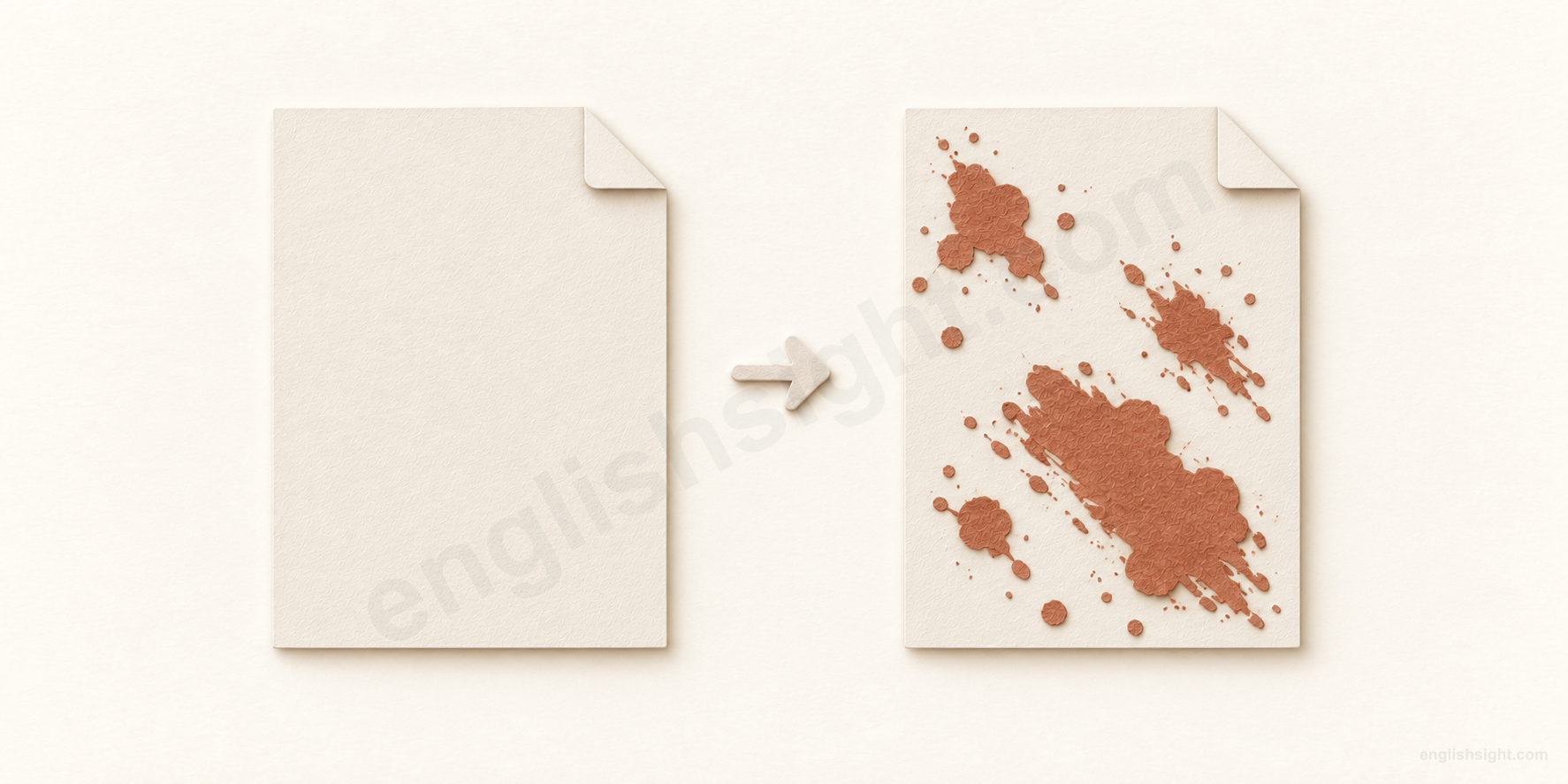
The paper is clean and unmarked.
dirty
The paper is now dirty.
Mud leaves unwanted marks on its surface.
Mud marks make the paper dirty. Dirty names its unclean condition.
In the central physical use, dirty means not clean because unwanted material is present. The same sheet of paper, before and after mud marks appear, makes the condition easy to compare.
The adjective does not require an observed before-and-after event. The comparison illustrates the physical state; it does not prove how every figurative expression developed.
Picture a clean sheet of paper with mud marks on its surface: the paper is dirty. Dirty names its condition; get dirty describes a change, and dirty the paper describes causing it.
English also uses dirty to judge tactics, describe sexual language, and form everyday expressions. These branches share some associations with cleanliness, but each established combination needs its own explanation. The paper is a teaching model, not a picture every native speaker necessarily imagines.
01
Things that need cleaning
Start with a condition you can describe, then distinguish becoming dirty, causing it, and work that makes it happen.
01
dirty + noun; subject + be / look / feel + dirty
dirty clothes / be dirty
have dirt or unwanted material on or in something
Situation / starting point
A shirt has food marks on it.
Condition / interpretation
You put it aside to wash.
Dirty describes a condition, not the act of cleaning.
Use dirty before a noun or after be: a dirty shirt; the shirt is dirty. The marks might come from food, dust, grease, or mud. You need not name the substance.
Compare The room is messy: things are out of place. A room can be messy but clean, or tidy but dirty. Dirty is about cleanliness, not arrangement.
The physical model is paper with unwanted marks. The adjective itself does not say when they appeared or who caused them.
In a sentence
The kitchen is tidy, but the floor is still dirty.
Watch the difference Dirty is an adjective here; say The floor is dirty, not The floor dirties to describe its present condition.
02
get / become + dirty; get / make + object + dirty
get dirty / get something dirty
become unclean, or cause something to become unclean
Situation / starting point
The children play on wet ground.
Condition / interpretation
Their clothes now have mud on them.
Get supplies change; dirty names the resulting condition.
My clothes are dirty describes the state. My clothes got dirty describes becoming dirty. In I got my clothes dirty, I am presented as causing that result.
Make works with an object and adjective too: The muddy water made my shoes dirty. Keep describes maintaining a state: Keep the towels clean by keeping them away from muddy boots.
These are ordinary adjective constructions, not phrasal verbs with dirty as a particle.
In a sentence
We got our shoes dirty while planting the tree.
Watch the difference Keep the object before the result adjective: got them dirty, not got dirty them.
03
dirty + object; be dirtied + by / with
dirty something
make something unclean
Situation / starting point
A dog walks across a clean mat.
Condition / interpretation
Its paws leave marks on the mat.
The object of dirty is the thing that becomes unclean.
Dirty can be a verb: Muddy paws dirtied the mat. Unlike the adjective construction, it carries the tense itself. Compare The mat is dirty with The paws dirtied the mat.
Forms are dirty, dirties, dirtied, dirtying. The -ing form keeps y: dirtying, not dirting. A passive is possible: The cloth was dirtied by the spilled ink.
Dictionaries also record intransitive dirty meaning become dirty, but get dirty is an easy everyday choice. Dirty someone’s reputation is a figurative verb use: damage how people regard that person, without literal mud.
In a sentence
Please take off your boots before you dirty the rug.
Watch the difference Do not use adjective comparative dirtier as a verb form: the boots dirtied the rug.
04
a dirty + job / task
a dirty job
work that gets the worker or their clothes dirty
Situation / starting point
An old engine is covered in grease.
Condition / interpretation
Repairing it leaves grease on the mechanic’s clothes.
A dirty job may cause dirtiness rather than already be dirty itself.
In a dirty job, dirty can describe what doing the work will do to you. Repairing oily machinery is one example; the work need not be dishonest.
Contrast a dirty trick: that judges someone’s conduct. The noun and situation decide whether dirt is physical or a negative judgment. Doing dirty work for someone can also have an idiomatic meaning, explained later.
In a sentence
Cleaning the old engine is a dirty job, so wear overalls.
Watch the difference Physical dirt on someone’s work clothes is not evidence of bad character.
02
Pollution, appearance, and disapproval
Read the noun carefully. An energy source, a colour, a trick, and money each give dirty a different job.
05
dirty + air / water / energy / industry
dirty air / dirty energy
contaminated, or producing harmful pollution
Situation / starting point
An energy source releases a lot of pollution.
Condition / interpretation
People discuss replacing it with a cleaner source.
Something may contain pollution or cause pollution.
Dirty air and dirty water focus on contamination. Dirty energy and dirty industries focus on the pollution that producing or using them creates.
This extends the physical contrast with clean. Dirty energy does not mean that energy has visible mud on it, and the expression by itself does not specify a measurement or a particular pollutant.
In a sentence
The town wants to replace dirty energy sources with cleaner ones.
Watch the difference Do not assume water is safe because it looks clean; dirty and clean are broad descriptions, not test results.
06
dirty + colour; dirty blond / blonde
a dirty brown / dirty blond
a dull or muted shade rather than a clear bright colour
Situation / starting point
You compare a muted brown with a brighter brown.
Condition / interpretation
You describe the muted shade.
In colour descriptions, dirty can name the shade itself.
A dirty brown describes a dull-looking brown. It need not mean that brown material has recently become soiled.
Dirty blond or dirty blonde describes a muted dark-blond or light-brown hair colour, not a person who has failed to wash their hair. The exact colour comes from the full colour expression.
In a sentence
The old curtains were a dirty brown even after washing.
Watch the difference Do not infer hygiene from dirty blond; it is a colour label.
Dirty judges the method or behaviour, not a physical surface.
A dirty trick is an unfair or dishonest act. Dirty politics similarly criticizes the way people compete or gain influence. Neither requires anything physically unclean.
A dirty little secret is something someone wants hidden because it is shameful or damaging. Little can add a dismissive tone; the secret is not necessarily small in importance.
In an insult such as You dirty liar!, dirty strengthens condemnation. This is emotionally strong speech, not a neutral way to disagree or a literal comment about washing.
In a sentence
Inventing that story about her was a dirty trick.
Watch the difference The moral judgment belongs to the speaker. Dirty is not an objective rating of a whole person.
08
play / fight + dirty
play dirty / fight dirty
compete or fight using unfair methods
Situation / starting point
A player wants an advantage.
Condition / interpretation
They break the rules or deceive others.
Here dirty describes how someone acts.
Play dirty works in sport and figuratively in business or politics. Fight dirty can refer to an actual fight or to an unfair contest.
Dirty is an adverb in these established combinations. It is not an object, and you do not need to turn it into dirtily. Compare play a dirty trick, where dirty is an adjective before a noun.
In a sentence
We can argue strongly without playing dirty.
Watch the difference Not every strong or successful move is playing dirty; the phrase accuses someone of unfair conduct.
09
dirty money
dirty money
money obtained through illegal or disreputable activity
Situation / starting point
Money has come from crime.
Condition / interpretation
Someone tries to conceal where it came from.
The problem is the money’s source, not dirt on banknotes.
Dirty money is money connected with wrongdoing in how it was obtained. It may be held in a bank account; no physical banknotes are necessary.
Compare dirty coins, which can simply mean coins with grime on them. The expression dirty money usually points to an illegitimate source, so context matters.
In a sentence
The investigation traced the dirty money to a fraud scheme.
Watch the difference Dirty money is not just money you personally dislike spending.
03
What words and looks communicate
These expressions concern sexual content, anger, or a topic people reject. They do not all describe the same kind of offence.
10
dirty + joke / book / mind; have a dirty mind
a dirty joke / a dirty mind
sexual content regarded as rude or offensive
Situation / starting point
A story uses sexual suggestions for humour.
Condition / interpretation
A listener calls it a dirty joke.
The expression describes sexual content and the way it is presented.
A dirty joke or dirty book contains sexual material that is regarded as indecent or offensive. A dirty mind means a tendency to interpret things sexually, even when another interpretation is possible.
Dirty old man is an informal, disapproving label for an older man whose sexual interest is considered offensive or inappropriate. A dirty weekend is a humorous British expression for a weekend away with a sexual partner, often secretly. Recognize the tone of each expression rather than using them as neutral labels for people or ordinary holidays.
This is a conventional branch of meaning, not a claim that sex is physically dirty. Reactions and suitability depend on the audience and setting.
In a sentence
He stopped telling dirty jokes when he saw that the audience was uncomfortable.
Watch the difference Rude is broader than dirty: interrupting can be rude without having sexual content.
11
talk dirty; talk dirty to + person
talk dirty
use sexual language to excite someone
Situation / starting point
Two adults choose an intimate style of conversation.
Condition / interpretation
One uses sexually explicit or suggestive words.
This fixed combination concerns sexual talk, not dishonest talk.
Talk dirty is an informal adult expression. In this combination dirty functions as an adverb, describing the sexual manner or content of the talking.
A person can tell a dirty joke for comic effect; talk dirty typically points to an intimate or sexually exciting purpose. Neither simply means speak with bad grammar.
In a sentence
In the film, one character asks the other to talk dirty.
Watch the difference Do not use talk dirty as a neutral synonym for criticize, lie, or use any rude words.
12
give / shoot + person + a dirty look; get a dirty look from + person
give someone a dirty look
show annoyance or dislike by the way you look at someone
Situation / starting point
Someone pushes ahead of you in a queue.
Condition / interpretation
You look at them with visible annoyance.
A dirty look is a facial expression directed at another person.
Give someone a dirty look means look at them angrily or with disapproval. You can also shoot someone a dirty look or get a dirty look from someone.
The person receiving the look has not been given an object. Dirty look is a conventional phrase; it says nothing about the cleanliness of anyone’s face.
In a sentence
The driver gave me a dirty look when I blocked the exit.
Watch the difference A dirty look is not normally a sexual look; the fixed phrase expresses hostility or annoyance.
13
a dirty word; dirty words
a dirty word
an offensive word, especially one relating to sex
Situation / starting point
A child repeats a word heard in a film.
Condition / interpretation
An adult identifies it as inappropriate language.
This is the literal word or expression people find offensive.
A dirty word can mean an obscene or sexually offensive word. The noun word is countable: a dirty word, several dirty words.
You can discuss the category without repeating an offensive example. Not every word someone dislikes is a dirty word in this sense; compare the separate figurative construction be a dirty word.
In a sentence
The teacher explained why that expression was considered a dirty word.
Watch the difference Do not confuse this with a misspelled word or a word printed on dirty paper.
14
something + be + a dirty word + to / for + person or group
be a dirty word
be an idea or topic a person or group rejects
Situation / starting point
A team dislikes any suggestion of compromise.
Condition / interpretation
Even mentioning compromise gets a negative reaction.
The named idea is treated as unacceptable; its spelling is not offensive.
If compromise is a dirty word to someone, they react to the idea as something bad or unacceptable. The expression often criticizes that attitude.
Compare Compromise is not a dirty word: the speaker defends compromise against such rejection. The phrase can apply to ordinary respectable words; they need not refer to sex.
In a sentence
For that team, compromise seems to be a dirty word.
Watch the difference Identify whose attitude is described. The speaker may be reporting or challenging it.
04
Unpleasant work, involvement, and privacy
Learn each whole expression, including its participants and tone. Doing practical work may be praised; betrayal is condemned.
15
do + someone’s + dirty work; do the dirty work for + person
do someone’s dirty work
handle unpleasant or dishonest tasks another person avoids
Situation / starting point
A manager wants someone dismissed but avoids speaking to them.
Condition / interpretation
Another person has to deliver the news.
The task is unwanted, and one person leaves it to another.
Do someone’s dirty work highlights delegation of an unpleasant task. It may involve dishonesty or cruelty, but it can also be an unpleasant necessary task, such as delivering bad news.
The possessive identifies the person whose task or purpose is being served: her dirty work is not necessarily work done to her. Work is uncountable here.
Compare a dirty job such as scrubbing grease, which may simply make your clothes dirty. Context distinguishes literal cleaning work from this criticism of someone avoiding responsibility.
In a sentence
The director let her assistant do her dirty work and announce the dismissals.
Watch the difference Do not assume every unpleasant task is illegal; the expression covers both unpleasant and dishonest work.
take part in practical work instead of only directing others
Situation / starting point
A team leader could stay in the office.
Condition / interpretation
They join the team packing boxes.
Hands stand for direct involvement; praise is possible.
Literally, gardening can get your hands dirty. Figuratively, the expression often approves of someone who joins in ordinary practical tasks rather than leaving them all to junior staff.
The hands need not actually become unclean. A manager can get her hands dirty by helping answer customer questions. The possessive changes with the person: I get my hands dirty; she gets her hands dirty.
Someone who won’t dirty their hands may be criticized for avoiding manual or disagreeable work. Other contexts can suggest involvement in wrongdoing, so ask what the work actually is rather than treating the expression as always praise.
In a sentence
Our supervisor got her hands dirty and helped pack the last orders.
Watch the difference Keep this separate from do someone’s dirty work: helping with routine work does not by itself imply dishonesty.
17
air / wash + possessive + dirty laundry / linen + in public
air your dirty laundry in public
discuss private, embarrassing matters where others can hear
Situation / starting point
A family has a private disagreement.
Condition / interpretation
Details are shared publicly with outsiders.
Private trouble is exposed, not physically washed.
Air your dirty laundry in public and wash your dirty linen in public refer to publicly discussing personal problems or embarrassing disputes. The expression usually disapproves of making them public.
Laundry and linen are metaphors for private matters. In public gives the crucial audience contrast; this is different from putting actual clothes in a washing machine.
Dirty laundry alone can also refer to embarrassing private information. The phrase expresses a view about privacy; it does not establish that a particular disclosure is wrong.
In a sentence
They decided to talk privately instead of airing their dirty laundry in public.
Watch the difference Laundry and linen are uncountable here: their dirty laundry, not their dirty laundries.
18
do the dirty on + person; do + person + dirty
do the dirty on someone
betray or treat someone very unfairly
Situation / starting point
Two partners have an agreement.
Condition / interpretation
One secretly breaks it for personal gain.
The person after on is the one treated badly.
Do the dirty on someone is informal British English. It condemns a breach of trust or unfair treatment, rather than describing physical dirt.
Compare do someone’s dirty work: in that expression you carry out their unwanted task. In do the dirty on them, they are the victim. Do someone dirty is an American slang form meaning treat them unfairly, for example by cheating or slandering them.
In a sentence
His business partner did the dirty on him and secretly sold their shared equipment.
Watch the difference Keep the roles straight: on him names the victim, not the person you are helping.
05
Informal expressions with special meanings
These combinations have established meanings. Size, a rough first solution, and aggressive behaviour cannot be predicted from mud on a sheet of paper.
19
a quick-and-dirty + estimate / guide / solution; something + be + quick and dirty
quick and dirty
done rapidly and simply, without a polished full treatment
Situation / starting point
You need an initial estimate before a meeting.
Condition / interpretation
You produce a rough but usable calculation.
Dirty describes a shortcut or lack of refinement in this fixed phrase.
A quick-and-dirty estimate is made quickly with a simple method. It can serve an immediate purpose without claiming the care or completeness of a final version.
The expression is informal and often used for guides, calculations, or solutions. Before a noun it is commonly hyphenated: a quick-and-dirty guide. It does not by itself accuse the writer of dishonesty.
In a sentence
I made a quick-and-dirty estimate before checking the figures in detail.
Watch the difference Quick and dirty is not a promise that a shortcut is accurate or suitable for every purpose.
20
get down and dirty; a down-and-dirty + campaign / performance
get down and dirty
use aggressive or unfair methods; sometimes be boldly crude
Situation / starting point
An election contest becomes hostile.
Condition / interpretation
The rivals use nasty tactics against one another.
Context distinguishes condemnation of tactics from descriptions of a bold performance.
In a contest, get down and dirty means act aggressively or unfairly to gain an advantage. Down-and-dirty can modify a noun: a down-and-dirty campaign. This informal expression is especially associated with American English.
In entertainment writing, a down-and-dirty performance can instead mean bold, earthy, and perhaps vulgar. For example: The reviewer enjoyed the band’s down-and-dirty stage show. Here the reviewer may be praising its directness, not accusing the band of cheating.
Learn the combination as a whole. Down does not simply mean movement toward the ground, and the expression is not interchangeable with quick and dirty.
In a sentence
As the election approached, both sides got down and dirty.
Watch the difference Do not assign the unfair-competition meaning automatically to a review of music or a stage show.
21
a dirty great / big + noun
a dirty great / big…
emphasize that something is very large
Situation / starting point
A large crack is visible in the wall.
Condition / interpretation
You describe its size emphatically.
Dirty strengthens great or big in this British informal expression.
A dirty great crack means a very large crack. Dirty is an informal intensifier here, not a description of mud inside the crack.
This is a fixed use with great or big. Do not generalize it to every adjective: dirty interesting does not mean very interesting.
In a sentence
There’s a dirty great crack above the window.
Watch the difference Mark the register: use very large in neutral formal writing.
Read the noun and the whole construction
Cleanliness is different from tidiness
Dirty concerns unwanted material; messy concerns disorder. Filthy is stronger than dirty. Dusty and muddy identify particular material. Dirt is normally an uncountable noun: some dirt, a bit of dirt; dirty is the adjective or verb.
Forms and grammar
The adjective has dirtier and dirtiest. The verb has dirties, dirtied, dirtying. Be dirty states a condition; get dirty marks a change; make something dirty and dirty something name a cause. A passive such as was dirtied by ink is possible. Play dirty and talk dirty use a fixed adverb form, not a separable particle verb.
A judgment is not a universal rule
Dirty tricks, dirty jokes, and dirty money concern different kinds of disapproval. Explain the context rather than treating physical dirt, sexual content, and dishonesty as the same thing. Some fixed phrases, such as get your hands dirty, can even show approval.
Dirt cheap is a different expression
Dirt cheap means very cheap. It uses dirt as an intensifier, not dirty. This lesson covers common uses and selected informal expressions, not every technical, regional, or historical meaning.
Choose the meaning that fits
Use the situation and the whole phrase, not just an association with mud.
1. You want to describe the current condition of the towels. Which sentence does that directly?
2. You accidentally put mud on your coat. Which order works?
3. Someone gives you a dirty look after you interrupt. What does it show?
4. Your manager gets her hands dirty by helping the team pack orders. What does this normally praise?
5. A boss avoids delivering bad news and asks you to do his dirty work. What is your role?
6. “In this office, compromise is a dirty word.” What is being reported?
7. A colleague sends a quick-and-dirty guide. What should you expect?
Sources and teaching notes
The publisher pages below were read to check meanings, forms, register, and expressions. The explanations, examples, exercises, and visual teaching model are original to this lesson.
This comparison is a teaching aid, not an image shared by every native speaker.