From physical revulsion to forceful disapproval: name the feeling, its cause, and the person affected.
Something repellent provokes strong rejection
Something repellent provokes strong rejection
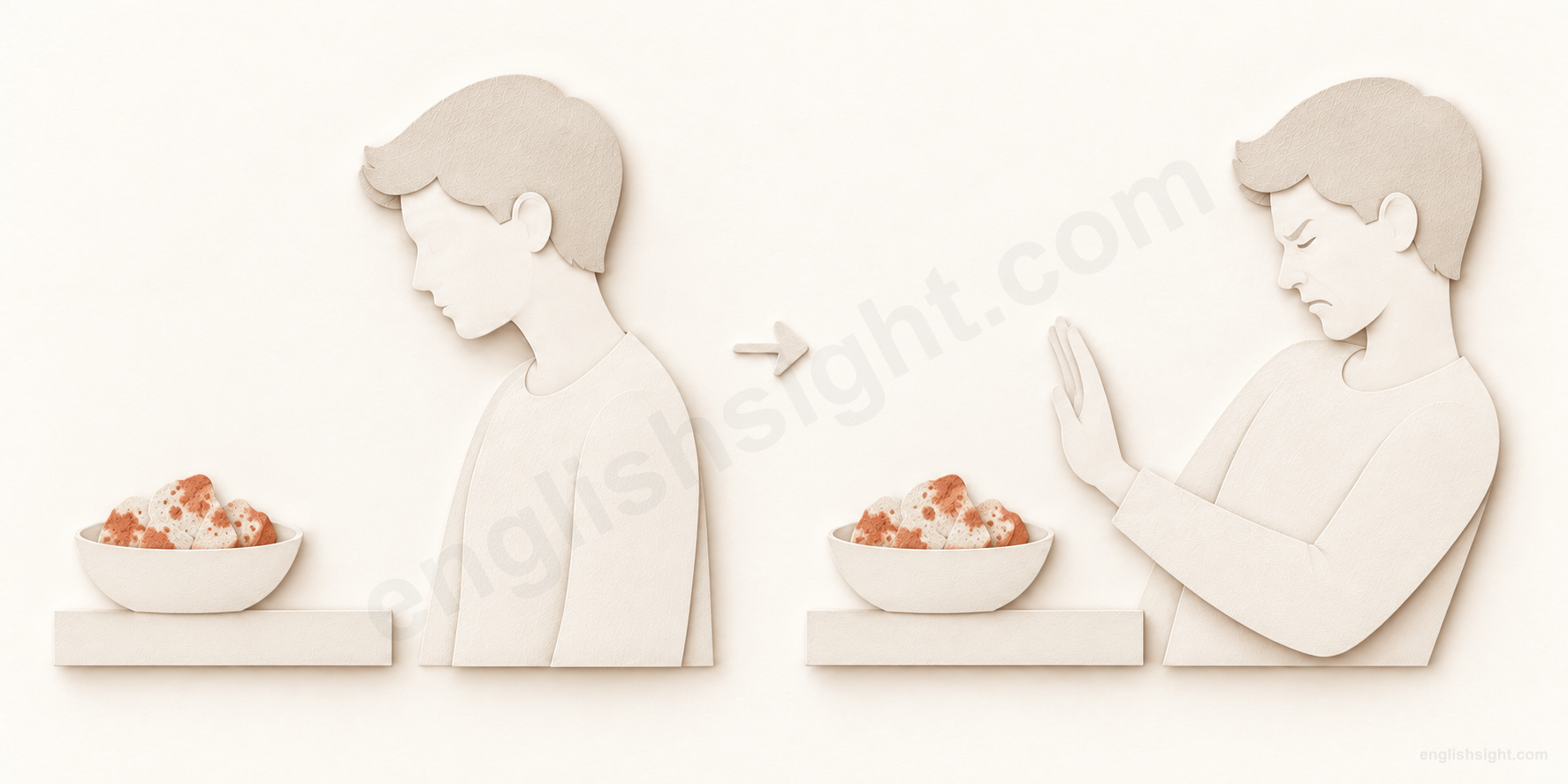
A person notices a bowl of spoiled food.
disgust
The person recoils, frowns and raises a hand toward the bowl.
The unpleasant food provokes a strong feeling of revulsion.
The food provokes disgust; unacceptable behavior can provoke it too.
Someone encounters something they find highly unpleasant or unacceptable and feels strongly repelled by it.
The sketch uses spoiled food to show a physical reaction. Disgust can also concern conduct or ideas without a smell, sickness, or visible movement away.
Disgust is the strong reaction you may have to something repellent or deeply unacceptable. Rotten food can provoke it, and so can cruel behavior.
Use the relationship as a learning aid: something provokes disgust in someone. The noun, verb, and related adjectives let you describe different parts of that relationship.
01
Name the feeling and its target
Disgust can be a reaction to something physically repellent or something judged deeply wrong. The noun names that feeling.
01
feel disgust; a feeling of disgust
feel disgust
feel a strong physical revulsion
Situation / cause
You notice mold on food.
Feeling / response
You feel repelled by it.
The noun names the reaction, not the food.
Food, smells, dirt, and unpleasant sights can provoke disgust. You may recoil or feel sick, but the word does not require actual vomiting.
Say I feel disgust or a feeling of disgust. In this ordinary use the noun is uncountable: not a disgust or several disgusts. The countable word in a feeling of disgust is feeling.
In a sentence
I felt disgust when I opened the box and saw the mold.
Watch the difference For a mild food preference, I don’t like it is usually more proportionate.
02
feel / express / show disgust at or with something; disgust for somebody
disgust at / with / for
strong rejection of conduct, a situation, or a person
Situation / cause
You learn that someone has cheated vulnerable customers.
Feeling / response
You strongly reject that behavior.
The same reaction can concern what seems morally unacceptable.
Disgust is not limited to smell or taste. It can convey forceful disapproval of dishonesty, cruelty, or exploitation.
Disgust at or with often introduces an event, conduct, or situation; disgust for can name a person or what they represent. These choices overlap rather than dividing into absolute rules. Express disgust means communicate it; show disgust can also be nonverbal.
In a sentence
Customers expressed disgust at the company’s treatment of older people.
Watch the difference Disgust is stronger than ordinary disagreement. It reports a reaction, not proof that a judgment is fair.
02
Show the reaction in a situation
These noun phrases describe a visible response, the feeling behind an action, or whose reaction an event produces.
03
action verb + in disgust
turn away in disgust
act while feeling disgust or because of it
Situation / cause
A speaker makes a cruel joke.
Feeling / response
A listener turns away, rejecting it.
In disgust explains the reaction accompanying or motivating an action.
Someone can walk out, shake their head, turn away, or give up in disgust. The phrase gives the emotional background to the action; it is not a location.
In a frustrating situation, giving up in disgust can suggest angry rejection after repeated trouble. It need not involve physical nausea. In heads this prepositional phrase; it is not a particle attached to the verb.
In a sentence
When the speaker laughed at the injured worker, Maya walked out in disgust.
Watch the difference Walking away alone does not imply disgust; in disgust supplies that interpretation.
04
a look / expression / snort of disgust; look with disgust; fill somebody with disgust
a look of disgust
a visible or audible sign of the feeling
Situation / cause
A person reacts to a revolting smell.
Feeling / response
Their expression reveals the reaction.
Of connects a sign with the feeling it expresses.
A look of disgust and an expression of disgust describe how the feeling becomes visible. A snort of disgust describes a sound. These are ways of showing one emotion, not separate senses of disgust.
Look at something with disgust also describes the observer’s attitude. Compare with filled someone with disgust: there the whole construction means that something caused a strong feeling.
In a sentence
A look of disgust crossed Leo’s face when he lifted the dirty lid.
Watch the difference Say a look of disgust or a disgusted look; disgust is a noun, disgusted an adjective.
05
(much) to + possessive + disgust; to the disgust of + person
much to someone’s disgust
an event causes someone to feel strongly displeased or repelled
Situation / cause
A coach has asked the team to take practice seriously.
Feeling / response
The team laughs through another session, displeasing the coach.
To introduces the affected person’s reaction to the whole event.
To my disgust means that the situation made me feel disgust. Much to my disgust strengthens the reaction. To the disgust of the coach is another way to identify the person affected.
This expression can describe indignant annoyance or exaggerated displeasure as well as revulsion. The context supplies the strength and tone; it does not always suggest something physically revolting.
In a sentence
Much to the coach’s disgust, the players spent the practice session joking.
Watch the difference To my disgust states my reaction; in disgust describes the feeling behind an action I take.
03
Say what causes disgust
The verb puts the cause first and the person affected after it. A clause can name the offending event.
06
something / somebody + disgust(s) + person
disgust someone
cause another person to feel disgust
Situation / cause
You see someone deliberately harm an animal.
Feeling / response
Their behavior provokes a strong reaction in you.
The subject is the cause; the object is the person affected.
In That cruelty disgusts me, cruelty names the cause and me identifies the person experiencing the reaction. This verb already expresses causation; it does not mean that the subject feels disgust.
Compare I dislike that behavior with That behavior disgusts me: the second is much stronger. Forms are disgust, disgusts, disgusted, disgusting. Stress the second syllable in disgust, /dɪsˈɡʌst/. The past ending in disgusted is pronounced as an extra syllable, /ɪd/.
In a sentence
The way they mocked the frightened animal disgusted me.
Watch the difference I disgust him means I cause his disgust, not that I feel disgust toward him.
07
it disgusts + person + to see / hear…; it disgusts + person + that…
It disgusts me to see…
react strongly to an event or fact
Situation / cause
You hear that donated supplies are being sold for profit.
Feeling / response
Learning this causes your disgust.
The clause identifies what causes the feeling.
It disgusts me to see or hear something focuses on an experience that provokes the reaction. It disgusts me that… introduces a fact or claim. It refers forward to that content, rather than naming an object you can point to.
Compare I was disgusted to hear the news: this starts with the person affected and uses disgusted to describe their reaction. To hear introduces what prompted it, not an aim they hoped to achieve.
In a sentence
It disgusts me that they are selling supplies meant for the shelter.
Watch the difference Use It disgusts me that…, not I disgust that… to describe your own reaction.
04
Describe the person and the cause
Disgusted describes the feeling; disgusting describes what provokes it. Following words identify the target or reason.
08
be / feel / look disgusted; be disgusted at / by + noun or -ing
be / feel disgusted at or by
describe the person experiencing the reaction
Situation / cause
You discover something repellent or offensive.
Feeling / response
You feel or show disgust.
Disgusted belongs to the affected person, and by can name the cause.
Be disgusted by something corresponds to something disgusts you. Feel disgusted describes the emotional state; look disgusted describes its outward appearance. At can also introduce what prompts the reaction.
The -ed form does not by itself put the feeling in the past. I am disgusted is present; I was disgusted is past. Disgusted can function as an adjective as well as appear in a passive construction.
In a sentence
We were disgusted by the amount of waste left on the beach.
Watch the difference I am disgusting describes me as a cause of disgust; I am disgusted describes my feeling.
09
be disgusted with + person / thing / reflexive pronoun; for + -ing
disgusted with someone / yourself
direct strong disapproval at someone, including yourself
Situation / cause
You realize you joined in unkind laughter.
Feeling / response
You judge your own behavior harshly.
With identifies the target of disapproval; for can introduce the reason.
You can be disgusted with a person, their behavior, or yourself. With is natural when you evaluate someone’s conduct, but it is not restricted to people.
Disgusted with myself for doing something identifies both the target and the reason. After for, use the -ing form. This is a strong self-criticism, beyond being mildly disappointed.
In a sentence
I was disgusted with myself for laughing at his mistake.
Watch the difference Myself refers back to I; use herself after she and themselves after they.
Someone sees rotten food or witnesses cruel behavior.
Feeling / response
They judge it repellent or deeply unacceptable.
Disgusting describes the cause, whether sensory or moral.
A disgusting smell is extremely unpleasant; disgusting behavior is judged offensive or wrong. That’s disgusting! is a forceful conversational reaction, and absolutely disgusting makes the judgment stronger.
Find something disgusting means judge it that way, not locate it. A person can also be called disgusting, but this is a harsh judgment of them. Calling someone disgusted instead describes their feeling.
In a sentence
I found his jokes about the accident disgusting.
Watch the difference Not every -ing form is an adjective: in His behavior is disgusting everyone, disgusting is a verb with the object everyone.
Keep the feeling, cause, and strength distinct
Noun, verb, and adjective
Disgust names the emotion; disgust someone means cause it; disgusted describes the affected person; disgusting describes the cause. Say I feel disgust or I feel disgusted, not I am disgust.
Disgust, dislike, and anger
Dislike can be a quiet preference. Disgust conveys strong revulsion or rejection; anger centers on being angry at someone or something. They can occur together, but one does not automatically imply the other.
Grammar and scope
The ordinary verb is transitive: the cause disgusts a person. Be disgusted by is a natural passive or state description. These preposition phrases are not phrasal verbs. Objectless uses recorded in some dictionaries and specialist theories of emotion are outside this practical lesson.
A teaching picture, not a universal image
The drawing illustrates one response. People need not physically recoil, become ill, or share one mental picture when using disgust. The speaker’s evaluation and the context matter.
Choose the right relationship
Decide who feels disgust and what causes it.
1. The smell of rotten food makes you feel repelled. Which sentence gives the smell as the cause?
2. You feel disgust after witnessing cruelty. Which describes your feeling?
3. You leave because a speaker’s cruel remarks offend you. Which describes the emotion behind your action?
4. A resident expresses disgust at a scam. Must the scam have a bad smell?
Sources and teaching notes
The sources below support the meanings and patterns. Explanations and examples are original; the diagram is a teaching illustration.
The diagram is a learning aid, not a mental picture shared by every native speaker.