Measure space, describe separation, and recognize the expressions built around distance.
The space separating two reference points
The space separating two reference points
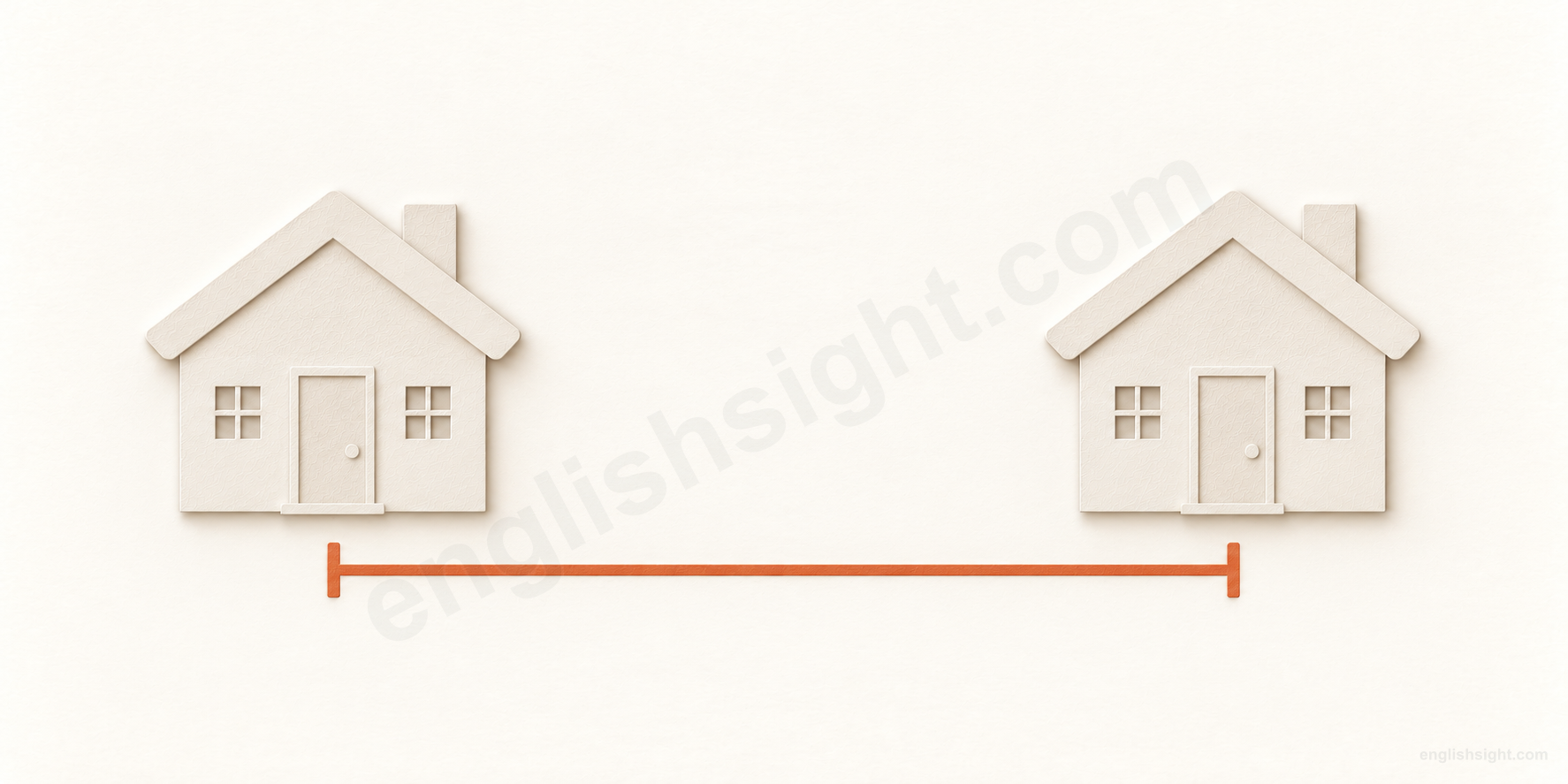
One house marks a fixed reference place.
distance
The other house marks the second fixed reference place.
The orange span marks the separation between the centres of the two houses.
The houses stay still; the highlighted span shows how far apart their centres are.
Distance names how far apart two points are; it can also describe separation in time, connection, or feeling.
The sketch isolates physical separation. Emotional distance, changing involvement, and established idioms are explained in their own sections; no single picture predicts every use.
Distance usually starts with two reference points and the space separating them. You can measure that space, travel along a route, or describe something too far away to reach easily.
English also uses distance for separation in time, feelings, and involvement. These connections help organize the lesson, but fixed expressions such as go the distance still need their own explanations.
01
Measure, travel, and locate
Identify the two reference points, then choose whether you mean their separation, a route traveled, a distant location, or practical reach.
01
the distance between A and B; the distance from A to B; a distance of + measurement
the distance between A and B
the amount of space separating two places or things
Situation / starting point
You know where the hotel and station are.
What is described
You ask how far apart they are.
Distance measures separation; the points need not move.
The distance between A and B names the separation of two reference points. The distance from A to B frames the same question with a starting point and destination. A distance of three kilometres supplies a measurement.
Distance can be countable when you specify a stretch: a short distance, several long distances. In Distance is measured in kilometres, it is uncountable. Ask How far is the station? or What is the distance to the station? How long does it take? asks about travel time.
In a sentence
What is the distance between the hotel and the station?
Watch the difference Between pairs with and; from pairs with to. Distance alone does not tell you how long the trip takes.
02
travel / cover + a distance (of + measurement); over a distance of + measurement
cover a distance
travel along a length of route
Situation / starting point
The walkers set off in the morning.
What is described
Their route totals twelve kilometres.
The distance covered is the length traveled, which may follow a winding route.
Walk, travel, cover, and run can take a distance as the length of a journey. Cover does not mean putting a lid over something here; the whole combination reports progress along a route.
We covered twelve kilometres tells you the route length, not necessarily the straight-line separation between start and finish. Over a distance of twelve kilometres describes the extent across which movement or an effect occurs: The path climbs steadily over a distance of twelve kilometres.
In a sentence
We covered a distance of twelve kilometres before lunch.
Watch the difference A circular walk can cover a long distance and end exactly where it started.
03
a short / long / considerable distance + away / from + place; some distance away
a short distance away
a small amount of space from a reference point
Situation / starting point
You are standing outside the museum.
What is described
The café is nearby, beyond the next corner.
Away and from locate something relative to a known or named starting point.
The café is a short distance away locates it relative to here or another point already understood. Add from the museum when the reference point needs to be explicit. A short distance to the entrance describes a stretch leading toward that destination.
Some distance away often suggests a noticeable separation, not an exact small amount. Long distances describes substantial stretches, while Distance makes visits difficult refers to remoteness in general.
In a sentence
The café is a short distance from the museum.
Watch the difference Distance is a noun; use far away or distant for an adjective description, not The café is distance.
04
see / hear + something + in the distance; look / disappear / stretch + into the distance
in / into the distance
in, or toward, the far part of what you can see or hear
Situation / starting point
You look beyond the nearby fields.
What is described
You notice a tower far away.
The distance here is the far-off part of the scene.
A tower in the distance is far from the observer but visible. A sound can come from that far-off area too: We heard a train in the distance. This expression identifies where the thing is perceived.
Into the distance gives a direction for looking, stretching, or moving: She stared into the distance; The road disappeared into the distance. It need not mean that someone is physically entering a container.
In a sentence
We could see a tower in the distance.
Watch the difference Use the in this expression. From a distance instead emphasizes the observer’s separated viewpoint.
05
at / from a distance; at / from a distance of + measurement + from + object
at / from a distance
located or observing some way away
Situation / starting point
You stay back from the waterfall.
What is described
You watch it without going close.
At describes a separated position; from presents that position as a viewpoint.
Watch from a distance means watch while standing away from the object. At a distance can describe position: The camera stood at a distance of two metres from the bird. Both at and from can occur with observation, so the distinction is useful rather than an absolute rule.
Without a measurement, a distance often suggests being some way away. With of two metres, the phrase gives a specified separation and does not have to mean very far. Compare a bird in the distance, which places the bird in a far-off part of the scene.
In a sentence
We watched the waterfall from a distance.
Watch the difference Do not replace every from a distance with in the distance: the viewpoint and the distant object play different roles.
06
be + within walking / easy commuting distance (of + place)
within walking distance
close enough to reach conveniently on foot
Situation / starting point
You need accommodation near the station.
What is described
You find a hotel you can walk to.
Within sets a practical limit; walking tells us how the place can be reached.
Within walking distance of the station means close enough to walk there reasonably easily. It does not name a universal number of metres. The route, the person, and the situation affect what is practical.
Within easy commuting distance similarly describes a manageable trip to work. Within a distance of two kilometres gives a numerical boundary instead. Use of to name the reference place after within walking distance.
In a sentence
Our hotel is within walking distance of the station.
Watch the difference Say within walking distance of the station, not within walking distance to the station.
02
Separation beyond the map
People can share a room yet feel far apart. Time, feelings, and ideas also allow us to talk about distance, without measuring metres.
07
emotional distance between + people; distance in + someone’s voice / manner
emotional distance
a lack of closeness or warmth between people
Situation / starting point
Two sisters still meet every week.
What is described
They no longer share their worries.
Emotional separation does not require physical separation.
Distance between people can describe a weakening relationship, even when they live together. Emotional makes that reading explicit. A growing distance suggests that their closeness is decreasing over time.
There was distance in her voice describes a reserved or cold manner; this wording is more formal than She sounded unfriendly. Distance here does not specify an emotion such as anger, and does not by itself explain why the person sounds detached.
In a sentence
Despite their weekly visits, there was growing emotional distance between the sisters.
Watch the difference A long-distance relationship concerns where partners live; it does not by itself mean they lack emotional closeness.
08
distance between + ideas / positions; maintain critical / professional distance from + something
distance between ideas; critical distance
a gap in outlook or a degree of detachment
Situation / starting point
Two groups use the same word for different goals.
What is described
You notice how far their expectations differ.
Distance can compare positions in thought rather than places on a map.
The distance between their expectations names a substantial difference or lack of connection. It does not refer to how far apart the groups sit. This use occurs especially in discussion of ideas, evidence, values, or social groups.
Maintain critical distance from a proposal means keep enough intellectual detachment to examine it rather than simply accept it. Professional distance similarly limits personal involvement. Detachment can serve careful judgment; it need not imply hostility.
In a sentence
The discussion revealed the distance between their expectations.
Watch the difference Do not use distance as a general replacement for every difference: a spelling difference is normally just a difference.
09
look back + from / at a distance of + period of time
from a distance of twenty years
viewed after a substantial passage of time
Situation / starting point
Twenty years have passed since your first job.
What is described
You look back with a changed perspective.
Elapsed time can separate the observer from an earlier event.
From a distance of twenty years looks back across time. The number measures the interval between the experience and the later viewpoint, rather than physical space.
With time, painful or confusing events may be easier to assess, but distance does not guarantee a wiser judgment. For an ordinary schedule, say The appointment is two weeks away; distance is especially useful when discussing remoteness or perspective.
In a sentence
From a distance of twenty years, I can understand why I left that job.
Watch the difference The period describes the time separating the event and the viewpoint, not how long the event lasted.
03
Make or maintain separation
The verb distance changes involvement. Keep your distance can instead maintain physical space or limit a relationship; read the whole construction.
10
keep + my / your / his / her / our / their + distance (from + person / thing)
keep your distance: physical space
avoid coming too close
Situation / starting point
A dog seems frightened.
What is described
You stay back instead of approaching it.
Keep maintains enough separation; it need not increase an existing gap.
Keep your distance from someone or something can be a literal request to stay back. The possessive matches the subject: I kept my distance; they kept their distance. The phrase itself supplies no fixed safe measurement.
Keep a safe distance from the edge states the safety purpose more explicitly. Keep your distance can sound firm as a direct command; Please stay back is another clear way to make that request.
In a sentence
The dog looked frightened, so we kept our distance.
Watch the difference Keep your distance can also limit involvement; the dog and the physical situation make this reading literal.
11
keep one’s distance from + person / group; keep + someone + at a distance
keep your distance: involvement
avoid becoming close or involved
Situation / starting point
You distrust a colleague’s business scheme.
What is described
You avoid becoming part of it.
The gap is in involvement, even if you meet the person daily.
Keep your distance from a person or group can mean avoid a close relationship or involvement. The context, rather than a different grammatical form, distinguishes this from standing farther away.
Keep someone at a distance shifts the focus to the other person: She keeps her colleagues at a distance means she does not let them become personally close. The object is the person kept away emotionally; use at a distance, not your distance after that object.
In a sentence
I still work with him, but I keep my distance from his business schemes.
Watch the difference He keeps his distance focuses on his own limited involvement; He keeps me at a distance focuses on the closeness he denies me. Neither necessarily describes physical metres.
12
distance + reflexive pronoun + from + person / group / action / idea; put (some) distance between A and B
distance yourself from
make clear that you are less connected or involved
Situation / starting point
A group makes a statement you reject.
What is described
You publicly separate your position from theirs.
The reflexive object is the person or organization reducing its own connection.
Distance yourself from a view, action, or group means reduce involvement or show that you do not share that position. The subject acts on its own association: I distance myself; the company distances itself.
This may describe a public statement or a more gradual emotional withdrawal. The form can be progressive: She is distancing herself from the group. From introduces what she is separating herself from; it is not a movable particle.
The noun construction put distance between A and B can express a similar separation: The candidate put distance between herself and the unpopular policy. Here put is the verb, distance is its noun object, and between identifies the two sides; the construction can also describe literal physical separation.
In a sentence
The club distanced itself from the captain’s comments.
Watch the difference Match the reflexive to the subject: the club distanced itself, not himself. Physical movement is not required.
13
distance + someone + from + someone / something; be distanced from
distance someone from something
cause someone to feel or become less connected
Situation / starting point
A report describes people only as statistics.
What is described
Readers find it harder to connect with their lives.
The cause and the affected person can be different participants.
In This style distances readers from the people described, the style is the cause, readers are affected, and the people described are the other side of the separation. The object is not reflexive because the style is not distancing itself.
A passive is possible: Readers are distanced from the characters by the formal narration. This is about involvement, not a command to move readers across a room. Such wording is especially useful in commentary on communication, art, or social relationships.
In a sentence
The report’s impersonal style distances readers from the people it describes.
Watch the difference Do not automatically insert yourself after every form of distance: the affected person may be a separate object.
04
Finish, approach, or lead
These established expressions draw on length or a remaining gap, but each has a conventional meaning that needs to be learned as a whole.
14
go the (full) distance
go the distance
continue until the end despite the effort required
Situation / starting point
A runner is tired halfway through a race.
What is described
She continues to the finish.
The fixed phrase emphasizes lasting through the whole task, not winning.
In sport, go the distance means continue for the full race or contest. In boxing, go the full distance means reach the end of the scheduled rounds without an earlier stoppage. It does not say who wins.
The informal figurative use concerns sustained effort in a demanding task: We need a team that can go the distance. Learn the whole expression with the; ordinary go a long distance simply describes traveling far.
In a sentence
She did not win the race, but she went the distance.
Watch the difference Going the distance is compatible with losing; it is not a synonym for winning.
15
be / come / get + within striking distance of + place / goal
within striking distance
near enough to reach a place or achieve a goal
Situation / starting point
The team needs only one more win.
What is described
The title is now realistically within reach.
Nearness is judged by the possibility of reaching the target.
Within striking distance of a place means near enough to reach it readily. With a goal such as victory or an agreement, it means close to achieving it: The extra funding puts us within striking distance of our target.
The expression does not require hitting anything. It also does not promise success: a team may be within striking distance of the title and still lose.
In a sentence
One more win would put us within striking distance of the title.
Watch the difference Use of before the target, and do not confuse being close to success with having achieved it.
16
within touching / shouting / spitting distance (of + place / goal)
within touching / shouting / spitting distance
very close, literally or figuratively
Situation / starting point
The fundraising target is almost reached.
What is described
Only a small amount remains to collect.
These informal expressions use familiar physical reach to convey closeness.
Within touching distance of a goal means very close to achieving it: We are within touching distance of our fundraising target. A place can likewise be within spitting distance of the station, meaning extremely nearby; nobody needs to spit.
Within shouting distance can describe being near enough to call to someone. Oxford also records it as an informal very-close expression, especially in North American English. Spitting distance is vivid and informal; near or very close to suits more neutral wording.
In a sentence
We are within touching distance of our fundraising target.
Watch the difference These expressions do not supply exact measurements. Choose a neutral alternative when the vivid or informal wording would be distracting.
17
by some distance + superlative; superlative + by some distance
by some distance
by a substantial margin
Situation / starting point
You compare several proposed routes.
What is described
One is much faster than the others.
The imagined gap measures the size of the advantage.
By some distance emphasizes that one person or thing is well ahead in a comparison. This use is especially British English: It is by some distance the best option means it is much better than the alternatives.
The phrase can accompany a superlative or a lead. It need not refer to physical space; with fastest route, it emphasizes the difference in performance. Much the best or easily the best may be clearer for an international audience.
In a sentence
This is the fastest route by some distance.
Watch the difference This use means by a large margin; it does not give the length of the route.
05
Study, communicate, and keep space
Distance also appears in names for activities and arrangements. Its position in a compound matters: a long distance and a long-distance journey have different grammatical jobs.
18
study by / through distance learning; a distance learning course
distance learning / distance education
study without regularly attending the institution in person
Situation / starting point
Your course provider is in another city.
What is described
You study at home and send work to your teachers.
The separation concerns where teaching and study take place.
Distance learning names an educational arrangement in which students study away from the institution and receive materials, instruction, and feedback remotely. Distance education is another name for it.
Distance modifies learning or education; it does not say the subject is difficult or that the course must last a long time. Online tools are common, but the important feature is studying away from the teaching institution rather than sharing its classroom.
In a sentence
She completed the course through distance learning while living abroad.
Watch the difference Do not confuse a distance learning course with a long course: place and duration are different.
19
long-distance + noun; travel + a long distance
a long-distance relationship / journey
involving people or places far apart
Situation / starting point
Two partners take jobs in different countries.
What is described
They maintain their relationship across that separation.
Before a noun, long-distance works as a compound adjective: a long-distance flight, phone call, or relationship. The hyphen helps show the words belong together as one modifier.
A long-distance relationship can be emotionally close. Contrast We traveled a long distance, where distance is a noun and long describes its length. The adjective distant is useful in other structures, such as a distant city; distance is not a general adjective meaning far away.
In a sentence
They maintained a long-distance relationship while working in different countries.
Watch the difference Write a long-distance relationship but travel a long distance; do not use a long distance as a complete modifier before relationship.
An athlete chooses longer races rather than sprints.
What is described
Training focuses on sustained running.
Distance before runner names a sporting category, not someone who is far away.
A distance runner or distance swimmer competes over longer courses. Distance here modifies the name of an athlete or activity; it does not say where the athlete is standing.
Long-distance and middle-distance also appear in event names. These are sporting categories whose exact ranges depend on the sport and classification, so do not assume that every event containing distance has one universal minimum length.
In a sentence
The club has separate sessions for sprinters and distance runners.
Watch the difference A distance runner is not a distant runner: distant tells you the runner is far away.
21
maintain social distance; practise / practice social distancing
social distance / social distancing
physical separation maintained to help prevent disease from spreading
Situation / starting point
People arrange seats for a meeting to reduce the spread of infection.
What is described
They leave space between participants.
In this health-related use, social distance concerns physical spacing.
In health-related language, maintain social distance means keep physical space between people during ordinary activities to help prevent disease from spreading. Social distancing names the practice of arranging or behaving in ways that maintain that separation.
This expression does not necessarily mean refusing friendship. Someone may keep in regular, friendly contact while maintaining physical space. No particular number of metres is contained in the words themselves.
In a sentence
The room was rearranged to make social distancing easier.
Watch the difference Read the context: emotional distance concerns a relationship, while this health-related use concerns physical space.
Keep the grammatical job clear
Noun, verb, and adjective
Distance /ˈdɪstəns/ is a noun and a verb. The plural noun and third-person verb are distances; the verb also has distanced and distancing. Distant is an adjective: a distant village. A long distance is a noun phrase; long-distance before a noun is a compound modifier.
Countability depends on what you mean
Use a distance for a particular extent, distances for several extents, and uncountable distance for remoteness in general. In the distance is a fixed expression with the. Learn the article with each construction rather than choosing one rule for all uses.
The verb takes an affected participant
Distance yourself from is reflexive; distance someone from affects a separate object. The transitive verb allows progressive forms and a passive when the context suits them. These are verb-plus-object and preposition patterns, not a family of separable particle verbs.
A teaching connection has limits
Spatial separation helps explain figurative distance, but emotional coldness, perspective, completion, and closeness to a goal are not interchangeable. This selection teaches modern practical uses, with register notes where useful, rather than a frequency ranking or every technical sense.
Find the right kind of distance
Check the participants, the preposition, and whether the separation is physical or figurative.
1. You stand well back while looking at a waterfall. Which sentence describes your viewpoint?
2. The hotel is close enough for an easy walk from the station. Complete: It is within walking distance ___ the station.
3. A club says a player’s offensive remarks do not represent its position. Which sentence fits?
4. A boxer goes the full distance but loses on points. Is the description consistent?
5. Two partners live in different countries but feel close and talk every day. Which description states only the geographical separation?
6. You meet a colleague daily but avoid involvement in his doubtful schemes. What does keep my distance mean here?
Sources and teaching notes
Dictionary entries support the meanings and constructions below. The explanations, examples, and relation sketch were written for this lesson; the visual connection is a teaching aid.
The sketch is a teaching aid, not a claim that every English speaker imagines the same picture.