Distribution can name the sharing-out process, the route to recipients, or the pattern that exists across a group or area.
Across several destinations or parts
Across several destinations or parts
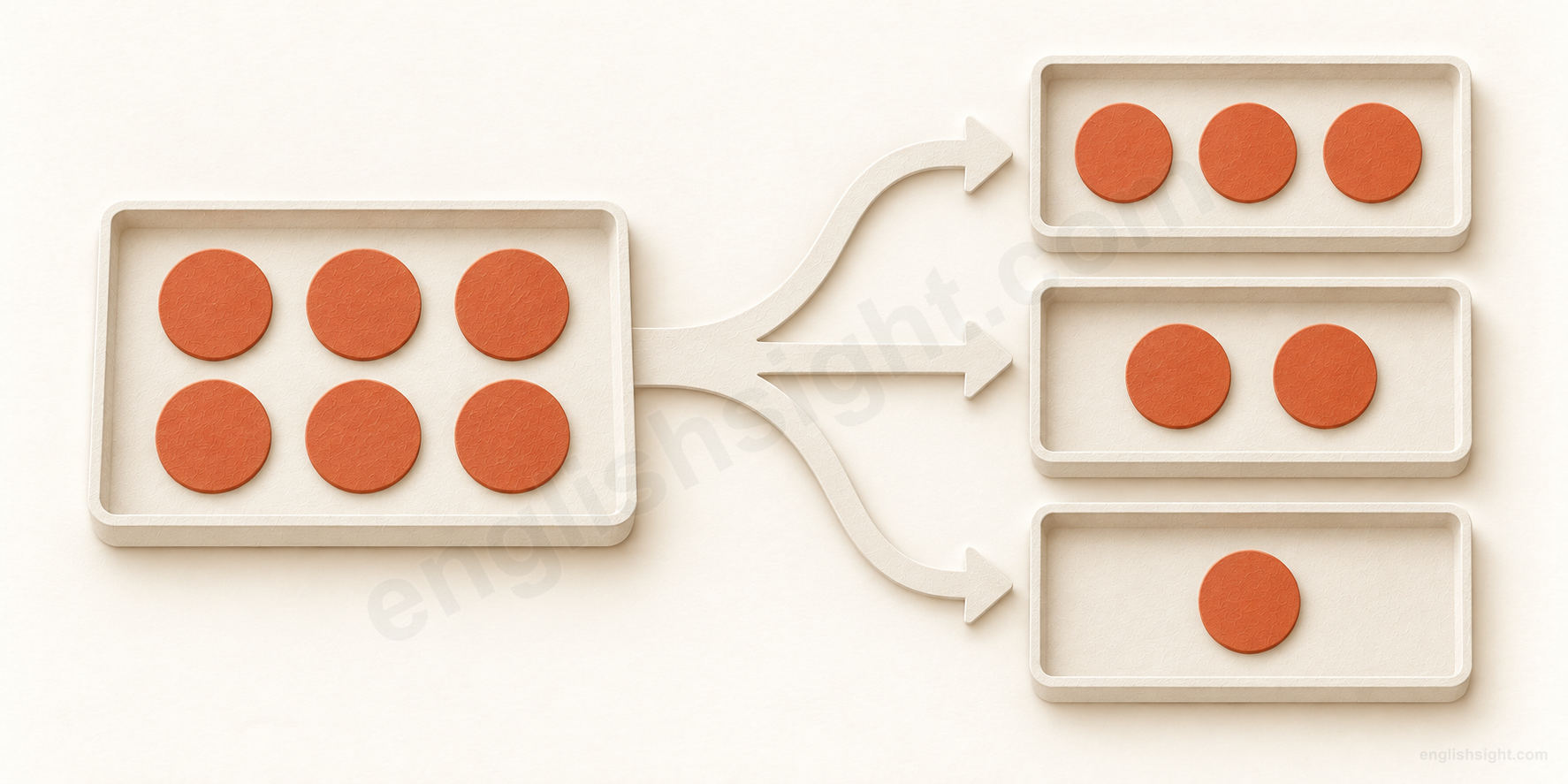
Six tokens together in one tray.
distribution
The trays hold three, two and one token.
Branching arrows show the tokens being shared among three trays.
Sharing out is the process; three, two and one show the resulting unequal distribution.
Distribution concerns how something is shared or spread among people, across places or periods of time, or over categories: the process of doing this, or the pattern of where it is and how much is in each part.
The sketch illustrates deliberate sharing out. A map or statistical chart can show a distribution without any act of giving, movement from one source, or equal shares.
Imagine six items being divided between three trays. You can ask how they are being handed out, or look at the trays and ask where the items are and how many each tray holds. Distribution can describe either the process or the resulting arrangement.
The same questions help with supplies, wealth, wildlife, weight, and data. A distribution can be unequal, and an existing distribution does not require anyone to have deliberately arranged it. These connections are a learning aid, not a claim about a picture shared by all English speakers.
01
Getting things to people
Name the activity, its intended recipients, or the system that makes goods and information available.
01
distribution of + thing + to / among + recipients; distribution by + agent
the distribution of food
giving or sending things to several recipients
Situation / starting point
Supplies are available, and several households need them.
Process / pattern described
An organized activity gets supplies to the households.
Distribution names the activity as a whole, not one person’s act of receiving.
In the distribution of food, of introduces what is given out. To can name the destination or recipients; among highlights the recipient group. Distribution by volunteers names the people doing the work.
You can organize, begin, delay, or control distribution. Unlike the verb distribute, the noun cannot take food as a direct object after it: use the distribution of food or distribute food.
Free distribution means recipients are not charged. Distribution without free does not say whether anything is sold, donated, or supplied as an entitlement.
In a sentence
Volunteers organized the distribution of hot meals to families after the storm.
Watch the difference Do not assume distribution means an equal share or a free gift.
02
be ready / available for distribution (to / among + recipients)
for distribution
intended to be given or sent out
Situation / starting point
Printed notices are ready in boxes.
Process / pattern described
The notices are intended to reach local homes.
For describes purpose; it does not confirm the recipients have received anything.
For distribution commonly follows prepared, printed, packed, ready, or available. The thing exists now, but giving it out may still be planned.
Add to or among for recipients: ready for distribution to schools. For general distribution means intended for broad circulation rather than a tightly limited audience.
Not for distribution tells the reader not to circulate the material. It concerns circulation, not necessarily whether the material is free to read in its present location.
In a sentence
The safety cards are ready for distribution to every new employee.
Watch the difference Ready for distribution does not mean distribution is finished.
03
distribution network / centre / costs; the distribution of goods
a distribution network
the connected system that gets products to outlets or customers
Situation / starting point
A producer has goods, and shops in several towns need stock.
Process / pattern described
Warehouses, routes, and deliveries connect the producer with the shops.
Commercial distribution concerns getting a product to its market.
Distribution in business covers the system for moving and supplying products. A distribution network joins facilities, routes, and outlets; a distribution centre is a hub where goods can be stored and sorted before onward delivery.
Production makes the product; distribution gets it to places where people can obtain it. Distribution costs are the costs of this supply activity, not simply the cost of making each item.
Wholesale and retail distribution describe supply through different selling arrangements. The exact activities included depend on the business; the word does not mean that every business uses the same chain.
In a sentence
The bakery expanded its distribution network to supply shops in three more towns.
Watch the difference A distribution centre is a supply hub; it need not be a shop open to the public.
04
distribution through + outlet; distribution channel / deal / agreement / rights
distribution channels and distribution rights
routes to a market and permission to supply content or products
Situation / starting point
A company has a product or film but needs a way to reach its audience.
Process / pattern described
A route is chosen, and an agreement may authorize distribution.
Channel names the route; rights name permission, not a physical path.
A distribution channel is a way a product reaches its market, such as retailers or an online platform. Through names the intermediary or route: distribution through local bookshops.
A distribution deal or agreement sets arrangements for supplying a product or making content available. Film distribution concerns getting a film to cinemas or other audiences; it is separate from shooting the film.
Distribution rights are permission to distribute something, often within specified territories or arrangements. Digital distribution makes content or software available electronically; no truck or warehouse is required. Rights concern authorization, while channels concern how the audience is reached.
In a sentence
The studio signed a distribution deal to bring the film to cinemas overseas.
Watch the difference Do not read distribution rights as a promise that the distributor owns the underlying film or product.
05
be on / add someone to / remove someone from a distribution list
a distribution list
a list of people or addresses intended to receive the same information
Situation / starting point
A team needs to circulate one notice to a known set of recipients.
Process / pattern described
The list identifies who should receive the notice.
Here the thing distributed is information, and the list records recipients.
A distribution list is used to circulate messages or documents to a group. In email it can collect several addresses under one group name, so a message can be sent to the group.
A list may be out of date or a message may fail, so being on the list does not prove a particular message was delivered. Add someone to a distribution list and remove someone from it are useful surrounding patterns.
Information distribution names the wider activity of circulating information. A distribution list is one tool for doing that; it is not a statistical list of how often something occurs.
In a sentence
Please add the new volunteers to the email distribution list before sending the update.
Watch the difference A distribution list identifies recipients; a frequency distribution records counts or proportions.
02
Describing who has what and where things are
Distribution can describe an arrangement already present. No giver, journey, or change needs to be implied.
06
the distribution of wealth / income / resources / work among / across / between + groups
the distribution of wealth or resources
how much different people or groups have or receive
Situation / starting point
A town has limited resources, and its districts have different needs.
Process / pattern described
You compare the shares assigned to or held by different districts.
The pattern of shares matters; a transfer may or may not be taking place now.
The distribution of wealth describes how wealth is held across a population. Income distribution concerns how income is spread across people or groups; it does not have to describe an official handing-out event.
The distribution of resources or work can concern allocation and responsibility: who gets resources, or who does how much. Among points to a group, across to the wider spread, and between to distinct people, groups, or categories under comparison. Between is also possible with more than two separately identified groups.
An unequal distribution has different-sized shares. An equitable distribution is judged fair; larger shares for greater need may be equitable without being equal. The adjective supplies that judgment, not distribution itself.
In a sentence
The report compares the distribution of public funds across the town’s five districts.
Watch the difference A fair distribution and an equal distribution are not automatically the same thing.
07
the geographical distribution of + species / population; distribution across / in + area
the geographical distribution of a species
the places where something occurs and its spread across an area
Situation / starting point
Researchers observe wild plants at different sites.
Process / pattern described
A map records where the plants occur.
An existing spatial pattern need not result from anyone sharing things out.
Geographical distribution describes where a species, disease, population, or other phenomenon occurs. A distribution map can show its range and, depending on the data, its concentration in different places.
Across, over, throughout, and in locate the area being considered. A wide distribution means occurrence across a broad range; a localized distribution is limited to a smaller area. Wide does not by itself mean equally common everywhere.
This is the pattern side of the core model. The wild plants have not necessarily moved from one central store or been deliberately planted by someone.
In a sentence
The map shows the distribution of wild orchids across the island.
Watch the difference Do not infer a delivery operation from distribution when the subject is a wild species.
08
even / uneven distribution of + quantity; weight / heat distribution
even distribution of weight or heat
how a physical quantity is spread across the parts of something
Situation / starting point
Most of the heavy equipment is on one side of a trailer.
Process / pattern described
Moving it changes how the weight is spread between the sides.
Distribution describes the arrangement of a quantity, not necessarily separate objects being delivered.
Weight distribution concerns where the load is carried. Heat distribution concerns how heat is spread through a space or material. The same pattern language can describe cream spread through hair or another substance across a surface.
An even distribution is reasonably balanced across the relevant parts; an uneven one has concentrations or gaps. Which arrangement is desirable depends on the task. Distribution alone does not tell you that the arrangement is safe or effective.
You can improve, change, check, or ensure distribution. The of-phrase identifies the quantity; across or through identifies the space. In weight distribution, the noun weight provides the same information compactly.
In a sentence
We moved two boxes to improve the weight distribution on the trailer.
Watch the difference Weight distribution is about where weight is supported, not just the total weight.
03
Reading charts and financial statements
These established technical uses are useful to recognize. Their extra precision comes from the subject area and the complete expression.
09
a frequency distribution; the age / score distribution of + group
a frequency distribution
a summary of how often different values or ranges occur
Situation / starting point
A class has many individual test scores.
Process / pattern described
Scores are grouped into ranges, with a count for each range.
The categories take the place of destinations in the teaching model.
In statistics, a frequency distribution shows how observations are spread over values or categories, often in a table or graph. It answers questions such as how many students scored within each range.
The age distribution of a population similarly shows how people are spread over ages or age groups. A distribution may use counts or proportions; read the labels to know which is being shown. The spread can also be over time: “The chart shows the distribution of rainfall throughout the year” compares how much rain falls in different months, not deliveries of water.
There is no need for anyone to give the scores out. This is an abstract arrangement of observations. Different distributions can have the same total number of observations but very different shapes.
In a sentence
The teacher made a frequency distribution of the class’s test scores.
Watch the difference A frequency distribution describes the data pattern, not the act of handing test papers to students.
10
a normal distribution; follow a normal distribution; a probability distribution
a normal distribution
a particular statistical pattern with a symmetric bell shape
Situation / starting point
You inspect the shape of a set of measurements or a statistical model.
Process / pattern described
You consider whether the pattern can reasonably be described by a normal distribution.
Normal is a technical label here, not a judgment that every observation is ordinary.
A normal distribution has a symmetric bell-shaped curve: values near the centre are more concentrated than values far from it. It is one kind of distribution, not another name for all distributions.
Data are not automatically normal just because they are numerous. A bell-like sketch alone is not enough to establish that a particular statistical model fits; this lesson introduces the expression rather than teaching a statistical test.
A probability distribution describes how probability is assigned across possible outcomes or values. A normal distribution is one particular probability model, so the two expressions are not interchangeable.
In a sentence
The model assumes that the measurement errors follow a normal distribution.
Watch the difference A normal distribution is not a flat, equal spread of values, and normal does not mean morally acceptable.
11
a quarterly / annual distribution; make / pay a distribution to + recipients
a distribution to investors
an amount of money paid out from a fund or investment
Situation / starting point
A fund has money available to pay its investors.
Process / pattern described
Each payment can be referred to as a distribution.
The countable noun can name an amount paid, not just the overall process.
In financial reporting, a distribution can be a payment from a fund to its holders or beneficiaries. Distributions is natural when several payments are being counted.
Compare the distribution of profits, which focuses on the sharing-out process, with a quarterly distribution, which can identify a particular payment. The financial setting and words such as paid make the intended reading clear.
The term does not by itself explain where the money came from, whether it is taxable, or whether the investment made a profit. Those details depend on the fund and the relevant rules.
In a sentence
The fund paid a small quarterly distribution to its investors.
Watch the difference Do not assume every distribution is interest or a dividend; the wider term can cover different kinds of payout.
Read the noun and its surroundings
A process or a pattern
The distribution of blankets began at noon describes an activity. The distribution of trees across the island describes where trees grow. Look at the thing being distributed and the rest of the sentence before deciding whether any transfer is involved.
Countability depends on the intended meaning
Use distribution without a/an for a general activity or system: Distribution is expensive. An article can identify a particular pattern: a very uneven distribution of weight. Distributions can refer to several patterns or separate payments. Do not put a before every instance, or treat the noun as always uncountable.
A noun, its verb, and its companions
Distribution is a noun; distribute is the verb: They distribute supplies; they organize the distribution of supplies. Nouns before distribution identify the content or field, as in food distribution and income distribution. In distribution costs or a distribution centre, distribution modifies the following noun. Centre is the usual British spelling; center is the American spelling.
Distribution, delivery, and allocation
Delivery often focuses on taking something to its destination; distribution can cover a wider system or the spread across recipients. Allocation emphasizes assigning an amount or share. Distribution may describe the actual giving out or the arrangement that exists. These words overlap, but a map of bird distribution is not a map of bird deliveries.
Equal, even, and fair are extra information
Distribution alone promises neither equal amounts nor fairness. Equal emphasizes the same amount per person or part; even often emphasizes a balanced spread. Fair or equitable introduces a judgment about what is reasonable, which may depend on need rather than identical shares.
Learn combinations without inventing an idiom
For distribution, distribution of, distribution to, and distribution across are noun phrases with prepositions, not phrasal verbs. This lesson does not add a separate idiom family: the checked headword entries organize the main uses as noun senses and collocations. Specialized legal, medical, computing, and advanced mathematical meanings are outside the main course.
Choose the right reading
Decide whether the sentence describes giving out, an existing pattern, a business route, or a specialized amount.
1. A map marks the places where a wild flower grows. What does its distribution describe?
2. The leaflets are packed for distribution to residents. Have the residents necessarily received them yet?
3. Two districts receive different amounts of aid because one has many more residents. Which claim is justified by the word distribution alone?
4. A bakery uses a distribution network to supply twenty shops. What does network emphasize?
5. A chart groups test scores into ranges and counts the students in each range. What is shown?
6. An investment report says, “Two distributions were paid this year.” What are the distributions?
Sources and teaching notes
The dictionary entries below support the senses and combinations taught here. Explanations, examples, comparisons, and the visual model were created for this lesson. The connections in the model are teaching interpretations, not evidence of a universal mental image.
The diagram connects sharing out with the resulting spread. It does not imply that every distribution is deliberate or equal.