An animal name, a following image, and fixed expressions.
Use dog for the animal; read the grammar and the full phrase for its other meanings.
Staying close, again and again
Staying close, again and again
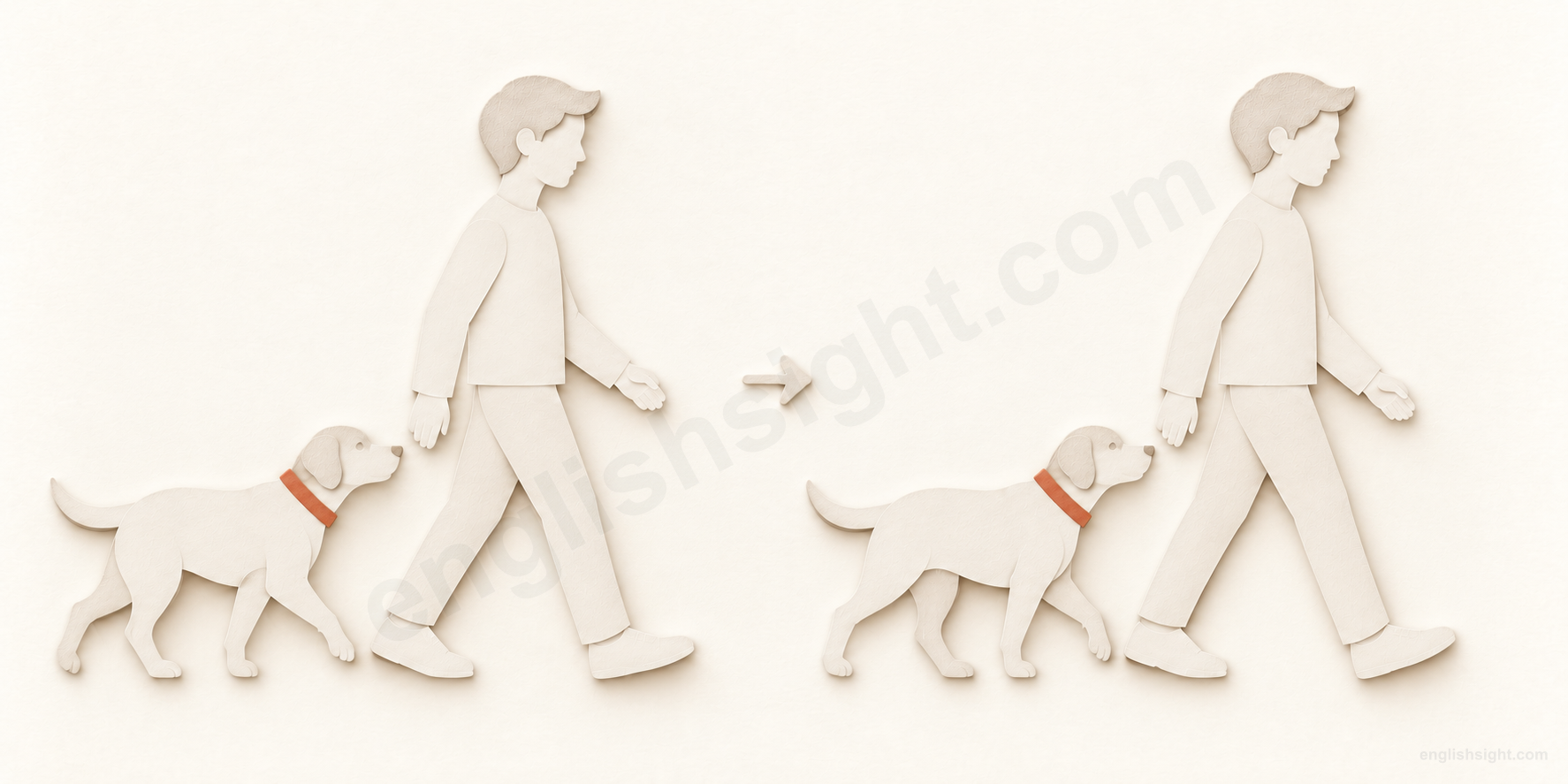
A person walks to the right with a dog close behind.
dog
The same dog is still following the same person.
As the person takes another step, the dog stays close.
The dog keeps following as the person moves: a memory link to the verb dog, not a rule for every use.
A dog is the animal; as a verb, dog can present a follower or an unwanted problem as persistently staying with someone.
The noun does not itself mean follow. The close-following analogy helps with the verb, while expressions such as rain cats and dogs or a hot dog need their own established meanings.
Dog usually names a familiar animal. It is also a verb for close, persistent following or continuing trouble. Many everyday phrases use dogs in conventional comparisons whose meanings must be learned as whole expressions.
The sketch connects a dog staying close behind a person with the verb’s persistence. It is a teaching analogy, not a definition of every dog or a claim that all English speakers share one mental picture.
01
The animal and everyday care
Start with the countable animal noun. Other words specify care, equipment, training, or biological sex.
01
a / the / my + dog; dogs + plural verb
a dog / dogs
the familiar animal, whether a pet or a working animal
Situation / starting point
You hear an animal barking outside.
Meaning in context
You identify it as a dog.
Dog names an animal; it does not require one breed, size, or job.
Use a dog for one unspecified animal and the dog for one already identifiable. Dogs need exercise makes a general statement about the animals. The ordinary plural is dogs.
A puppy is a young dog, not a different species. A breed of dog identifies a type, such as a spaniel. The noun alone does not say that the animal belongs to somebody, is friendly, or is male.
In a sentence
A small dog was waiting beside the gate.
Watch the difference Use a determiner with an ordinary singular count noun: I have a dog, not I have dog.
02
walk + dog; take + dog + for a walk
walk the dog / take the dog for a walk
give a dog a walk and accompany it
Situation / starting point
Your dog has been indoors all afternoon.
Meaning in context
You go outside with it for exercise.
Walk supplies the action; the dog is the animal you accompany.
Walk the dog uses walk transitively: the person takes the animal out. Take the dog for a walk describes the same everyday activity. The dog walked home instead makes the dog the subject doing the walking.
Feed the dog and train the dog are similarly ordinary verb–object combinations. They are not special meanings of dog. A stray dog has no home or is away from home; pet dog identifies an animal kept as a companion.
In a sentence
Could you walk the dog before dinner?
Watch the difference Dog is not the everyday verb for exercising a dog: say walk the dog.
03
dog + noun; role noun + dog; the dog’s + noun
dog food / a guide dog
use a noun combination to specify a product or a trained animal
Situation / starting point
You need to name food or an animal’s role.
Meaning in context
The other noun tells you how dog relates to it.
The last noun names the kind of thing; the earlier word narrows it.
Dog food is food for dogs, while a dog owner is a person who owns a dog. Dog is normally singular in these noun modifiers even when several dogs are involved. The exact relation comes from the combination, not from a hidden preposition inside dog.
A guard dog is trained to protect a place; a guide dog helps a person who cannot see well. These are dogs with different tasks, not separate basic meanings. Compare food for the dog with the dog’s food: the latter identifies food associated with a particular animal.
In a sentence
The guide dog waited while its handler opened the door.
Watch the difference A guide dog is an animal; a dog guide may instead be a guide about dogs. Word order matters.
04
male / female + dog; dog as a sex-specific animal term
a male dog
specify the animal’s sex when it matters
Situation / starting point
A form asks for the animal’s sex.
Meaning in context
You specify male or female.
The general noun dog can cover both sexes; a narrower animal term can mean male.
In breeding or animal descriptions, dog can specifically mean a male, including the male of certain related animals. In normal conversation, however, our dog can refer to a female animal too.
Male dog and female dog make the distinction clear for learners. Bitch is a technical word for a female dog, but using it about a person can be deeply insulting. The animal terminology is not a model for addressing people.
In a sentence
Our dog is female, and her name is Pepper.
Watch the difference Do not infer male sex whenever you see the ordinary noun dog.
02
People, judgments, and persistent following
Context can turn an animal name into a personal remark, a judgment of quality, or a verb. These uses differ in grammar and tone.
05
you + adjective + dog; call someone a dog
You lucky dog! / You dirty dog!
refer to a person with a strongly context-dependent tone
Situation / starting point
A friend wins a free holiday.
Meaning in context
You react playfully to the friend’s good luck.
The adjective and relationship help determine whether this personal label is playful or insulting.
You lucky dog! can be an informal, playful response to someone’s good fortune. It does not mean the person looks like an animal. A bare dog is not a safe neutral substitute for person.
You dirty dog! expresses disapproval of a man’s behavior. Dog is also used as an offensive judgment of a person’s appearance, especially a woman’s. Recognize that use without treating it as friendly vocabulary; the tone of lucky dog does not transfer to every combination.
In a sentence
“They upgraded my ticket for free.” “You lucky dog!”
Watch the difference A personal label can offend even if a similar phrase sounds playful among friends.
06
something + be + a dog; a dog of a + noun
a real dog
an unsatisfactory thing or a failure
Situation / starting point
A used car keeps breaking down.
Meaning in context
Its owner dismisses it as a poor purchase.
This informal judgment evaluates quality, not animal characteristics.
Especially in North American informal English, a thing can be called a dog when it is disappointing, unsuccessful, or poor quality. A car or a movie can be the subject; this is an established evaluative noun use.
The surrounding words normally make the judgment clear. The film was a dog is a blunt negative opinion. The film was about a dog instead names an animal in its subject matter.
In a sentence
That cheap printer turned out to be a real dog.
Watch the difference This is informal criticism, not a neutral technical quality rating.
07
the dogs; go to the dogs + racing context
go to the dogs
attend greyhound racing in a British context
Situation / starting point
Friends are discussing evening entertainment.
Meaning in context
They suggest a visit to a greyhound track.
The dogs can refer collectively to a racing event.
In British informal English, the dogs can mean greyhound racing. Here go to the dogs can describe attending the races, with actual racing animals understood.
Context distinguishes this from the idiom meaning deteriorate: Our town is going to the dogs complains about decline, rather than describing a trip to a race meeting. The words alone do not fix the interpretation.
In a sentence
They went to the dogs on Saturday and watched three races.
Watch the difference Keep the article in this event use: the dogs.
08
dog + person / someone’s steps / movements; dog + person + for + information
dog someone’s steps
follow someone closely and persistently
Situation / starting point
A person leaves one street for another.
Meaning in context
Someone continues following very closely.
The follower stays close as the other person moves.
As a transitive verb, dog can describe persistent following, often unwanted. A person dogs someone, their steps, or their movements. The dog-following sketch is a memory analogy for this relation, not a claim that every animal behaves this way.
Follow is the broader neutral word: a guide can ask you to follow her. Dog suggests a more relentless pursuit. It is not the usual verb for walking your pet.
Dog can also mean pester someone persistently, without following them along a street. In Callers dogged the office staff for updates all morning, the callers keep pressing the staff for information. For updates names what they want; it is not a required particle belonging to dog.
In a sentence
The reporter dogged the actor’s steps outside the hotel.
Watch the difference The object follows the verb directly: dogged him, not dogged after him in this pattern.
09
problem + dog + person / project; be dogged by + problem
be dogged by problems
suffer repeated or continuing trouble
Situation / starting point
Work on the new road begins.
Meaning in context
Delays keep affecting it over time.
An unwanted problem keeps returning or remains hard to escape.
A problem, injury, rumor, or bad luck can dog a person or project: delays dogged the project. The following image helps link this to persistence, but the subject need not physically move.
The passive be dogged by is particularly useful: the person or project comes first, and by introduces the persistent source of trouble. Dogged is the past participle here, not an adjective meaning determined.
In a sentence
The project has been dogged by delays since January.
Watch the difference Use by for the cause in the passive: dogged by injuries, not dogged of injuries.
10
dog it; be dogging it
dog it
make little effort, especially in sport
Situation / starting point
A player stops trying hard during a match.
Meaning in context
The coach criticizes the lack of effort.
The whole informal expression means failing to try, rather than persistent pursuit.
Dog it is a North American informal expression for being lazy or not making an effort, particularly in sport. It is separate from dog someone, where dog means follow or trouble persistently.
Keep the conventional it in the expression. Compare work like a dog, which means work very hard: the two expressions give opposite judgments about effort.
In a sentence
The coach accused two players of dogging it during practice.
Watch the difference Do not replace it with an arbitrary object while keeping this idiomatic meaning.
03
Effort, health, weather, and relationships
Learn each complete comparison. Dog does not have one transferable meaning that predicts them all.
11
work + like a dog
work like a dog
work extremely hard
Situation / starting point
You spend long hours carrying supplies.
Meaning in context
You emphasize how hard you have worked.
The comparison intensifies effort; it does not mean working for an animal.
Work like a dog is an informal way to stress very hard work. Like a dog modifies the action expressed by work; it is not a new verb made from dog.
It may suggest exhausting or unrewarding work, but it does not by itself specify pay, ownership, or a precise number of hours. The comparison changes meaning with a different verb, as in treat someone like a dog.
In a sentence
We worked like dogs to get the hall ready before noon.
Watch the difference Plural dogs can agree with we; learn the comparison with its verb rather than assigning like a dog one universal meaning.
12
treat + person + like a dog; be treated like a dog
treat someone like a dog
treat someone very badly
Situation / starting point
A manager humiliates an employee.
Meaning in context
A colleague condemns that treatment.
The object is the person receiving the bad treatment.
Treat someone like a dog condemns cruel or degrading treatment. The phrase is about how the person is treated, not about the person being inferior.
The passive keeps the affected person in focus: She was treated like a dog. Unlike work like a dog, this comparison evaluates treatment rather than effort. The established wording does not make a general factual claim about the care of real pets.
In a sentence
He quit because the supervisor treated him like a dog.
Watch the difference Keep the person as the object of treat; dog is part of the comparison.
13
be / feel + (as) sick as a dog
(as) sick as a dog
feel very ill, often with severe nausea or vomiting
Situation / starting point
A rough boat journey makes you unwell.
Meaning in context
You describe how ill you felt.
The fixed comparison expresses intensity rather than naming an illness.
Sick as a dog is informal and emphatic. It commonly concerns feeling physically very ill, especially being nauseated or vomiting. It is not the name of a disease.
The first as is optional: I was sick as a dog. Do not infer from the phrase that an actual dog is sick, or that a particular cause has been diagnosed.
In a sentence
I felt sick as a dog on the ferry.
Watch the difference This lesson teaches the physical-illness use; the phrase is not a precise description for a medical form.
14
be / feel + dog-tired
dog-tired
extremely tired
Situation / starting point
You finish moving heavy boxes.
Meaning in context
You have almost no energy left.
The compound adjective emphasizes exhaustion.
Dog-tired is an informal adjective, usually placed after be or feel: We were dog-tired. It does not mean that you are tired of dogs.
Dog strengthens tired in this established compound. It does not freely strengthen every adjective: very ready is ordinary English, but dog-ready is not a standard equivalent.
In a sentence
By the time we carried the last box upstairs, we were dog-tired.
Watch the difference Distinguish dog-tired from tired of the dog, which means annoyed or bored with the animal.
15
it + be + raining cats and dogs
rain cats and dogs
rain very heavily
Situation / starting point
Heavy rain starts just before you leave.
Meaning in context
You describe the downpour informally.
The complete idiom names heavy rainfall, not falling animals.
It is raining cats and dogs is a vivid informal weather expression. It is the usual weather subject; cats and dogs form a fixed plural pair.
The expression does not follow from a general meaning of dog, and a literal picture of animals falling would misrepresent the weather. For a plain report, It is raining heavily gives the same basic information.
In a sentence
Take an umbrella—it’s raining cats and dogs out there.
Watch the difference Do not change the fixed pair to cats or dogs when using this idiom.
16
people + fight like cat and dog / cats and dogs
fight like cat and dog / cats and dogs
argue with each other repeatedly
Situation / starting point
Two colleagues keep disagreeing noisily.
Meaning in context
You comment on their repeated arguments.
The comparison describes a relationship between people.
British English uses fight like cat and dog; North American English commonly uses fight like cats and dogs. Both can describe people who argue all the time, without any physical fighting.
Unlike rain cats and dogs, this expression compares the people’s behavior with animals fighting. Learning the whole expression prevents you from confusing the two meanings.
In a sentence
Those two fight like cats and dogs, even over tiny decisions.
Watch the difference The idiom does not necessarily report physical violence.
17
lead / have + a dog’s life
a dog’s life
a life full of hardship or unfair treatment
Situation / starting point
Someone works long hours and is treated unfairly.
Meaning in context
You describe that life as miserable.
The possessive form belongs to a fixed description of hardship.
Lead a dog’s life or have a dog’s life means live unhappily with many difficulties. The idiom is different from a literal account of the comfortable life of a pet.
Context determines the reading: A dog’s life on this farm begins with a morning walk might be about a real animal. He leads a dog’s life on almost no pay instead makes a conventional complaint about hardship.
In a sentence
With no days off and barely enough to eat, he led a dog’s life.
Watch the difference Keep the possessive: a dog’s life, not a dog life for this idiom.
04
Problems, competition, and advice
These established expressions help you comment on a situation. Their meanings belong to the whole wording, not to a literal dog.
18
place / organization + go to the dogs
go to the dogs
deteriorate badly
Situation / starting point
A once pleasant park loses maintenance.
Meaning in context
It becomes dirty and neglected.
Going expresses decline in this established idiom, not a destination.
A business, place, or system goes to the dogs when it gets into a very bad state. The phrase is informal and often expresses a strongly negative personal judgment.
The noun after to is fixed as the dogs. Distinguish the British racing use, where people literally go to a racing event. A park going to the dogs is usually a complaint about decline.
In a sentence
The park has gone to the dogs since the maintenance budget was cut.
Watch the difference Do not use this phrase just to say that dogs are allowed in a place.
19
let sleeping dogs lie
let sleeping dogs lie
leave a potentially troublesome matter undisturbed
Situation / starting point
An old disagreement has finally gone quiet.
Meaning in context
You choose not to reopen it.
The advice is to avoid stirring up a problem that is currently quiet.
Let sleeping dogs lie advises leaving a situation alone because interfering may cause trouble. The matter need not concern an animal or literal sleep.
In the literal image, lie means remain resting, not tell an untruth. In the idiom, sleeping marks a dormant problem. It is a judgment about whether to raise a matter, not a rule that every difficult issue should be ignored.
In a sentence
We settled that argument last year; let’s let sleeping dogs lie.
Watch the difference Keep lie after let; do not use lay or lying in the fixed expression.
20
can / can’t teach an old dog new tricks
You can’t teach an old dog new tricks.
suggest that established habits are hard to change
Situation / starting point
Someone resists learning a new method.
Meaning in context
A speaker comments on the difficulty of changing habits.
The saying concerns long-established ways, not a proven rule about age.
This saying is used when people are reluctant or find it difficult to change familiar methods or ideas. It can be humorous, self-deprecating, or dismissive depending on context.
A speaker can challenge the saying with You can teach an old dog new tricks. Neither version is a scientific statement about what older people or actual dogs can learn.
In a sentence
“I still use my paper diary—you can’t teach an old dog new tricks,” she joked.
Watch the difference Calling another person an old dog can sound patronizing; context and tone matter.
21
every dog has its / his day
Every dog has its day.
everyone gets a turn at good fortune or success
Situation / starting point
A team finally wins after many defeats.
Meaning in context
A supporter celebrates its turn at success.
The saying offers hope or recognition, not a prediction of a specific date.
Every dog has its day means that even someone who is usually unsuccessful can have a successful or lucky moment. The traditional variant Every dog has his day is also used.
Day here stands for an opportunity or period of success. It does not promise that success will happen every day, or require the subject to be a dog.
In a sentence
After five failed attempts, we finally won—every dog has its day.
Watch the difference Use singular has after every dog.
22
a dog-eat-dog + noun; it is dog eat dog
a dog-eat-dog world
a situation of ruthless competition
Situation / starting point
Rivals will harm one another to win contracts.
Meaning in context
You condemn the competitive environment.
The phrase adds ruthlessness, not just ordinary competition.
Dog eat dog describes a situation in which people pursue their own success at others’ expense. A competitive game can still be friendly; dog eat dog usually expresses a harsher judgment.
Before a noun the expression is commonly hyphenated: a dog-eat-dog industry. It is also used as a fixed phrase: It’s dog eat dog in that business. The frozen eat does not become eats in this expression.
In a sentence
She left the dog-eat-dog world of sales for a more cooperative workplace.
Watch the difference Do not interpret this as doggy-dog; eat is part of the expression.
23
be / become + (the) top dog
top dog
the dominant or most successful person or group
Situation / starting point
One team repeatedly beats its rivals.
Meaning in context
It holds the leading position.
Top marks competitive rank or power, not physical height.
Top dog is informal and can refer to a person, team, organization, or country in the strongest position. A person need not be kind or admirable to be top dog.
Be top dog and be the top dog are both possible in context. It does not mean that someone owns the best animal, and it is not a formal job title.
In a sentence
After three league titles, they were clearly top dog in the region.
Watch the difference Top dog describes relative dominance; it does not automatically mean a person is your manager.
24
have / not have + a dog in the fight
have a dog in the fight
have a personal interest in the outcome
Situation / starting point
A decision affects the value of your investment.
Meaning in context
You are not a disinterested observer.
The dog represents a stake in the outcome, not a pet present at a fight.
Have a dog in the fight is informal: you stand to gain or lose from a result. I don’t have a dog in this fight says that you lack that personal stake.
North American variants include a dog in the race or hunt. This is different from taking part physically in an argument. Someone may quietly have a stake without publicly joining either side.
In a sentence
I own shares in the company, so I have a dog in this fight.
Watch the difference Not having a dog in the fight does not necessarily mean having no opinion.
25
make + a dog’s breakfast / dinner + of + something
make a dog’s breakfast of something
do something so badly that the result is a mess
Situation / starting point
An account sheet needs organizing.
Meaning in context
A poor edit leaves it confused.
The possessive food expression evaluates a badly done task.
In British informal English, a dog’s breakfast or a dog’s dinner can mean a mess. Make a dog’s breakfast of the figures criticizes how they have been handled, rather than describing food.
Compare the literal We prepared the dog’s breakfast. The idiomatic construction make a dog’s breakfast of something gives the task or material after of.
In a sentence
I made a dog’s breakfast of the seating plan and had to start again.
Watch the difference The idiom is regional and informal; a mess is a plainer alternative.
26
the tail + be + wagging the dog; a case of the tail wagging the dog
the tail wagging the dog
a minor part wrongly controlling the main thing
Situation / starting point
A small reporting requirement starts determining all the work.
Meaning in context
The secondary matter controls the main activity.
The usual control relationship has been reversed.
The tail wagging the dog describes a less important part controlling a more important whole. The point is the imbalance of control, not merely that two things affect each other.
The tail is wagging the dog and a case of the tail wagging the dog are both useful forms. Which part counts as less important is the speaker’s assessment.
In a sentence
When the report format determines the entire project, it’s the tail wagging the dog.
Watch the difference Do not use the idiom for every ordinary example of a small detail having an effect.
27
be + like a dog with a bone
like a dog with a bone
very persistent and unwilling to let something go
Situation / starting point
A researcher finds an unexplained error.
Meaning in context
She keeps investigating until she understands it.
Holding on to a bone provides a comparison for persistence.
Someone who is like a dog with a bone will not give up a subject or task easily. The persistence can be praised as determination or criticized as refusing to move on.
The object of the person’s attention need not be physical. Unlike dog someone as a verb, this comparison does not itself say that a person is being followed or harassed.
In a sentence
Once Maya spots an error, she’s like a dog with a bone.
Watch the difference The phrase alone does not tell you whether the speaker approves of the persistence.
28
a dog and pony show
a dog and pony show
a presentation intended mainly to impress people
Situation / starting point
A company stages a flashy presentation with little substance.
Meaning in context
An observer criticizes the display.
The complete phrase questions the value behind an impressive show.
A dog and pony show is a North American informal, disapproving expression for a staged display intended to win support or customers. It can refer to a business or political presentation, without any animals.
It is not a neutral term for every demonstration. Calling a meeting this suggests that showmanship matters more than useful substance; use presentation when you want to remain neutral.
In a sentence
The launch was a dog and pony show, with bright lights but no answers about the product.
Watch the difference The negative judgment belongs to the whole expression, not to dog by itself.
05
Useful compounds and their meanings
A familiar word inside a compound does not guarantee a literal animal meaning.
29
a / two + hot dog(s)
a hot dog
a sausage, commonly served in a long bread roll
Situation / starting point
You order food at a stand.
Meaning in context
You receive a sausage in a roll.
The compound names food; its components do not describe a warm animal.
A hot dog is a familiar food name. In an ordering context, two hot dogs counts the food items, not animals. In some informal American food contexts dog alone can be short for hot dog.
An overheated pet can also literally be a hot dog, but that is a different grammatical reading. This lesson focuses on the food compound; the sporting show-off meaning is outside its practical scope.
In a sentence
We bought two hot dogs and a bottle of water at the station.
Watch the difference A hot dog is not dog meat; the food name does not identify meat from that animal.
30
a dog-eared + book / copy; pages + be + dog-eared
a dog-eared book
a well-used book with bent page corners
Situation / starting point
A book has been read and handled repeatedly.
Meaning in context
Its page corners are folded down.
The compound describes the pages’ condition, not an animal’s presence.
Dog-eared describes a book or pages with corners turned down, often from much use. The adjective can come before the noun or after be.
The ear comparison helps you remember the shape, but this is a fixed adjective. A book is not dog-eared merely because a dog has touched it, and dog-eared does not mean that the contents are bad.
In a sentence
She pulled a dog-eared copy of the novel from her bag.
Watch the difference Keep the hyphen in the written adjective dog-eared.
31
be / get + in the doghouse; in the doghouse with + person
be in the doghouse
be in trouble because someone is annoyed with you
Situation / starting point
You forget a promise you made to your partner.
Meaning in context
Your partner is annoyed about what you did.
The idiom describes being out of someone’s favor, not a physical location.
A doghouse is a small shelter for a dog, especially in North American English; British English commonly uses kennel for that structure. Be in the doghouse is an informal idiom used in both varieties.
In I’m in the doghouse with Sam, with names the person who is annoyed with you. The speaker may sound humorous, but the phrase still points to displeasure over something the speaker has done. It does not simply mean feeling angry yourself.
In a sentence
I’m in the doghouse with Lee because I forgot our anniversary.
Watch the difference Use in the doghouse, including the article the. The idiom does not mean you are in a pet’s shelter.
32
the dog days (of summer); during the dog days
the dog days of summer
the hottest period of the year
Situation / starting point
The summer heat reaches its peak.
Meaning in context
You describe that particularly hot period.
The compound names a period of seasonal heat, not days assigned to dogs.
The dog days are the hottest part of the year, commonly discussed as the dog days of summer. The plural days refers to a period, not one particular date.
Learn this as a whole seasonal expression. Every dog has its day is a different saying about a turn at success; the shared nouns do not make the meanings interchangeable. This lesson does not assign universal calendar dates to the hot period.
In a sentence
During the dog days of summer, we waited until evening to go outside.
Watch the difference Dog days is not the ordinary expression for any difficult or unhappy day.
Read the noun, the verb, and the whole expression
An animal noun does not dictate a personality
Dog covers many breeds, sizes, roles, and temperaments. The following image explains one useful connection; it does not make all dogs persistent followers or predict every compound and idiom.
Forms and grammar
The noun plural is dogs. Verb forms are dog, dogs, dogged, dogging, with a doubled g in the last two forms. The ordinary verb is transitive; be dogged by problems is a passive. It has no productive everyday causative construction or required particle family to memorize.
Dogged has two readings
In Injuries dogged him, dogged is a one-syllable past-tense verb ending in /d/. The adjective dogged meaning determined normally has two syllables, /ˈdɒɡɪd/ or /ˈdɔːɡɪd/. This lesson focuses on the noun and verb, rather than teaching the adjective as another verb tense.
Register changes with the expression
An ordinary animal description is neutral. Lucky dog may be playful, a dog of a printer is dismissive, and dog used about a person’s appearance is offensive. Similar wording does not guarantee similar social meaning.
Scope
This is a practical selection, not a frequency ranking or an exhaustive list. Technical gripping devices, astronomy, older slang, additional animal-name compounds, and less central proverbs are recorded in the coverage notes rather than expanded into separate lessons.
Choose the meaning in context
Use the subject, construction, and situation to select the interpretation.
1. Pepper is a female pet. Which description is ordinary English?
2. You want someone to take your pet outside for exercise. Which request fits?
3. “The project was dogged by delays.” What happened?
4. Which sentence says the people worked extremely hard?
5. “The old shopping street has gone to the dogs.” Which reading fits?
6. A dispute has gone quiet. Someone says, “Let sleeping dogs lie.” What are they advising?
Sources and teaching notes
Definitions and usage were checked against the sources below. Explanations, example sentences, and the diagram were written for this lesson; the visual connection is a teaching interpretation.
The following image is a teaching analogy; it does not predict every use of dog.