From a physical panel to access, neighbouring places, and possibilities.
A panel controls an entrance
A panel controls an entrance
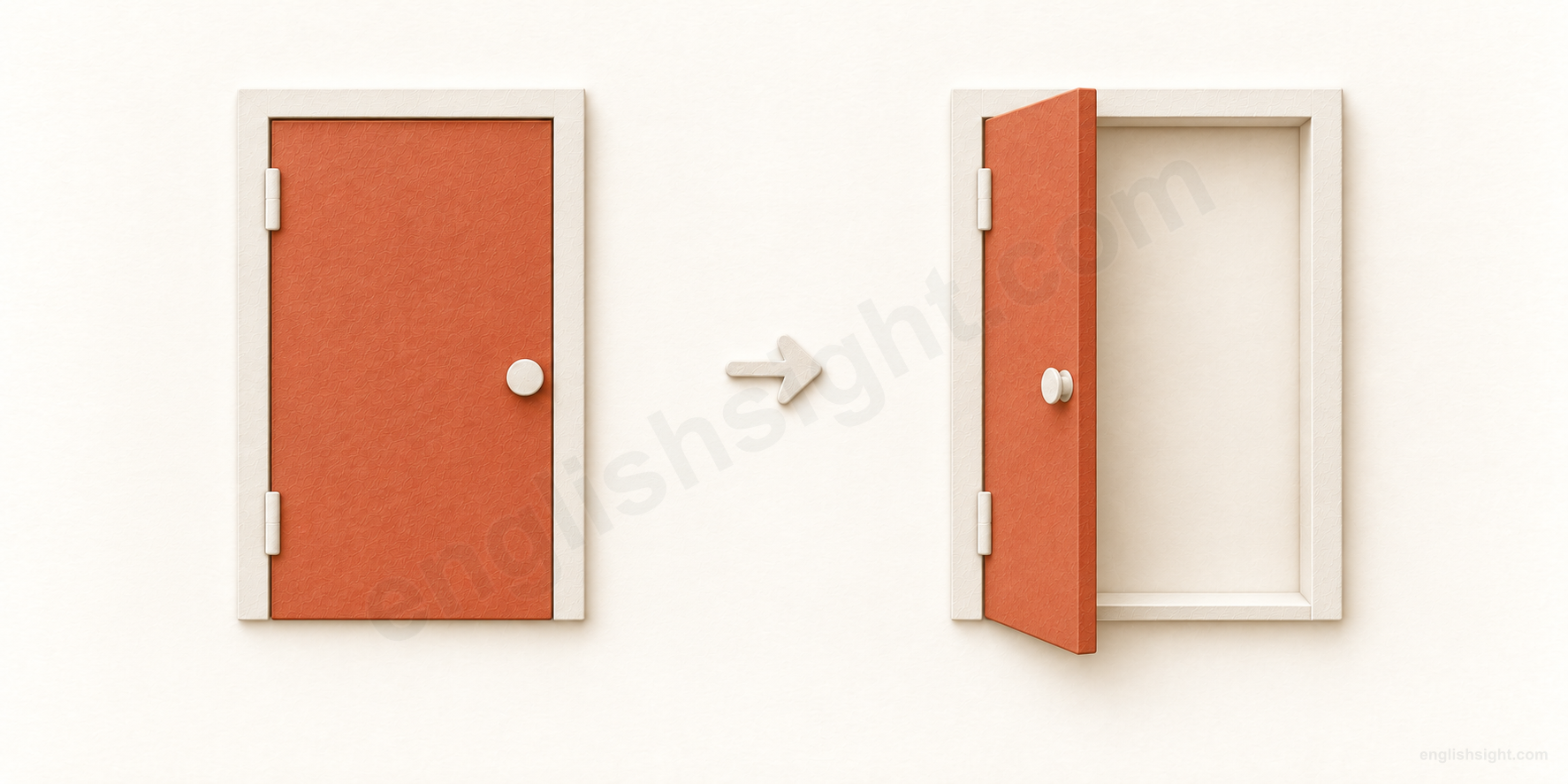
The closed panel covers the entrance.
door
The open doorway makes passage possible.
The same door swings open on its left-side hinges.
Closed panel → open doorway. Passage is possible; permission and lock state are not shown.
A door is a movable panel that can close an entrance or be moved to let people or things pass through.
The physical relation explains the panel and opening senses. Access is a useful bridge to several figurative expressions; fixed uses such as blame and illness must still be learned separately.
A door is usually a movable panel at an entrance. In everyday English, the same word can name the opening, the entrance area, or the home reached through it. Look at the whole phrase to see which part matters.
An open entrance can also help you remember access to opportunities; a closed one can suggest exclusion or privacy. These are teaching connections, not a rule that generates every idiom or a picture shared by every English speaker.
01
The panel, the opening, and its state
Start with the physical object. Then distinguish the panel from the space it closes, and an action from the resulting state.
01
a / the + door; noun + door; door + noun
a door; the car door
a movable panel that closes an entrance
Situation / starting point
A cupboard has an opening.
Meaning in this situation
Its door can cover or uncover that opening.
The door is a physical panel; it need not belong to a house.
Door is normally a countable noun: a door, one door, two doors. A front door faces the front of a building; a back or side door identifies another entrance. Car doors, cupboard doors, and fridge doors are the same basic kind of object in different settings.
In door handle, door frame, and door lock, door is a noun modifying another noun. The handle is what you turn or pull; the frame surrounds the opening; the lock secures the door. A sliding door moves sideways rather than turning on hinges.
In a sentence
The cupboard has two doors and a small drawer.
Watch the difference Use a determiner for an ordinary singular count noun: Open the door, not Open door. Signs can use shortened wording.
02
open / close / shut / lock / unlock + the door; the door + is + open / closed / locked
Open the door and close or shut the door describe actions. The door opens or closes describes the movement with the door as subject. The door is open or closed describes its state. In Please keep the door shut, shut names the state you want to maintain.
Locking a door secures it; unlocking removes that security and does not itself mean that the panel has moved. A door can be closed but unlocked. A door left ajar is slightly open. Close the door behind you means close it after you pass through.
In a sentence
The door is closed, but it isn’t locked.
Watch the difference Open is the usual adjective for the state. The door is opening describes movement in progress.
03
go / walk / look + through + the door; come in / go out + the door
through the door; out the door
use door to name an opening for passage
Situation / starting point
You are in the kitchen.
Meaning in this situation
You pass through its doorway into the hall.
Here door can mean the open space, not the solid panel.
Walk through the door normally means pass through the opening. Look through the door can mean look into the room through that opening. Doorway is a more explicit name for the opening or entrance space; door is also natural in these contexts.
Come in the door and go out the door are established informal movement patterns. Out of the door is also possible. The same noun refers to the solid panel in He walked into the door: without a context of entering through it, this usually suggests a collision.
In a sentence
Maya walked through the door into the hall.
Watch the difference Do not confuse through the door with into the door when you mean passing through an entrance.
04
a door to / into / onto + place; a door opens onto + place
the door to / into / onto…
identify the space reached through an entrance
Situation / starting point
The bedroom connects to a balcony.
Meaning in this situation
You identify the connecting door.
The preposition names the destination or adjoining space.
The door to the kitchen identifies an entrance giving access to the kitchen. Into highlights going inside a space. Onto is natural for an adjoining open surface or area such as a balcony or terrace.
The door opens onto the garden describes where the doorway leads when open. It need not describe someone opening it at this moment. The door of the cupboard instead identifies the object or structure to which the door belongs.
In a sentence
Our bedroom has a door onto a small balcony.
Watch the difference Choose the relation you mean: door to the office identifies access; door of the cupboard identifies its owner or whole.
02
Arriving, helping, and saying goodbye
At home and at public entrances, the verb and preposition tell us what people are doing in relation to the door.
05
knock on / at + the door; a knock on / at + the door
knock on / at the door
make a sound to announce a visit
Situation / starting point
You arrive outside a friend’s home.
Meaning in this situation
You knock so someone inside will notice.
The person outside signals; the person inside may answer.
Knock on the door and knock at the door are both standard. On highlights the surface being struck; at presents the door as the place of the action. Neither phrase guarantees that anyone will let you in.
There was a knock at the door uses knock as a noun. Ring the doorbell uses a bell instead of striking the panel. These are different ways to announce arrival, not meanings supplied by door alone.
In a sentence
I knocked on the door and waited for an answer.
Watch the difference Knock the door alone does not express the ordinary visiting action; include on or at.
06
answer + the door
answer the door
respond to a visitor at the entrance
Situation / starting point
The doorbell rings while you are cooking.
Meaning in this situation
Someone goes to open the door for the visitor.
Answer refers to responding to the knock or bell.
Can you answer the door? asks someone to respond to the caller, normally by going and opening it. The door is not a question and does not need a spoken answer.
Opening a door for fresh air is not answering the door. Answer the door adds the situation of a visitor calling; the verb contributes the response meaning.
In a sentence
Could you answer the door? My hands are covered in flour.
Watch the difference Do not replace this with answer to the door. Answer the door takes a direct object.
07
at the door; pay at / on the door; be on / work the door
at the door; pay on the door
refer to the entrance area and admission arrangements
Situation / starting point
People arrive for a small concert.
Meaning in this situation
A volunteer checks admission at the entrance.
Door can stand for the place where entry is managed.
Someone is at the door means someone is waiting near the entrance, usually the home’s front entrance. At gives a location; it does not mean the person is standing on the wooden panel.
For events, pay at the door means buy admission when you arrive; pay on the door is also used, especially in British English. Someone working the door checks tickets or controls admission. In British event usage, the door can also mean ticket income: The band receives half the door. This money sense is less useful for a beginner than the entrance sense.
In a sentence
You can buy tickets online or pay at the door.
Watch the difference Working the door means managing entry, not repairing the panel. Read the event context.
08
hold + the door + open + for + person; hold + the door + for + person
hold the door open for someone
keep a door from closing so another person can pass
Situation / starting point
A person is approaching the entrance.
Meaning in this situation
You keep the door open while they pass.
The help concerns the door’s state, not control of the other person.
Hold the door open for someone explicitly names the state being maintained. Hold the door for someone is a familiar shorter version when the situation is clear.
Open the door for someone describes making the opening available. Holding it open adds keeping it that way, perhaps against a spring or the wind. For introduces the person who benefits; it is not the destination.
In a sentence
Ravi held the door open for the person behind him.
Watch the difference Hold the door shut has the opposite practical result. The adjective matters.
09
see + person + to + the door
see someone to the door
accompany a departing visitor to the exit
Situation / starting point
Your guest is ready to leave.
Meaning in this situation
You walk with them to the entrance and say goodbye.
To marks the endpoint of accompanying the visitor.
I’ll see you to the door offers to go with a visitor as they leave. It can be a polite, friendly ending to a visit.
This is different from see someone at the door, which may simply describe noticing or meeting someone there. It is also different from the idiom show someone the door, which commonly means tell an unwelcome person to leave.
In a sentence
Thanks for coming. I’ll see you to the door.
Watch the difference Do not assume see to the door and show the door express the same social intention.
03
Neighbours, visits, journeys, and outside space
A door can stand for the room or home it belongs to. Some fixed expressions use this connection to describe location or travel.
10
be / live + next door; next door to + place; next-door + noun
next door; a next-door neighbour
in or at the adjoining home, room, or building
Situation / starting point
Your office is beside the manager’s office.
Meaning in this situation
You describe the manager’s office as next door.
Next door locates a neighbouring place, not another panel.
Next door can stand alone: The bakery is next door. Add to to identify the neighbouring place: We live next door to a bakery. It can refer to the next room as well as the next building.
Before a noun, write next-door with a hyphen: our next-door neighbour. After live or be, use the ordinary two-word expression: Our neighbour lives next door. This distinction concerns grammatical position, not different distances.
In a sentence
The manager’s office is next door to mine.
Watch the difference Say next door to the bank, not next door of the bank.
11
number / a few + doors + down / up + (from + place)
two doors down / up
count homes, rooms, or businesses along a route
Situation / starting point
A friend’s home is nearby on the same street.
Meaning in this situation
You locate it by counting neighbouring addresses.
Door stands for the place belonging to that entrance.
Two doors down means two homes, rooms, or premises away along a street or corridor. We live three doors up from the shop uses the shop as the reference point.
Up and down need not mean a hill or a higher floor. They can mark the direction along a road or hallway. If directions matter, add a clear landmark or say on the left rather than relying on up or down alone.
In a sentence
The dentist is two doors down from the pharmacy.
Watch the difference This counts neighbouring premises, not loose door panels or a precise distance in metres.
12
go (from) door to door; door-to-door + sales / enquiries
go from door to door
visit one home after another
Situation / starting point
Volunteers want to contact every household.
Meaning in this situation
They call at successive homes along the street.
The repeated doors stand for successive households.
Go from door to door and go door to door describe repeated calls at homes, for example to ask questions, deliver notices, or sell something. There is usually more than one stop.
Before a noun, door-to-door is normally hyphenated: door-to-door sales or door-to-door enquiries. In a journey context the same expression has a different meaning, explained next.
In a sentence
Volunteers went from door to door asking about the missing cat.
Watch the difference Door to door does not always mean a single journey between two endpoints. Check what people are doing.
13
take + time + door to door; door-to-door + journey / delivery; deliver + something + to your door
door to door; deliver to your door
measure a whole journey or promise home delivery
Situation / starting point
You plan travel from home to a friend’s home.
Meaning in this situation
You include every stage, not only the train ride.
In a journey, the doors mark the actual starting and finishing places.
Forty minutes door to door counts travel from the starting place to the final destination, including the walk to the station and the final walk if relevant. It does not describe visiting each house on the route.
Door-to-door delivery carries something from the sender’s location to the recipient’s location. Delivered to your door stresses arrival at your home. A parcel placed outside the door is nearby; that phrase alone does not promise a complete delivery service.
In a sentence
The trip takes fifty minutes door to door, including the bus ride.
Watch the difference Do not give only the flight or train time if you are claiming a door-to-door journey time.
14
be / eat / work + out of doors
out of doors
outside a building, in the open air
Situation / starting point
The weather is warm and dry.
Meaning in this situation
You choose to eat outside.
This fixed plural expression describes outside space.
Out of doors means outdoors: We ate out of doors. No particular set of doors needs to be visible. Keep the plural doors and the preposition of in this expression.
Compare She went out the door, which describes leaving through one opening. We ate out of doors describes where the meal took place. Outdoors is a straightforward alternative.
In a sentence
We had lunch out of doors while the weather was warm.
Watch the difference Out of the door refers to an exit through a particular doorway; out of doors means outside.
04
Opportunities and continuing access
An entrance can suggest access to work, knowledge, or a future possibility. These are useful connections, but the full expressions have their own grammar and meaning.
15
open the door to + noun / -ing; open doors for + person
open the door to something; open doors for someone
make access or new possibilities available
Situation / starting point
A learner gains a useful qualification.
Meaning in this situation
More kinds of work become accessible.
The entrance is a metaphor for access to an activity or possibility.
Open the door to further study means create access or make it possible. Open doors for someone focuses on the person receiving opportunities. Neither expression promises that the person will use the opportunity or succeed.
To is a preposition in open the door to studying abroad, so it can be followed by an -ing form. Open doors for new graduates names the beneficiaries. The results need not be good: a weak security system can be an open door to criminals.
In a sentence
The qualification opened the door to further study.
Watch the difference An open door suggests access, not a guaranteed result. Do not use it as proof of future success.
16
leave / keep + the door + open + for / to + noun; an open-door policy
leave / keep the door open
keep a future possibility available
Situation / starting point
You decline an offer for now.
Meaning in this situation
You avoid ruling out a later agreement.
The possibility remains; it has not necessarily been accepted.
Leave the door open for further talks means keep talks possible. Keep the door open to a return has a similar idea. With an actual room, leave the door open can be entirely literal, so read the surrounding nouns.
My door is always open can offer access to help or conversation. An open-door policy in an organization allows people to approach those in charge; in a wider public policy context it can concern access to a place or country. It is a policy of access, not necessarily an instruction to leave every physical door open.
In a sentence
We rejected today’s offer but left the door open for further talks.
Watch the difference Leaving the door open is not the same as agreeing to the proposed plan.
17
close / shut + the door + on + noun
close / shut the door on something
rule out or greatly reduce a possibility
Situation / starting point
A team considers several ways to fund a project.
Meaning in this situation
A final refusal removes one possible route.
The closed entrance suggests an option that is no longer available.
Close the door on a plan can mean stop considering or pursuing it. An action can also close the door on a possibility by making it unlikely to happen. The subject may be a person, an organization, or a decision.
We haven’t shut the door on an agreement explicitly keeps the possibility alive. Compare close the door behind you, where the object is a real door and behind you gives its position after you pass.
In a sentence
The final vote closed the door on an early restart.
Watch the difference In this pattern, on introduces the rejected option. Close the door to the office can instead describe shutting a real entrance.
18
get / have + a / your + foot + in the door
get / have a foot in the door
gain an initial chance in a field or organization
Situation / starting point
You want to enter a competitive industry.
Meaning in this situation
A small first job provides an initial connection.
This is a first foothold, not full success.
Get a foot in the door or get your foot in the door means obtain an initial opportunity that may lead to something larger. Have a foot in the door describes already having that starting position.
The fixed image suggests having enough access to begin, but you should not interpret it as advice to physically prevent a door from closing. A brief placement can give you a foot in the door without guaranteeing a permanent job.
In a sentence
A short placement helped Lina get a foot in the door at the studio.
Watch the difference Keep singular foot in this expression; it does not mean she has already achieved a secure career.
19
business / institution + open / close + its doors; open its doors to + people
open / close its doors
begin admitting people or stop operating
Situation / starting point
A cinema reaches the end of its business life.
Meaning in this situation
It stops operating for the public.
The entrance stands for the operation of the whole institution.
A shop opens its doors can mean it starts welcoming customers, either for the first time or for the day; the time expression makes the intended sense clear. Opens its doors to visitors names the people admitted.
Closes its doors often means a business stops operating, especially with for good or for the last time. A shop that closes its doors at six may simply finish the day. Do not infer permanent failure without context.
In a sentence
After forty years, the cinema closed its doors for good.
Watch the difference Its agrees with one institution. A plural subject takes their: The two shops closed their doors.
05
Privacy, rejection, blame, and illness
Learn these expressions as whole units. The physical door offers a memory aid; it does not let you predict every idiom.
20
meet / discuss / negotiate + behind closed doors
behind closed doors
without public access to the proceedings
Situation / starting point
A committee wants a private discussion.
Meaning in this situation
The public cannot observe the meeting.
The expression concerns access to events or information.
Talks held behind closed doors take place in private. It is an established plural expression even if the actual room has just one door.
The phrase can suggest secrecy, but it does not by itself prove wrongdoing. Medical consultations and sensitive negotiations may properly be private. With a single physical door, behind the closed door can simply describe a location.
In a sentence
The committee discussed the complaint behind closed doors.
Watch the difference Keep plural doors for the idiom. A physically closed door alone does not establish that an event is secret.
21
do / introduce / obtain + something + by / through the back door
by / through the back door
use a concealed, unofficial, or unfair route
Situation / starting point
A proposal would not pass normal public scrutiny.
Meaning in this situation
It is introduced indirectly through another measure.
The back entrance becomes a metaphor for avoiding the usual route.
By the back door and through the back door can criticize an indirect or unofficial way of achieving something. The criticism belongs to the full expression; by does not always mean secretly in other phrases.
Someone entering a house through the back door may simply be using a real rear entrance. A report saying a policy was introduced through the back door usually alleges that ordinary checks or open discussion were avoided.
In a sentence
Opponents said the new fees were being introduced through the back door.
Watch the difference In the figurative use this is usually critical wording, not a neutral description of an alternative method.
22
shut / slam + the door + in + person’s + face
shut / slam the door in someone’s face
close a real door on a caller or reject contact rudely
Situation / starting point
Someone asks for a meeting.
Meaning in this situation
Their attempt to make contact is harshly rejected.
The expression can describe either a physical action or a social refusal.
Literally, a caller may have a door shut in their face before they can enter. Figuratively, the expression can describe a rude refusal to meet, talk, or provide information even when no one is standing at a doorway.
Slam adds force and anger to the physical action and gives the figurative refusal a particularly harsh tone. A neutral rejection of a proposal need not deserve this description.
In a sentence
I asked for an explanation, but the office simply slammed the door in my face.
Watch the difference Use in my face, not on my face, in this established expression.
23
show + person + the door
show someone the door
tell an unwelcome person to leave
Situation / starting point
A guest repeatedly insults the staff.
Meaning in this situation
The manager tells the guest to leave.
This idiom removes social access; it need not involve pointing.
Show someone the door commonly means make it clear they must leave because they are no longer welcome. It may also describe dismissing someone from a job in a suitable context.
Compare I’ll see you to the door, which normally offers to accompany a departing visitor. A literal request such as Please show me which door to use asks for directions; it does not automatically use the rejection idiom.
In a sentence
When the guest threatened the staff, the manager showed him the door.
Watch the difference Do not use this idiom for an ordinary friendly goodbye.
24
lay + blame / problem + at + person’s door; be laid at + person’s door
lay something at someone’s door
attribute a problem or fault to a person or organization
Situation / starting point
Several things caused a delay.
Meaning in this situation
Someone is singled out as responsible.
This is an attribution of responsibility, not delivery to a building.
Lay the blame at someone’s door means hold them responsible. The idiom can also take the problem itself as object: They laid the delay at the supplier’s door. This is relatively formal wording, often found in commentary.
The passive is common: The failure was laid at her door. Lay has the past tense and past participle laid. Door can stand for an organization too; the expression does not prove that the accusation is fair.
In a sentence
It would be unfair to lay the whole delay at Noor’s door.
Watch the difference Use laid for the past form here, not layed. Keep the fixed preposition at.
25
be + at death’s door
at death’s door
so seriously ill that death seems near
Situation / starting point
A person suffers a life-threatening illness.
Meaning in this situation
They are described as very close to dying.
The door is an imagined threshold, not a real place.
At death’s door is a strong informal expression for being extremely ill and in danger of dying. The person is still alive. Speakers may also exaggerate minor illness humorously with the same phrase.
Context decides whether the speaker is reporting a grave condition or making a joke. This metaphor is not a medical diagnosis and cannot tell you someone’s actual prognosis.
In a sentence
He was at death’s door that winter, but he later recovered.
Watch the difference Keep the possessive death’s. The expression does not mean the person has already died.
Read the noun and the whole expression
Door, doorway, and gate
Door can name a panel or the space it closes. Doorway explicitly names the opening or entrance space. A gate typically closes an opening in a fence or wall around an area. Choose the object that is actually there.
The verbs supply the actions
This lesson teaches the noun door and established expressions containing it. In open the door, open is the verb; in through the door, through is a preposition. These combinations are not all phrasal verbs. Passive sentences such as The door was opened follow the grammar of open.
Forms and boundaries
The ordinary plural is doors. In a four-door car, door stays singular inside the hyphenated modifier. Compounds and idioms do not form a complete catalogue of every door type or literary expression. The physical access model cannot establish someone’s intentions, blame, or health.
Choose the relation that fits
Use the situation, the preposition, and the whole phrase. Some sentences can be grammatical but have a different meaning.
1. The panel covers the entrance, but you can turn the handle and enter without a key. Which sentence fits?
2. The bell rings while you are cooking. Ask your flatmate to respond to the visitor.
3. You live in the house immediately beside the bank. Which wording is natural?
4. A taxi trip takes thirty minutes door to door. What does this mean?
5. A welcome guest is leaving. You want to accompany them politely to the exit.
6. An employer is willing to discuss a future job but has made no offer. Which sentence preserves that distinction?
Sources and teaching notes
Dictionary usage was checked against the publisher pages below. The event organizer provides an additional example of admission wording. Explanations and examples are original. The diagram is a teaching model; dictionary evidence supports the uses, not a universal mental picture.
The diagram connects a panel with access through its opening; it does not predict every idiom.