Read down as a direction, a position, a particle, or a word in an established expression.
Follow the reference level
Follow the reference level
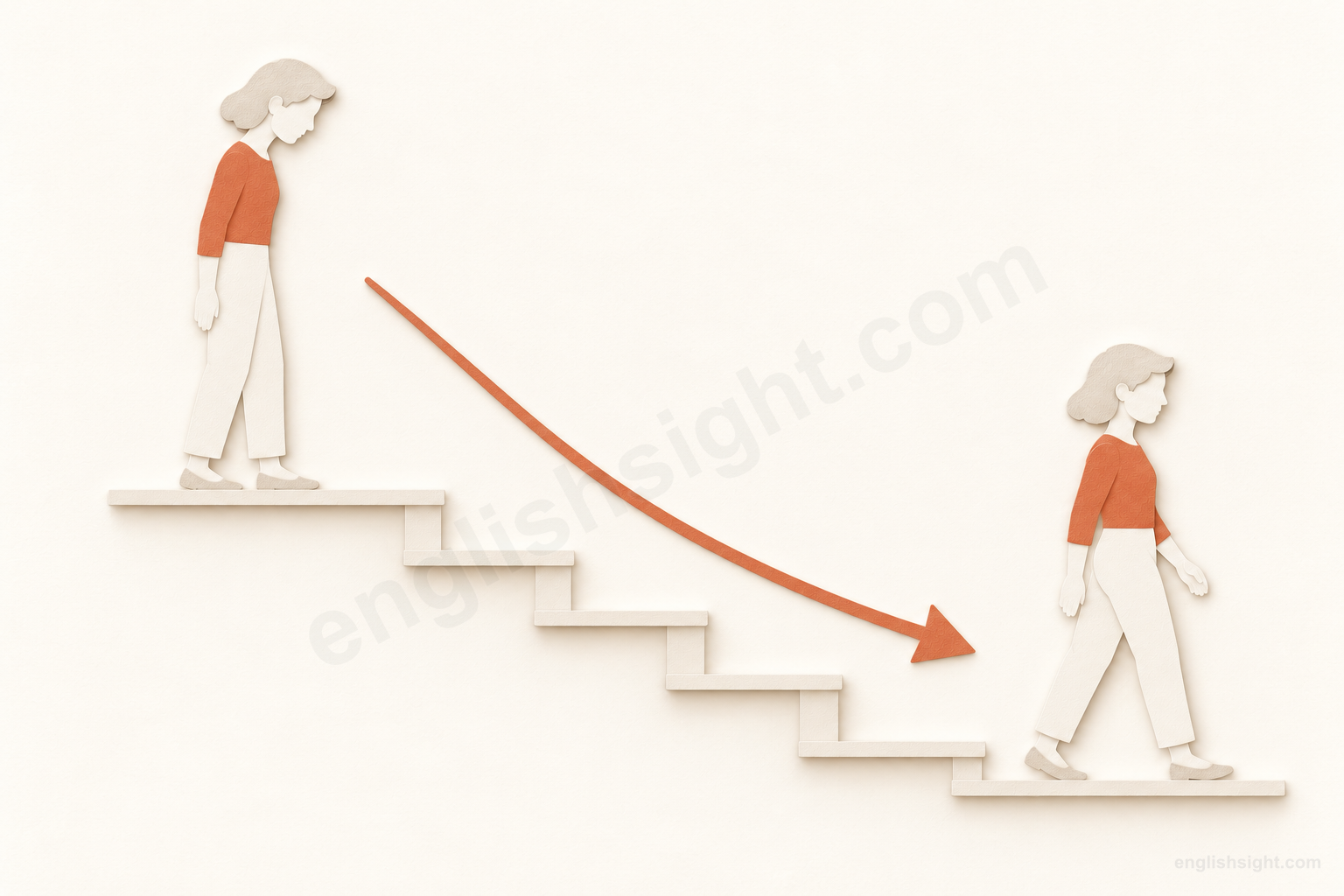
The woman is on the higher landing.
down
The same woman is now on the lower landing.
She moves down the steps toward a lower level.
Down marks a lower direction or level. This model also helps with reduced amounts or intensity; fixed expressions and feather down need separate explanations.
Ask what is lower, relative to what, and whether down describes movement or an existing position.
A lower level can help connect several uses. It does not mechanically generate idioms or explain every homonym.
Down often locates something lower or moves it toward a lower point. English also uses lower levels for amounts, activity, and mood. Along a road, recorded information, and fixed expressions need their own explanations.
The diagram is a memory aid, not a claim that all native speakers see the same picture. Feather down is a separate noun meaning.
01
Position and direction
Start with height, routes, posture, orientation, and the route into the body.
01
verb + down; down + path
go / look down
toward or at a lower position
Situation / reference
She is upstairs.
Result / position
She reaches a lower floor.
The verb gives the action; down gives its direction.
Go down moves lower; look down directs your eyes lower. Down the stairs names the route, so down is a preposition there. The sun goes down means it passes below the horizon. A down arrow points toward the bottom.
In a sentence
She walked down the stairs without a sound.
Watch the difference Down can describe a position too: The blinds are down. It need not mean a new movement.
02
down + road / street / river
down the road
along a route
Situation / reference
You are at this end of the road.
Result / position
The bakery is farther along it.
A route need not slope downward.
Down can follow the length of a street, corridor, page, or river. It does not by itself prove that a street goes downhill. In a crossword, a down answer is read vertically; across is horizontal.
In a sentence
The bakery is just down the road.
Watch the difference Use context to distinguish along a route from a genuinely lower level.
03
down south; go down to + place
down south / down to the shops
toward a place viewed as down
Situation / reference
You start inland.
Result / position
You reach the coast.
Geography and local convention supply the reference point.
Down south explicitly refers to the south. Down to the shops may simply describe a local trip; it need not involve a hill. Down under informally refers to Australia or New Zealand.
In a sentence
We drove down to the coast on Friday.
Watch the difference British informal down the shops omits to or at; retain them in neutral learner English.
04
sit down; lie down
sit down / lie down
move into a seated or reclining position
Situation / reference
The visitor is standing.
Result / position
The visitor takes a seat.
Down marks a lower body position.
Sit down means take a seat; lie down means stretch your body into a resting position. Sit can describe the position alone, whereas sit down highlights taking that position. Down! can tell a dog to lie down.
In a sentence
Please sit down while I find the form.
Watch the difference Lie down has past lay down; lay something down needs an object.
05
put + object + down; put down + noun
put something down
stop holding and place on a surface
Situation / reference
The cup is in your hand.
Result / position
The tray supports the cup.
The object ends supported elsewhere.
Put down a bag and put a bag down both work. With a pronoun, say put it down. Put the baby down can mean put the baby to bed; put the phone down can mean end a call, especially in British English.
In a sentence
Put the cup down on the tray.
Watch the difference Do not say put down it. The full expression and object determine the meaning.
06
face down; turn + object + upside down
face down / upside down
with a face or top directed downward
Situation / reference
The pictures are visible.
Result / position
The pictures face the table.
Orientation differs from movement.
Face down tells which side faces the surface. Upside down reverses normal top and bottom. Figuratively, the move turned our lives upside down means it disrupted normal life, not that anything physically rotated.
In a sentence
Place the cards face down on the table.
Watch the difference Face down describes the direction of the front surface; upside down reverses the usual top and bottom. Both can apply to the same object.
07
get / keep + food or drink + down
get / keep food down
swallow or retain food
Situation / reference
You try to eat.
Result / position
The food does not stay in your stomach.
Get down concerns swallowing; keep down concerns retaining.
Get the medicine down means manage to swallow it. Keep food down means avoid vomiting it back up. These refer to the route into the body, but the verbs distinguish entering from remaining.
In a sentence
After the journey, I could not keep any food down.
Watch the difference Keep food down is not a request to eat less; cut down on food expresses reduction.
02
Less amount or activity
Choose the verb and complement that identify what is reduced.
08
be / go down by + difference; down to + level
go down by / to
reach or show a smaller value
Situation / reference
The price was fifty dollars.
Result / position
It is forty dollars.
By gives the change; to gives the endpoint.
Prices, temperatures, and numbers can go down. Sales are down on last year compares two periods, especially in British usage. Bring costs down and keep costs down respectively cause a reduction and maintain a low level.
In a sentence
The price went down by ten dollars to forty dollars.
Watch the difference Down does not automatically mean bad: lower costs may be welcome.
09
turn + object + down
turn the volume down
reduce a setting
Situation / reference
The music is too loud.
Result / position
It plays more quietly.
A control changes intensity.
Turn down can reduce sound, heat, or light. Turn it down keeps the pronoun before the particle. Turning a device off stops it; turning it down usually leaves it operating at a lower setting.
In a sentence
Could you turn the music down a little?
Watch the difference Turn down an invitation means refuse it; an invitation has no volume control.
10
cut down on + noun / -ing
cut down on
do or use less
Situation / reference
You buy snacks often.
Result / position
You buy them less often.
On introduces what is reduced.
Cut down on coffee reduces consumption; cut spending down reduces an amount directly. Cut down a tree instead means fell it. The object and on help distinguish these established uses.
In a sentence
I am cutting down on buying snacks.
Watch the difference Cut down on doing takes an -ing form, not cut down on do.
11
calm down; slow down; die down
calm / slow / die down
become less intense or active
Situation / reference
The street is noisy.
Result / position
It becomes quieter.
The verb identifies which kind of activity decreases.
Calm down concerns emotion or excitement; slow down concerns speed; die down concerns something such as wind, noise, or excitement becoming weaker. You can calm someone down or slow a vehicle down.
In a sentence
The noise died down after midnight.
Watch the difference Die down does not mean a person dies. Calm down! can sound dismissive when said to an upset person.
03
States, shortfalls, and payments
A low state, a remaining supply, and an initial payment are different uses.
12
feel / be down; get + person + down
feel down / get someone down
feel sad or become discouraged
Situation / reference
You have been waiting for hours.
Result / position
Your mood gets worse.
A low mood is a metaphorical low level.
Feel down describes sadness; get someone down causes discouragement. Down in the dumps is an informal idiom for feeling unhappy. These expressions alone do not establish a medical diagnosis.
In a sentence
The long wait was getting me down.
Watch the difference Get me down may mean help me descend in a physical setting; read the situation.
13
be down with + illness; come down with + illness
be / come down with
be ill or begin to be ill
Situation / reference
Maya was well.
Result / position
She now has a cold.
Be gives the condition; come marks its onset.
Be down with flu describes being ill, often unable to follow the usual routine. Come down with a cold describes developing the illness. Neither expression says that a person physically moved down.
In a sentence
Maya has come down with a cold.
Watch the difference Down with + a disease differs from a protest slogan and from slang approval.
14
system + be down; machine + break down; shut + object + down
be down / break down / shut down
not operate, fail, or stop operation
Situation / reference
Customers expect an online service.
Result / position
They cannot use it.
A state, a fault event, and a shutdown differ.
The site is down reports unavailability without specifying the cause. The engine broke down reports a fault. We shut the system down reports stopping it, possibly deliberately. Talks broke down means the negotiations failed.
In a sentence
The booking site is down this morning.
Watch the difference Be down does not necessarily mean permanent damage; maintenance can also make a service unavailable.
15
amount + down; down by + amount
two goals / twenty dollars down
be behind or have lost an amount
Situation / reference
The other team has scored more.
Result / position
Your team trails by two goals.
The number measures a deficit.
Two goals down means two fewer goals than the opponent. Twenty dollars down after a game means having lost that amount. A person down on their luck is going through misfortune, often with money problems.
In a sentence
Our team was two goals down at half-time.
Watch the difference Down by two goals reports the gap, not your team’s total score.
16
be down to + remaining quantity
be down to
have only a limited amount left
Situation / reference
Most eggs have been used.
Result / position
Only two remain.
To identifies the remaining supply.
Down to the last two eggs emphasizes a reduced stock. Down to three candidates similarly narrows a choice. This is different from something being down to a cause or a person’s responsibility.
In a sentence
We are down to our last two eggs.
Watch the difference Down to ten is the endpoint; down by ten is the reduction.
17
pay + amount + down; a down payment
pay money down
pay an initial part of the price
Situation / reference
The full price is not yet paid.
Result / position
An initial payment is made.
The balance is paid later.
An amount down is the part paid at the beginning of a purchase; the rest remains due. A down payment names that initial sum. This payment expression is especially associated with American usage.
In a sentence
We paid two hundred dollars down on the bike.
Watch the difference Two hundred down does not mean two hundred cheaper or two hundred lost.
04
Records, completion, and transmission
Some established uses concern recording, finishing, mastering, or passing something on.
18
write / take / put + object + down; be down for + event
write it down / be down for
record information or list a commitment
Situation / reference
Her name is not yet recorded.
Result / position
It is on the trip list.
Down can indicate a written record.
Write it down records information; take down a number does too. Put me down for the trip registers my participation. I’m down for an interview at ten can mean it is scheduled; it does not mean I feel sad about it.
In a sentence
I wrote her name down for the trip.
Watch the difference Write down it is wrong: use write it down. Listing someone does not prove enthusiasm.
19
number + down and number + to go; have / get + object + down (pat)
three down / have it down
finish items or master a skill
Situation / reference
Five questions need answers.
Result / position
Three are finished; two remain.
Completion and mastery are related but distinct.
Three down counts completed tasks. I’ve got the steps down means I can perform them reliably; down pat emphasizes thorough mastery, especially in American English. It need not mean I wrote the steps on paper.
In a sentence
That is three questions down and two to go.
Watch the difference Finished tasks and a mastered skill are different meanings; identify what the object refers to.
20
hand + object + down; down through + time
hand down / down through the years
pass to later generations or continue through time
Situation / reference
An earlier generation knows the recipe.
Result / position
A later generation receives it.
Time can be imagined as a continuing route.
Hand down or pass down transmits possessions, knowledge, or traditions. Down through the years spans a long period and sounds more formal. A court handing down a ruling announces a decision; that is a separate institutional use.
In a sentence
This recipe was handed down by my grandmother.
Watch the difference Hand it down is separable; down through the years is a time phrase, not a particle verb.
05
Fixed expressions and their contrasts
Learn the complete expression and its register; a downward arrow is only a partial memory aid.
21
be down to + cause; be down to + person + to-infinitive
be down to someone / something
identify a cause or assign responsibility
Situation / reference
The delivery is late.
Result / position
A missing part explains why.
The complement selects the intended meaning.
The delay was down to a missing part gives its cause. It’s down to you to call assigns you the task. These familiar informal expressions, especially British, are conventional; no physical descent is required.
In a sentence
The delay was down to a missing part.
Watch the difference Responsibility for a future task differs from blame for a past outcome.
22
down to + smallest detail; from + top + down to + bottom
down to the last detail
include even the smallest part
Situation / reference
Many details need checking.
Result / position
Even the smallest are checked.
Down to can mark the inclusive limit.
Down to the last detail emphasizes completeness. Everyone from the manager down to the newest recruit includes the whole hierarchy. Here down follows an ordered range; it does not say people at the lower end are less valuable.
In a sentence
She checked everything down to the last detail.
Watch the difference This inclusive meaning differs from down to two eggs, which describes what remains.
23
get down to + noun / -ing
get down to work
begin to give serious attention
Situation / reference
You have been chatting.
Result / position
You start planning seriously.
The whole construction marks focused engagement.
Get down to work or business means start the real task. In get down to planning, to is a preposition introducing the activity. The picture of settling lower can help memory, but it does not predict the idiom.
In a sentence
Let us get down to planning the trip.
Watch the difference Use get down to doing, not get down to do.
24
Down with + target!; be down with + idea
Down with…! / be down with…
oppose in a slogan or approve in slang
Situation / reference
A friend suggests a picnic.
Result / position
You express approval.
Sentence structure and register can reverse the message.
Down with waste! calls for opposition to waste. I’m down with that means I approve or accept it in US slang. Be down with an illness instead means be sick. Learn these as distinct expressions.
In a sentence
I am down with your plan for a picnic.
Watch the difference The slogan Down with your plan! opposes it; I’m down with your plan supports it.
25
be down for + noun / -ing
be down for something
be willing or interested in taking part
Situation / reference
A friend suggests a walk.
Result / position
You agree to join.
The whole informal expression signals willingness.
Be down for a walk or be down for going out means be willing or interested in doing it. It is similar to be up for. Context distinguishes this from being listed or scheduled for an event; the arrow does not predict this meaning.
In a sentence
I am down for a walk after lunch.
Watch the difference For is a preposition: use down for going, not down for go. This informal use does not mean feeling sad.
26
be down to earth; a down-to-earth + noun
down to earth
practical and approachable
Situation / reference
You need a realistic choice.
Result / position
Practical advice helps you decide.
The full adjective has an established positive meaning.
A down-to-earth person is sensible and unpretentious; down-to-earth advice deals with real conditions. The image of returning to solid ground is a memory aid, not a rule for inventing new expressions.
In a sentence
Her down-to-earth advice helped us choose a flat.
Watch the difference This is normally praise, not a claim that someone lacks intelligence or imagination.
27
deep down; deep down inside
deep down
in your private or underlying feelings
Situation / reference
You keep insisting you are fine.
Result / position
You recognize an inner truth.
Depth refers metaphorically to what is beneath the surface.
Deep down contrasts inner feelings or beliefs with outward behavior or what someone admits. It can describe a kind person beneath an unfriendly manner. The phrase does not itself mean a physically deep location in this use.
In a sentence
Deep down, I knew I needed a break.
Watch the difference Deep down does not always mean sad: Deep down, she was happy.
28
later / further down the line
further down the line
at a later stage
Situation / reference
The current room is sufficient.
Result / position
A later need may arise.
A process is treated as a route.
Further down the line places something later in time or development. Right down the line can instead mean throughout or in every case. A literal railway line is possible too; context decides.
In a sentence
We may need a bigger room further down the line.
Watch the difference The phrase does not give a precise date or guarantee the future event.
29
go / be down the drain
down the drain
be wasted, ruined, or lost
Situation / reference
The work has value.
Result / position
Its value may be lost.
The drain suggests something disappearing beyond recovery.
Money or effort down the drain has been wasted. A business going down the drain is failing. This informal idiom describes loss of value; an actual pipe or liquid is unnecessary.
In a sentence
Without a backup, all that work could go down the drain.
Watch the difference Down in price is a reduction; down the drain suggests waste or ruin.
30
up and down; the ups and downs of + noun
up and down / ups and downs
alternate directions, levels, or good and bad periods
Situation / reference
A friendship has good periods.
Result / position
It also has difficult ones.
The noun pair names contrasting experiences.
Walk up and down a corridor describes repeated movement along it; prices going up and down fluctuate. Ups and downs names positive and negative periods in life, work, or relationships. The plural nouns are part of the expression.
In a sentence
Every friendship has its ups and downs.
Watch the difference Ups and downs is not the same grammatical form as the adverb phrase up and down.
31
win hands down; hands down the best
hands down
easily, or without any doubt
Situation / reference
Several cafés have been compared.
Result / position
One is clearly the best.
The idiom expresses a clear advantage or certainty.
Win hands down means win easily. Hands down the best emphasizes that there is no real doubt about the comparison. Learn the whole informal idiom; it does not require anyone to lower their hands.
In a sentence
This is hands down the best café on the street.
Watch the difference Hands is plural in the idiom. Lowering your hands is a separate literal action.
06
Actions and responses
Objects and sentence structure distinguish rejection, disappointment, demolition, and analysis.
32
turn + object + down; be turned down for + noun
turn someone / something down
refuse an offer or reject a person
Situation / reference
You receive a job offer.
Result / position
You decide not to accept.
This meaning belongs to the whole particle verb.
Turn down an offer rejects it. They turned me down means they rejected my application or request. I was turned down for the job puts the rejected person in subject position. Nothing needs to move lower.
In a sentence
I turned down the job because the hours were too long.
Watch the difference Use turn it down, not turn down it. Compare reducing music with refusing an invitation.
33
put + person + down
put someone down
make someone feel inferior
Situation / reference
You contribute to a discussion.
Result / position
Another person repeatedly belittles you.
Social status supplies the metaphorical height.
Put someone down belittles or humiliates them, often through hurtful remarks. Put down a rebellion means suppress it by force; have a sick animal put down means arrange for it to be killed humanely. The object changes the conventional meaning sharply. Look down on someone instead describes regarding them as inferior: She never looks down on new colleagues.
In a sentence
He kept putting me down in front of the team.
Watch the difference Do not interpret a person being put down as merely being placed on a surface.
34
let + person + down; be let down by + noun
let someone down
fail to meet someone’s expectations
Situation / reference
You are relying on a promise.
Result / position
The speaker promises to fulfill it.
Expected support can be imagined as giving way.
Let someone down disappoints them, often by failing to do what was promised. I felt let down describes the affected person’s feeling. A weak ending can let a film down by reducing its overall quality.
In a sentence
I promised to help, and I will not let you down.
Watch the difference Get me down causes sadness; let me down fails my trust or expectations.
35
knock / cut + object + down; be knocked down
knock / cut something down
bring down physically or demolish
Situation / reference
A wall blocks the opening.
Result / position
The wall is demolished.
The verb supplies the method; down supplies a resulting loss of height.
Knock down a wall demolishes it; cut down a tree fells it. A cyclist knocked down by a car is hit and falls. Down can support a destructive result, but it does not make every verb mean destroy.
In a sentence
They knocked the old wall down to make a doorway.
Watch the difference Cut down a tree differs from cut down on paper use. Keep the object and preposition clear.
36
break + object + down into + parts
break something down into
divide for analysis or easier action
Situation / reference
The task feels complicated.
Result / position
Three manageable parts become clear.
A whole is reduced to smaller components.
Break it down into steps makes a task easier to handle. Food can be broken down in digestion. Compare the engine broke down, which reports failure, and she broke down in tears, which reports losing emotional control.
In a sentence
We broke the task down into three small steps.
Watch the difference Break the task down is transitive; the engine broke down has no object.
07
Main verb and separate noun
Recognize down as an inflecting verb and as a material noun.
37
down + object; down / downs / downed / downing
down a drink / down trees
consume quickly or force to the ground
Situation / reference
A glass of water is full.
Result / position
He drinks it quickly.
Here down is the main verb.
Down a drink means finish it quickly; down food can mean eat it quickly. The storm downed trees means it caused them to fall. Downed power lines describes the resulting fallen lines. British down tools means stop work, often to strike.
In a sentence
He downed his water before joining the queue.
Watch the difference The main verb inflects: downed. In put it down, put is the verb and down is a particle.
38
uncountable down; down + noun
goose down / a down jacket
soft feathers, or fine soft hair
Situation / reference
A jacket needs insulating filling.
Result / position
Soft goose feathers provide it.
This noun is a separate lexical branch.
Down names the soft feather material used in bedding and clothing; it can also mean fine soft hair on skin or plants. This meaning is not explained by the downward arrow. In a down jacket, down identifies the filling.
In a sentence
This jacket is filled with goose down.
Watch the difference Material down is uncountable: some down, not a down. Plural downs has other meanings.
Read the whole expression
Word class and form
Down is pronounced /daʊn/. It can be an adverb or particle (go down), preposition (down the stairs), adjective (feel down), verb (downed a drink), or noun (goose down). Dictionary category labels sometimes differ, especially after be.
Word order matters
In the separable uses taught here, object pronouns precede down: write it down, turn it down. A preposition keeps its complement: down the road; cut down on it. Do not move on or to as though every construction were separable.
Scope of the model
These are common uses, not a frequency ranking or every particle verb. Specialist sport, local railway conventions, geographic downs, and more restricted idioms are not expanded. Passive and causative readings depend on the verb, not on down alone.
Choose the intended meaning
Use the situation and the complete construction.
1. A price falls from fifty dollars to forty. Which sentence gives the change correctly?
2. A friend proposes a picnic and you approve. Which sentence supports the plan?
3. You want to start serious planning. Which form fits?
4. You decline an invitation. What does down mean here?
Sources and teaching notes
Definitions and usage were checked against the sources below. Explanations, example sentences, and the diagram were written for this lesson; the visual connection is a teaching interpretation.
This diagram helps explain a connection; it is not a picture shared by every native speaker.