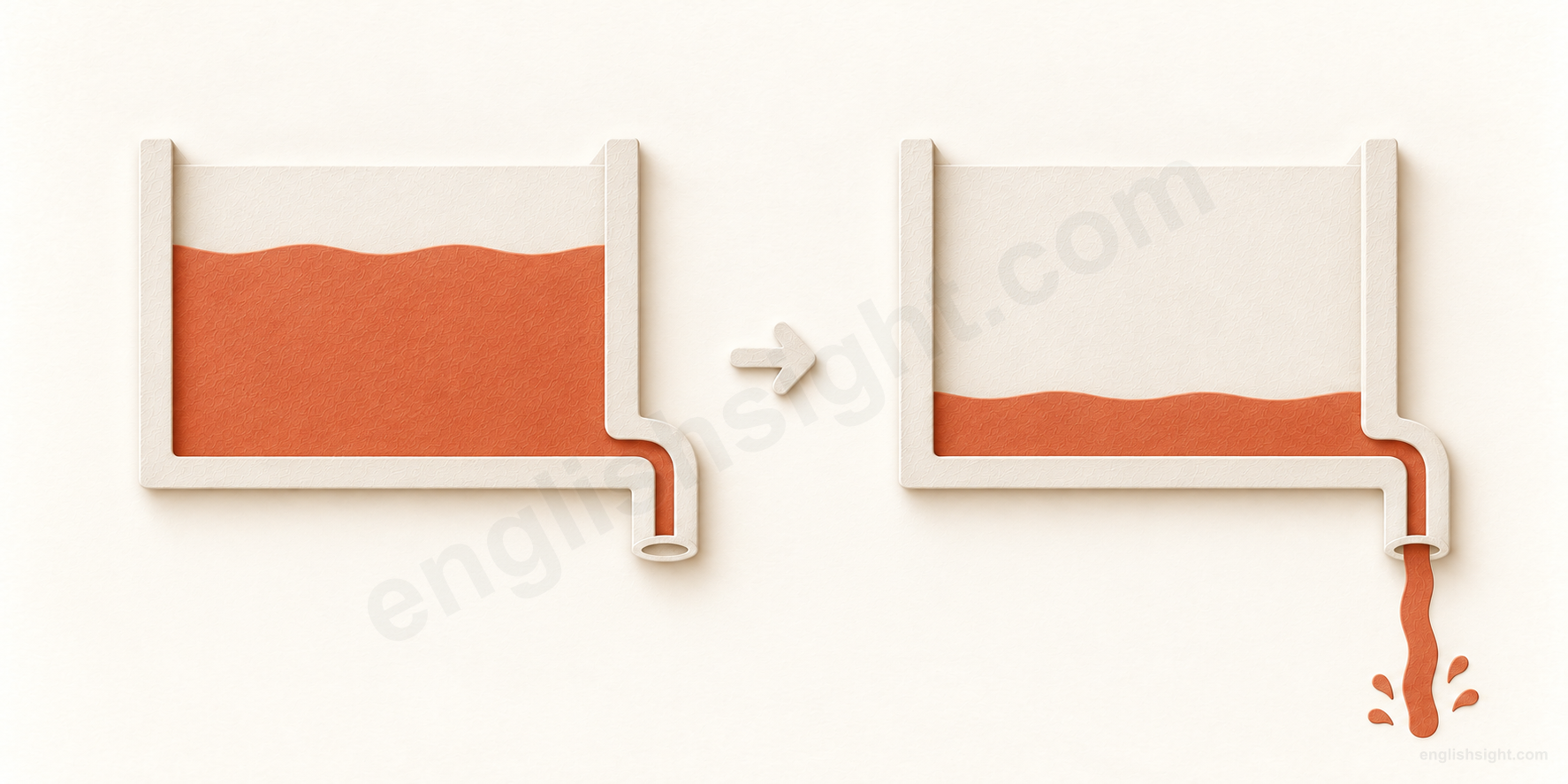
Follow the liquid, then recognize how drain describes other kinds of loss.
Something leaves; less remains
Something leaves; less remains
More liquid is in the tank.
drain
Less liquid remains in the tank.
Liquid flows out through the bottom outlet.
Liquid flows out, leaving less behind.
Liquid flows out of a container or area, leaving less liquid behind. Drain can describe causing this process or the process happening.
This model connects literal drainage with established depletion uses. It does not mean every use involves a pipe, happens slowly, or ends with nothing left; fixed expressions have their own limits.
Drain can name an outlet, describe liquid leaving, or describe removing liquid from something. The subject and object tell you whether to follow the liquid or the thing losing it.
English also uses drain for losing charge, money, energy, or confidence. The liquid picture is a useful teaching connection, while fixed expressions need their own explanations.
01
Water, outlets, and removing liquid
The noun names a route for liquid to leave. The verb can name the departing liquid or the thing losing it; read the subject and object carefully.
01
a / the + drain; blocked / clogged drain; clear / unblock a drain
a blocked drain
an outlet, pipe, or channel that carries liquid away
Starting situation
Water collects in a sink or beside a road.
What changes or remains
An open drain lets it leave; a blockage prevents that.
The noun names the exit route, not the water.
A drain is a countable noun: a drain, two drains. In household or street contexts it can mean a pipe or channel carrying liquid away. The drains can refer to the connected pipe system. A storm drain carries rainwater away.
In American English, the drain commonly means the opening in a sink or bath; British English often uses plughole there. In British English, a road drain can also mean the metal covering over the opening, often called a grate in American English. These are context-dependent preferences, not absolute bans.
Blocked and clogged describe an obstructed drain; unblock or clear a drain means remove the obstruction. In a medical setting, a drain can instead be a tube or device placed to let fluid leave a wound or body cavity. It does not refer to household plumbing there.
In a sentence
The shower drain is clogged with hair.
Watch the difference A drain is not necessarily a sewer: drains can carry rainwater or other liquid, while a sewer carries sewage and sometimes surface water.
02
drain + liquid + from / out of + container
drain water from a tank
remove liquid by letting or drawing it out
Starting situation
A tank contains water.
What changes or remains
The water leaves through an outlet.
With the liquid as object, from names its source.
In drain water from the tank, water is the direct object: it is what you remove. From the tank tells you where the liquid starts. Out of can make the movement from the interior explicit.
The same construction works with oil or other fluids. Drain suggests removal by flow or drawing off; it does not mean the liquid has evaporated. The surrounding instructions tell you how much to remove.
In a sentence
We drained the water from the tank before moving it.
Watch the difference Drain the water from the tank and drain the tank describe the same event from different object choices.
03
drain + container; container + drains; container + be + drained; have + container + drained
drain the tank / the tank drains
make a container empty of liquid, or become empty in that way
Starting situation
A tank holds liquid.
What changes or remains
The tank has less liquid, or is empty.
The container can be the object of a caused change or the subject of the change.
Drain the tank makes the container the object; the liquid being removed is understood. The tank drains slowly makes the container the subject and describes the process without naming a person causing it.
The tank was drained is a normal passive when the result or maintenance matters more than the worker. Have the tank drained can mean arrange for someone to do the job. This is the general have + object + past participle pattern, not a separate meaning of drain.
In a sentence
The tank was drained before the new pipe was fitted.
Watch the difference The liquid does not have to be the grammatical subject: The bath is draining means its water is leaving.
04
drain off + liquid; drain + liquid + off; drain it off
drain off the excess liquid
remove unwanted liquid from something
Starting situation
Cooked food has more liquid or fat than you want.
What changes or remains
You separate and remove the excess.
Off highlights separation; the liquid is what leaves.
Drain off often appears in cooking instructions. In drain off the excess fat, off emphasizes removing liquid from the food or container. The verb already supplies the idea of liquid leaving.
With a noun object you can say drain off the liquid or drain the liquid off. With an unstressed object pronoun, use drain it off. A source can follow from: drain off the excess liquid from the vegetables. Plain drain the liquid from the pan is also natural.
In a sentence
There is too much liquid in the pan; drain some of it off.
Watch the difference Do not move a pronoun after off: use drain it off, not drain off it.
05
liquid + drains away / out; drains from / out of + source; drains into + destination
water drains away / into a river
liquid flows out or toward a destination
Starting situation
Water is standing on a surface or held in a container.
What changes or remains
It follows a route away from that place.
Away emphasizes departure; into names the receiving place.
Water drains away describes the liquid leaving without an object. Water drains out of the bath names its source; water drains into a pipe names its destination. From, out of, and into supply those relationships.
In Rainwater drains into the river, the water may travel through soil, channels, or pipes. Drain does not require a visible plughole. Away and out can mark departure, while into is a preposition followed by the destination.
In a sentence
Rainwater drains from the roof into a storage tank.
Watch the difference Into gives a destination, not a cause: The water drains into the tank says where it goes.
let liquid separate from food or drip off washed objects
Starting situation
Cooked pasta is mixed with water, or dishes are wet.
What changes or remains
The liquid runs away while the food or dishes remain.
The object names what you keep, not what you throw away.
Drain the pasta means remove its cooking water, usually with a colander. It does not mean discard the pasta. Drained beans on a food label or in a recipe are beans with the surrounding liquid removed.
Leave the dishes to drain means let water drip off them. Here dishes are understood as the subject of drain in to drain. Draining is a way of removing liquid; drying with a towel is a different action.
In a sentence
Drain the pasta, then put it back in the warm pan.
Watch the difference Drain and rinse are different: rinse adds clean water to wash something; drain removes liquid.
07
soil / land + drains well; well-drained + soil; drain + land / area
well-drained soil / drain a field
allow water to leave land, or remove excess water from it
Starting situation
Water remains in soil or on a field.
What changes or remains
A route allows excess water to leave.
Land may lose water naturally or through an installed drainage system.
Well-drained soil lets water pass through and away readily; poorly drained soil holds it. A field drains well describes its behavior without naming anyone doing work.
Drain a field means remove excess water, often by making channels or installing pipes. A river drains an area means it carries the area’s surface water away. That geographical construction does not mean someone empties the river.
In a sentence
These plants need well-drained soil.
Watch the difference Well-drained does not mean permanently dry: the point is that excess water can leave.
08
drain + glass / cup; drain the last of + drink
drain a glass
drink all the liquid in a container
Starting situation
A glass still holds a drink.
What changes or remains
The drink is finished.
The container stands for the drink inside it.
Drain a glass or cup means drink its contents completely. Unlike drain the tank, the normal interpretation in a drinking scene is that someone consumes the liquid, rather than pours it away.
You may also drain the last of your drink. This use highlights finishing what remains; it does not by itself specify whether you drink slowly or in one gulp.
In a sentence
He drained his glass and went to catch the bus.
Watch the difference Drink some water does not imply finishing a container; drain the glass does.
02
Losing charge, strength, feeling, or colour
Drain also describes supplies being used up and qualities fading. These are established uses; the liquid picture helps connect them without making them literal.
09
drain + battery / savings / resources; be drained by + cause
drain a battery / drain our savings
use up a supply, often gradually
Starting situation
A battery has charge, or a person has savings.
What changes or remains
Use leaves less of that supply available.
The supply is depleted; no literal liquid has to move.
An app can drain a battery by consuming its stored charge. Costs can drain savings by using up money. The object names the supply or the thing containing it. Drain often suggests unwelcome or substantial depletion.
The loss can be in progress without the supply being completely gone: is draining the battery does not mean it has already reached zero. A drained battery, in contrast, presents the resulting low or exhausted charge in context.
The passive is useful too: Our savings were drained by repeated repairs. Do not assume drain means steal; ordinary expenses can drain a supply.
In a sentence
Leaving the screen on all night drained the battery.
Watch the difference The battery drains quickly describes loss of charge, not liquid leaking from the battery.
10
drain + person + (of energy); feel / be drained; a draining + experience
drain someone of energy / feel drained
leave someone with little physical or emotional strength
Starting situation
A person has energy for work or other activities.
What changes or remains
An experience leaves them exhausted.
The person loses strength; of can name what is lost.
A long or difficult experience can drain someone or drain them of energy. In the second pattern, the person is the direct object and energy follows of. The general depletion idea now applies to someone’s capacity to act.
I feel drained describes the resulting exhaustion. Draining describes the experience that causes it: a draining day. You can be emotionally drained even without doing hard physical work.
In a sentence
The long meeting drained me of energy.
Watch the difference Use drained for how the person feels and draining for what causes that feeling: I feel drained after a draining day.
11
feeling + drains away; feeling + drains out of + person
confidence drains away
a feeling or quality gradually disappears
Starting situation
Someone feels confident, angry, or enthusiastic.
What changes or remains
That feeling becomes weaker.
A feeling is treated as something that can ebb or leave.
Confidence, anger, or enthusiasm can drain away. The feeling is the subject, and away emphasizes its gradual disappearance. Drain out of someone similarly presents the feeling as leaving a person.
This is an established figurative extension of liquid flowing away. Losing anger may be welcome; losing confidence may be unwelcome. Drain alone does not tell you whether the change is good or bad.
Be drained of a quality can also describe its absence: Her reply sounded drained of emotion. This presents an emotionless reply; it does not necessarily mean the speaker feels exhausted.
In a sentence
As the questions grew harder, her confidence drained away.
Watch the difference Confidence drained away describes the feeling diminishing; She felt drained describes her exhaustion.
12
colour + drains from + face; face + drains of colour
the colour drains from someone’s face
someone becomes pale, often from fear or shock
Starting situation
A face has its usual colour.
What changes or remains
The face becomes noticeably pale.
The change is in visible colour, not a literal coloured liquid.
When the colour drains from someone’s face, they become pale. Stories often use this expression after bad news or a frightening sight. The context supplies the cause.
You can also say His face drained of colour. Here face is the subject and of colour names the quality disappearing. This pattern differs from The news drained him of energy, where him is the object.
In a sentence
The colour drained from his face when he read the warning.
Watch the difference This describes appearance; it does not mean someone’s face has physically emptied.
03
Costs, lost talent, and fixed expressions
Some combinations name a continuing loss; others have conventional meanings that you need to learn as whole expressions.
13
a + heavy / constant / major + drain on + resource
a drain on resources
something that keeps consuming a limited supply
Starting situation
Time, money, or energy could be used for other things.
What changes or remains
A continuing demand uses a substantial share of it.
The noun names the demand or burden, not the resource.
A drain on our resources is something consuming resources. Repairs are a drain on our savings identifies repairs as the continuing cost; it does not call savings themselves a drain.
The pattern works with time, energy, money, and patience. In this meaning, use a drain, often with an adjective such as heavy or constant, followed by on and the affected supply.
In a sentence
The repeated repairs are a drain on our savings.
Watch the difference Use a drain on our time, not a drain of our time, when naming the thing that consumes it.
14
the drain of + people / resources; a brain drain; a brain drain to + destination
the drain of talent / brain drain
the loss of people or resources from a place
Starting situation
A place has skilled people or other resources.
What changes or remains
Some leave, reducing what remains available there.
This noun use names the outflow itself.
The drain of skilled workers describes their departure as a loss to the place they leave. Compare a drain on resources, where the noun names something consuming a supply rather than the outflow itself.
Brain drain is the established expression for skilled or highly qualified people moving away, especially to another country for better work or pay. Brain refers figuratively to expertise; it does not mean a medical problem or temporary tiredness.
The liquid image helps remember the loss of a supply, but the whole expression brain drain has a conventional social and economic meaning.
In a sentence
The country hopes better research jobs will slow the brain drain.
Watch the difference Feeling mentally tired is not normally called brain drain; use exhausted or mentally drained for that experience.
15
go down the drain; money / effort + down the drain
go down the drain
be wasted or lost, or deteriorate badly
Starting situation
You have invested time, money, effort, or hope in something.
What changes or remains
It is wasted, or its condition becomes much worse.
The whole informal expression supplies the figurative meaning.
If hours of work go down the drain, the work is wasted or its value is lost. Money down the drain is common without go: an unnecessary purchase can be money down the drain.
The expression can also describe serious deterioration: Since the cuts, service standards have gone down the drain. This is a judgment about quality becoming much worse, not necessarily about a particular payment.
A coin can literally fall down a drain. With work, money, plans, or standards, the figurative reading comes from the established expression and context.
In a sentence
Without a backup, weeks of work could go down the drain.
Watch the difference The noun normally needs the: go down the drain, not go down drain.
16
laugh like a drain
laugh like a drain
laugh very loudly
Starting situation
Someone hears something funny.
What changes or remains
They laugh loudly.
This British informal comparison must be learned as a whole.
Laugh like a drain is an informal British expression for loud laughter. It does not mean feel exhausted or waste something.
The familiar liquid-loss model does not reliably predict this meaning. Keep this expression as a separate recognition item; laugh loudly is a straightforward choice in general international English.
In a sentence
When I told her what had happened, she laughed like a drain.
Watch the difference Do not generalize like a drain to other verbs or assume this expression is equally usual in every English-speaking region.
Read the object and the whole expression
Two ways to describe the same liquid leaving
Drain the water names what is removed; drain the sink names what loses its contents. Drain the pasta names what you keep after the liquid is removed. These object choices matter more than a single translated gloss.
Forms, process, and result
Forms are drain, drains, drained, draining. The verb has ordinary progressive forms and transitive passives. Drained can describe a result; draining can describe an ongoing action or an exhausting experience. Drain does not always imply a completely empty result.
Related words are not interchangeable
Empty covers removing contents of many kinds; drain normally concerns liquid or an established depletion meaning. Leak suggests escape through an unwanted opening; ordinary drainage may be intended. Drainage names the process or system, while a drain names an outlet or, figuratively, a demand.
Scope of the picture
The picture illustrates liquid leaving and a lower amount remaining. It is a teaching aid, not a claim about a shared native-speaker mental picture. This lesson covers everyday uses and selected news and regional expressions. Specialized sports uses such as drain a putt are outside the main lesson.
Follow what leaves and what remains
Read the situation and choose the expression that fits.
1. The pasta is cooked. You want to remove the water and keep the pasta. What do you do?
2. In “We drained the tank,” what is the direct object?
3. A difficult day has left you exhausted. Which sentence describes your state?
4. Repairs keep using money you hoped to save. Which phrase names that continuing demand?
5. “All that effort went down the drain.” What does the speaker mean?
6. A report says a country is experiencing a brain drain. What is happening?
Sources and teaching notes
The sources below were read to check meanings and usage. Explanations and examples are original; the visual connection is a teaching interpretation.
The picture is a teaching aid, not an image shared by every native speaker.