Recognize a drawer, explain where things are, and understand familiar combinations.
A fitted compartment you can slide out
A fitted compartment you can slide out
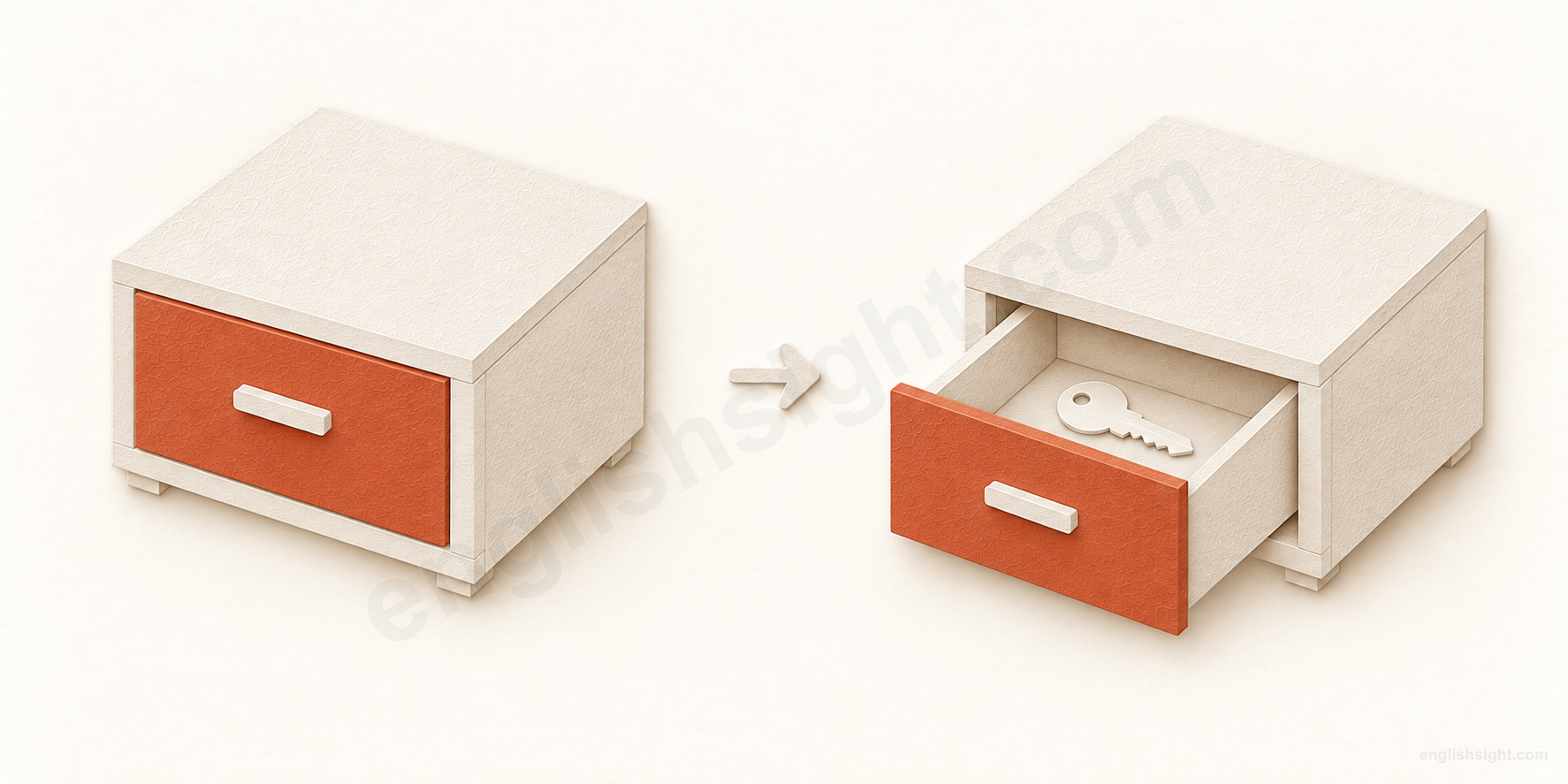
The drawer is closed inside its cabinet.
drawer
The open top exposes a key still inside the drawer.
The fitted compartment slides outward.
The compartment slides out, making its contents accessible.
A drawer is a box-shaped storage compartment that slides out of a larger unit so you can reach what is inside.
The diagram models the furniture sense. It does not derive every idiom or the clothing sense, and is not a claim about an image shared by all English speakers.
A drawer keeps things in a compartment that fits inside furniture. Pull the compartment outward and you can reach its contents; push it back and it fits inside again. This physical relation is the starting point for the lesson.
Most everyday combinations keep that storage meaning. App drawer extends it to digital organization; idioms and the older clothing word need their own explanations.
01
Recognize, locate, and use a drawer
Start with the sliding compartment. The surrounding verbs and prepositions say where things are and how you reach them.
01
a / the + drawer; number + drawers
a drawer / two drawers
a sliding storage compartment in furniture
Situation
You need a place to keep small objects.
What you mean
A fitted box holds them and can slide outward.
The drawer is the moving compartment, not the whole desk.
A drawer stores things inside a larger unit. Its open top becomes accessible when the box slides outward. A loose box need not be fitted into anything; a shelf is a supporting surface rather than this sliding container.
Drawer is a countable noun: a drawer, the drawer, and three drawers. In There is a drawer under the desk, drawer names the compartment; it is not a verb describing opening it.
In a sentence
The desk has two drawers for stationery.
Watch the difference Say a drawer or two drawers; a singular count noun normally needs a determiner.
02
something is in a drawer; keep something in a drawer; put something in / into a drawer; take something out of / from a drawer
in / into / out of a drawer
locate, store, or remove something
Situation
You are looking for a key.
What you mean
You identify its storage place or take it out.
In gives a location; into and out of give a direction.
The keys are in the drawer describes their location. Put the keys in the drawer is also natural: put supplies the movement, so in can mark its destination. Into makes movement to the inside explicit.
Take the key out of the drawer and take the key from the drawer both describe removal. The key moves; the drawer can remain open in the same place. These are ordinary verb-and-preposition combinations, not new senses of drawer.
In a sentence
Please take the spare key out of the drawer.
Watch the difference On the drawer usually means on its surface, not among its contents.
03
open / close / shut a drawer; pull a drawer open / out; push a drawer shut
open / close / pull out a drawer
move the compartment to allow or prevent access
Situation
The drawer is closed inside its housing.
What you mean
Pulling it outward exposes its contents.
Pull out moves the drawer; take out can move an item inside it.
Open the drawer or pull the drawer open asks someone to expose the compartment. Close the drawer, shut the drawer, and push the drawer shut describe closing it. The adjective open or shut describes the resulting state.
Pull the drawer out emphasizes outward sliding. Pull it out keeps the pronoun between pull and out. It may mean partly opening it or, in a repair context, removing it completely; the words do not guarantee full removal.
The drawer is stuck describes a problem with movement. I can’t open it reports the difficulty. Drawer still names the same object; stuck, locked, open, and closed describe different conditions.
In a sentence
I pulled the drawer open to reach the scissors.
Watch the difference Pull it out can refer to the drawer; take the scissors out refers to its contents. Make the object clear.
04
the top / middle / bottom drawer (of something); the second drawer down
the top / middle / bottom drawer
identify one compartment by its position
Situation
Several drawers are stacked in a unit.
What you mean
The listener knows which one to open.
Top and bottom specify position in a literal storage instruction.
Use the top drawer for the highest one, the bottom drawer for the lowest, and the middle drawer when the arrangement makes a middle one clear. The second drawer down counts from the top.
The top drawer of the desk identifies both the compartment and the furniture. This literal meaning is different from the quality expression top-drawer. A historical British meaning of bottom drawer is noted separately in the scope notes.
In a sentence
The receipts are in the second drawer down.
Watch the difference The second drawer down counts from the top, not from the floor.
02
Name the furniture, contents, or digital collection
A word before drawer can identify its location or usual contents. A few complete names need to be learned as combinations.
05
noun + drawer; number + noun + drawers
a kitchen drawer / a sock drawer
identify a drawer by location, furniture, or contents
Situation
You need to distinguish several storage spaces.
What you mean
A familiar noun explains which drawer you mean.
The first noun adds information; drawer remains the main noun.
A kitchen drawer is in the kitchen; a desk drawer belongs to a desk. A sock drawer is used for socks. The first noun may therefore name a place, a larger object, or the usual contents; it does not always express the same relation.
Sock drawer normally uses singular sock before the main noun. In two sock drawers, plural -s goes on drawers. An underwear drawer holds underwear; this is distinct from the older use of drawers to mean the clothing itself.
In a sentence
I put the clean socks in the sock drawer.
Watch the difference A sock drawer is a container; a pair of socks is clothing.
06
a / the + junk drawer
a junk drawer
a drawer for miscellaneous small things
Situation
Small items do not each have a separate storage place.
What you mean
They are kept together in one drawer.
Junk drawer is a familiar name for mixed small household items.
A junk drawer might contain spare buttons, old keys, bits of string, and other odds and ends. Calling it a junk drawer does not necessarily mean every item is rubbish or should be thrown away.
The expression still names a real drawer, but the combination gives it a familiar household function. It can be messy or organized; being disorderly is not a grammatical requirement.
In a sentence
There may be a spare button in the junk drawer.
Watch the difference Do not assume junk drawer means a rubbish bin.
07
a chest of drawers; two chests of drawers
a chest of drawers
a piece of furniture containing a set of drawers
Situation
You need a furniture unit for clothes.
What you mean
Several drawers are fitted into one frame.
One chest contains multiple drawers.
A chest of drawers names the whole piece of furniture. A drawer names one compartment inside it. You can buy a chest of drawers and then open its top drawer.
The plural of the furniture name is chests of drawers: two chests of drawers. One chest of drawers is singular for agreement because chest is the main noun.
In a sentence
A small chest of drawers stands beside the bed.
Watch the difference Say one chest of drawers, keeping drawers plural even when there is only one unit.
08
open / find something in the app drawer
the app drawer
the collection of installed apps on a device
Situation
You need to find an app on your device.
What you mean
You open the collection containing its installed apps.
This drawer organizes digital items rather than physical objects.
An app drawer is the collection of apps installed on a device, commonly presented as a screen or panel. In instructions, open the app drawer means display that collection.
The name borrows the storage idea. It does not require a physical sliding box, and the precise gesture or layout depends on the device. A folder may contain only a selected group of apps, so it is not automatically the same thing.
In a sentence
Open the app drawer and look for the calculator.
Watch the difference Do not infer a particular swipe direction from the word drawer.
03
Recognize figurative and older expressions
These expressions have established meanings. The physical storage model helps with some connections, but cannot predict their meaning or tone.
09
top-drawer + noun; be out of the top drawer
top-drawer / out of the top drawer
of excellent quality; in some contexts, high social standing
Situation
Someone wants to praise a performance.
What you mean
They describe it as belonging among the best.
The quality meaning belongs to the established expression.
Top-drawer before a noun means excellent or of high standing: a top-drawer performance. The expression out of the top drawer, especially British, can similarly praise quality: Her singing was out of the top drawer. This is not a claim that something came from an actual piece of furniture.
In descriptions of people or social background, the expression can refer to privileged status: He came from a top-drawer family describes a family of high social standing. Context distinguishes quality from social rank. Learn this as a conventional expression; literal height alone does not make any object excellent.
In a sentence
That was a top-drawer performance from the whole team.
Watch the difference The top drawer is usually a physical compartment; top-drawer before a noun can be an evaluative adjective.
10
not (exactly) the sharpest knife in the drawer
not the sharpest knife in the drawer
a humorous or unkind way to say someone is not very intelligent
Situation
A speaker comments on someone’s poor judgment.
What you mean
The listener understands an assessment of intelligence.
The whole knife expression evaluates a person.
Not the sharpest knife in the drawer is an informal idiom suggesting that someone is not very clever. Sharp already has a mental sense; the knife comparison makes the description vivid.
The expression may be presented as humorous, but it can insult the person. It is not a neutral assessment for a formal report. Drawer by itself does not mean intelligence, and changing the container freely may lose the familiar idiom.
In a sentence
He called himself “not the sharpest knife in the drawer” after missing the obvious clue.
Watch the difference Use care when applying this idiom to someone else; humorous wording can still be hurtful.
11
drawers; a pair of drawers
drawers / a pair of drawers
an older word for underwear worn on the lower body
Situation
You meet an unfamiliar clothing word in an older story.
What you mean
Context shows that drawers means underwear.
This plural clothing noun is separate from furniture compartments.
In this clothing sense, drawers is plural and can follow a pair of. Collins labels it old-fashioned. It is useful for understanding older writing; underwear or underpants is usually a more neutral modern choice.
Two drawers in a desk counts compartments. A pair of drawers in a clothing description refers to one garment. Do not force the sliding-storage picture onto this separate meaning.
In a sentence
In the old story, he escaped wearing only his drawers.
Watch the difference Drawers does not always mean furniture, but it does not mean all kinds of trousers either.
Keep the object, construction, and register distinct
Pronunciation depends on sense and accent
For the furniture sense, Oxford gives British /drɔː(r)/ and American /drɔːr/. Other dictionaries and accents also allow a two-syllable pronunciation. Oxford marks the person senses with /ˈdrɔːə(r)/ and /ˈdrɔːər/. Do not assume every speaker makes exactly the same distinction.
Not the default name for an artist
Drawer can mean someone who draws, but artist or someone who draws is often clearer in ordinary conversation. In formal banking language, the drawer of a cheque is the person who writes it. This is a separate person sense, not a metaphor for storage; this lesson gives recognition notes rather than technical banking instruction.
A historical British combination
Bottom drawer can also refer to household goods traditionally collected by a woman in preparation for marriage. This cultural use, especially associated with the past, is separate from the ordinary bottom drawer of a desk.
The noun does not supply the action
Drawer names the compartment. Open, shut, pull, push, put, and take supply actions; in, into, and out of supply spatial relations. A passive such as The drawer was opened uses the verb open. There is no everyday phrasal-verb family formed from drawer itself.
Scope of this lesson
The core covers everyday furniture, storage instructions, compound names, and selected expressions. Historical bar staff and specialized manufacturing meanings are outside the lesson.
Choose the meaning in context
Decide what the full phrase identifies: a compartment, a whole unit, a digital collection, or an established expression.
1. You need the pen that is inside a drawer. Which request specifically asks for the pen to be removed?
2. You bought one bedroom furniture unit containing four drawers. Which sentence describes the whole purchase?
3. Someone says, “The tape is in the top drawer of the desk.” What does top identify?
4. A phone guide tells you to open the app drawer. What should you look for?
5. A character says, “I’m not the sharpest knife in the drawer.” What is the likely meaning?
6. An older story describes “a pair of drawers” among someone’s clothes. What does drawers mean here?
Sources and teaching notes
The dictionary pages below support the meanings, constructions, and register notes. The explanations and examples are original; the diagram is a teaching model.
The diagram illustrates the sliding-storage relation; it does not represent an image shared by every speaker.