Distinguish a dress from clothing, the action of getting dressed from the state of being dressed, and the established meanings of dress up and dress down.
Put clothes on a person, or shape how they are clothed
Put clothes on a person, or shape how they are clothed
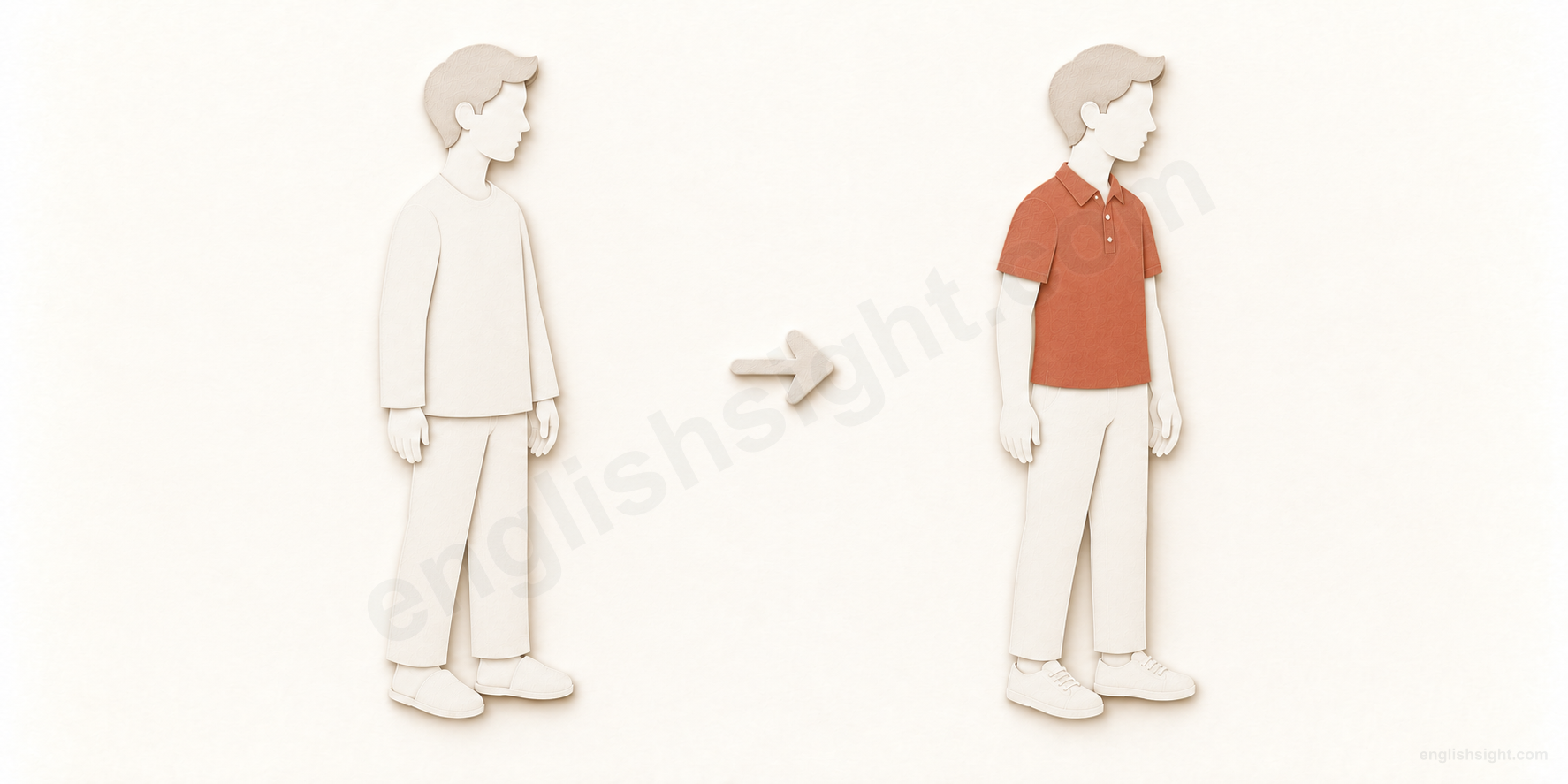
The person is still wearing sleepwear.
dress
The person is dressed in a collared shirt, trousers, and shoes.
The same person changes into ordinary day clothes.
The person stays the same; the clothing changes. Get dressed names the change; be dressed describes the resulting state.
In the clothing uses, dress concerns putting clothes on a person or choosing the clothes that form their appearance. The clothes and the occasion can be specified separately.
This model connects the main clothing meanings. Preparation uses are established branches, and a reprimand in dress somebody down must be learned separately. Dressing does not always improve an appearance or make it formal.
Start with a person and their clothes. Dress can describe putting clothes on, choosing how to appear, or the clothing itself. A dress is one particular garment; formal dress is a category of clothing.
The main picture shows one person moving from sleepwear to day clothes. It is a teaching example of the clothing action, not a claim that dressing always means becoming formal or that every speaker pictures the word this way.
Other meanings have their own objects and limits. Dressing a salad, dressing a wound, and dressing someone down do different things. Use the construction and situation, not one memorized translation, to choose the meaning.
01
A garment, clothing, and clothing expressions
A dress names one kind of garment. Uncountable dress refers more broadly to clothing or a style of clothing. Compounds may have their own established meanings.
01
a / the + dress; number + dresses; wear / put on + a dress
a dress / two dresses
a single garment with a top and a skirt joined together
Situation before / context
You are choosing one item in a clothes shop.
Result / intended meaning
You pick a garment that covers the upper body and extends down over the legs.
Countable dress names a garment, not the whole category of clothes.
Use a dress for a garment with a skirt as part of the same piece. A separate skirt covers the lower body; a dress includes an upper part. Dresses are conventionally associated with women and girls, but the word identifies the garment.
A summer dress and a wedding dress describe a season or occasion. An evening dress is one formal garment; evening dress without an article can instead mean formal evening clothing in general.
Use wear a dress for having it on and put on a dress for the action. To ask about its size, say What dress size do you wear?
In a sentence
The red dress has two deep pockets.
Watch the difference Do not use a dress to mean any single item of clothing: a shirt is an item of clothing, but it is not a dress.
02
wear + adjective + dress; in + adjective + dress
formal / casual / traditional dress
clothing considered as a type, style, or convention
Situation before / context
An invitation describes what guests should wear.
Result / intended meaning
You understand the required kind of clothing, whatever individual garments people choose.
Uncountable dress can refer to clothing worn by people of any gender.
Formal dress refers to formal clothing collectively. Traditional dress identifies a cultural style; modern dress contrasts with clothing from an earlier period. None of these expressions requires a skirted garment.
Compare She bought an evening dress, one garment, with The guests were in evening dress, formal evening clothing. In traditional dress means wearing that type of clothing.
Clothes is the broad everyday plural word: I need new clothes. Dress often selects a style or occasion. Dress sense means judgment about choosing clothes that look good together.
In a sentence
The invitation asks guests to wear formal dress.
Watch the difference For the collective meaning, do not add a or plural -es: formal dress. Formal dresses means several garments.
03
a / the + dress code; have / follow + a dress code
dress code
rules about the clothing people are expected to wear
Situation before / context
You are booking a table and do not know the restaurant’s clothing rules.
Result / intended meaning
You ask whether certain clothes are required or unsuitable.
The compound names a rule system, not one garment or a secret code.
A dress code can apply at work, school, a restaurant, or an event. It may specify formal clothing, permit casual clothes, or rule out particular items.
The head noun is code, so the whole expression is countable: a dress code, the school’s dress code, different dress codes. Dress identifies what the rules concern.
In a sentence
Is there a dress code for the restaurant?
Watch the difference A dress code concerns clothing generally; it does not automatically require everyone to wear a dress.
04
dress + clothing noun: a dress shirt; dress shoes
dress shirt / dress shoes
clothing intended for smart or formal use
Situation before / context
You are packing clothes for a ceremony.
Result / intended meaning
You choose smart clothing rather than ordinary leisure clothing.
Before another clothing noun, dress can signal a formal purpose.
Dress shoes are smart shoes for more formal situations. In North American English, a dress shirt is a smart long-sleeved shirt suitable for wearing with a tie. The term can also refer more narrowly to a formal white shirt worn with a suit and bow tie.
The following noun tells you what the object is: a dress shirt is still a shirt. Compare dress material, where dress can instead mean material for making dresses. The position alone does not determine the meaning.
In a sentence
I packed a dress shirt for the ceremony.
Watch the difference Do not read dress shirt as a shirt that must be worn with a skirted dress; regional usage also affects how formal the shirt is.
05
in / wear + fancy dress; a fancy-dress party
in fancy dress
wearing a costume to look like a character or another kind of person
Situation before / context
A school fundraiser invites people to come as characters.
Result / intended meaning
Guests arrive wearing costumes.
British fancy dress refers to costume clothing, not simply elegant clothes.
In British English, fancy dress is an uncountable expression for clothes worn to look like a character. A fancy-dress party is a costume party; someone might go as a robot or a detective.
Compare a fancy dress, which can describe one elaborate or stylish dress. The article changes the noun phrase. For a smart outfit at a formal dinner, say formal clothes or evening dress rather than assuming fancy dress will mean the same thing.
In a sentence
We arrived in fancy dress for the school fundraiser.
Watch the difference The established British expression does not mean that all guests wear expensive evening clothes.
06
a dress rehearsal; a dress rehearsal for + performance / event
a dress rehearsal
a final practice under conditions like the actual performance
Situation before / context
A theatre group has practised separate scenes.
Result / intended meaning
The group runs the show with its performance costumes and lighting.
Theatre clothing helps explain the compound, but the whole expression names a rehearsal.
For a play, a dress rehearsal brings the planned costumes and stage lighting into the final practice. The performers practise the production as it will be presented, rather than merely trying on clothes.
The expression also works figuratively for a trial before an important event: The small launch was a dress rehearsal for the national campaign. Clothing need not be involved in that figurative use.
In a sentence
Our dress rehearsal is on Thursday, before the first public performance.
Watch the difference A dress rehearsal is a practice event; it is not the name of a type of dress.
02
Putting clothes on and describing what people wear
Identify the person wearing the clothes, then distinguish the action of dressing from the state of being dressed. In names clothing; for gives an occasion or conditions.
07
dress; get dressed; be getting dressed
dress / get dressed
put clothes on yourself
Situation before / context
You are still in sleepwear when the alarm rings.
Result / intended meaning
You put on the clothes you will wear for the day.
Dress and get dressed can describe the clothing action without a direct object.
I dressed quickly and I got dressed quickly both describe putting on clothes. Get dressed is especially useful for everyday routines. You can say I’m getting dressed while the action is in progress.
The clothes do not have to be fancy, new, or a dress. The change may be from sleepwear to ordinary day clothes, as in the diagram. The verb does not necessarily mean becoming more formal.
Wear describes having clothing on: I’m wearing a coat. Put on names the action with a clothing item as object: I’m putting on my coat. Dress focuses on clothing a person.
In a sentence
I got dressed before making breakfast.
Watch the difference Say I got dressed or I put on my shirt, not I dressed my shirt for the ordinary action of putting it on.
08
dress + person / yourself + (in + clothes)
dress yourself / dress a child
put clothes on yourself or another person
Situation before / context
A child needs help putting clothes on.
Result / intended meaning
An adult puts suitable clothes on the child.
The direct object is the person who receives the clothes.
Dress the baby means put clothes on the baby. Dress yourself makes the wearer and the person doing the action the same person, often stressing independence. You can also dress a doll.
Use in to name the clothing: She dressed the baby in a clean shirt. This is an ordinary verb followed by an object and a prepositional phrase, not a particle verb.
In fashion reporting, a designer who dresses a singer may supply or design the singer’s clothes rather than physically help put them on: The designer dressed the singer for the awards show. The context selects that professional sense.
In a sentence
Mina dressed her little brother in a warm sweater.
Watch the difference The person is the object and the clothes follow in: dress him in a sweater, not dress him a sweater.
09
be + dressed; be fully dressed; be dressed by + person
be dressed / be fully dressed
have clothes on, or be wearing a stated kind of clothing
Situation before / context
Someone asks whether you can leave yet.
Result / intended meaning
You already have your clothes on and are ready for the next step.
Be dressed normally describes a state; get dressed describes reaching that state.
I’m dressed says the clothing is already on. I’m getting dressed says the action is happening. Fully dressed emphasizes that the person has all their ordinary clothes on, for example when lying on a bed without changing into sleepwear.
In She was dressed in blue, dressed can function as an adjective describing appearance. It does not require an unnamed helper. A genuine passive is also possible: The child was dressed by his father. Here by introduces the person who performed the action.
In a sentence
I’m already dressed; I’m just looking for my keys.
Watch the difference Do not assume every be dressed sentence means that someone else put the clothes on the subject.
10
dress in + colour / clothes; be dressed in + colour / clothes
dress in black / be dressed in jeans
choose or wear the clothing or colour named after in
Situation before / context
You describe a person’s usual clothing or their current outfit.
Result / intended meaning
In identifies the colour, material, or clothes they wear.
In introduces clothing, not a place that the person enters.
She dresses in black can describe her usual choice. She is dressed in black describes what she is wearing in the relevant situation. In jeans, in silk, and in a blue suit identify clothing or material in the same pattern.
Compare He is wearing jeans. Wear takes the garment directly; dress in and be dressed in use in. Dress like a teacher compares styles, while dress as a teacher can identify a role or costume; the following words carry that difference.
In a sentence
The guide was dressed in a yellow jacket.
Watch the difference Say She dresses in black, not She dresses black. Do not add in after wear: She wears black.
11
dress + adverb; be + adverb + dressed; a well-dressed + person
dress casually / dress warmly
choose clothing in a particular style or for comfort and protection
Situation before / context
You explain how people choose their clothes.
Result / intended meaning
An adverb identifies the style or practical effect of their clothing.
How someone dresses concerns clothing choices, not how fast their hands move.
Dress casually describes an informal style; dress smartly describes a neat, stylish appearance; dress warmly means choose clothes that keep you warm. These adverbs describe different aspects of the clothing choice.
She dresses well evaluates her choices. She is well dressed describes the resulting appearance. A well-dressed guest uses a compound before a noun; smartly dressed uses an -ly adverb. Dress sense is a person’s judgment about clothing.
Contrast dress quickly, which tells us about the speed of putting clothes on. The same verb allows both style and action descriptions; the adverb and context select the reading.
In a sentence
Dress warmly if you’re going to wait outside.
Watch the difference Use an adverb to describe the verb: dress casually. Use be dressed for a state: She is smartly dressed.
12
dress / be dressed + for + occasion / conditions; dress + to-infinitive of purpose
dress for work / dress for dinner
choose clothing with an occasion, activity, or conditions in mind
Situation before / context
You are planning clothes for a situation.
Result / intended meaning
Your clothing choice responds to the activity, weather, or expected formality.
For identifies what the clothing is intended to suit.
Dress for work and dress for cold weather relate the choice of clothes to a purpose or conditions. For does not say whether the clothes are formal; the situation supplies that information.
In a traditional or formal setting, dress for dinner can specifically mean change into formal evening clothes. Do we need to dress for dinner? can therefore ask about formality, rather than whether clothes are required at all.
Be dressed for a meeting describes the prepared state. Compare be dressed in a suit: for gives the occasion, while in names the clothing. Dress to impress is a purpose construction: choose clothes with the aim of making a good impression.
In a sentence
We dressed for cold weather before leaving the cabin.
Watch the difference Dress for does not always mean dress formally: dress for a hike may call for practical outdoor clothes.
03
Changing appearance, presenting things, and fixed expressions
Dress up and dress down have several established uses. An object, a following phrase, and the situation help you choose the right one; up and down do not describe physical travel here.
13
dress the part; dress the part of + role
dress the part
wear clothes that fit an expected job, role, or position
Situation before / context
Someone is about to perform a role.
Result / intended meaning
Their clothes help them look suitable for that role.
The part is an expected role, not a piece of someone’s body.
Dress the part means make your clothing match a role or position. It can concern an actual job or a character in a play. Look the part is broader and can include other aspects of appearance.
The expression concerns how the person appears, not proof of their ability. A person can dress the part of a confident presenter while still feeling nervous.
In a sentence
For her first day as a hotel manager, Leila wanted to dress the part.
Watch the difference Learn the full expression with the: dress the part. It does not mean put clothing on one body part.
14
dress up + (for + occasion); dress + person + up
dress up for an occasion
wear clothes that are smarter or more formal than usual
Situation before / context
You usually wear everyday casual clothes.
Result / intended meaning
For a celebration, you choose a smarter outfit.
Up marks a change in presentation here, not upward movement.
Dress up can mean choose more formal or elegant clothes. You can dress up for a celebration without wearing a costume. There’s no need to dress up tells guests that their ordinary clothes are acceptable.
With an object, dress someone up means put special or smart clothing on them. Pronouns go between the verb and up: dress them up. With a noun, dress the children up and dress up the children are both possible.
Dress without up can simply mean put on clothes. Get dressed does not carry the extra suggestion of making your appearance special.
In a sentence
We decided to dress up for our anniversary dinner.
Watch the difference Do not assume dress up always means wear a costume; look for as and the wider situation.
15
dress up as + character; dress up in + clothes; dress + person + up as + character
dress up as a character
put on a costume or special clothes to represent someone or something
Situation before / context
A child chooses a character for a school event.
Result / intended meaning
The child wears clothes that represent that character.
As names the represented identity; in names the clothes themselves.
Dress up as a pirate identifies the character. Dress up in a long coat identifies part of the costume. Be dressed up as a pirate describes the resulting appearance. The shorter be dressed as a pirate can describe a costume too.
Someone can do this for another person: We dressed the baby up as a bear. The baby is the object; up stays next to dress in dress up the baby, but a pronoun must come between them: dress her up.
For children’s costume play, British English also uses dressing-up clothes and North American English dress-up clothes. Dressing up need not involve trying to deceive anyone.
In a sentence
Sam dressed up as a robot for the school parade.
Watch the difference Use as for the character and in for the outfit: as a robot, in a silver costume.
16
dress + thing + up; dress + thing + up as + description; dress + thing + up with + details
dress something up / dress it up as…
make something seem more attractive, acceptable, or different through presentation
Situation before / context
A company proposes charging customers more.
Result / intended meaning
Its announcement describes the change as an improvement.
The object is an idea or thing; the change concerns its presentation.
Dress up can shift from special clothing to attractive wording or added detail. Dress a price rise up as an improvement presents it under a more appealing description. As introduces that description.
The expression often suggests a gap between the attractive presentation and the underlying facts. It does not prove that every claim is false. It can also describe making something look more appealing through decoration.
This particle verb is separable: dress up the proposal or dress the proposal up. With a pronoun, say dress it up, not dress up it. With can introduce the added details: dress it up with impressive charts.
In a sentence
The company dressed the price rise up as a service improvement.
Watch the difference An object such as a proposal selects presentation rather than costume; learn the full construction rather than treating up as a direction.
17
dress down; dress down for + occasion; a dress-down day
dress down
wear less formal clothing than usual or than a setting normally expects
Situation before / context
A workplace normally expects smart office clothes.
Result / intended meaning
On one day, staff choose more casual outfits.
Without a person object, dress down usually concerns the wearer’s clothing.
We dress down on Fridays describes choosing a less formal appearance. Down is relative to the usual style or expectations; the expression does not mean wearing dirty clothes or removing all your clothes.
A dress-down day is a day when a school or workplace allows more casual clothing. Dress down is the verb phrase; dress-down can modify day. Contrast dress up for a more formal appearance.
In a sentence
Our team dresses down on Fridays, so jeans are fine.
Watch the difference Dress down does not mean get undressed. Adding a person object can produce a very different meaning.
18
dress + person + down + (for + noun / -ing); be dressed down for + noun / -ing
dress somebody down
criticize someone sharply for doing something wrong
Situation before / context
Someone has repeatedly broken a rule.
Result / intended meaning
Another person gives them a sharp reprimand.
In this established use, the person object receives a reprimand.
Dress someone down means speak to them severely about something they did. It often occurs when a manager, coach, or other person in authority is angry. Learn this established meaning separately from the clothing model.
You can say dress the players down or dress down the players; with a pronoun, say dress them down. The passive is possible: They were dressed down for being late. A dressing-down is a related countable noun for the reprimand.
In a sentence
The coach dressed them down for ignoring the safety rules.
Watch the difference Keep a pronoun before down: dressed them down. Compare They dressed down, which normally concerns casual clothes.
19
be dressed (up) to the nines; dress (up) to the nines
dressed (up) to the nines
wearing especially smart or elegant clothes
Situation before / context
Guests have put effort into choosing special outfits.
Result / intended meaning
Their appearance is notably smart or elegant.
The nines is part of a fixed informal expression, not a count of garments.
Dressed to the nines and dressed up to the nines both emphasize a very smart or elegant appearance. The phrase is informal and often adds admiration or a slightly playful tone.
Dressed describes the state. You can also say dress up to the nines for the action or choice. Do not invent a literal explanation involving nine items of clothing; it is the established phrase that carries this meaning.
In a sentence
Everyone arrived dressed to the nines for the anniversary party.
Watch the difference Keep the plural nines and the: to the nines. It does not mean dressed until nine o’clock.
20
be / arrive + dressed to kill
dressed to kill
wearing striking clothes intended to attract attention and admiration
Situation before / context
Someone has chosen a particularly striking outfit.
Result / intended meaning
Their appearance is likely to make a strong impression.
Kill is figurative in this informal idiom.
Dressed to kill describes an attention-getting, impressive appearance. It suggests that the person wants others to notice them and find them attractive; it does not report a violent intention.
Compared with dressed to the nines, this expression places more emphasis on the impact on other people. Use the whole expression as an informal description, not as a neutral rule on an invitation.
In a sentence
Nora arrived at the party dressed to kill in a silver suit.
Watch the difference The idiomatic reading depends on the appearance context. It is not an instruction to harm someone.
21
be / be left + all dressed up with nowhere to go
all dressed up with nowhere to go
ready for an activity but unable to put that preparation to use
Situation before / context
A group has prepared a presentation, but the meeting is cancelled.
Result / intended meaning
The group is ready, yet has no opportunity to present.
The whole expression extends beyond clothing to unused preparation.
A person can have special clothes on but no event to attend. The expression also applies when other preparations are complete but there is no chance to use them; no special clothing is required in that figurative use.
All emphasizes readiness. With nowhere to go describes the missing opportunity. Learn the complete expression rather than giving dress up alone the meaning of cancelled plans.
In a sentence
When the conference was cancelled, our speakers were left all dressed up with nowhere to go.
Watch the difference The figurative use does not mean that someone is lost or has nowhere to live.
04
Wounds, food, and arranged displays
Away from clothing, dress can describe particular ways of treating or preparing something. Learn the object with the verb: a wound, a salad, and a chicken require different actions.
22
dress + wound / cut; a wound is dressed
dress a wound
treat a wound and apply a protective covering
Situation before / context
A clinician examines a cut that needs attention.
Result / intended meaning
The cut has been treated and covered.
The object is an injured area, not a person being clothed.
In healthcare, dress a wound refers to cleaning or treating it and putting an appropriate protective covering on it. The connection with covering is useful for memory, but this is a specific medical use, not ordinary clothing.
The passive is natural: The wound was dressed. A dressing is the material placed over the wound; the same spelling also has a food meaning. This lesson explains the language, not a method for treating an injury.
In a sentence
The nurse dressed the cut before the patient went home.
Watch the difference Do not infer that dress a wound means stitch it closed. The verb alone does not specify that procedure.
23
dress + salad + (with + dressing)
dress a salad
add dressing to a salad
Situation before / context
The salad ingredients are ready in a bowl.
Result / intended meaning
A sauce or seasoning mixture has been added.
With salad, dressing means the mixture used to season it.
Dress the salad means add its dressing, such as an oil-and-vinegar mixture. With can identify that mixture. The verb does not itself say whether you pour, mix, or toss it.
The noun dressing can name salad sauce: salad dressing. The relationship is about preparing food to eat, not putting a miniature outfit on vegetables.
In a sentence
I dressed the salad with lemon juice and olive oil just before serving it.
Watch the difference Do not confuse a dressed salad with a wound dressing; the object and setting select the meaning.
24
dress + chicken / fish; dressed + food noun
dress a chicken / dressed crab
clean and prepare food for cooking or eating
Situation before / context
An animal or seafood needs preparation before it can be used as food.
Result / intended meaning
The required cleaning and removal of unsuitable parts have been done.
The object determines the preparation; this is not the same operation as dressing a salad.
With a chicken or fish, dress can mean clean it and remove parts not wanted for cooking. Dressed describes the prepared product. This use is especially useful for understanding recipes and food labels.
Dressed crab is crab prepared for eating, often with the meat arranged for serving. Dressed does not by itself describe every preparation step, seasoning, or cooking time; those depend on the food and recipe.
In a sentence
The recipe starts with a dressed chicken, ready for roasting.
Watch the difference Dressed chicken does not mean chicken with salad dressing on it. Read the food noun and recipe context.
25
dress + shop window / hair; have + hair + dressed
dress a shop window / dress hair
arrange or decorate something for presentation
Situation before / context
A shop’s display is ready to be arranged for a new season.
Result / intended meaning
A display worker positions the goods and decorations.
This broader preparation use concerns an arranged appearance.
Dress a shop window means arrange its display to make it effective or attractive. It describes working on what is displayed, not putting clothes on the glass.
Dress someone’s hair similarly means arrange or style it. These uses can sound formal or belong to a professional context. In everyday conversation, do or style someone’s hair is often a simpler choice.
The shared teaching connection is preparing an appearance. It does not make dress a general replacement for prepare: say prepare a report, not dress a report unless a specific presentation-related expression is intended.
In a sentence
The display team dressed the shop window for the autumn sale.
Watch the difference Use these established object combinations. Do not extend dress freely to every task that involves preparation.
Keep the clothing, grammar, and setting distinct
One garment or a whole style?
A dress and dresses are countable garments. Traditional dress and formal dress are uncountable clothing expressions. Dress code, dress shirt, and dress rehearsal are compounds with different head nouns; they are not additional skirted garments.
Action, state, and direct object
Get dressed describes an action or change; be dressed normally describes a state. Dress a child takes the wearer as object, while wear a shirt and put on a shirt take clothing as object. In specifies clothing; for specifies an occasion or conditions; as can identify a represented role.
Do not derive every expression from the picture
Dress up may concern smart clothes, a costume, or attractive presentation. Dress down may concern casual clothes; dress somebody down means reprimand. The object and context matter. A wound, a salad, and a chicken each select a particular treatment or preparation.
Forms and pronunciation
The noun and verb dress are pronounced /dres/. Dresses is both the plural noun and the he/she/it verb form, pronounced /ˈdresɪz/. The regular past and past participle are dressed, /drest/; the -ing form is dressing. Progressive forms are ordinary for an action: I’m dressing the baby.
Scope and register
This lesson covers clothing, useful compounds and idioms, healthcare and food recognition, and display or hair preparation. It does not teach specialist material finishing, military alignment, agricultural preparation, or old uses. An offensive British expression comparing an older woman to a younger one is excluded from productive practice.
Choose the meaning that fits the situation
Check whether dress names a garment, a clothing action or state, a fixed expression, or a particular kind of preparation.
1. An invitation asks every guest to choose formal clothing, not one particular garment. Which wording fits?
2. Your clothes are already on. You are waiting for a taxi. Which sentence describes your state?
3. You help a child put on a clean shirt. Which sentence has the right object pattern?
4. Sam wears a robot costume. Which phrase names the character rather than just an occasion?
5. A manager angrily criticizes staff for breaking a rule. Which sentence reports the reprimand?
6. A proposal gets attractive new wording, but its underlying problems remain. Which expression fits?
7. A cook dresses a salad with oil and lemon juice. What happens?
Sources and teaching notes
Clothing meanings, constructions, expressions, and recognition uses were checked against the dictionary pages below. The explanations and examples are original. The picture offers a teaching connection, not an explanation of every historical meaning.
The clothing change is a teaching example. It does not represent every meaning or a picture shared by all English speakers.