From swallowing water to beverages, social invitations, and familiar figurative phrases.
Taking liquid into the body
From outside the body to inside
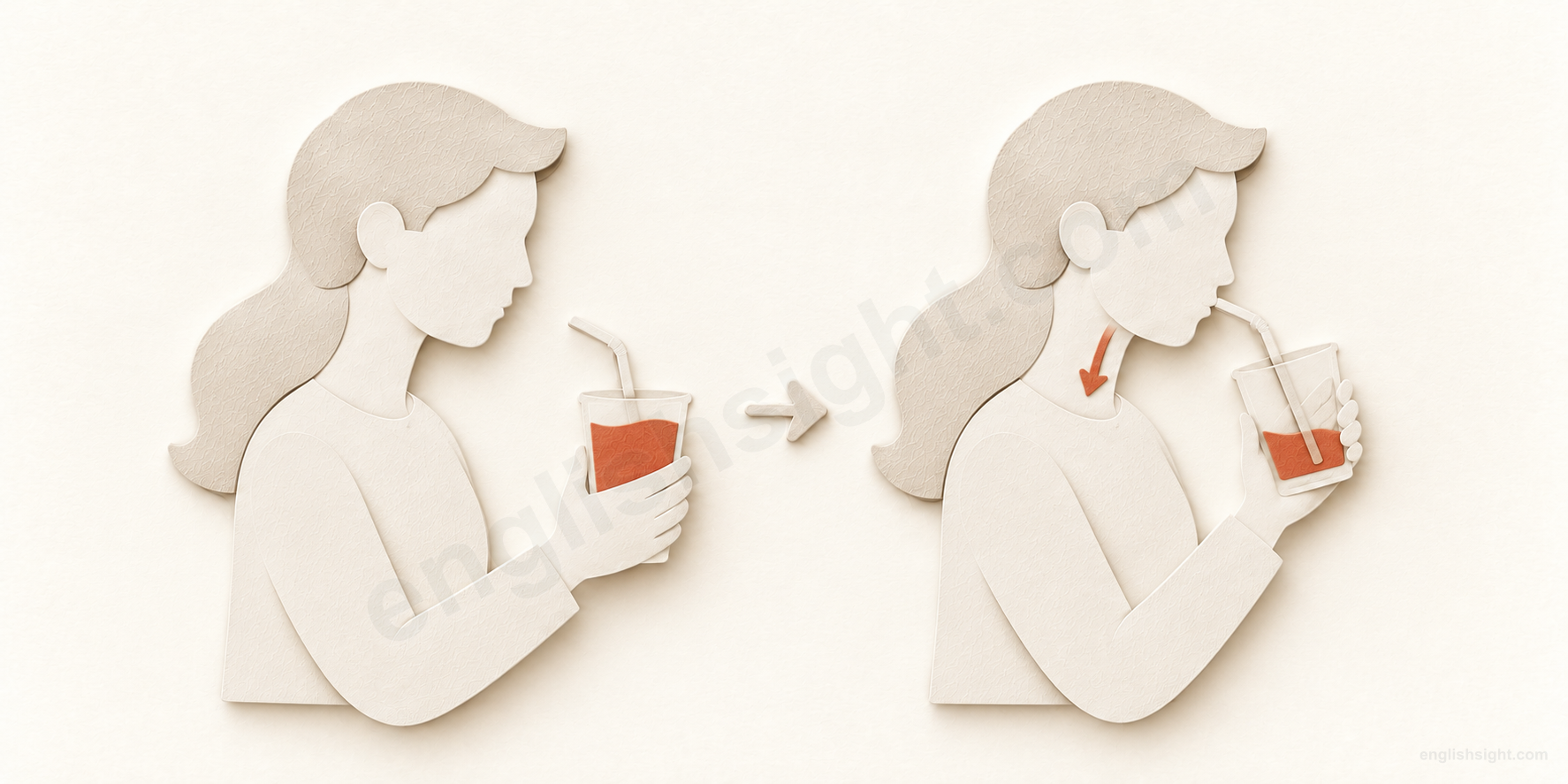
The liquid is in the cup, outside the body.
drink
Some liquid has entered her body; some remains in the cup.
She takes liquid through the straw into her mouth and swallows.
Drinking takes liquid into the body; it need not empty the cup.
To drink is to take liquid into the mouth and swallow it.
This physical action explains the central verb and helps connect the beverage noun. Taking in a view is a metaphor; toasting, alcohol idioms, and the drink meaning water require their own explanations.
Drink connects a bodily action with the liquid consumed. As a noun it can name that liquid, a serving, or an occasion built around it. Alcohol is an established contextual sense, not the meaning of every drink.
Use the intake picture as a starting point. Particle verbs and idioms add conventions that you must learn as whole expressions; they cannot all be predicted from a cup.
01
Liquid, containers, and verb forms
Start with the action: liquid enters a person or animal through the mouth. Grammar tells us what is consumed and where it comes from.
01
drink + liquid; drink without an expressed object
drink water
take liquid into the mouth and swallow it
Situation before
Water is in your bottle.
What happens or is meant
Some of the water is inside your body.
The drinker consumes the liquid; the bottle is only its container.
Drink names the action, whether the liquid is hot tea, cold water, or milk. The subject can be a person or an animal. I drink tea describes a habit; I am drinking tea describes an activity now.
The liquid can be an object, as in drink water, or be understood from the situation: The dog stopped to drink. Drinking does not by itself mean finishing everything. Sip adds the idea of small amounts; swallow focuses on passing something down the throat and can also apply to solid things.
Drink it down in one gulp adds a way of completing the action: the liquid goes down the throat in a single swallow. Down here does not make the drink alcoholic.
In a sentence
The dog drank some water after the walk.
Watch the difference Drink some water does not promise that the bowl becomes empty.
02
drink (something) from + source; drink through + a straw
drink from a glass
identify the container or source
Situation before
Juice is in a glass.
What happens or is meant
You consume juice from that glass.
From names the source; through can name the route.
In drink juice from a glass, juice is consumed and the glass supplies it. Drink from a bottle and drink from a fountain use the same source relation. Through a straw names the route the liquid follows.
Drink a glass of juice measures the juice by the glass. Drink your glass can occasionally mean its contents, but drink from your glass is clearer when the container is the point. These source and route phrases are ordinary prepositional phrases, not new phrasal verbs.
In a sentence
Mia drank the juice through a straw.
Watch the difference Drink a straw would make the straw the thing consumed.
03
drink – drank – drunk; be drinking; have drunk; be drunk (passive)
drink / drank / drunk
choose the standard tense form
Situation before
You describe yesterday or an event before now.
What happens or is meant
The verb form matches the time construction.
Drank is the simple past; drunk follows have in the perfect.
Use drink / drinks for the present, drank for the simple past, and drunk as the usual standard past participle: We drank tea yesterday; We have drunk all the tea. The -ing form is drinking.
Drunk in has drunk water is a verb participle and does not mean intoxicated. In He is drunk, it is an adjective meaning affected by alcohol. A passive is possible when the consumed liquid matters: The last of the juice was drunk before lunch. Drink does not itself mean make someone drink; that requires a separate construction such as get someone to drink.
In a sentence
We drank tea earlier, but we haven’t drunk any coffee.
Watch the difference For ordinary learner English, use have drunk, not have drank; use drank for a completed past event.
02
A drink, some drink, and drinks
The noun can name a beverage, one serving, a swallow, or a social occasion. Context tells you whether alcohol is intended.
04
a / two + drink(s); adjective + drink; food and drink
a cold drink
a beverage or a serving of one
Situation before
You choose something to have with lunch.
What happens or is meant
You order one beverage.
A drink is countable when it means a beverage or serving.
A drink can be water, juice, tea, or an alcoholic beverage. Two drinks can mean two servings or two different beverages. Adjectives specify the kind: a hot drink, a cold drink, a sugary drink. A soft drink is a cold non-alcoholic drink, often a sweet fizzy one.
Uncountable drink groups liquids as refreshments: We provided food and drink. Food and drinks instead draws attention to individual beverages or kinds. A drink on a café menu need not contain alcohol; a drink at a bar may suggest it.
In a sentence
The lunch price includes a sandwich and a cold drink.
Watch the difference The noun drink does not always mean alcohol.
05
have / take a drink of + liquid; a drink from + container
a drink of water
an amount of water to swallow
Situation before
You pause during a long conversation.
What happens or is meant
You swallow some water.
Of identifies the liquid; the amount is not a fixed measure.
A drink of water can mean some water provided for drinking or an act of taking some. Take a drink emphasizes one drinking action; have a drink can describe consuming a beverage more generally.
Compare a glass of water, which names a container-based quantity, with a drink of water, which does not specify a glassful. In a drink from the bottle, from identifies the source instead of the liquid.
In a sentence
I took a drink of water before answering the next question.
Watch the difference A drink of water need not be a whole glass.
06
something to drink; would like + to drink; get someone a drink
something to drink
offer or request a beverage
Situation before
A visitor has just arrived.
What happens or is meant
You invite them to choose a beverage.
The infinitive describes what the offered thing is for.
Would you like something to drink? is an open offer. Can I get you a drink? offers to bring or provide one. What would you like to drink? asks the person to choose. Can I have a drink of water? is a request.
Here get means obtain or bring, have means receive or consume, and drink supplies the action. There is no everyday double-object drink pattern meaning provide a drink: say I’ll get you a drink, not I’ll drink you a drink.
In a sentence
Would you like something to drink while you wait?
Watch the difference Something to drink contains the verb; a drink contains the noun.
07
go / meet for a drink; come for drinks; a round of drinks; the drinks are on + payer
go for a drink / come for drinks
meet socially over beverages
Situation before
You want to spend time with friends after work.
What happens or is meant
You suggest a casual meeting.
The noun can stand for a social activity, not just liquid.
Go for a drink commonly suggests meeting socially, often where alcohol is served. Come for drinks can name a small social gathering; plural drinks is also a dictionary-listed social-occasion use. Neither expression gives an exact number of glasses.
The drinks are on me means I will pay. A round of drinks is a set bought for the people in a group. You can order a non-alcoholic beverage on such an occasion; the invitation itself does not require you to consume alcohol.
In a sentence
“Shall we meet for a drink?” “Yes, and the drinks are on me.”
Watch the difference On me here identifies who pays, not where a glass is placed.
08
uncountable drink; a drink problem; a stiff drink
drink as alcohol
refer to alcohol without naming a serving
Situation before
A report discusses a person’s alcohol habit.
What happens or is meant
Drink names alcohol generally.
Uncountable drink can mean alcohol, especially in British usage.
In a problem with drink, drink refers to alcohol generally, not one cup. A drink problem is a familiar British expression for an alcohol problem; drinking problem is also widely used.
A stiff drink is a strong alcoholic drink. She ordered a drink is ambiguous without a setting, whereas a stiff drink strongly points to alcohol. The amount, adjective, and context all help select the sense.
The British expression the worse for drink means drunk or visibly affected by alcohol: He arrived home the worse for drink. It describes his condition on that occasion, rather than simply naming a beverage.
In a sentence
The biography describes his long struggle with drink.
Watch the difference Do not add a plural merely because alcohol was consumed many times.
03
Finishing, taking in, and making a toast
Up, in, and to add different meanings. Learn their object patterns rather than translating each small word in isolation.
09
drink up; drink + object + up; drink up + noun
drink up
finish the drink
Situation before
There is some juice left.
What happens or is meant
You finish the remaining juice.
Up marks completion rather than upward movement.
Drink up asks someone to finish what they are drinking. With a noun you can say drink up your juice or drink your juice up. With a pronoun, put it in the middle: drink it up.
Without an object, Drink up! depends on the drink already being clear. Plain drink does not carry the same completion instruction. Up does not add alcohol: children can drink up their milk.
In a sentence
Drink your juice up, and then we can leave.
Watch the difference Say drink it up, not drink up it.
10
drink in + sight / sound; drink + object + in
drink in the view
give eager attention to what you see or hear
Situation before
You reach a viewpoint and stop.
What happens or is meant
You enjoy looking carefully at the scene.
A sensory experience is treated metaphorically as something taken in.
Drink in a view or drink in someone’s words means absorb the experience with close attention and often pleasure. No liquid is swallowed. A view is visual; a voice or someone’s words makes the extension work with hearing too.
This particle verb allows drink in the view and drink the view in; a pronoun goes before in: drink it in. Compare drink in the kitchen, where in the kitchen merely says where literal drinking happens.
In a sentence
We stood at the window and drank in the mountain view.
Watch the difference Drink in the view is a figurative expression, not a command to consume water.
11
drink to + person / occasion; drink a toast to + person; drink someone’s health
drink to someone or something
make a toast in honor or hope
Situation before
Friends celebrate a new beginning.
What happens or is meant
They raise their glasses and express a good wish.
To identifies the person, event, or hope honored by the toast.
Drink to the new team celebrates or wishes success to that team. Drink a toast to someone makes the ceremony explicit. Drink someone’s health is a traditional expression, especially British, for wishing them good health while drinking.
The object follows to: drink to them, not drink them to. This is not the result pattern drink yourself to death; the noun after to here names the toast’s target. Alcohol is conventional in descriptions of toasts, but people can participate with a non-alcoholic drink.
In a sentence
At dinner, we drank to the success of the new team.
Watch the difference Drink to success is a toast; drink for success is not the same established pattern.
12
I’ll / we’ll drink to that
I’ll drink to that!
express enthusiastic agreement
Situation before
Someone hopes for a quieter working week.
What happens or is meant
You show that you share the hope.
That refers to a previous idea, not a beverage.
I’ll drink to that! is an informal response meaning that you welcome an idea or agree with it. It borrows the language of toasting. A real toast may follow, but the phrase can also function as a playful spoken reaction.
The future form is part of a familiar response, not a promise to start drinking regularly. Learn the whole expression; that supplies the content being endorsed.
In a sentence
“Here’s to fewer meetings next week!” “I’ll drink to that!”
Watch the difference Do not interpret that as the name of the liquid.
04
Alcohol and its effects
Recognize the alcohol sense and expressions about habits, results, and comparison. These expressions describe behavior; they are not instructions to imitate it.
13
drink without an object (alcohol sense); drink heavily; drink and drive
I don’t drink
say that you do not consume alcohol
Situation before
Someone offers wine.
What happens or is meant
You decline and explain your usual choice.
Without a named liquid, drink can have its established alcohol sense.
I don’t drink commonly means I do not consume alcohol. Have you been drinking? can ask whether someone has had alcohol recently. Drink heavily describes consuming a lot of alcohol; drink and drive combines alcohol consumption with driving.
Context still matters. The baby won’t drink, said while offering milk, concerns feeding. Do not automatically assign alcohol to every use without an object. Nor does She drinks by itself prove that she drinks excessively.
In a sentence
“Would you like some wine?” “No, thanks. I don’t drink.”
Watch the difference I don’t drink coffee is limited to coffee; I don’t drink in this exchange refers to alcohol.
14
drink + reflexive + adjective / into + state / to + endpoint
drink yourself into a stupor
reach a harmful state through drinking
Situation before
A person continues consuming alcohol.
What happens or is meant
The drinking leaves the person barely conscious.
The reflexive object is the person affected; the complement names the result.
Drink yourself unconscious and drink yourself into a stupor describe a state caused by consuming alcohol. Drink yourself to death names an extreme fatal result. These are result constructions, not separate meanings of yourself.
The subject and reflexive refer to the same person: he drank himself…, she drank herself…. Into introduces a resulting state, while to in to death introduces an endpoint. This grammar differs from the toast pattern drink to a friend.
Drink yourself silly is an informal version: “She drank herself silly at the reunion” means she drank so much that she could no longer behave sensibly. Silly describes the resulting behavior, not an amusing kind of beverage.
In a sentence
The novel describes a man who drinks himself into a stupor each evening.
Watch the difference Drink yourself to death is a harmful result, not a toast to death.
Away marks loss; the money is not literally swallowed.
Drink away money means spend it on alcohol until it is gone. The object is the resource lost, not the beverage. You can say drink away the money or drink the money away; with a pronoun use drink it away.
Drink away your troubles instead expresses trying to escape worries through alcohol. It does not guarantee the troubles actually disappear. The money example describes expenditure; the troubles example describes an intended emotional escape. For example, “After losing his job, he tried to drink his troubles away” describes an attempted emotional escape, rather than expenditure.
In a sentence
He drank away the money he had saved for the rent.
Watch the difference The object changes the interpretation: money is spent; troubles are something someone tries to forget.
16
drink like a fish
drink like a fish
drink a large amount of alcohol
Situation before
Someone describes a former heavy-drinking habit.
What happens or is meant
The comparison emphasizes excess.
The whole simile conventionally refers to heavy drinking.
Drink like a fish is informal and usually refers to consuming a lot of alcohol, often habitually. It does not describe the physical technique of fish or a careful measurement.
The comparison can sound critical or joking. He used to drink like a fish places the habit in the past; it does not assert that he still does.
In a sentence
He used to drink like a fish, but he stopped several years ago.
Watch the difference This idiom normally concerns alcohol, not simply being thirsty.
17
drink + person + under the table
drink someone under the table
outdrink another person
Situation before
Two people compare how much alcohol they can tolerate.
What happens or is meant
One claims to last longer than the other.
The object is the person being outdone in drinking.
This informal idiom means drink more alcohol than another person can manage, often with less apparent drunkenness. The table is part of the expression; nobody needs to be physically underneath one.
It often occurs as a boast with can: She says she can drink him under the table. The claim concerns a comparison, not whether either person is unharmed by the alcohol.
In a sentence
He boasted that he could drink his older brother under the table.
Watch the difference Do not read under the table as a location instruction.
18
take / took / taken to drink
take to drink
begin drinking heavily as a habit
Situation before
A difficult period begins.
What happens or is meant
A person develops a heavy alcohol habit.
Take to contributes the beginning of a habit; drink is a noun.
Take to drink is an established expression for beginning to consume a lot of alcohol regularly, often during distress. It sounds more like narrative description than an ordinary order at a bar.
It differs from take a drink, which means swallow some liquid. In took to drinking tea in the morning, the -ing phrase describes a new tea habit and does not carry the same alcohol-problem meaning.
In a sentence
During that lonely winter, the character took to drink.
Watch the difference Take to drink and take a drink describe different things.
19
drive + person + to drink
drive someone to drink
make someone extremely distressed or frustrated
Situation before
Repeated problems wear someone down.
What happens or is meant
They describe the strain as pushing them toward alcohol.
Drive expresses pressure; drink is the outcome named in the phrase.
Drive someone to drink can describe distress leading to heavy drinking. It can also be humorous exaggeration: These endless password changes are driving me to drink. The speaker may simply mean that the situation is intensely frustrating.
The person after drive experiences the pressure. This is an idiom built with drive, not a causative use of drink itself. Contrast drive someone to the shop, which describes transportation to a place.
In a sentence
These endless password changes are driving me to drink.
Watch the difference A joking use does not establish that the speaker actually consumes alcohol.
20
mix + possessive + drinks
mix your drinks
consume different kinds of alcohol during one period
Situation before
Someone has beer and then wine at a party.
What happens or is meant
They have mixed their drinks.
The idiom concerns what a person consumes over time.
Mix your drinks means drink different kinds of alcohol within a relatively short period. It need not mean physically combining them in one glass.
Mix drinks without the possessive can also mean prepare beverages, such as cocktails. The context and the presence of your help distinguish the consumption idiom from making a mixture.
In a sentence
She had beer and then wine, so she had mixed her drinks.
Watch the difference Mixing your drinks does not require pouring them together.
05
Wider idioms and figurative uses
Some expressions reach beyond swallowing. Learn the whole phrase and notice its tone and limits.
21
you can lead a horse to water, but you can’t make it drink
You can lead a horse to water, but you can’t make it drink.
opportunity does not ensure willing participation
Situation before
You provide free training, but a colleague refuses it.
What happens or is meant
You recognize the limit of providing an opportunity.
The literal horse illustrates a wider point about another person’s choice.
The saying means you can offer someone an opportunity but cannot ensure they will take it if they do not want to. It often comments on an unsuccessful attempt to help or persuade.
Drink remains literal inside the horse image; the whole proverb supplies the wider meaning. Make it drink uses make + object + bare infinitive. The proverb is not a scientific claim about every way an animal might be made to drink.
In a sentence
“I sent him the free course, but he won’t open it. You can lead a horse to water, but you can’t make it drink.”
Watch the difference After make + object, use drink, not to drink.
22
something is meat and drink to + person
be meat and drink to someone
be something greatly enjoyed or a familiar task
Situation before
A specialist receives a task others find difficult.
What happens or is meant
For that person, it is welcome or routine.
The fixed pair names something that suits a person very well.
This British idiom can mean something someone greatly enjoys or something that is a normal, familiar task for them. The surrounding sentence tells you whether enjoyment, ease through experience, or both are emphasized. “A lively political debate is meat and drink to Lena” emphasizes her enjoyment; the calculation example below emphasizes familiar work.
The whole pair meat and drink has this figurative use. It does not say the task is edible or that drink alone means enjoyment.
In a sentence
This kind of detailed calculation is meat and drink to our analyst.
Watch the difference Do not assume this idiom is equally usual in every variety of English.
23
eat, drink and be merry
eat, drink and be merry
encourage present enjoyment
Situation before
Friends put their worries aside for a celebration.
What happens or is meant
Someone urges them to enjoy the occasion.
The saying combines ordinary activities into a message about enjoying life.
Eat, drink and be merry encourages enjoyment now rather than worrying about the future. It has a familiar saying-like tone and may be playful.
The message belongs to the whole expression. It is not a separate meaning of drink, nor does it specify what beverage must be served.
In a sentence
Tonight, let’s eat, drink and be merry; tomorrow we can tidy up.
Watch the difference Merry means cheerful here; the saying is not a recipe or a precise plan.
24
in / into the drink
fall into the drink
fall into the sea or another body of water
Situation before
A sailor loses a cap over the side.
What happens or is meant
The cap lands in the water.
The fixed informal noun phrase names surrounding water.
The drink can informally mean the sea, or more broadly a body of water in American use. It is especially easy to recognize in fell into the drink or ended up in the drink.
This is a separate established noun use. It does not mean a beverage big enough to swim in, and it is not a normal formal geographical term.
In a sentence
A gust blew his cap off, and it landed in the drink.
Watch the difference The is part of this informal expression.
Read the object, the grammar, and the context
The liquid and the container differ
Drink the milk identifies what is consumed. Drink from the cup identifies its source. Drink a cup of milk uses the container to measure the liquid.
Alcohol is contextual
I don’t drink often refers to alcohol; The baby won’t drink usually refers to milk or other liquid. Neither drink nor a drink automatically means excessive consumption.
Words around drink do different jobs
From a bottle is a source phrase. Up marks completion in drink up. In is a particle in drink in the view but a place preposition in drink in the kitchen. To marks a toast in drink to a friend, and a result in drink yourself to death.
The diagram has a limited job
The straw illustration shows one way to drink, not a requirement. People and animals drink in other ways. The connection is a teaching aid, not a shared mental picture claimed for all native speakers.
Scope
This lesson covers modern everyday verb and noun uses and selected recognizable idioms. It does not teach every regional, poetic, technical, or derived use. Common verb forms are drink, drinks, drank, drunk, drinking.
Choose what drink means here
Use the context and the complete construction.
1. You offer wine and hear “No, thanks. I don’t drink.” What does the reply usually mean?
2. There is juice left. Ask someone to finish it using drink up.
3. Complete the sentence in standard learner English: “We have ___ all the milk.”
4. “We stopped to drink in the view.” What happened?
5. Which sentence expresses a good wish for a team?
6. Someone says “The drinks are on me.” What are they offering?
Sources and teaching notes
The publisher pages below were consulted for senses, forms, constructions, and idioms. Explanations and examples are original; the intake model is a teaching connection.
The diagram illustrates liquid intake. It does not claim that all native speakers share one mental picture.