From the activity of driving to powerful causes, weather, and familiar expressions.
Control movement as it happens
Control movement as it happens
A driver at the controls
driving
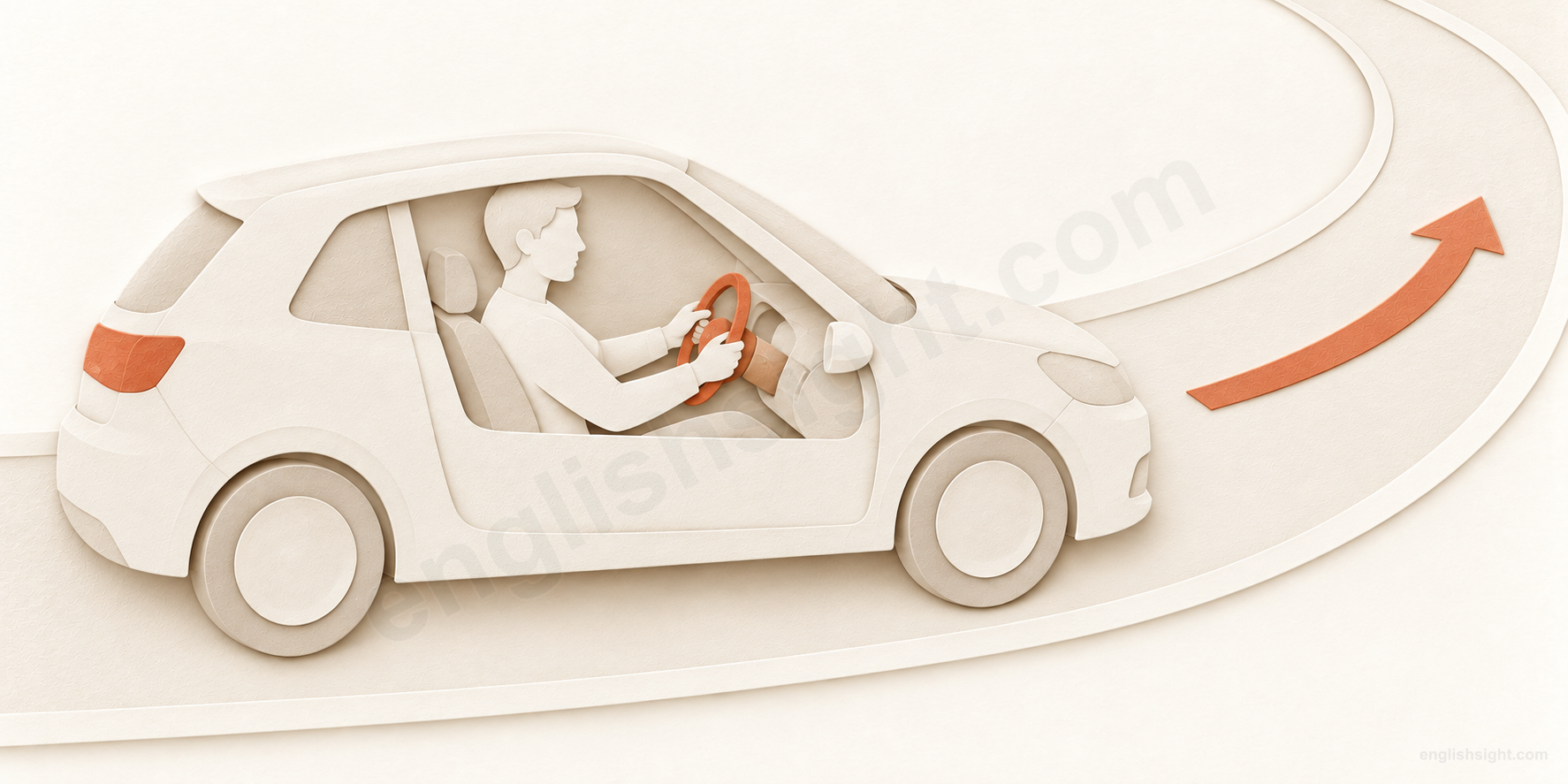
The car follows the chosen direction
Steering guides the car along the bend.
Driving involves controlling a moving vehicle. Here the driver steers the car along a bend.
Driving means controlling a vehicle as it travels; related uses can describe a force that keeps movement or change going.
The driver controls the car; the engine provides power. The sketch focuses on that control relationship. Weather, motivation, and fixed expressions need their own context.
Driving most often names controlling a vehicle as it travels, or the skill involved. It is also the -ing form of drive and an adjective in expressions such as driving rain and a driving ambition.
A useful connection is control or force that keeps movement or change going. This is a teaching model, not a rule that predicts every expression or a picture shared by every English speaker.
01
The activity and skill of driving
Name the activity, describe how it is done, or talk about learning and permission.
01
driving as subject or object; someone’s driving
Driving takes practice.
operating a vehicle, considered as an activity
Situation / starting point
Someone starts learning to control a car.
Meaning / result
Practice develops the skill.
Driving names an activity; a drive names a particular car journey.
Driving can be an uncountable noun: Her driving has improved. It can also head an -ing clause: Driving at night takes concentration.
Compare We went for a drive, a countable journey. Say I enjoy driving or I go driving, rather than I go for a driving. The driver controls the vehicle; a passenger rides in it.
In a sentence
Driving in a busy city takes practice.
Watch the difference Use driving for the activity and a drive for one journey.
02
adjective + driving; be driving + adverb
safe / careless / reckless driving
the way someone controls a vehicle
Situation / starting point
You observe a person’s behavior on the road.
Meaning / result
You describe the quality of that behavior.
An adjective modifies the activity; an adverb modifies the verb.
Safe driving describes a way of driving. He is driving safely uses an adverb with the verb. Careless driving points to insufficient attention; reckless driving emphasizes disregard for danger.
These phrases occur in news and official reports as well as conversation. Here they teach vocabulary, not the legal definitions of offences in a particular country.
In a sentence
Her calm, careful driving made the journey comfortable.
Watch the difference Compare careful driving with driving carefully, not driving careful.
03
a driving school / instructor / lesson; take driving lessons
driving lessons / a driving instructor
instruction in controlling a vehicle
Situation / starting point
A learner wants help with road skills.
Meaning / result
An instructor gives lessons.
Driving identifies what is taught; the lesson itself does not drive.
A driving school provides instruction. A driving instructor teaches the learner, and a driving lesson is one teaching session. You can book or take driving lessons.
In these combinations, driving relates to the activity. It does not have the forceful meaning found in driving rain. The following noun tells you whether you mean a person, a business, or a session.
In a sentence
I have booked a driving lesson for Friday.
Watch the difference Learn to drive is the ordinary phrase for acquiring the skill; driving lessons names the teaching.
04
take / pass / fail a driving test
take / pass / fail a driving test
have your driving ability assessed
Situation / starting point
A learner is ready for an assessment.
Meaning / result
The result shows whether the learner passed.
Taking a test and passing it describe different events.
You take a driving test when you undergo the assessment. You pass it if you meet the required standard and fail it if you do not. Take alone does not report success.
Driving test is familiar in British English; road test and driver’s test are also used in North American English. This names the assessment, rather than the lessons that prepare you.
In a sentence
Maya is taking her driving test next week.
Watch the difference Do not use pass if you only mean take: the outcome may still be unknown.
05
have / hold / get / renew a driving licence
a driving licence / a driver’s license
the official document confirming driving qualification
Situation / starting point
A rental company asks for a document.
Meaning / result
You show the requested licence.
The phrase names a document, not the act of driving.
Driving licence is British English; driver’s license is the usual North American form. Notice both the word choice and the spelling licence/license in these noun phrases.
Have, hold, get, and renew can be used with this document. In She lost her licence, context may mean mislaying the document or losing the right to drive.
In a sentence
Please bring a valid driving licence when you collect the car.
Watch the difference Do not confuse a driving licence with a driving test: one is a document, the other an assessment.
06
drink-driving; drunk driving; be banned from driving
drink-driving / drunk driving
driving after too much alcohol
Situation / starting point
A report describes an alcohol-related driving incident.
Meaning / result
The phrase identifies the kind of conduct involved.
Drink-driving is a compound; it does not mean drinking while someone else drives.
British English commonly uses drink-driving; North American English commonly uses drunk driving or drunken driving. These name driving after too much alcohol.
Reports also use driving under the influence (DUI) and driving while intoxicated (DWI). A driving ban or being banned from driving means a prohibition on driving. Exact official categories depend on context.
In a sentence
The article discusses ways to reduce drink-driving.
Watch the difference Do not read drink-driving as a recommended activity or as a name for a passenger having a drink.
02
On a journey
Read who controls the vehicle, who travels in it, and what the route or time expression adds.
07
be + driving + vehicle / direction / destination
I’m driving to work.
be controlling a vehicle or traveling by car
Situation / starting point
Someone asks about your current journey.
Meaning / result
You explain the activity in progress.
Am/is/are plus driving forms the present progressive.
I’m driving to work describes a journey in progress, or an arranged future journey in an appropriate context. I drive to work normally describes a habit.
Driving a bus supplies the vehicle as object; driving to the station supplies a destination. In A car is driving past, the car is the moving subject. The driver is understood.
With a group subject, We’re driving to the coast can describe the group’s travel by car; it does not mean that everyone in the group controls the vehicle.
In a sentence
I’m driving to the station now.
Watch the difference Say I’m driving or I drive, not I driving. Driving is not the past tense; that is drove.
08
be driving + person + home / to + place; be being driven
driving someone home
take a person somewhere in a vehicle you control
Situation / starting point
A friend needs a lift.
Meaning / result
You take your friend home by car.
The person is the passenger; home gives the destination.
In I’m driving Ben home, I control the vehicle and Ben travels with me. In Ben is driving home, Ben is the driver. Adding the object changes who does what.
Use to before most destinations: driving Ben to the airport. Home is an adverb here, so driving Ben home has no to. In the passive, Ben is being driven home, someone else is driving.
In a sentence
I’m driving my aunt to the airport tomorrow.
Watch the difference Being driven describes the passenger’s situation; it does not mean the passenger is controlling the vehicle.
09
do the driving; share the driving
do the driving
take responsibility for controlling the car
Situation / starting point
Two people plan a long journey.
Meaning / result
One drives while the other helps with directions.
Do the driving allocates the task.
I’ll do the driving offers to be the driver. Share the driving means divide that responsibility, usually by taking turns.
The points to the driving needed for this journey. Compare I like driving, which names the activity generally, without assigning a particular task.
In a sentence
I’ll do the driving if you read the map.
Watch the difference Do the driving does not mean do a driving test.
10
within (easy) driving distance of + place; two hours’ driving
within driving distance
close enough for a practical car journey
Situation / starting point
You choose a place to stay.
Meaning / result
Nearby places can be reached by car.
Driving distance depends on a road journey, not just a straight line.
Within driving distance means near enough to reach by car in the context. Easy driving distance suggests the trip is manageable; it does not specify a fixed number of kilometres.
Two hours’ driving expresses time spent driving. A two-hour drive uses the countable journey noun. Driving conditions refers to road, traffic, and weather circumstances that affect a trip.
In a sentence
The village is within easy driving distance of the coast.
Watch the difference In a two-hour drive, hour stays singular; two hours’ driving uses plural hours and a possessive apostrophe.
03
A force that keeps things moving
Outside road travel, driving can describe strong influence, motivation, weather, or musical energy. These uses do not all involve a person steering.
11
be / put someone in the driving seat
in the driving seat
in control of a situation
Situation / starting point
A team needs someone to make the decisions.
Meaning / result
One person has the main control.
The driver’s control becomes a metaphor for decision-making.
In the driving seat is a British expression for having control; in the driver’s seat is the North American equivalent. No actual car is necessary.
Saying that a colleague is in the driving seat means the colleague has a leading decision-making role. It does not necessarily mean the colleague does every task.
In a sentence
With the new contract signed, our team is in the driving seat.
Watch the difference Distinguish the idiom from someone literally sitting in the seat used by a driver.
12
be a / the driving force behind + noun phrase
the driving force behind something
a person or factor chiefly responsible for making something happen
Situation / starting point
A community project needs sustained support.
Meaning / result
One person provides the main push.
Force can be a person, an aim, or another important cause.
The driving force behind a project is what chiefly makes it happen or continue. It may be a person organizing others or a factor such as demand.
Here driving is an adjective before force. Behind introduces the activity or development being explained; it does not locate a person behind a vehicle.
Compare Demand is driving growth: the verb directly names the cause and its effect. Growth is driven by demand reverses the viewpoint in a passive construction.
In a sentence
Leila was the driving force behind the community garden.
Watch the difference A driving force is not necessarily the person with the official title of leader.
13
a driving ambition / passion / idea
a driving ambition
a powerful desire that strongly motivates action
Situation / starting point
Someone wants to achieve a demanding goal.
Meaning / result
That desire keeps the person working toward it.
The ambition supplies motivation, rather than steering a vehicle.
A driving ambition is an especially strong motivating desire. Driving can similarly describe a forceful idea or passion.
This adjective normally goes before a noun: a driving ambition. She is driving needs a different reading, usually the verb, rather than meaning that she has great ambition.
Compare She is driven by a desire to help: driven is the past participle in a passive construction, and by introduces the motivating cause. She is driving normally describes an action in progress instead.
In a sentence
His driving ambition was to build an affordable home for his family.
Watch the difference Driving ambition names strong motivation; it does not guarantee success or say that the goal is good.
14
driving + rain / snow; in / through driving rain
driving rain / snow
precipitation moving forcefully, typically at an angle in wind
Situation / starting point
Strong wind blows during a storm.
Meaning / result
Rain strikes people and surfaces forcefully.
Driving describes the movement of rain, not a journey in rain.
Driving rain is forceful rain, typically blown slantwise by wind. Driving snow describes a similar forceful weather condition.
We walked through driving rain is natural: nobody has to be in a car. Compare driving in the rain, where driving is the vehicle activity and in introduces the weather around it.
In a sentence
We hurried across the field in driving rain.
Watch the difference Heavy rain stresses amount or intensity; driving rain also evokes forceful movement.
15
a driving rhythm / beat
a driving rhythm / beat
a vigorous musical pulse that carries the music along
Situation / starting point
A song begins with strong repeated beats.
Meaning / result
The music feels energetic and propulsive.
The sense of force extends to musical energy.
A driving rhythm gives music a strong forward-moving feel. Forward here describes the musical effect, not physical travel.
This use is especially useful when discussing music. Driving does not by itself mean loud or fast: rhythm and emphasis can create the effect too.
In a sentence
A driving beat gives the song its energy.
Watch the difference A driving beat is musical rhythm, not the sound of a car engine.
04
Read the whole verb pattern
Driving is also the -ing form of drive. Objects, complements, and particles can change the interpretation substantially.
16
drive + person + adjective; drive + person + to + noun / to-infinitive
driving someone crazy
making someone intensely annoyed or distressed
Situation / starting point
A repeated noise bothers you.
Meaning / result
Your irritation becomes intense.
The object experiences the state named by the adjective.
You’re driving me crazy is a familiar informal complaint. Mad and nuts occur in the same pattern. Often this is exaggeration about annoyance, not a medical claim.
Driving me to despair uses to plus a noun state. Driving someone to do something can describe pressure causing an extreme action: Rising costs are driving families to borrow more.
In a sentence
That constant tapping is driving me crazy.
Watch the difference Do not say driving me to crazy: use crazy directly or to plus a noun such as despair.
17
drive + amount + up / down; drive up / down + amount
driving prices up / down
causing an amount to rise or fall
Situation / starting point
Demand increases while supply stays limited.
Meaning / result
Prices rise because of that pressure.
Up or down gives the direction of change.
Driving prices up means causing them to rise, often sharply. Driving prices down gives the opposite direction. The subject is a cause, not a driver in a car.
Both driving up prices and driving prices up work. With a pronoun, use driving them up, not driving up them. Compare driving up the hill, which describes a vehicle route.
In a sentence
A shortage of rooms is driving hotel prices up.
Watch the difference Prices are driving up lacks the cause-and-object structure used here; prices are rising is the ordinary intransitive alternative.
18
drive away; drive + person + away; drive away + person
driving away / driving customers away
leaving by car, or making people unwilling to stay
Situation / starting point
A shop introduces unfriendly policies.
Meaning / result
Customers choose to go elsewhere.
The object and context distinguish transport from repelling people.
A driver who is driving away is leaving in a vehicle. Driving someone away can also mean taking the person away in a vehicle.
High prices are driving customers away means the prices discourage customers from staying or returning. There is no vehicle. Driving customers away and driving away customers are possible; with them, use driving them away.
In a sentence
The rude service is driving customers away.
Watch the difference Do not assume that every person after driving is a passenger; identify what the whole sentence causes.
19
drive + object + into + material; drive + machine
driving a nail / driving a machine
forcing an object into position, or providing power
Situation / starting point
A hammer strikes a nail; a motor supplies power.
Meaning / result
The nail enters the wood; the machine operates.
The object distinguishes impact from mechanical power.
Driving a nail into wood means forcing it in by blows or pressure. The carpenter is not steering the nail like a car.
A motor driving a pump supplies the power that operates it. These related physical uses help explain force, but driving does not always imply repeated blows or a human driver.
In a sentence
The small motor is driving a water pump.
Watch the difference A driving instructor teaches a person; a motor driving a pump powers a machine. Read the object.
20
what + be + person + driving at; drive + point / message + home
What are you driving at?
what someone is trying to say or suggest
Situation / starting point
A speaker hints instead of stating the main point.
Meaning / result
You ask for the intended meaning.
At belongs to an established expression about meaning.
What are you driving at? asks what a person really means or is suggesting. It is informal and can sound impatient or challenging; a gentler alternative is What do you mean?
It does not ask about the destination of a car. Driving the point home is another figurative expression: making a message clearly understood or accepted, often through emphasis or repetition.
In a sentence
I understand your examples, but what are you driving at?
Watch the difference Keep at in this expression; driving to usually introduces a destination instead.
21
go to / practise at a driving range
a driving range
a place to practise hitting golf balls
Situation / starting point
A golfer wants to practise shots.
Meaning / result
The golfer goes to a practice area.
In golf, driving involves striking the ball forcefully.
A driving range is a golf practice facility. It is not an area where beginners learn to operate cars; that would be connected with a driving school.
The sporting verb drive can mean hit a ball forcefully forward. This established compound is worth recognizing even though detailed golf technique is outside this lesson.
In a sentence
We spent an hour at the driving range practising our golf shots.
Watch the difference Use the surrounding words: golf shots identifies the sporting meaning of driving.
Read the grammar before choosing the meaning
One spelling, several grammatical jobs
Driving is pronounced /ˈdraɪvɪŋ/. Drop the final e of drive before -ing. The forms are drive, drives, drove, driven, driving. Driving can name an activity, occur after be in a progressive verb phrase, or modify a noun.
Driving, riding, and traveling
A person driving a car controls it. A passenger rides in it; a cyclist rides a bicycle. Traveling by car does not by itself identify the driver. Autonomous or self-driving describes a vehicle or system that drives automatically; it does not mean any car driven by its owner.
Patterns contribute meaning
Driving someone home takes a passenger to a place; driving someone crazy produces a state; driving something home can emphasize a message. Do not get these readings from driving alone.
Coverage boundary
This lesson covers the driving noun and adjective, common compounds, and selected useful -ing verb patterns. It does not reproduce every sense or idiom of drive. Mining, specialist transmission parts, hunting, and detailed sport techniques are outside the main course.
Choose the intended relationship
Look at the subject, object, and words after driving.
1. Which sentence names a particular car journey?
2. Ben is the passenger and Ana is taking him home. Which sentence fits?
3. You are walking through wind-blown rain. Which phrase describes the weather?
4. A shortage is causing hotel prices to rise. Complete: The shortage is…
5. A colleague says, “You’re in the driving seat on this project.” What is meant?
6. A speaker gives hints and you want the main point. Which question fits?
Sources and teaching notes
Dictionary entries below support the uses and constructions. Explanations, examples, and the compatibility sketch are original teaching material; the visual connection is a teaching interpretation.
The diagram explains a relationship; English speakers do not all share one mental picture.