Follow drop from falling and releasing to reductions, departures, and familiar expressions.
From support to a lower position
From support to a lower position
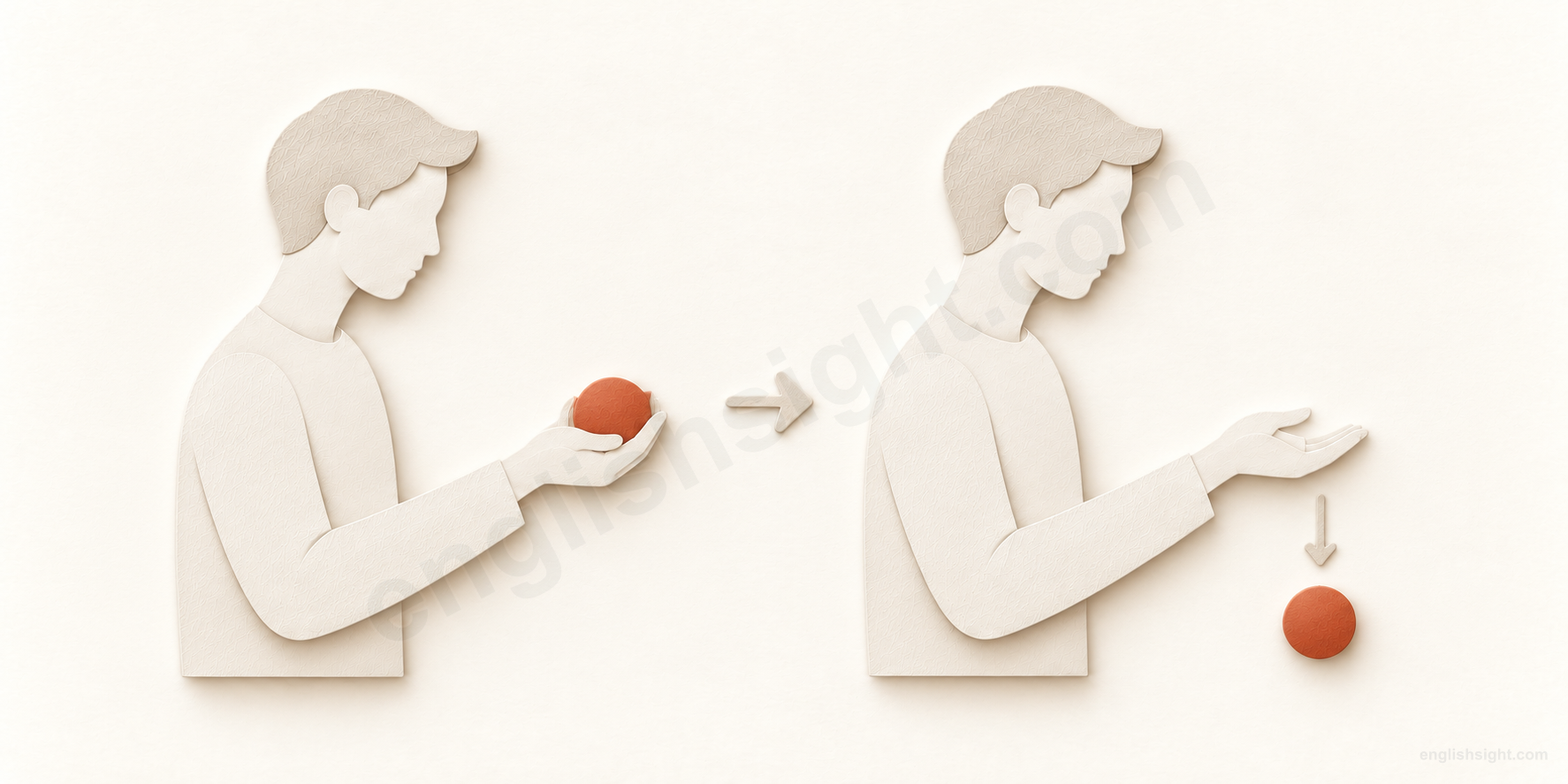
The ball is held in the hand.
drop
The ball is lower and no longer supported.
The hand releases the ball.
A physical drop: the ball falls after the hand lets go.
An object moves to a lower position, or someone lets it fall from where it is held or supported. Amounts and levels can also drop.
The sketch illustrates physical dropping. Lower quantities make a useful comparison; visits, messages, release announcements, and fixed idioms need their own explanations. A drop of liquid is a separate noun branch.
A useful starting point is a change to a lower position: a thing drops, or someone drops it. The same word can describe a lower amount or weaker level. But a casual visit, a message, and an album release are established uses to learn in their own patterns.
The noun also names a tiny amount of liquid, even when it is sitting still. This lesson groups related uses without claiming that every meaning comes from one physical picture or that every English speaker imagines the same scene.
01
Falling, releasing, and moving down
Start with physical movement. The subject may fall, or a person may let an object fall. Intention comes from the situation, not from drop alone.
01
something drops + from / onto / into + place
drop from / onto / into
fall from one position to a lower one
Situation before
A key is on the edge of a shelf.
Change or result
It falls into a box below.
The falling thing can be the subject; no person needs to be named.
The key dropped makes the key the subject of an intransitive verb. From identifies its starting point; onto names a surface it reaches; into names an interior it enters.
A drop can be accidental. Tears can drop onto a sleeve, and fruit can drop from a branch. Drop often draws attention to the downward change or release; fall has a wider range of uses, including fall in love.
In a sentence
A key dropped from the shelf into the box.
Watch the difference Do not give this pattern a passive form: The key dropped, not The key was dropped, unless someone caused or allowed the fall.
02
drop + object (+ into / onto / from + place); be dropped
drop something
let something fall, accidentally or deliberately
Situation before
You are holding a coin.
Change or result
You release it into a container.
The person is the subject; the object is what they let fall.
I dropped the cup can describe a mishap. Drop the coin into the slot is a deliberate instruction. The verb by itself does not mean either carelessness or intention.
The cup was dropped is a natural passive when the cup matters more than the person. Drop the bag is different from put the bag down: put down normally describes placing it somewhere, without implying a fall.
Supplies can be dropped from an aircraft. The passive Supplies were dropped over the island describes delivery by letting them fall, often with parachutes.
In a sentence
Drop the coin into the slot and turn the handle.
Watch the difference Drop is not throw: throwing adds a pushing or propelling action; dropping need not.
03
drop to + position; drop into + seat; drop + body part
drop to your knees / into a chair
move your body or part of it to a lower position
Situation before
A tired walker reaches a chair.
Change or result
She sinks into it.
A person can lower themselves without falling helplessly.
Drop into a chair suggests sitting down with a downward, often tired or sudden movement. Drop to your knees means move into a kneeling position; to identifies the resulting position.
Drop your head or hands makes the body part the object. Your head dropped describes the movement with the body part as subject. Drop your gaze means look down; it is especially associated with more formal narration.
In the figurative sentence My heart dropped when I read the rejection, the speaker feels suddenly disappointed or dismayed. It describes an emotional reaction rather than a literal movement of the heart; it does not make drop a general synonym for feel sad.
In a sentence
Maya dropped into the chair beside the door.
Watch the difference Drop into a chair is physical movement; drop into a café can mean make a casual visit.
04
be ready / about to drop; verb + till / until + subject + drop
ready to drop / until you drop
be so tired that you can hardly continue
Situation before
You have been working for hours.
Change or result
You feel almost unable to stand.
The physical fall becomes a way to emphasize exhaustion.
Ready to drop or about to drop can mean extremely tired, even if the person never actually collapses. The surrounding situation distinguishes exhaustion from a literal imminent fall.
Work until you drop and shop till you drop exaggerate continuing until exhausted. Till and until supply the endpoint; these are not particle verbs.
In a sentence
After carrying boxes all afternoon, I was ready to drop.
Watch the difference This does not mean ready to quit a course: use ready to drop out for withdrawal.
02
Lower amounts, strength, and volume
A measurable level can move down without anything physically falling. Check whether the subject changes or causes a change.
05
drop (by + amount); drop from + start + to + result; drop below + level
drop by / to / from
become lower in amount, level, strength, or position
Situation before
A ticket costs forty units.
Change or result
It later costs thirty.
By gives the amount of change; to gives the new level.
The price dropped from 40 to 30 states both endpoints. It dropped by 10 states the size of the decrease. It dropped 10 percent is also possible without by.
Temperatures, sales, error rates, and wind strength can drop. A team can drop to fourth place without physically moving down a slope. Drop below zero describes crossing a lower boundary.
These are uses of drop with prepositional phrases, not separate phrasal verbs called drop to and drop by. Compare drop by tomorrow, where drop by means visit.
In a sentence
The ticket price dropped from 40 to 30, a decrease of 10.
Watch the difference Dropped by 10 and dropped to 10 give different information. Specify units when the context does not supply them.
06
drop + price / speed / voice; something is dropped
drop the price / your voice
make a level lower or speak more quietly
Situation before
A seller wants to attract buyers.
Change or result
She reduces the price.
An object after drop can identify what somebody reduces.
The shop dropped the price makes the shop responsible for the reduction. The price dropped only states the change. The price was dropped is passive and leaves the responsible person unmentioned.
Drop your voice usually means speak more quietly. His voice dropped to a whisper describes a change in volume. A voice can also drop in pitch in an appropriate context; volume and pitch are different properties.
Lower the price and lower your voice are useful alternatives. Drop your voice does not mean stop speaking altogether.
Informal drop a few pounds or drop a few kilos means lose that amount of body weight. Here the object gives the amount lost: She dropped three kilos, not She dropped her weight three kilos.
In a sentence
She dropped her voice so the children would not hear.
Watch the difference Do not interpret every voice dropping as silence or as a lower musical note; check the context.
03
Stop, remove, or lose
In these uses something no longer continues or remains included. Read the object carefully: a subject, a player, a friend, and a game produce different meanings.
07
drop + plan / idea / subject / charges; be dropped
drop a plan / a course / the charges
stop pursuing or continuing something
Situation before
A team is considering a costly plan.
Change or result
They decide not to pursue it.
The object is an activity, proposal, or action that no longer continues.
Drop the plan means abandon it, not merely reduce its cost. Drop a subject such as chemistry can mean stop studying it. Drop the charges means stop pursuing the accusations; the verb alone does not establish why.
The plan was dropped is a natural passive. Drop everything and come here tells someone to interrupt their other activities, not necessarily throw down the objects they are holding.
Compare drop a course, with the course as object, and drop out of a course, with the student as subject withdrawing from it. Both can describe leaving study, but their grammar differs.
Drop a habit means stop following it; drop your objections means stop opposing something. Let’s drop the formalities asks people to stop using formal social conventions and interact more informally. These are different objects in the stop-or-abandon family.
In a sentence
We dropped the plan because the repairs would cost too much.
Watch the difference For the meaning stop, use drop the plan, not drop to plan or drop the plan down.
08
drop + it / the subject; let + matter / it + drop
drop it / drop the subject / let it drop
stop discussing a matter
Situation before
An argument keeps returning to the same point.
Change or result
Someone asks for the discussion to end.
The pronoun refers to a topic rather than an object in the hand.
Drop it is a direct request to stop talking about something. It can sound impatient. Can we drop the subject? makes the request less abrupt.
Let the matter drop means do not pursue it further. In this pattern let takes an object and the base form drop: let it drop, not let it to drop. A decision to let a complaint drop need not mean the complaint was untrue.
In a sentence
Can we drop the subject and enjoy the rest of the evening?
Watch the difference Let it drop can stop a discussion; let it drop that… can instead introduce a disclosure. Read what follows.
09
drop + person / item + from + group / text; be dropped from / by
be dropped from the team
be excluded or removed from a selection
Situation before
A player was in the team.
Change or result
The coach does not select him this time.
The passive names the person affected by someone else’s selection.
The coach dropped him from the team means the coach removed or left him out. He was dropped from the team reports the same selection decision from the player’s perspective.
Drop a word from a sentence means leave it out. Drop an h means not pronounce that sound in the relevant word. These are omissions, not falling letters.
A record label can drop an artist by ending their association. Context decides whether the exclusion concerns one selection, a contract, or a longer relationship.
In a sentence
He was dropped from the team after missing training.
Watch the difference He dropped out suggests he withdrew; he was dropped identifies a decision made by others.
10
drop + person (social relationship)
drop an old friend
stop seeing or associating with someone
Situation before
Two people used to meet regularly.
Change or result
One stops maintaining the relationship.
A person as object can mean a social connection is ended.
Drop someone can describe no longer treating them as a friend or choosing to see them. It can sound cold or critical because it presents the relationship as something discarded.
Location changes the reading: She dropped Sam near the station means she took him there and left him. She dropped Sam after the argument can describe ending contact. Neither reading follows from the person’s name alone.
In a sentence
She dropped several old friends when she became famous.
Watch the difference Do not use drop a friend as a neutral substitute for miss a friend or fail to meet them once.
11
drop + set / game / points
drop a set / points
fail to win a unit of a sporting contest
Situation before
A tennis player wins the first set.
Change or result
She loses the next one.
The direct object is a competitive unit or points lost.
Drop a set means lose that set. Drop points describes failing to take points that might have been won. A player can drop a set and still win the match.
This differs from dropping a player, which means excluding someone, and dropping to third place, which describes a lower ranking. Sport supplies the established interpretation of the object.
In a sentence
She dropped the opening set but won the next two.
Watch the difference Do not confuse dropped a set with dropped out of the tournament; withdrawal and losing one set are different events.
04
Leave, send, mention, and release
These established uses concern getting something to a destination or into public attention. They need their own constructions rather than a literal downward arrow.
12
drop + person / thing + at / near + place; drop + object + off
drop someone off / drop something off
take someone or something to a place and leave them or it there
Situation before
A driver is taking a friend into town.
Change or result
The friend gets out at the library.
The destination is where the passenger or item is left.
Drop me at the library and drop me off at the library both work. This use does not imply making the passenger fall. You can also drop off a parcel on the way to work.
With a noun, drop the parcel off and drop off the parcel are both possible. A pronoun goes between the verb and off: drop it off, drop me off. The passenger can be passive: I was dropped off outside the library.
Pick up often describes the reverse transport stage: collecting someone rather than leaving them at their destination.
In a sentence
Could you drop me off outside the library?
Watch the difference Say drop me off, not drop off me. Delivering a parcel and falling asleep are different meanings of drop off.
13
drop + person + a line / a note / an email / a text
drop someone a line / an email
send someone a brief written message
Situation before
You want news after a friend arrives.
Change or result
You ask for a short message.
The person receives the message; a line is a short piece of writing.
Drop me a line is a friendly way to ask someone to write. An email, note, text, or message can replace a line. Drop supplies a casual tone rather than a literal physical action.
In drop me an email, me is the recipient and an email is the thing sent. The common construction has two objects; it is not a phrasal verb. Drop a letter in the mailbox instead names a physical destination.
In a sentence
Drop me an email when you have chosen a date.
Watch the difference A line here is not a telephone connection: drop me a line usually asks for writing.
14
drop a hint (to + person) (about + topic / that + clause)
drop a hint
suggest something indirectly
Situation before
You would like help but do not ask directly.
Change or result
The listener gets a clue to your wish.
A hint enters the conversation without a direct request.
Drop a hint means communicate something indirectly so another person can work out what you mean. The clue may be deliberate; it is not necessarily an accidental disclosure.
The person you hint to can follow to, while about names the topic. Saying I keep dropping hints that I need a lift introduces the content with a that-clause. This is an established pairing of drop with hint.
In a sentence
I dropped a hint that I would like a lift home.
Watch the difference A hint is less explicit than a request; it does not guarantee the listener will understand or agree.
15
drop names; name-dropping
drop names
mention famous acquaintances to impress people
Situation before
A speaker wants to seem well connected.
Change or result
They mention people with status.
The social purpose makes this more than simply saying a name.
Someone who drops names repeatedly brings famous or important people they know into conversation to impress listeners. The related label is name-dropping.
Mentioning the name of your doctor so a receptionist can find an appointment is not automatically dropping names. The critical implication depends on the effort to appear important.
In a sentence
He kept dropping names instead of answering our questions.
Watch the difference Do not interpret drop names here as remove names from a list; that needs a different context.
16
drag and drop + item + into / onto + target
drag and drop
move an on-screen item and release it in a target position
Situation before
A file icon is selected.
Change or result
You release it over a folder.
Drop identifies the release or placement stage of a computer action.
In a mouse-based interface you drag an item while holding the button, then drop it by releasing the button at the destination. A touch interface can provide an equivalent hold, move, and release action.
Drag and drop names the combined action. Onto or into identifies the on-screen target. Whether the file is moved, copied, or uploaded depends on the application; the phrase alone does not promise one of those results.
In a sentence
Drag and drop the photo into the upload area.
Watch the difference Dropping an icon does not by itself mean deleting the file.
17
artist drops + recording; recording / episode + drops
drop a new album / an episode drops
make media available to the public
Situation before
An album has been announced.
Change or result
People can now listen to it.
This informal release sense is a separate modern branch.
An artist can drop an album, with the artist as subject and album as object. An album or episode can also drop, with the release itself as the event.
This is informal language common in entertainment announcements. Release is a more neutral choice. The use does not mean sales have decreased or the artist has abandoned the album.
In a sentence
Their new album drops on Friday.
Watch the difference The album dropped and album sales dropped describe release and reduction respectively.
18
drop + amount of money + on + purchase
drop money on something
spend an amount of money, often a surprisingly large one
Situation before
Someone sees an expensive jacket.
Change or result
They spend a large amount on it.
The money is spent, not physically lost from a pocket.
In informal conversation, drop an amount on something can present the spending as substantial or casual. The amount is the object, and on introduces what is bought.
Neutral spend works in more situations. This use differs from drop the price, which lowers a seller’s price, and drop some coins, which may describe a physical accident.
In a sentence
He dropped two hundred dollars on a jacket he barely wears.
Watch the difference The informal tone often adds a judgment about the amount; it is not the best neutral wording for every expense.
05
Read the whole combination
Visits, sleep, reduced activity, withdrawal, and relative position are distinct uses. A small word such as off or out does not have one automatic translation.
19
drop by / in; drop in on + person; drop into + place
drop by / in / in on / into
make an informal, often brief visit
Situation before
You are passing near a friend’s home.
Change or result
You stop for a casual visit.
The combination describes visiting, not falling into a building.
Drop by or drop in can stand alone: Drop in tomorrow. Drop in on someone identifies the person visited. Drop into a place identifies the location. British English also uses drop round.
These expressions suggest an informal visit, often without elaborate arrangements. They do not guarantee that the visitor gave no warning at all. A visit can still be discussed in advance.
Compare The price dropped by five: there by introduces a numerical difference. In Drop by tomorrow, by belongs to the established visiting expression.
In a sentence
We dropped in on my aunt on our way home.
Watch the difference For a visit, say drop in on her. Drop her off instead describes taking her somewhere and leaving her there.
20
drop off; drop off to sleep
drop off (to sleep)
begin to sleep, often lightly
Situation before
You are watching a film in an armchair.
Change or result
You fall asleep before the ending.
There is no delivered object in this intransitive use.
I dropped off means I fell asleep. To sleep can make that reading explicit, especially where several meanings of drop off might be possible.
I dropped the children off means I took them somewhere and left them there. I dropped off while the children watched TV means I myself began sleeping. The object and context distinguish the readings.
In a sentence
I dropped off halfway through the film.
Watch the difference Do not add a sleeping person as a direct object: I dropped him off normally describes transport.
21
amount / activity + drops off
sales / attendance drop off
become lower or less numerous
Situation before
Many people attend at the start.
Change or result
Fewer people attend later.
Off contributes to an established expression for declining activity or quantity.
Sales dropped off and attendance dropped off describe reduced business or participation. No delivery destination is involved.
Plain drop can also report a decrease: Sales dropped by ten percent. Drop off often describes a reduction in activity or demand over a period; it does not specify an exact speed or size of decline.
In a sentence
Attendance dropped off after the first month.
Watch the difference Off does not mean attendance reached zero. A decline can be small or large.
22
drop off; drop off + call / meeting
drop off a call
leave a telephone call or online meeting
Situation before
You are in a video meeting.
Change or result
You leave while the meeting continues.
In this current meeting use, leaving is different from sleeping or delivering.
I need to drop off the call means I need to leave it. Drop off can stand alone when the call or meeting is already understood. Rejoin can describe coming back later.
The call dropped can instead report that the connection failed. I need to drop off presents leaving as the speaker’s action or intention; an unexpected disconnection needs context.
In a sentence
I need to drop off the call in a minute.
Watch the difference The call is not a parcel: do not mechanically rearrange this as drop the call off in the same meeting sense.
23
drop out; drop out of + course / activity
drop out (of a course / race)
stop participating or leave studies unfinished
Situation before
A student has started a course.
Change or result
She leaves before completing it.
The participant withdraws; of introduces what they leave.
Drop out of a course means leave without finishing. A runner can drop out of a race, and a member can drop out of a project. The broader meaning is no longer participating, not necessarily failing an examination.
Drop out can stand alone when the activity is known. Keep of before an explicit course or activity: She dropped out of college. Compare She dropped chemistry, which makes the subject studied a direct object.
Drop out of society has a broader established meaning of rejecting conventional social life. That use is different from missing one meeting.
In a sentence
She dropped out of the course to care for her father.
Watch the difference She was dropped from the project means others excluded her; she dropped out means she withdrew.
24
drop back; drop behind + person / competitor
drop back / behind
move into a position behind someone else
Situation before
A runner is level with the leaders.
Change or result
She falls behind them.
The change is relative position, not necessarily vertical height.
Drop back can describe moving toward the rear of a group. Drop behind someone names who is now ahead. The person may still be moving forward, just more slowly than the others.
A business can drop behind its competitors figuratively. The expression reports a relative disadvantage and does not imply that the business has stopped working.
In a sentence
I dropped back to walk beside the slowest member of the group.
Watch the difference Do not force a downward reading onto back or behind; here they describe position relative to others.
25
feeling / pressure + drops away; land + drops away
tension drops away
become weaker or less
Situation before
You are nervous before receiving good news.
Change or result
The tension eases.
Away can present a feeling or pressure as receding.
When tension or anxiety drops away, it becomes weaker or less noticeable. The expression can suggest relief but does not guarantee that every trace of the feeling disappears.
In The land drops away beyond the wall, the words instead describe a steep downward slope. The subject tells you whether the relation concerns an emotion or physical terrain.
In a sentence
As the conversation became friendlier, my anxiety dropped away.
Watch the difference A slope can drop away without moving: the description concerns its shape, not an event.
06
Drops as things, quantities, and distances
The countable noun may name a tiny quantity of liquid, a decrease, or a downward distance. Some plural product names have special meanings.
26
a drop of + liquid; a few drops of + liquid; a drop more; not a drop
a drop of water / a drop more
a small rounded amount of liquid, or a very small quantity
Situation before
A little water gathers at the tip of a leaf.
Change or result
It forms a separate drop.
The noun names a small liquid unit; the verb can describe its movement.
A drop of water is countable: one drop, two drops. Of names the liquid. A drop can remain on a surface, so the noun does not require that it be falling.
A drop more milk means a little more milk without a precise measurement. Not a drop emphasizes none at all, and every last drop emphasizes the whole liquid quantity.
In a context about alcohol, not touch a drop can mean drink no alcohol. Drop alone is not a standard fixed measure such as a milliliter.
In a sentence
Add a few drops of lemon juice, then stir.
Watch the difference Use a drop of water or two drops of water, not two drop water.
27
eye / ear / nose + drops; cough / fruit + drops
eye drops / cough drops
liquid medicine in small portions, or small sweets of a named kind
Situation before
You read the name on a product.
Change or result
The full compound tells you what kind of product it is.
The plural noun does not identify the product without its modifier or context.
Eye drops, ear drops, and nose drops name liquid medicines applied in drops. A bottle of eye drops contains multiple small portions; the product name is ordinarily plural.
Cough drops are small sweets or lozenges; fruit drops are sweets flavored with fruit. These are solid products named for their small shape or size, not liquid eye medicine.
These examples explain vocabulary labels rather than giving instructions about using any medicine. The full product name matters.
In a sentence
The shop sells eye drops and fruit drops on different shelves.
Watch the difference Do not assume everything called drops is a liquid or that eye drops and cough drops are interchangeable.
28
a drop in + quantity; a drop of + amount; a ten-percent drop
a drop in sales / a drop of ten
a decrease in a level or quantity
Situation before
A shop compares two months of sales.
Change or result
The second month’s figure is lower.
In names what decreased; of can state the size of the decrease.
A drop in sales describes the changing quantity. A drop of ten percent states how much it decreased. A ten-percent drop combines the amount with the noun as a modifier.
There was a drop in temperature is a noun-based alternative to The temperature dropped. Sharp or steep describes a substantial or rapid decrease according to context, not a physical cliff.
The verb often uses by for the size of a change: Sales dropped by ten percent. The noun can use of: a drop of ten percent.
In a sentence
There was a drop of ten percent in sales last month.
Watch the difference A drop to ten percent gives the resulting level; a drop of ten percent gives the reduction.
29
a sheer drop; a five-metre drop; a drop of five metres
a sheer drop / a five-metre drop
a downward distance or a steep downward edge
Situation before
A path runs along a cliff.
Change or result
There is a long distance to the ground below.
The noun can measure a potential fall even when nothing falls.
A five-metre drop is a downward distance of five metres. A sheer drop emphasizes a very steep, nearly vertical descent.
Compare The path drops steeply into the valley: the verb describes the shape or direction of the path. Neither sentence requires an object to be falling at that moment.
The measurement before a singular noun uses the singular unit: a five-metre drop, but a drop of five metres. American spelling uses meter rather than metre.
In a sentence
Beyond the low wall was a five-metre drop to the rocks.
Watch the difference A five-metre drop is a distance, not necessarily a fall that actually happened.
30
a food / supply / parachute drop
a food drop / a parachute drop
an act of delivering by dropping or of descending by parachute
Situation before
Supplies cannot easily reach a village by road.
Change or result
An aircraft delivers them from above.
The countable noun can name the delivery event.
A food drop can mean an operation in which food is delivered from the air. A parachute drop can refer to people or supplies descending by parachute, according to context.
This links directly to the physical verb: the food was dropped from an aircraft. It is different from a drop in food prices, which describes a decrease.
In a sentence
The crew arranged a food drop for the isolated village.
Watch the difference Check what follows drop: a food drop is delivery; a drop in food supplies is a reduction in the amount available.
07
Familiar idioms and conversational signals
Learn the complete expression with its social purpose. These idioms cannot be reliably reconstructed by imagining an object falling.
31
drop the ball (on + task)
drop the ball
fail in a responsibility through a mistake or omission
Situation before
A team member was responsible for sending invitations.
Change or result
The invitations were not sent.
The idiom concerns a failure of responsibility, not necessarily a literal ball.
I dropped the ball admits that something you were responsible for went wrong because you failed to handle it. It is informal and is especially common in North American English.
On this or on the booking can identify the task involved. The expression often accepts blame; it does not identify the exact cause unless more information is supplied.
In a sentence
I dropped the ball on the booking and forgot to confirm the room.
Watch the difference In a sports report drop the ball may still be literal; context decides whether this is the idiom.
32
verb phrase + at the drop of a hat
at the drop of a hat
immediately or with very little prompting
Situation before
A friend is eager to travel.
Change or result
They are willing to leave with little warning.
The whole phrase describes readiness or speed of response.
Someone who travels at the drop of a hat is ready to do it very easily or at short notice. No actual hat needs to fall.
The phrase can express enthusiasm or criticism of an expectation that someone will act immediately. It describes how readily an action happens, not a reason to abandon it.
In a sentence
She would take a weekend trip at the drop of a hat.
Watch the difference Keep at: it is at the drop of a hat, not in the drop of a hat.
33
be + a drop in the ocean / bucket (compared with + need)
a drop in the ocean / bucket
an amount far too small compared with what is needed
Situation before
Repairs will cost a large sum.
Change or result
A small contribution covers very little of it.
The comparison concerns scale, not a decrease.
A drop in the ocean is chiefly British wording; a drop in the bucket is the North American counterpart. Both compare a small amount with a much larger need or total.
The expression can acknowledge that help is welcome while stressing how little of the problem it solves. It does not say the contribution became smaller after it was given.
In a sentence
The donation helped, but it was a drop in the ocean compared with the repair bill.
Watch the difference A drop in sales means a reduction; a drop in the ocean is a fixed comparison of scale.
34
the penny + drops / dropped (for + person)
the penny drops
someone finally understands something
Situation before
A joke is confusing at first.
Change or result
The meaning suddenly becomes clear.
The idiom marks realization, especially in British English.
When the penny drops, someone finally understands something that was not clear before. The expression is informal and especially British.
The person who understands need not appear as the grammatical subject: The penny finally dropped for me identifies them with for. Learn the phrase as a whole; drop alone does not generally mean understand.
In a sentence
When I saw the second photo, the penny finally dropped.
Watch the difference Say the penny dropped, not I dropped the penny, for this idiomatic realization.
35
you could hear a pin drop; you could have heard a pin drop
you could hear a pin drop
it was extremely quiet
Situation before
A room full of people stops speaking.
Change or result
Even a tiny sound would be noticeable.
The hypothetical small sound emphasizes silence.
You could hear a pin drop describes intense quiet. You could have heard a pin drop is common when looking back at a past moment.
No pin needs to have fallen, and no particular listener needs to have heard one. Could presents a sound that would have been audible in such silence.
In a sentence
When the result was announced, you could have heard a pin drop.
Watch the difference This is about silence, not good hearing or an actual event involving a pin.
36
drop + possessive + guard
drop your guard
become less careful or alert to danger
Situation before
You have been watching for possible trouble.
Change or result
You relax your vigilance.
The protection is lowered figuratively.
Drop your guard means stop being as careful or prepared for a possible threat. It can concern physical safety, competition, or emotional openness.
The expression may suggest a mistake that exposes you to risk, but in a trusted conversation it can simply describe becoming less defensive. Guard here is vigilance or protection, not necessarily a security worker.
In a sentence
He relaxed and dropped his guard during the conversation.
Watch the difference Drop your guard does not necessarily mean dismiss a guard from a job.
37
possessive + jaw + drops; mouth + drops open
someone’s jaw drops
someone shows sudden surprise or shock
Situation before
A person hears an astonishing price.
Change or result
Their mouth opens in surprise.
The body image becomes a familiar description of a reaction.
My jaw dropped describes a sudden visible reaction to something surprising, shocking, or disappointing. It need not be a precise report of how far the mouth moved.
Her mouth dropped open is a related physical description with open as the resulting state. The result adjective tells what position the mouth reaches; it is not an object being dropped.
In a sentence
My jaw dropped when I saw the hotel bill.
Watch the difference A jaw-dropping price is a related adjective; not every use of drop means surprise.
38
drop dead; imperative Drop dead!; drop like flies
drop dead
die suddenly; also a rude dismissal
Situation before
Someone describes an unexpected death or an angry exchange.
Change or result
Context separates a report from an insult.
The same words have a literal event reading and a hostile conversational use.
He dropped dead describes dying suddenly and unexpectedly. Dead names the resulting state; it is not an object.
Drop dead! directed at someone is an offensive dismissal telling them to go away or stop bothering the speaker. It is hostile, not a neutral request for quiet.
People were dropping like flies is another informal, vivid expression for large numbers becoming ill or dying. It is not suitable for every sensitive context.
In a sentence
The report said the owner had dropped dead at work.
Watch the difference An imperative Drop dead! is insulting even if the speaker does not literally expect a death.
39
let it drop that + clause
let it drop that…
mention information as if casually or unintentionally
Situation before
Someone knows a private detail.
Change or result
They allow the detail into the conversation.
The that-clause gives information disclosed, rather than a subject being abandoned.
She let it drop that she was leaving means she mentioned her departure, perhaps accidentally or as though it were accidental. It does not by itself prove the disclosure was unintended.
Compare Let the matter drop: stop pursuing that subject. In let it drop that she was leaving, the following clause supplies what became known. The two meanings need separate contexts.
In a sentence
He let it drop that he had already accepted another job.
Watch the difference Do not read this as a request to stop discussing the job; that is the other let it drop pattern.
Keep the subject, object, and full expression in view
Forms and sounds
The forms are drop, drops, dropped, and dropping. Double p before -ed and -ing. Dropped ends in the sound /t/. British pronunciation is /drɒp/; American pronunciation is /drɑːp/.
Who changes, and who causes the change?
The glass dropped describes a fall. I dropped the glass names a person allowing or causing it. The glass was dropped is passive. The same contrast works with reductions: Prices dropped / the shop dropped prices. Drop can be progressive when an event is in progress: The temperature is dropping.
Particles are not interchangeable
Drop it off can deliver it. Drop off can mean fall asleep, decline, or leave a call. Drop out means stop participating. Drop by can mean visit, but by in prices dropped by five gives the size of a change. Learn the object and construction together.
A useful picture has limits
The falling-ball sketch supports the physical meaning and a comparison with lower levels. It cannot predict the idioms or the informal media-release sense. Fall, lower, leave, release, and abandon overlap with particular uses; none replaces drop in every expression.
Coverage boundary
This is a selection of common modern uses and useful idioms, not a frequency ranking or every dictionary sense. Specialist knitting, nautical, theatrical, drug-slang, and technical cable meanings are not developed here. Less broadly useful regional expressions are recorded in the coverage notes rather than expanded into full lessons.
Choose the meaning that fits
Use the subject, object, and following words to distinguish the readings.
1. A price was 50 and is now 40. Which statement gives the size of the decrease?
2. You want a driver to leave you at the station. Which sentence uses the usual pronoun position?
3. A friend says, “I dropped off during the film.” What is the ordinary reading?
4. A student decides to leave college before finishing. Which wording describes the student’s withdrawal?
5. A small bead of water rests on a leaf and has not moved. Can it be called a drop?
6. An artist announces, “My album drops tomorrow.” What does drop mean here?
7. “He let it drop that he was moving abroad.” What happened?
Sources and teaching notes
Usage was checked against the dictionary pages below. Explanations and examples are original. The diagram is a teaching model, not evidence that every sense has one origin.
The diagram illustrates physical dropping; the lesson explains the other branches.