Move from a physical state to drying actions, practical combinations, and established meanings.
Little or no moisture on or in something
Little or no moisture on or in something
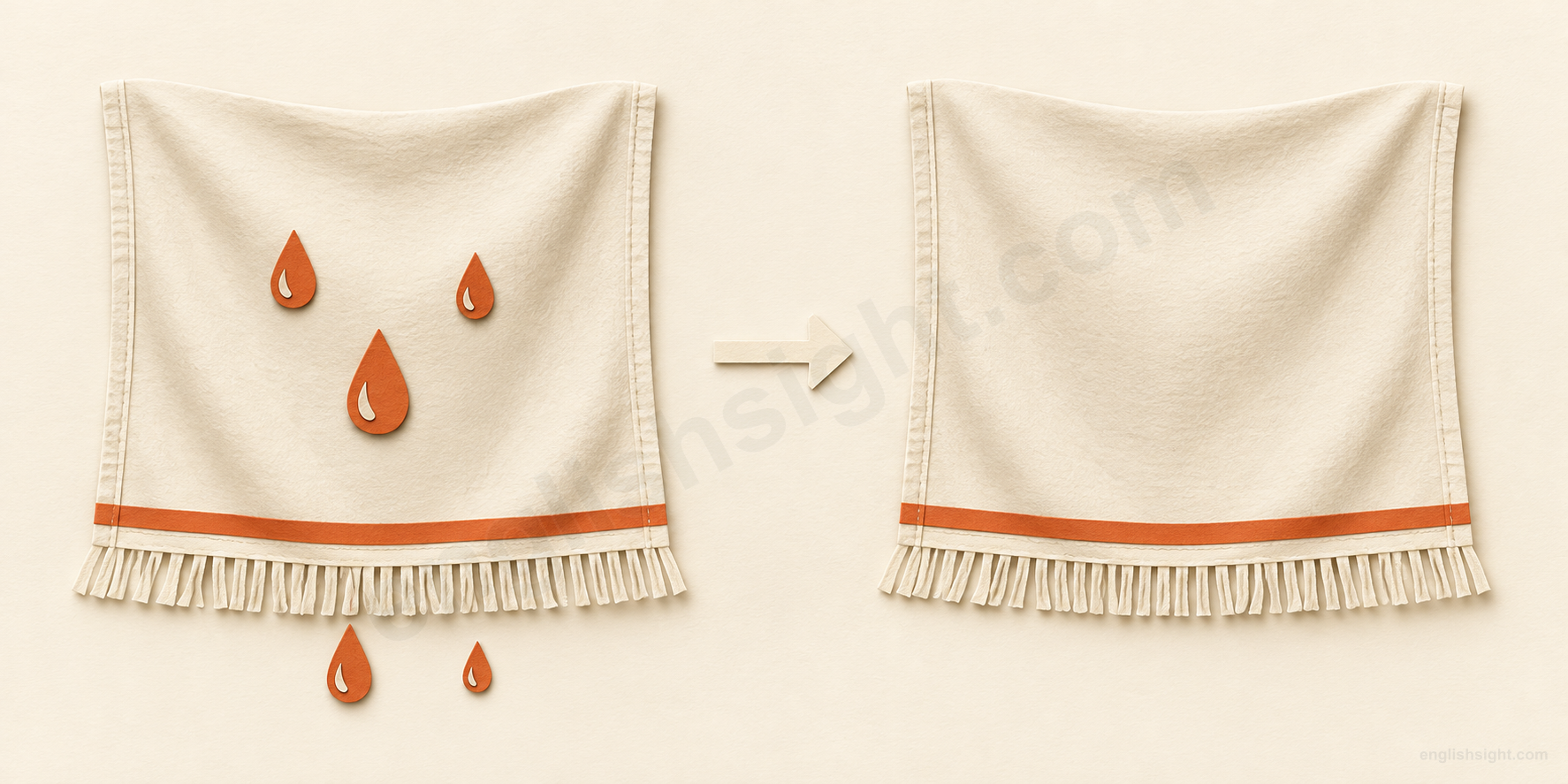
The cloth holds moisture.
dry
The same cloth is dry, with little or no moisture.
The moisture is lost; the arrow marks the change.
The cloth becomes dry as it loses moisture. Dry describes the condition; as a verb, it can describe the change or causing it.
Dry describes a state with little or no moisture; as a verb, it means to become dry or make something dry.
The picture illustrates the physical moisture branch. An object can already be dry without a drying event being mentioned. Wine, humor, and fixed expressions need the separate explanations below.
Start with a wet cloth that loses its moisture. The cloth is dry afterward; it dries as the moisture leaves; you dry it if you cause the change. Those are different grammatical ways of talking about one physical situation.
Then look at the object and the whole expression. Dry skin, dry toast, dry wine, and dry humor use different expectations. Some meanings connect naturally with missing moisture or supply; others are established expressions to learn in context.
01
Moisture, weather, bodies, and food
Start with the thing being described. A dry towel, dry skin, and dry toast point to different kinds of moisture or different expectations.
Dry names the condition; it does not by itself say how it came about.
Use dry before a noun or after a linking verb: a dry towel; the towel feels dry. Stay dry means continue without getting wet. Keep the towel dry means prevent it from getting wet.
Dry is relative to the object and task. A dry shirt is ready to wear; dry paint is no longer wet or sticky. Neither claim is a laboratory measurement of zero water.
Bone dry and as dry as a bone emphasize complete dryness: The flowerpot is bone dry. Drier and driest compare degrees: This towel is drier than that one.
In a sentence
Put on a dry shirt before we leave.
Watch the difference A shirt can be dry without being clean. Dry describes moisture, while clean describes freedom from dirt.
02
dry + day / weather / season / climate / air; it stays dry
dry weather / dry air
have little rain or little moisture in the air
Situation / starting condition
You are deciding when to walk or where to store something.
Meaning / resulting condition
You describe the relevant outdoor or indoor conditions.
Rainfall and moisture in the air are related but different features.
A dry day or dry season has little or no rain. If the weather stays dry, rain does not arrive during the period being discussed. Dry does not mean hot: a winter day can be cold and dry.
Dry air and dry heat concern low moisture in the air. A dry climate describes a broader pattern, not just today’s forecast. For storage, a cool, dry place protects things from damp conditions.
In a sentence
The air in this heated room is very dry.
Watch the difference Use sunny for sunshine and dry for lack of rain or moisture. A cloudy day can still be dry.
03
dry + skin / hair / lips; have dry skin
dry skin / dry hair
lack the natural oils or moisture needed for a soft condition
Situation / starting condition
Your hands feel rough rather than soft.
Meaning / resulting condition
You describe their condition as dry.
Dry skin is about its condition, not simply the absence of water on its surface.
In skin and hair care, dry contrasts with a comfortably soft or oily condition. Hair can be dry in this sense even though it is freshly washed and still wet.
Compare My hair is dry now, said after a shower, with I have dry hair, said when choosing shampoo. The context selects temporary surface dryness or a more general hair type.
In a sentence
My hands get dry in winter.
Watch the difference Do not infer that dry skin is dirty, or that wet hair cannot also be a dry hair type.
04
mouth / throat + be / feel / go dry; I’m dry (informal, especially British)
a dry mouth / throat
feel short of moisture in the mouth or throat
Situation / starting condition
You are nervous before speaking.
Meaning / resulting condition
Your mouth feels uncomfortable and you want water.
The phrase describes a bodily sensation, which can have different causes.
My mouth is dry and My throat feels dry describe the feeling in that part of the body. A mouth can go dry: go plus the adjective presents a change of state.
I’m a bit dry can also mean I am thirsty, especially in informal British English. I’m thirsty is the clearer general choice when you want a drink; I’m dry after swimming usually means your body is no longer wet.
In a sentence
My mouth went dry just before I spoke.
Watch the difference Dry describes a sensation here. The word alone does not identify why it happens.
05
have + a dry cough
a dry cough
cough without bringing up mucus
Situation / starting condition
Someone describes the kind of cough they have.
Meaning / resulting condition
You understand that it does not bring up phlegm.
Dry specifies what the cough does not produce, rather than its volume.
A dry cough does not bring up mucus or phlegm. It can still be loud, frequent, or uncomfortable: those are separate features.
The adjective belongs to this established body-description pattern. It does not mean that the person’s whole body has become dry, and it does not name a particular cause.
In a sentence
He mentioned a dry cough during the call.
Watch the difference Dry cough describes a symptom, not a diagnosis or a treatment.
06
dry + cake / bread / meat; the food + be dry
dry cake / dry meat
have too little moisture to be pleasant to eat
Situation / starting condition
You taste a piece of cake.
Meaning / resulting condition
It feels less moist than you wanted.
Food can be dry as a texture even when it is fresh or warm.
Dry cake or dry meat often criticizes texture: it lacks enough moisture or juice. Compare a moist cake or juicy meat. Dry does not automatically mean old, although some old food becomes dry.
The adjective evaluates the food as you eat it. That differs from dry toast ordered without butter, which describes what is served with it rather than a failed texture.
In a sentence
The cake tastes good, but it is a little dry.
Watch the difference Do not treat dry and stale as exact synonyms: stale concerns lost freshness, while dry concerns moisture or texture.
07
dry toast / bread; toast without butter
dry toast
toast served without butter or another spread
Situation / starting condition
You order toast and choose no spread.
Meaning / resulting condition
The toast arrives plain.
In this food expression, dry can mean without a topping rather than unpleasantly hard.
Dry toast, and sometimes dry bread, is served without butter, jam, or a similar spread. This can be a deliberate choice, not a complaint.
Context matters: This toast is too dry may criticize texture, while Two slices of dry toast, please normally specifies the order. Without butter is a useful explicit alternative if there could be doubt.
In a sentence
Could I have an egg and some dry toast?
Watch the difference Dry toast does not mean raw bread or necessarily burnt toast.
08
the dry ingredients; mix / combine the dry ingredients
dry ingredients
solid or powdered ingredients as opposed to liquid ones
Situation / starting condition
A recipe keeps flour and sugar separate from milk.
Meaning / resulting condition
You mix the two kinds at the instructed stage.
Dry here classifies ingredients by their form in a recipe.
Flour, sugar, and similar solid ingredients are called dry ingredients, in contrast with liquid ingredients. The recipe may group them together before any liquid is added.
This is a practical cooking category, not a claim that every ingredient contains absolutely no moisture. Do not infer that dry ingredients are cooked or dried for preservation.
In a sentence
Combine the dry ingredients in a large bowl.
Watch the difference Dry ingredients is a noun phrase. It is not an instruction to make the ingredients dry.
02
Land and shelter
These expressions contrast being on land or under shelter with being in water or exposed to wet conditions.
09
on / onto / back on dry land
on dry land
on land rather than in or on the water
Situation / starting condition
A ferry reaches the shore.
Meaning / resulting condition
The passengers step ashore.
Dry land contrasts land with water, even if the ground itself is damp.
After a journey by boat, being back on dry land means being ashore. The expression focuses on land as a place you can stand, rather than travel on water.
It need not describe desert land or a rain-free climate. You can step onto dry land while rain is falling.
In a sentence
After the rough ferry trip, we were glad to be on dry land.
Watch the difference Use on dry land for location. In the dry usually concerns shelter from wet conditions.
10
in / into the dry; the dry (especially Australian: dry season)
in / into the dry
in or into a place protected from wet conditions
Situation / starting condition
Rain is falling outside the shed.
Meaning / resulting condition
Your bags are under its roof.
The dry can act as a noun phrase for a dry place.
Keep the bags in the dry means keep them somewhere they will not get wet. Bring them into the dry adds movement into that protected place. This use is especially associated with British English; somewhere dry is an easy alternative.
In the dry can also contrast dry conditions with wet ones: These tires grip better in the dry. In Australian English, the dry can mean the dry season; it is not the general noun for any day without rain.
In a sentence
Bring the boxes into the dry before it rains.
Watch the difference Do not say a dry to mean a sheltered place in ordinary conversation. Use the dry or a dry place.
03
Become dry, make dry, or choose a method
Dry can name a state or a process. Grammar identifies the changing object, the person acting, the resulting state, and the drying method.
11
something dries; dry + object; be dried; let + object + dry; leave + object + to dry
dry / dry something
become dry, or cause an object to become dry
Situation / starting condition
Wet dishes need to be put away.
Meaning / resulting condition
Their moisture is removed before storage.
The object can change by itself or be made dry by someone.
The dishes are drying puts the changing dishes in subject position. I am drying the dishes makes the person the subject and the dishes the object. Dry does not specify whether you use a cloth, air, or heat.
Compare The dishes are dry, a present condition; The dishes dried, a completed change; and The dishes were dried, a passive description of an action. Let the dishes dry allows the process; dry the dishes asks someone to make it happen.
Forms are dry / dries / dried / dried / drying. Dried fruit or dried herbs have had moisture removed, often for storage. This names a process or its result, whereas dry cake can simply describe an unwanted texture.
In a sentence
I washed the bowls, and Lena dried them.
Watch the difference Use It dried yesterday for a past change, not It dry yesterday. In It is dry, dry is an adjective.
12
wipe / pat / towel + object + dry; dry your eyes / tears
wipe / pat / towel something dry
do an action until the object has a dry result
Situation / starting condition
A washed surface still has water on it.
Meaning / resulting condition
You remove the water with a chosen action.
The main verb names the method; dry names the resulting condition.
In Wipe the counter dry, wipe is the action verb and dry is an adjective describing the counter afterward. Pat it dry suggests light touches; towel yourself dry identifies a towel as the means.
Dry your eyes can refer to wiping away tears and, in context, to stopping crying. The target remains a person’s eyes or tears; it is not a command to remove all natural moisture from the eyes.
In a sentence
Pat the washed leaves dry with a clean towel.
Watch the difference Say pat them dry, not pat dry them. The object goes between the action verb and the result adjective.
choose a drying method, or describe a fabric suited to one
Situation / starting condition
You choose how to dry washed hair or clothing.
Meaning / resulting condition
The compound identifies a drying method or how a fabric dries.
The first part of the compound identifies how drying happens.
Air-dry means let air do the drying: I leave the shirt to air-dry. Blow-dry usually refers to drying and styling hair with a hairdryer: She blow-dries her hair before work.
Tumble-dry means dry clothes in a tumble dryer. A clothing label may say Do not tumble-dry. Spin-dry, especially in British English, means remove water by spinning washed clothes in a machine; it only partly dries them. For example: Spin-dry the towels, then hang them up.
A drip-dry shirt is made from fabric that dries quickly without creases when hung up wet. Here drip-dry is an adjective describing the garment, rather than the main verb in an instruction.
Air-dry, blow-dry, tumble-dry, and spin-dry are compound verbs, not dry plus a movable particle. Keep their parts together: air-dry it; tumble-dry it. Do not form air it dry by analogy with dry it off.
In a sentence
I let my hair air-dry instead of blow-drying it today.
Watch the difference The compounds specify different methods. Spin-dry does not promise completely dry clothing, and drip-dry in a drip-dry shirt is an adjective.
14
dry-clean + garment; have + garment + dry-cleaned
dry-clean a coat
clean clothing with a process that uses chemicals instead of water
Situation / starting condition
A garment has a special cleaning instruction.
Meaning / resulting condition
It is cleaned by the required method.
Dry-clean concerns cleaning, not just removing water from wet clothing.
Dry-clean is a compound verb for a cleaning method using chemicals instead of water. A dry-clean only label tells you how the garment must be cleaned, not how quickly it will dry.
I had my coat dry-cleaned usually means I arranged for a cleaner to do it. The coat was dry-cleaned is passive. The service is dry-cleaning, and the shop can be called the dry-cleaner’s.
In a sentence
I had my wool coat dry-cleaned before winter.
Watch the difference Dry-clean does not mean clean without any liquid of any kind. The contrast is with ordinary water-based washing.
04
Dry off, dry out, and dry up
The particles shape familiar meanings, but they are not interchangeable rules. Check whether the subject is a surface, material, water source, supply, or speaker.
15
dry off; dry + object + off; dry off + noun
dry off / dry something off
lose or remove moisture on a surface
Situation / starting condition
Your hands are wet after washing.
Meaning / resulting condition
You remove their surface water with a towel.
Off often draws attention to moisture coming off a surface.
You can dry off after swimming, or dry your hands off. The first has no object; in the second, your hands are the object being made dry. The phrase does not require rubbing: something can dry off in the air.
With a noun, dry your hands off and dry off your hands are both possible. With a pronoun, put it before off: dry them off. Dry yourself off makes the same person the actor and the affected person.
In a sentence
Here is a towel; dry your hands off before touching the screen.
Watch the difference Say dry them off, not dry off them. Do not assume off means the object must move away.
16
dry out; dry + object + out; dry out + noun
dry out / dry something out
lose or remove moisture held within a material
Situation / starting condition
Damp boots stand in a ventilated room.
Meaning / resulting condition
Their material gradually loses the moisture.
Out commonly highlights drying within material, sometimes more than is wanted.
Boots, wood, and soil can dry out. This may be useful, as with damp wood, or unwanted, as with soil around a plant. The surrounding situation tells us whether the change is desirable.
The heater dried out my skin makes the heater the cause and my skin the affected object. You can also say dried my skin out. With a pronoun, use dried it out. Compared with dry off, dry out often suggests more thorough loss from within, but the expressions overlap rather than form an absolute rule.
In a sentence
Leave the boots open so they can dry out inside.
Watch the difference Dry out does not always mean damage. Wood left to dry out may be exactly what the speaker wants.
17
someone dries out; dry somebody out (informal)
dry out (alcohol)
stop drinking after a period of excessive drinking, often with treatment
Situation / starting condition
A person has been drinking heavily.
Meaning / resulting condition
They spend time stopping and recovering.
This informal meaning belongs to the whole expression, not physical evaporation.
A person may go somewhere to dry out after drinking too much. Dry somebody out is also recorded for helping or treating a person who has been drinking excessively.
This informal wording can sound blunt when discussing another person. Stop drinking or receive treatment is often clearer. The expression does not establish a permanent recovery or describe a medical method.
In a sentence
In the memoir, he describes going away to dry out.
Watch the difference Keep this separate from dry off after a swim. It is an established alcohol-related use.
18
something dries up; dry up + noun; dry + object + up
a river / puddle dries up
lose the water or moisture until it is gone
Situation / starting condition
A shallow pond has water in spring.
Meaning / resulting condition
Later, its bed is exposed.
Up commonly emphasizes the complete disappearance of the water.
A river, pond, or puddle dries up when the water disappears. Plants or other material can also dry up and become hard or shriveled; the subject tells you what loses moisture.
A cause can be expressed with an object: The hot wind dried up the puddles. Dry them up places a pronoun before up. A dried-up pond describes the resulting state.
In a sentence
The pond dried up during the long summer.
Watch the difference A river dries up; water does not have to travel upward. Up is a particle here.
19
a supply of something / plural supplies + dry up
work / funding dries up
a continuing supply becomes unavailable
Situation / starting condition
Regular orders once arrived each week.
Meaning / resulting condition
Few arrive, and eventually none do.
The image of a disappearing water supply extends to things that used to keep coming.
Orders, funding, job offers, or other supplies can dry up. The expression emphasizes a loss of availability, often after a decline. It can describe money no longer coming in, not just money already spent.
This is intransitive in the common pattern: Funding has dried up. The supply is the subject. Compare We used up the funding, which directly names people consuming it.
In a sentence
When the festival ended, orders for costumes dried up.
Watch the difference Do not assume dry up always means someone spent everything. A source of new work may simply stop providing it.
20
person + dry up; dry up in the middle of something
dry up while speaking
suddenly find that you cannot think of what to say
Situation / starting condition
A speaker is giving a presentation.
Meaning / resulting condition
They stop because the next words will not come.
The person is the subject; the missing resource is something to say.
I dried up describes an interruption caused by not knowing or remembering what to say next. It fits a speech, performance, or conversation.
It does not have to mean that the speaker’s mouth physically lost moisture. My mouth went dry describes a sensation; I dried up describes the break in speaking. The two can occur together, but neither expression entails the other.
In a sentence
I dried up halfway through my answer and checked my notes.
Watch the difference This normally has no object in the speaking sense. I dried my answer up is not the pattern.
21
dry up; dry up + dishes; dry + dishes / them + up (British)
dry up (the dishes)
wipe washed dishes dry, especially in British English
Situation / starting condition
One person is washing plates.
Meaning / resulting condition
Another removes the water with a dish towel.
The household meaning is selected by the dishes or the washing context.
In British English, I’ll dry up can offer to dry the dishes. The object is understood from the household task. You can also say dry up the plates or dry the plates up.
With a pronoun, use dry them up. Outside this regional household use, dry the dishes is a clear general choice. This meaning should be learned separately from a river drying up.
In a sentence
You wash the cups, and I’ll dry up.
Watch the difference Dry up in this setting does not mean that the household has run out of dishes or water.
05
Taste, alcohol, communication, and unproductive periods
These established uses need their own contexts. The moisture sketch is a starting point for memory, not a recipe for interpreting every expression.
22
dry + wine / sherry / champagne
dry wine
wine whose taste is not sweet
Situation / starting condition
You choose a wine by taste.
Meaning / resulting condition
You select a style that is not sweet.
In a wine description, dry concerns sweetness, not the absence of liquid.
Dry wine, dry sherry, and dry champagne describe a non-sweet style. A person can prefer dry wine to sweet wine without saying anything about whether the wine is red or white.
This is an established taste term. Dry wine still contains liquid and can contain alcohol. Do not transfer the meaning of a dry wedding to a dry white wine.
In a sentence
She prefers a dry white wine to a sweet one.
Watch the difference Dry wine is not the same as alcohol-free wine, and dry does not mean bitter in every food context.
23
a dry + event / area; be dry for + period (informal, no alcohol)
a dry wedding / dry county
have no alcohol available, or restrict its sale or use
Situation / starting condition
An invitation explains what drinks will be served.
Meaning / resulting condition
Guests understand that alcohol will not be served.
The relevant absence is alcohol, not all drinks.
A dry wedding or dry party has no alcoholic drinks. A dry county or state is a place where alcohol is prohibited or restricted by rules or law; the exact restriction needs its own context.
Mara has been dry since January can mean she has not drunk alcohol during that time. This informal description of a person differs from I’m dry meaning thirsty and from My clothes are dry meaning not wet.
In a sentence
The invitation says it will be a dry wedding.
Watch the difference A dry event can serve water, tea, or juice. Dry wine usually means not sweet, rather than alcohol-free.
24
dry humour / humor / wit; a dry sense of humour / humor
a dry sense of humour / dry wit
make clever humor in a quiet, understated way
Situation / starting condition
Someone comments calmly on a ridiculous situation.
Meaning / resulting condition
You notice the joke in their restrained delivery.
Dry humor can be funny precisely because the delivery does not announce a joke.
A dry sense of humour or humor uses a restrained manner, often with irony. The speaker may sound serious while the situation makes the remark amusing.
For example, after a fourth delay someone might calmly say, “At least we’re getting to know this station.” Whether that sounds funny depends on context and delivery. Dry wit is often a compliment; dry reading usually is not.
In a sentence
Her dry comment about our “excellent timing” made everyone laugh after we missed the train.
Watch the difference Dry humor does not mean boring humor, and it does not have to be cruel or sarcastic.
25
a dry voice / tone; reply in a dry tone
a dry voice / tone
speak without much warmth or visible emotion
Situation / starting condition
You ask a question and receive a flat reply.
Meaning / resulting condition
The words convey little warmth.
Here dry describes the manner of delivery, not whether the statement is funny.
A dry tone can sound unemotional, reserved, or cold. The phrase is often encountered in writing about dialogue. It does not automatically tell us that the person is making a joke.
Context can give dry voice a physical sound quality instead, such as a rough or rasping voice. A dry throat names a bodily condition. Read the surrounding description rather than assign every dry voice the same intention.
In a sentence
“You have the wrong room,” she said in a dry tone.
Watch the difference An unemotional tone is not proof that the speaker feels no emotion; it describes what is expressed.
26
dry + report / lecture / subject; make dry reading
dry reading / a dry subject
present information in a dull or unstimulating way
Situation / starting condition
A report contains useful facts but little to engage the reader.
Meaning / resulting condition
You find reading it tedious.
Dry can criticize presentation or subject matter without calling the facts incorrect.
A dry report, lecture, or subject is uninteresting to the person making the judgment. Make dry reading is a familiar expression for material that is tedious to read.
This use often disapproves of the reading experience. It is distinct from dry humor, which can praise a quiet style of joking. A subject that one person finds dry can still interest someone else.
In a sentence
The report is useful, but the middle section makes dry reading.
Watch the difference Dry does not mean false, difficult, or academic by definition, although those descriptions may occur nearby.
27
a dry spell; go through / end a dry spell
a dry spell
a period without rain, or without the success you want
Situation / starting condition
A team has gone several games without scoring.
Meaning / resulting condition
You describe the unsuccessful stretch as one period.
Spell means a stretch of time; the complete phrase has weather and success uses.
In weather, a dry spell is a period with no rain: The garden needs water after this dry spell. In work, sport, or creative activity, it is a stretch with little or no success.
A writer may get through a dry spell and begin producing useful work again. The subject and context select the meaning; the phrase is not a statement that the writer is physically dehydrated.
In a sentence
The striker ended his dry spell with two goals.
Watch the difference A dry spell need not last a fixed number of days or months. State the period if it matters.
06
Fixed expressions for resources, practice, and outcomes
Learn the complete expression. Word order and the surrounding verb can change the meaning completely: a dry run and run dry do different jobs.
28
a source / supply + run dry; ran dry; has run dry
run dry
a source stops supplying something or a stock is exhausted
Situation / starting condition
A well or reserve once supplied what was needed.
Meaning / resulting condition
It can no longer supply any.
Run plus dry describes reaching a state of no remaining supply.
The well ran dry can describe the loss of a water source. Our funds are running dry extends the pattern to resources. The subject is the well, funds, or other supply; dry follows run as the resulting state.
For resources, run out is often a natural alternative. Run dry puts focus on the exhausted source or supply: The well has run dry. We have run out of water puts the people and the missing resource into a different structure.
In a sentence
Our savings will run dry if we keep spending at this rate.
Watch the difference Run dry is a verb phrase. A dry run is a practice session, not the same expression with flexible word order.
29
do / have + a dry run of / for + event or procedure
a dry run
a practice of an event or procedure before the real one
Situation / starting condition
A team has planned an event but has not tested the sequence.
Meaning / resulting condition
They rehearse it and discover what needs changing.
This compound noun names a rehearsal, not a lack of rain or water.
Do or have a dry run when you want to practice the steps before the real event. A dry run of the presentation can test timing and equipment without the final audience.
For can name the event being prepared for: a dry run for tomorrow’s ceremony. Learn the phrase as a unit; it need not involve running, and it does not mean the practice is dull.
In a sentence
Let’s do a dry run of the presentation before the guests arrive.
Watch the difference Keep the noun order: a dry run. The presentation ran dry is not the ordinary way to say it was a rehearsal.
30
leave + person + high and dry; be left high and dry
leave somebody high and dry
leave someone stranded without needed help or resources
Situation / starting condition
A supplier stops delivering just before your event.
Meaning / resulting condition
You must manage without what you were relying on.
The figurative phrase presents a person as stranded.
Being left high and dry means being in difficulty without the expected help, money, or resources. It can describe losing transport, support, or a promised service; it does not imply that the person is physically above the water.
There is also a literal boat use: At low tide, the boat lay high and dry on the sand. There the boat is out of the water and cannot float. Keep the complete phrase together in either use.
In a sentence
The cancelled delivery left the café high and dry on its busiest day.
Watch the difference High and dry usually describes difficulty in the figurative use. It is not a general compliment meaning safe and successful.
31
hang + person + out to dry; be hung out to dry
hang somebody out to dry
leave someone exposed to blame or trouble without support
Situation / starting condition
A team makes a mistake together.
Meaning / resulting condition
One member is left to face all the criticism.
The idiom concerns a person abandoned in a difficult position.
Hang someone out to dry is informal and critical. A speaker may use it when a person is allowed to take the blame or face consequences while others withhold support.
Compare the literal I hung the towels out to dry. Towels really are put outside so they can become dry; a colleague hung out to dry is figuratively exposed to trouble. In that idiom, hung is the ordinary past form.
In a sentence
The manager hung her out to dry when the project failed.
Watch the difference Say hung her out to dry, not hung out to dry her. Do not infer the figurative meaning when someone is literally hanging laundry.
32
be home and dry; not home and dry yet (British)
be home and dry
have succeeded, or be in a position where success is assured
Situation / starting condition
Most of the difficult work is finished.
Meaning / resulting condition
You judge that the goal has been secured.
This British expression describes a successful outcome, not a home address.
We’re home and dry can celebrate that the difficult part is over and success has been secured. We’re not home and dry yet warns that the result is not safe to assume.
This is especially British informal usage. Home free is the usual North American counterpart. Neither phrase means that the people must already be inside a dry house.
In a sentence
The forms are accepted and the payment is confirmed; we’re home and dry.
Watch the difference Do not confuse this favorable outcome with being left high and dry, which means being stranded without help.
33
there is / was not a dry eye in the house
not a dry eye in the house
an audience is deeply moved, as if everyone is crying
Situation / starting condition
An audience hears a very moving ending.
Meaning / resulting condition
The speaker describes a shared emotional response.
The fixed negative phrase uses tear-free eyes to describe the emotion of a group.
There wasn’t a dry eye in the house means the audience was very emotional, commonly moved to tears. House refers to the audience or place of performance, not necessarily someone’s home.
The phrase can be humorous or exaggerated. It is not a literal count of each person’s tears. Dry your eyes, by contrast, can address one person who has been crying.
In a sentence
When the choir finished its tribute, there wasn’t a dry eye in the house.
Watch the difference Keep the negative: There was a dry eye in the house does not express the same familiar audience-wide meaning.
34
bleed / milk / suck / squeeze + object + dry
bleed / milk / suck / squeeze somebody dry
take all, or as much as possible, of someone’s money or resources
Situation / starting condition
Repeated charges or demands draw on a person’s resources.
Meaning / resulting condition
Little or nothing is left for them.
Dry names the depleted result; the complete verb phrase signals taking too much.
Bleed somebody dry usually concerns taking all their money. Squeeze somebody dry can concern money or information. Milk or suck somebody or something dry can concern money, help, information, or other resources.
These expressions are forceful and often disapproving. The person or organization taking the resources is the subject; the affected person or source is the object. They need not refer to physical blood, milk, or suction.
In a sentence
The repeated fees are bleeding the small club dry.
Watch the difference Dry is a result adjective here. These are not separable dry-plus-particle verbs: do not move dry before the object.
35
be / seem + cut and dried; not cut and dried
be cut and dried
be settled so clearly that little can be changed or disputed
Situation / starting condition
A decision looks simple at first.
Meaning / resulting condition
Closer discussion may show that it is still open.
The whole expression describes how settled a matter is.
The decision is cut and dried presents it as already determined or beyond debate. In a negative, The answer isn’t cut and dried says there is room for uncertainty or discussion.
Learn cut and dried together rather than derive the meaning from physically cutting and drying an object. In this use dried is part of the established expression, not a new action on the decision.
In a sentence
The choice isn’t cut and dried; both routes have advantages.
Watch the difference Cut and dried is the form taught here. Cut and dry is also recorded as a less common variant; do not confuse either fixed expression with an ordinary action of cutting and drying.
Choose the state, process, or complete expression
Adjective and verb have different jobs
The towel is dry states a condition. The towel is drying describes an ongoing change. I am drying the towel describes my action. The towel was dried can be passive. After wipe or pat, dry can be a result adjective: wipe it dry.
Forms and related words
Say /draɪ/. Verb forms are dry, dries, dried, dried, drying. Drier and driest are the adjective comparison forms used here; dryer and dryest are also recorded variants. A dryer is a drying machine. Dryness names the condition; dryly or drily is an adverb, often describing a restrained tone.
Particles are context-sensitive
Dry off often concerns a surface; dry out often concerns moisture within material; dry up often concerns complete disappearance or a supply stopping. These are tendencies with overlap. The dishes meaning of dry up is British, and the speaking and alcohol meanings must be learned separately.
The model has a boundary
The cloth diagram explains physical moisture, not every use of dry. Dry wine is about sweetness; dry humor is about delivery; a dry run is a rehearsal. The sketch is a teaching aid and does not claim a shared mental picture for every English speaker.
Useful scope, not every compound
This course covers the modern adjective and verb, the dry as a limited noun use, common particle meanings, practical compounds, and selected fixed expressions. Technical senses, political labels, specialized product names, and old-fashioned expressions such as keep your powder dry are not expanded here.
Choose the meaning in context
Read the object, the grammar, and the complete expression.
1. The paint is still changing from wet to dry. Which sentence describes the process happening now?
2. Your hands are wet. Use them as the object in an instruction with dry off.
3. A menu offers dry white wine. What does dry describe here?
4. Someone praises a comedian’s dry wit. What is being praised?
5. You want to rehearse tomorrow’s presentation. Which expression fits?
6. A promised supplier cancels and gives you no help. Which phrase describes your difficult position?
7. An actor stops because the next line will not come to mind. Which sentence names that speaking problem?
Sources and teaching notes
The sources below support the uses and grammar. The lesson’s explanations, examples, and moisture diagram are original teaching material; the diagram illustrates one branch rather than proving the history of every meaning.
The diagram illustrates a moisture relationship; it does not claim that every speaker imagines the same picture.