Tiny particles, light layers, and what happens to them.
Read the material and the construction: dust can settle, be removed, or be added as a fine coating.
From airborne particles to a surface layer
Fine particles can float and settle into a layer
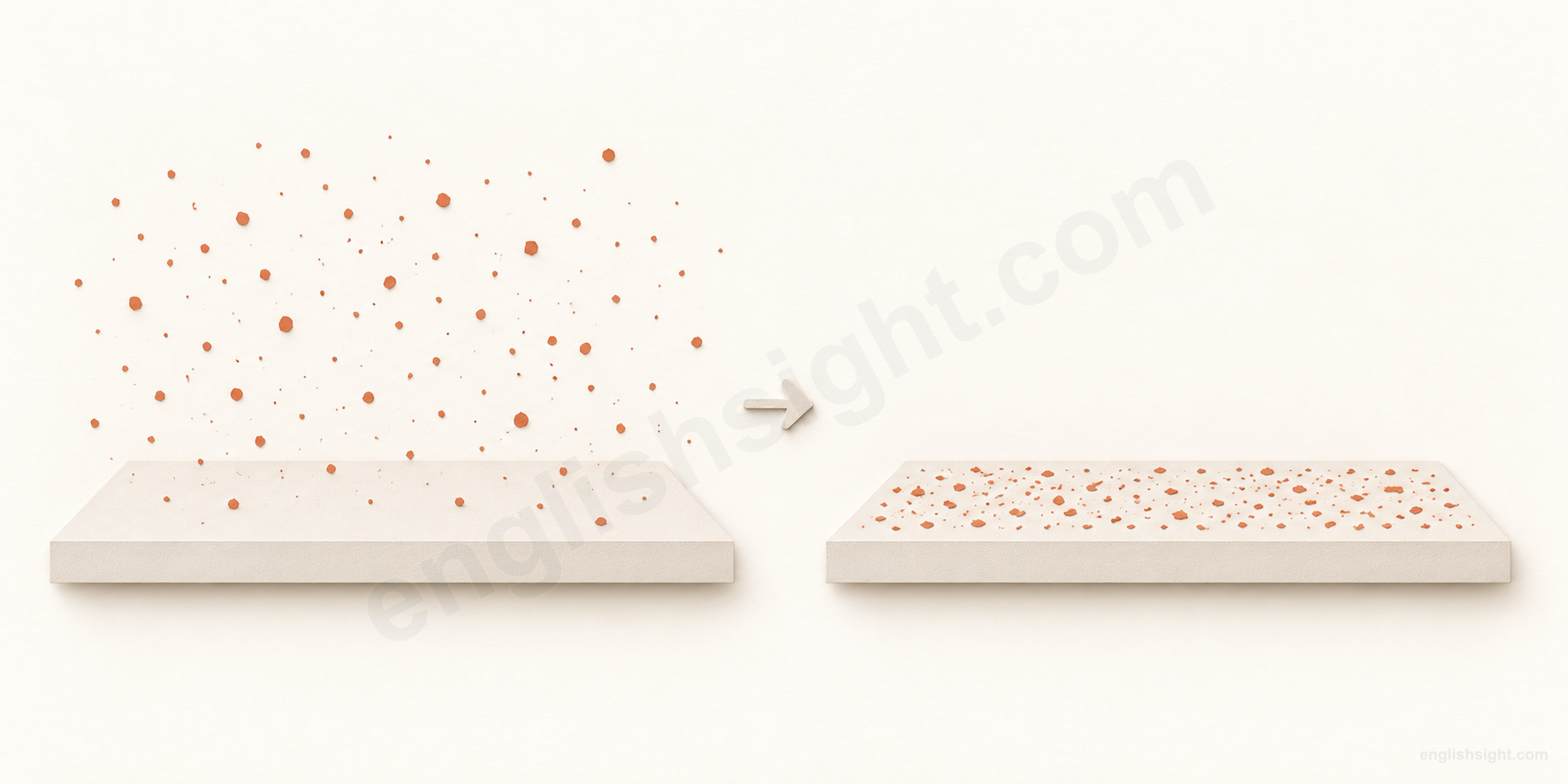
Fine particles float above a surface.
dust
A thin scattered layer rests on the surface.
The particles settle out of the air.
Fine dust particles settle from the air into a thin surface layer.
Dust is matter in very small dry particles that can be suspended in air or lie on a surface.
The picture follows particles from the air to a surface. Cleaning removes such a layer; coating deliberately adds fine powder. The fixed expressions below retain different degrees of connection to this physical model.
Dust starts with very small dry particles. They may float in the air, lie on a shelf, or consist of a particular substance. This simple physical idea connects several everyday uses, but it does not mechanically explain every idiom.
The verb deserves special attention: dust the shelves removes particles, while dust a cake with sugar adds them. Learn the situation and the surrounding words along with the verb.
01
Tiny particles in the room and in the air
Start with the material: dust can lie on a surface, rise into the air, or come from a named substance. Count the particles or layers rather than treating ordinary dust as a countable object.
01
dust on + surface; be covered in / with dust
dust on the shelf
fine dry dirt that rests on indoor surfaces
Situation at first
A shelf has not been cleaned for a while.
What is present or changes
A fine layer lies on its surface.
Dust names the material; on the shelf tells us where it is.
Dust can mean the tiny dry bits of dirt found on furniture, floors, and other indoor surfaces. The shelf has dust on it; the shelf itself is not dust. House dust makes the indoor context explicit.
You can say The shelf is covered in dust or covered with dust. These describe a condition, not necessarily an action happening now. A dusty shelf uses the related adjective to describe the shelf.
Dirt is a wider everyday category: a sticky mark can be dirt without being dust. Dust suggests very small dry particles; mud is wet soil.
In a sentence
There is dust on the shelf above the door.
Watch the difference Say There is some dust, not There are some dusts, for ordinary household dirt.
02
a cloud of dust; raise / kick up dust; dust settles
a cloud of dust
many tiny dry particles suspended in the air
Situation at first
A vehicle moves along a dry track.
What is present or changes
Particles rise and briefly obscure the view.
The material is the same; a cloud describes its airborne shape.
Outside, dust often comes from dry earth or sand. A vehicle or the wind can raise dust; a cloud of dust names the mass visible in the air, not a cloud made of water droplets.
The van kicked up dust means its movement sent loose particles into the air. In this literal use, up contributes the upward result. It does not mean that the van cleaned anything.
When dust settles, the particles come to rest on a surface. The air can become clearer even though the dust has not vanished. This physical change helps explain the later expression let the dust settle.
In a sentence
The van kicked up a cloud of dust on the narrow track.
Watch the difference Dust is particulate matter, not a synonym for smoke or fog; similar-looking clouds can be different materials.
03
material noun + dust
coal dust / gold dust
a substance in very small dry pieces
Situation at first
A material breaks into fine particles.
What is present or changes
Its name tells us what the dust consists of.
The first noun identifies the material, not the place where the dust lies.
Coal dust consists of tiny particles of coal. Gold dust is gold in powder form. These are not necessarily ordinary household dirt: dust describes the fine-particle form of the material.
Compare coal dust with dust on the coal. In the first, coal identifies the substance; in the second, on identifies the surface carrying dust, whose composition is not specified.
Powder is the broader everyday choice for many deliberately prepared fine substances, such as face powder. In a recipe, dust with flour tells us to apply flour lightly; it does not rename flour as dirty house dust.
In a sentence
A fine layer of coal dust covered his boots.
Watch the difference Do not assume that dust always means worthless dirt: gold dust can be valuable.
04
some / much dust; a speck / layer / cloud of dust; a dusting of + substance
a speck / layer of dust
describe the quantity or arrangement of uncountable dust
Situation at first
You want to distinguish one tiny particle from a coating.
What is present or changes
The noun before of provides a countable unit.
A speck is a tiny bit; a layer spreads over a surface.
Dust is normally uncountable in these everyday meanings: some dust, a little dust, too much dust. Use a speck of dust or a particle of dust when one tiny bit matters; use specks or particles for more than one.
A layer of dust describes dust spread over a surface, possibly quite thick. A cloud of dust describes it in the air. These nouns describe different arrangements, not different dictionary meanings of dust.
A dusting of sugar is a light covering, and a dusting of snow is a thin covering of snow. Here dusting is a countable noun for the layer; it is not saying that the sugar or snow is dirty.
In a sentence
A speck of dust was stuck to the camera lens.
Watch the difference For two tiny bits, say two specks of dust, not two dusts. Specialist plural dusts for kinds of dust is outside this everyday pattern.
02
Remove it, add it, or bring something back
The verb has two different practical directions: cleaning takes particles away, while dusting a cake with sugar adds a light coating. Dust off also has established uses for returning to an old activity or recovering after trouble.
05
dust + furniture / room; dust; do the dusting
dust the furniture
remove dust as a cleaning task
Situation at first
A table and shelves carry fine dirt.
What is present or changes
You wipe the particles away.
The object is the thing being cleaned, not the material being added.
Dust the furniture means remove dust from its surfaces, normally with a cloth. Dust the room similarly names the area whose surfaces you clean. This does not mean washing the room or removing every kind of dirt.
The verb can stand without an object when the cleaning task is understood: I was dusting when you called. Do the dusting uses an uncountable activity noun: I’ll do the dusting if you vacuum.
This is an ordinary action verb: she dusts, she dusted, she is dusting. The shelves were dusted this morning is a normal passive. The verb form dusts does not make the noun dust countable.
In a sentence
I dusted the shelves before putting the books back.
Watch the difference Dusting removes fine surface particles; it is more specific than cleaning in general.
06
dust + object + off / down; dust off / down + noun; dust + particles + off / from + surface
dust something off / down
brush particles away from an object or person
Situation at first
A jacket has loose dirt on it.
What is present or changes
A hand or brush removes the loose material.
Off highlights removal; down is an especially British alternative in this use.
Dust off a jacket and dust a jacket off both mean remove dust or dirt from it. Dust somebody or something down is especially British English. A person can dust herself off after sitting on a dusty floor.
With a personal pronoun as the object of the separable particle verb, put it between the verb and particle: dust it off, not dust off it. Dust it down follows the same placement.
Compare I dusted the ash off my sleeve. Here ash names the material removed and off my sleeve names its source. In I dusted my sleeve off, my sleeve is the object being cleaned. Dust some ash from a sleeve is also possible.
In a sentence
He dusted his jacket off before going inside.
Watch the difference Dust it off removes particles. Dust it with sugar adds a coating; the two constructions point in different directions.
put a light covering of fine powder onto something
Situation at first
A finished cake has a bare top.
What is present or changes
A thin scattering of sugar covers it.
The object receives powder rather than losing it.
In dust the cake with sugar, the cake is the surface receiving the coating and sugar names the powder added. The same pattern works for lightly coating food with flour or applying cosmetic powder.
The material can instead be the object: dust sugar onto the cake. Onto names the destination. This is not a special phrasal verb dust onto; the destination phrase tells us where the powder goes.
A recipe may say Dust lightly with flour when the surface is already understood. The cake was dusted with sugar is the passive. Compare dust the table with a cloth: a cloth is a cleaning tool, whereas sugar is a coating, so with alone does not determine the sense.
In a sentence
Dust the warm cake lightly with icing sugar.
Watch the difference Do not reduce the verb to remove dust in every sentence. Read the object, the material, and the situation.
08
dust off + old idea / skill / work; dust + object + off
dust off an old plan
bring something back into use after neglect
Situation at first
A useful plan or skill has been unused for a long time.
What is present or changes
You return to it and prepare to use it again.
Removing imagined dust suggests taking something out of inactivity.
Dust off an old plan means return to a plan that has not been used for some time. A musician can dust off old songs, and you can dust off your language skills before a trip. No physical dirt is required.
The familiar image of cleaning an unused object helps with memory, but the established meaning belongs to dust off as a whole. Simply dust a plan does not normally express reviving it.
Dust the plan off and dust it off follow the same separable pattern as literal cleaning. Collins also records dust down in British usage for reusing an old idea; off is a useful general choice for this lesson.
In a sentence
We dusted off an old plan for a community garden.
Watch the difference Bringing an old plan back does not guarantee improving it or putting it into action successfully.
09
dust oneself off / down; pick oneself up and dust oneself off
dust yourself off
recover your confidence and continue after a setback
Situation at first
A rejection or failure has discouraged you.
What is present or changes
You regain composure and try again.
The reflexive expression can describe recovery rather than literal cleaning.
Dust yourself off can be literal after a fall onto a dirty surface. In a discussion of rejection or failure, it commonly means recover enough to continue. The context tells you which meaning is intended.
After the interview rejection, she dusted herself off and applied elsewhere presents renewed effort. It does not claim that her disappointment disappeared immediately. British speakers may also use dust yourself down.
Use the reflexive that matches the subject: I dusted myself off; they dusted themselves off. The reflexive goes before off or down. This is a conventional figurative use, not a rule that off always means emotional recovery.
In a sentence
After the rejection, I dusted myself off and sent another application.
Watch the difference Without a setback or literal dirt, dust yourself off may not fit the situation. It is not a general synonym for feel happy.
03
Neglect, calm, competition, and completion
These expressions use the whole phrase to communicate a situation. Some retain a helpful connection to physical dust; others need to be learned as conventional expressions.
10
something gathers / collects dust; leave something to gather dust
gather / collect dust
remain unused for a long time
Situation at first
An object or project is left untouched.
What is present or changes
It stays idle instead of being used.
An accumulating layer suggests neglect or inactivity.
A guitar gathering dust is not being played. The phrase may describe real dust, but the point is that the instrument remains unused. An unopened proposal gathering dust similarly receives no attention.
Gather dust and collect dust are both established expressions. The object or project is the subject: My exercise bike is collecting dust. You are not saying that someone intentionally collects dust as a hobby.
Compare dust off the guitar: that suggests bringing it back into use. Gather dust describes continued inactivity; dust off describes ending that inactivity.
In a sentence
My exercise bike has been gathering dust in the spare room.
Watch the difference The phrase does not by itself mean the object is broken or useless.
11
let the dust settle; wait for the dust to settle; when / once the dust settles
let the dust settle
allow confusion or excitement to die down before acting
Situation at first
A sudden change has left people uncertain or upset.
What is present or changes
The situation becomes calmer or easier to understand.
Like an obscuring cloud clearing, the aftermath becomes easier to assess.
Let the dust settle means allow time for a disturbed situation to calm down or become clearer. Wait for the dust to settle emphasizes postponing your next step until that happens.
When the dust settles can introduce what happens after the initial confusion. In When the dust settles, we’ll review the costs, the present form settles can refer to future time after when.
The physical image is useful, but this is a conventional expression about a situation. It does not promise that every disagreement will be resolved or that all the facts will become certain.
In a sentence
Let’s wait for the dust to settle before changing the schedule again.
Watch the difference Retain the in this expression. It is about calming events, not removing dirt from furniture.
12
bite / bit / have bitten the dust
bite the dust
fail, be defeated, stop working, or die
Situation at first
A project, opponent, or machine seems likely to continue.
What is present or changes
It fails or is no longer functioning or surviving.
The whole informal expression conveys an end or defeat.
A plan that bites the dust has failed; a team can bite the dust through defeat. My old printer finally bit the dust means it stopped working, not that it literally ate dirt.
The phrase can also mean die, often in a humorous or dramatic style. That tone can be insensitive when discussing a real person’s death, so choose plain wording when sympathy or precision matters.
Bite changes form: bite the dust, bit the dust, has bitten the dust. Dust stays unchanged and the is part of the expression. This idiom cannot be predicted just from the ordinary noun meaning.
In a sentence
Our old printer finally bit the dust yesterday.
Watch the difference Do not confuse failure with delay: a plan that bites the dust has failed, rather than merely being postponed.
13
leave + competitor + in the dust; eat + possessive + dust
leave someone in the dust
move or perform so much better that others fall far behind
Situation at first
Two runners or businesses compete.
What is present or changes
One is far ahead of the other.
The comparison concerns the gap between a leader and a follower.
A fast runner can leave other runners in the dust. The expression also works for performance: A new delivery service left its rivals in the dust says it greatly outperformed them, even without literal dust or running.
Oxford labels leave somebody in the dust North American; Collins also records it in its British dictionary. Treat that as a usage association, not a claim that other speakers cannot use or understand it.
Eat someone’s dust looks at the same competitive gap from the losing side: In the final sprint, I was eating her dust. It is a vivid informal expression. Leave puts the leader in subject position; eat puts the person behind in subject position.
In a sentence
In the last lap, Maya left the other runners in the dust.
Watch the difference The phrase is stronger than simply be a little faster. Do not confuse being left behind with being physically abandoned in dirt.
14
be + done and dusted; get something done and dusted
done and dusted
completely finished
Situation at first
A task still needs attention.
What is present or changes
All the necessary work is finished.
The fixed pair emphasizes completion rather than actual cleaning.
Done and dusted is an informal expression especially associated with British English. The report is done and dusted means the work is fully finished, even if no surface has been cleaned.
Treat done and dusted as a fixed phrase. Dusted alone does not normally mean completed: The report is dusted is not the ordinary way to say the report is finished.
Compare I’ve done the dusting, which refers to completing a particular cleaning chore. In done and dusted, the whole pair has the broader completion meaning.
In a sentence
The booking is done and dusted, so we can plan the trip.
Watch the difference This is informal. For a formal status report, completed may be clearer.
15
(as) dry as dust; a dry-as-dust + noun
(as) dry as dust
extremely dry, or very dull and uninteresting
Situation at first
You assess a physical surface or a piece of writing.
What is present or changes
You emphasize dryness or a lack of interest.
The subject determines whether the comparison is physical or figurative.
The ground was as dry as dust compares physical dryness with dry particles. The lecture was dry as dust usually means it was extremely boring, not that the room contained dust.
The first as is optional in this familiar comparison. Before a noun, the compound adjective is commonly hyphenated: a dry-as-dust account. It comments negatively on how the material is presented.
Dust suggests dryness in the physical comparison; the dullness meaning is an established figurative judgment. It is not a scientific statement about how much moisture dust can contain.
In a sentence
The guide made a dry-as-dust topic surprisingly interesting.
Watch the difference With writing or teaching, the phrase is a criticism of dullness, not a literal cleanliness comment.
16
be + like gold dust
like gold dust
very hard to find or obtain
Situation at first
Many people want something in short supply.
What is present or changes
Getting it is unusually difficult.
Gold supplies the idea of something sought after; ordinary dust alone does not.
In British English, saying that something is like gold dust stresses how difficult it is to obtain. Available rooms, spare parts, or reliable help may be described this way.
The phrase does not require the thing to be made of gold, tiny, or literally expensive. It presents it as hard to come by. Compare literal gold dust, which is gold in powder form.
The special meaning comes from the complete comparison like gold dust. It cannot be generalized to like dust, which lacks gold’s contribution and is not this scarcity expression.
In a sentence
At festival time, empty hotel rooms are like gold dust.
Watch the difference This is a figurative British expression; it does not describe the room’s color or cleanliness.
Let the material, object, and whole phrase guide you
Two directions for the verb
Dust the shelf usually removes dust; dust the cake with sugar adds powder. With a cloth names a tool, while with sugar names a coating. The preposition with alone cannot tell you which sense is intended.
Forms and ordinary grammar
The noun is normally uncountable: dust /dʌst/. The verb forms are dust, dusts, dusted, dusting. Dusted ends in an extra syllable, /ˈdʌstɪd/. Cleaning can be intransitive, and both cleaning and coating allow normal progressives and passives. Dust does not have a special productive causative pattern; have someone dust the shelves uses the ordinary have + person + verb construction.
Related words have their own meanings
Dusty describes something carrying or characterized by dust. Dusting can mean the cleaning activity or a light covering. Compounds and separate words such as dustbin, dustpan, dust jacket, dust mite, and dust-up need their own definitions; recognizing dust inside them is not a guarantee of their meaning.
The picture has limits
The particle-to-layer picture helps with literal uses, neglect, and the dust settling. Done and dusted, bite the dust, and like gold dust must be learned as whole expressions. The picture is a teaching aid, not a claim that all English speakers share one mental image.
Read the whole situation
Choose the expression that fits the particles, the action, or the intended figurative meaning.
1. A recipe tells you to dust a cake with sugar. What should happen?
2. You see two tiny bits on a camera lens. Which phrase counts them naturally?
3. You have a dusty jacket. Replace the jacket with it and keep the meaning.
4. You return to a useful plan that nobody has used for years. Which sentence fits?
5. After a confusing reorganization, you postpone another decision until things calm down. Which expression fits?
6. A colleague says the booking is done and dusted. What does that mean?
Sources and teaching notes
The linked dictionaries were consulted for meanings, grammar, and expressions. Explanations and examples are original; the particle-and-layer picture is a teaching model, not a dictionary claim about mental imagery.
This picture illustrates one useful connection; it does not represent every speaker’s mental image.